Terry Gray’s slides come to life

August 18, 2013

There will be a fuller account of the great period shots gathered by early founder-member  Gray, when time permits.     For now, just relish a few picked at random from his newly-digitalised photo transparency slides.
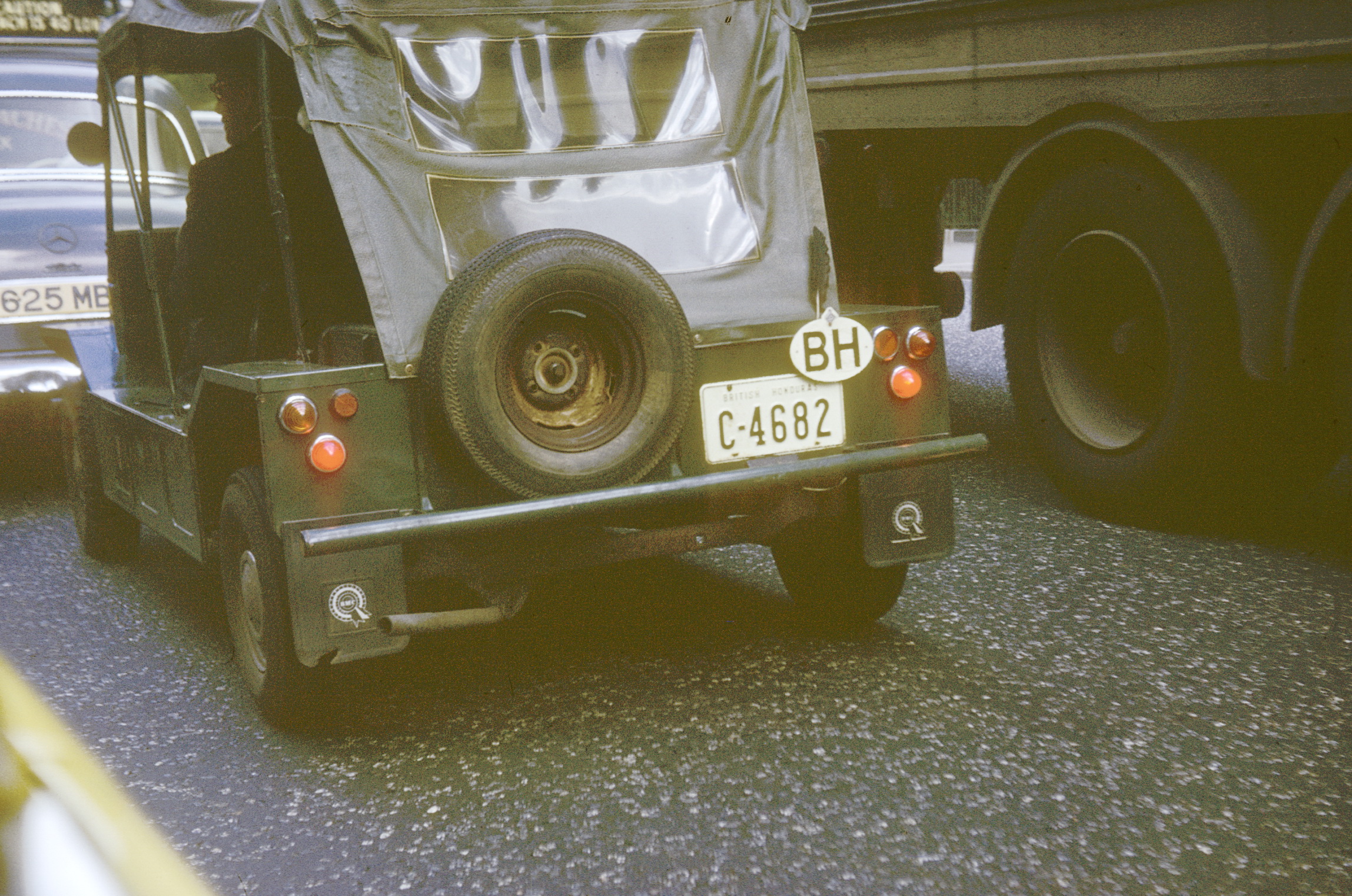
A mini-Moke in London in the 1960s with the ultra-rare pre-Belize series for British Honduras.   C=Corozal.    AND a BH oval, properly manufactured by the RAC.   Bet they didn't sellmany of them!    Gray archive.

A Mini-Moke in London in the 1960s with the ultra-rare pre-Belize series for British Honduras. C=Corozal.      AND with a BH oval, properly manufactured by the RAC.     Bet they didn’t sell many of them!                        Gray archive.
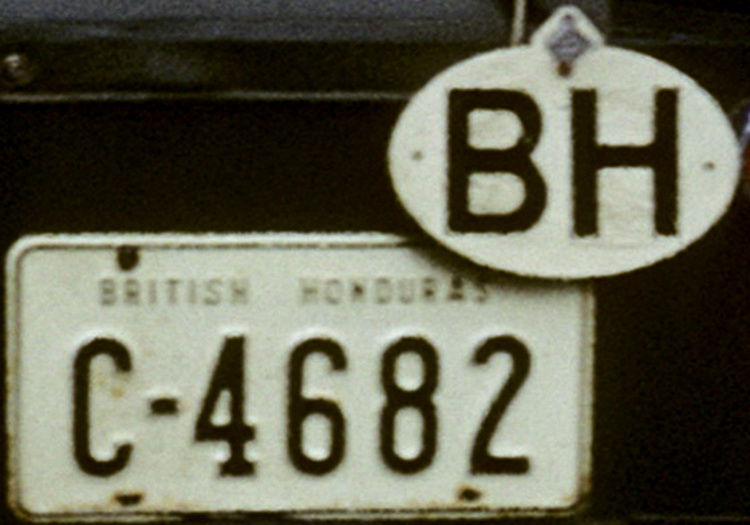
(BZ 65-73)(BH5)_C-4682_cu_TG2

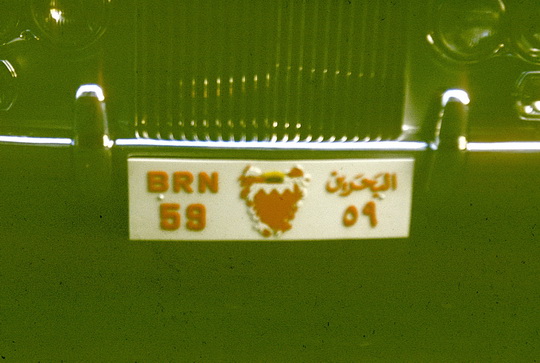
Soon after the Rolls-Royce Silver Shadow was launched about 1968, this Bahrein emir brought his new car to London.    Gray archive

Soon after the Rolls-Royce Silver Shadow was launched about 1968, this Bahreini emir brought his new car to London. Gray archive

A Venezuelan export plate seen in London in circa 1969.   Gray archive.
YV – 105    A blue Venezuelan export plate seen in London in circa 1969. Gray archive.

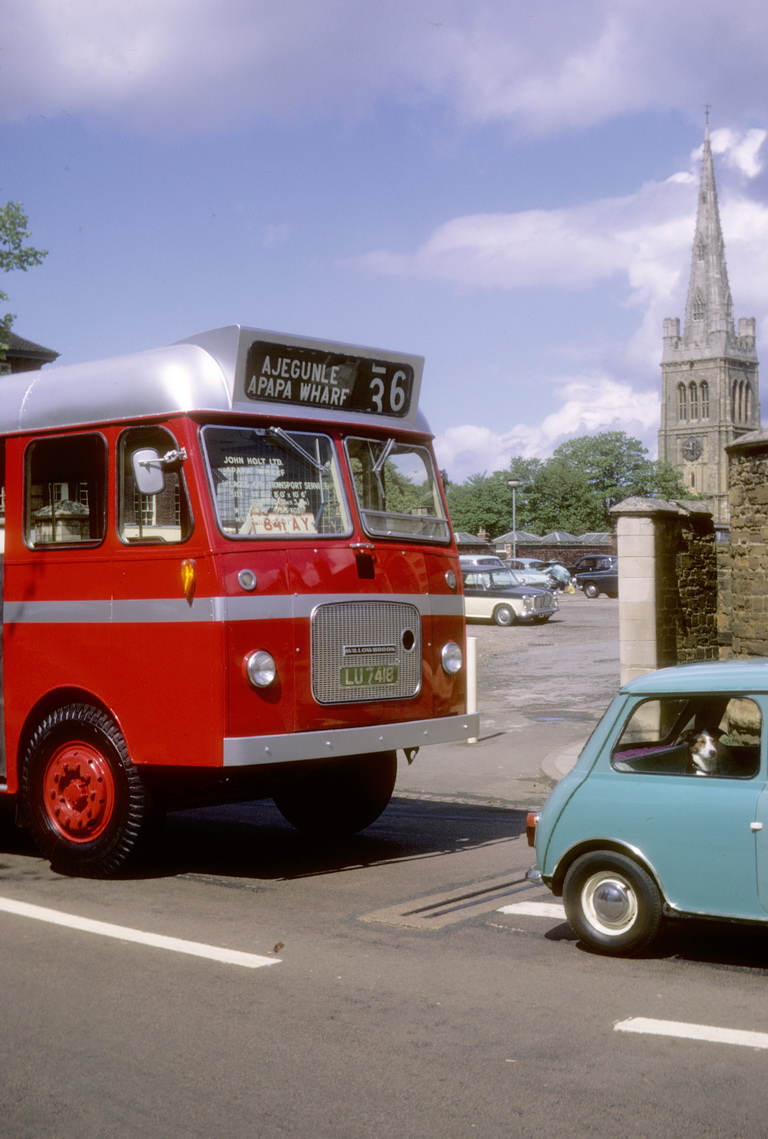
A batch of new buses passed Kettering in the late1960s in transit to the docks and their passage to Nigeria.    Already plated for use in Lagos, and using a green background not usually associated with WAN plates.    Gray Archive

WAN Nigeria – LU 7416.    A batch of new  Willowbrook-bodied Leyland Comet buses passed through Kettering in the late 1960s in transit to London docks and their sea-passage to Nigeria.     Already plated for use with the Lagos City Transport Service, and using a green background not usually associated with WAN plates, they were running on Leicestershire AY trade plates.       (NOT Alderney!)            Gray Archive 1968c
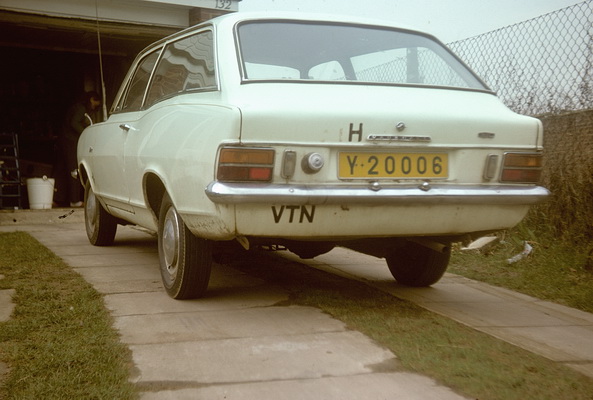
Y-20006, a Vauxhall Viva estate car from  the British embassy in Saigon during the 1970s.     See in England, carrying an unofficial 'oval' of (VTN).   I seems that the car had previously been posted in Budapest with its diplomat owner.     Gray archive

Y+20006, a Vauxhall Viva estate car from the British (definite) embassy in Saigon  during the 1970s.     Photo’d in England in 1976, carrying an unofficial ‘oval’ of (VTN). it seems that the car could have previously been posted in Budapest with its diplomat owner.   (See postscript 29 Sep.2013)       Gray archive

P.S.   I now learn from Ivan Thornley that the Vietnamese Vauxhall Y 20006 had not previously been registered in Hungary (H), but in Ethiopia (ETH)!     The owner had not finished removing his home-made IRC stickers.     (Those would have been fine plates to see on-car………)

Here another GB embassy plate, this time on a Land Rover in Saigon, 1970s.  Brumby archive

Y+00137   Here’s another VN GB embassy plate, this time on a Land Rover in Saigon, 1970s.     Brumby archive
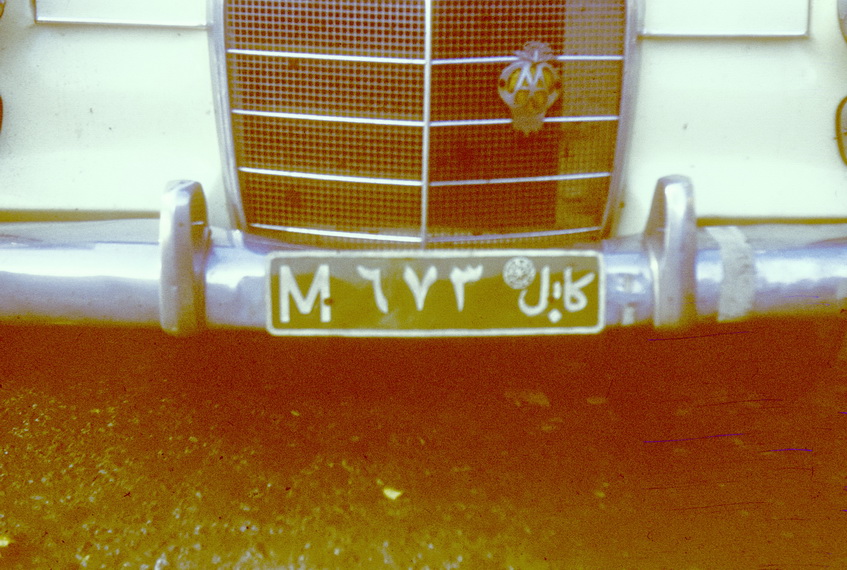
Mowqati 673, and Afghan Foreigner (M and green) on a Mercedes 190 in Britain did not escape TG's eye or camera.      A very rare sight indeed.  Gray archive

Mowqati 673, an Afghan Foreigner (M and green) from Kabul ,on a Mercedes 190 in Britain did not escape TG’s eye or camera.    A very rare sight indeed.        The overseas-issued Automobile Association badge is of interest, but the country of origin crest is illegible.     Gray archive c.1972
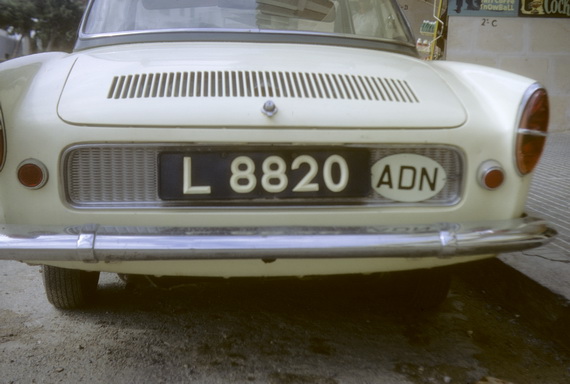
Aden was a moderately-frequent 'spot' in the 1960s, due to the commercial and military establishments in that then-British colony.     After the India-issued ADN series were changed in the 1950s, L, M, and N became the serials used in the Aden Colony.    Independence and the amalgamation with South Yemen closed down sightings and info from that hot zone, for many years after.    The car is a French Renault Floride, seen in GB.     Gray archive.

L 8829 ADEN     Aden was a moderately-frequent ‘spot’ in the 1960s, due to the active commercial and military establishments in that then-British colony.    Aden was administered from British India from the 1910s and employed the BI system, with code ADN.    Under later colonial administration, it changed in the 1950s, first to the prefix 2ADN, when, reaching 9999 again, L, then and N became the leading letters used in the Aden Colony.   (No-one knows why those letters were chosen).    Independence and the later amalgamation with South Yemen closed down sightings and info from that hot zone, for many years after. The car is a French Renault Floride, seen in GB.       Gray archive.

(A)(exp73)_G90.803_TG1973

AUSTRIA FOREIGN RESIDENT/EXPORT SERIES.      Graz is the registration area for this German-built Ford Taunus 17M, photo’d in Austria in 1973 before leaving for its ultimate export destination.     Most European countries offered a facility to purchasers from abroad, to collect their new European car, tax-free, from factory or dealer, to tour Europe for up to 6 months and then return it to the supplier for shipment to their country of origin – or even drive it home themselves.     With their acquired mileage they could be imported to their home countries as second-hand cars, so that their local import duties would be lower.      Tens, if not hundreds  of thousands of vehicles were supplied under these tax-free schemes.        Gray archive.

May 2014 q.           Can anyone say whether this Austrian series was used both for export and for identifying foreigners who came to live in Austria for extended periods, perhaps even with tax-free status?    There have always been too many of them around to be only for vehicles awaiting export, it seems……..

2015  — marcellotaverna@alice.it writes:    The blue plates with a red dated band are called “temporary registration marks” and they are issued, on request, to “anyone not having his main residence, or legal seat or main facilities in Austria, upon exhibition of the required documents….”. Further “if the vehicle comes from abroad, a valid foreign approval document will be accepted”   It seems that these plates are issued to foreign persons or companies, both for export or for temporary import.


~~~~~~~~~~~~~~~~~~~~~~~~~~~~

Some additions at Sept. 29th. – notes to add later

(AND 60-80)(exp75)_MT-6282_TG1975

MT-6282  —  Andorra’s duty-free foreigner export series valid to 1975.     MT =  ‘Temporary Matriculation’.                                   Gray archive 1974
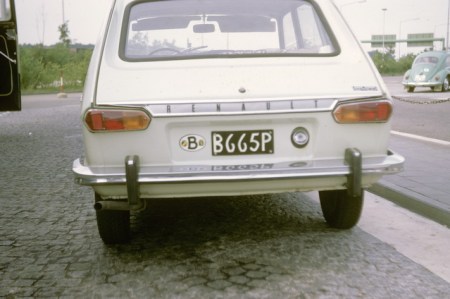
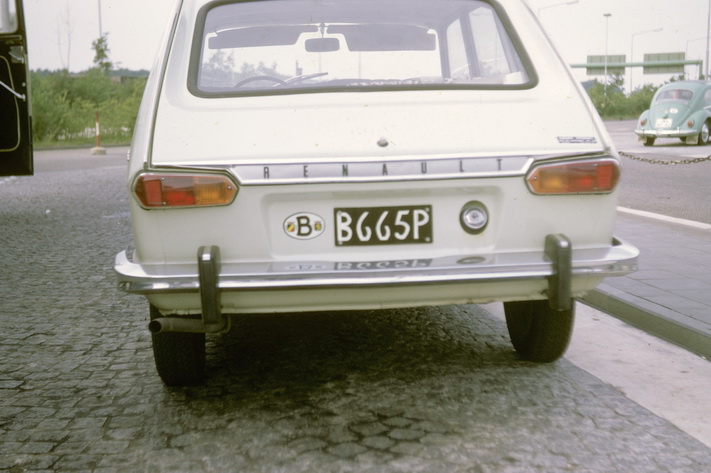
(B 58-07)(BfinD)_B.665.P_TG
This Belgian Forces in Germany car has replaced the official white on red plate with a home-made one. B.665.P.                                                            Gray archive, pictured in Germany circa 1974
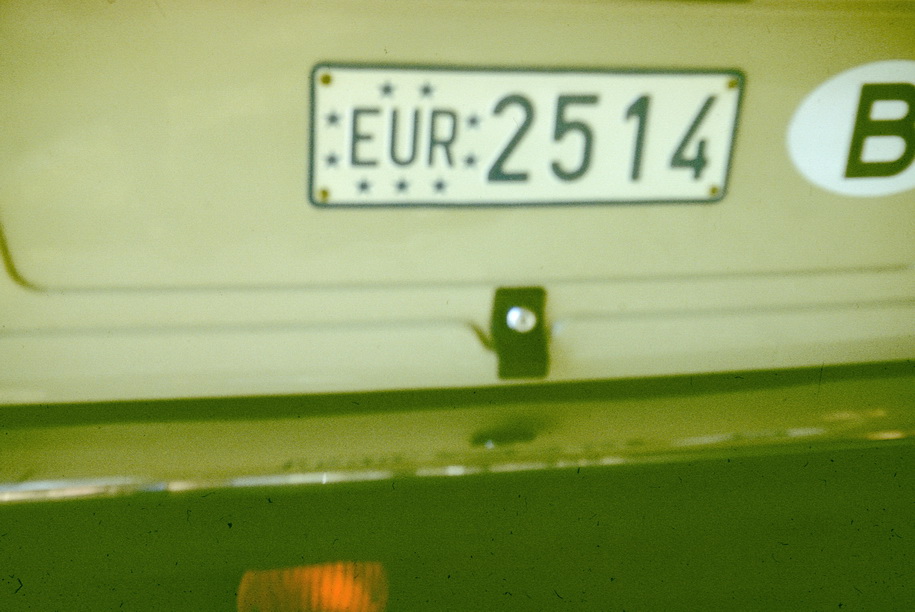
(B 75-00)(Eur)_EUR 2514_TG

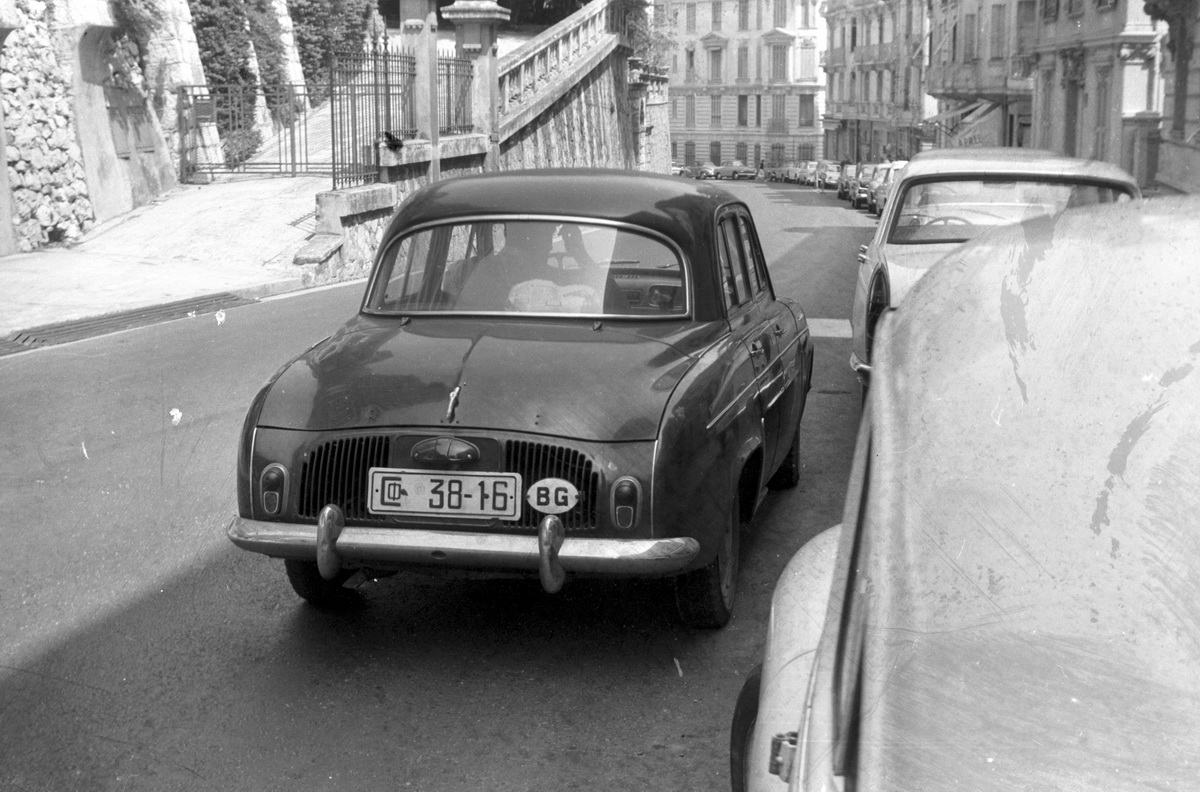
White plates were issued to privileged Party members in pre-democratic Bulgaria.    This fortunate citizen had a modern car and was allowed a passport to travel to Monte Carlo, where this picture was taken

Sf 38-16  —  White plates were issued to privileged Party members in pre-democratic Bulgaria.     This fortunate citizen had a  Sofia-registered Renault Dauphine and was allowed a passport to travel to Monte Carlo, where this picture was taken by member Terry Gray in the 1960s.   The series used the Cyrillic alphabet and  ran from 1958-85.

(CH)_ZH_300 723_TG

ZH 300 723     This is a puzzler.    A rear Swiss plate with no canton shields?    And in a poor (un-Swiss) condition.        And mounted in an odd place.      Was it perhaps a trade plate of the period (1960s) Any help, readers?    Gray archive  (silence May 2014!  Help!)
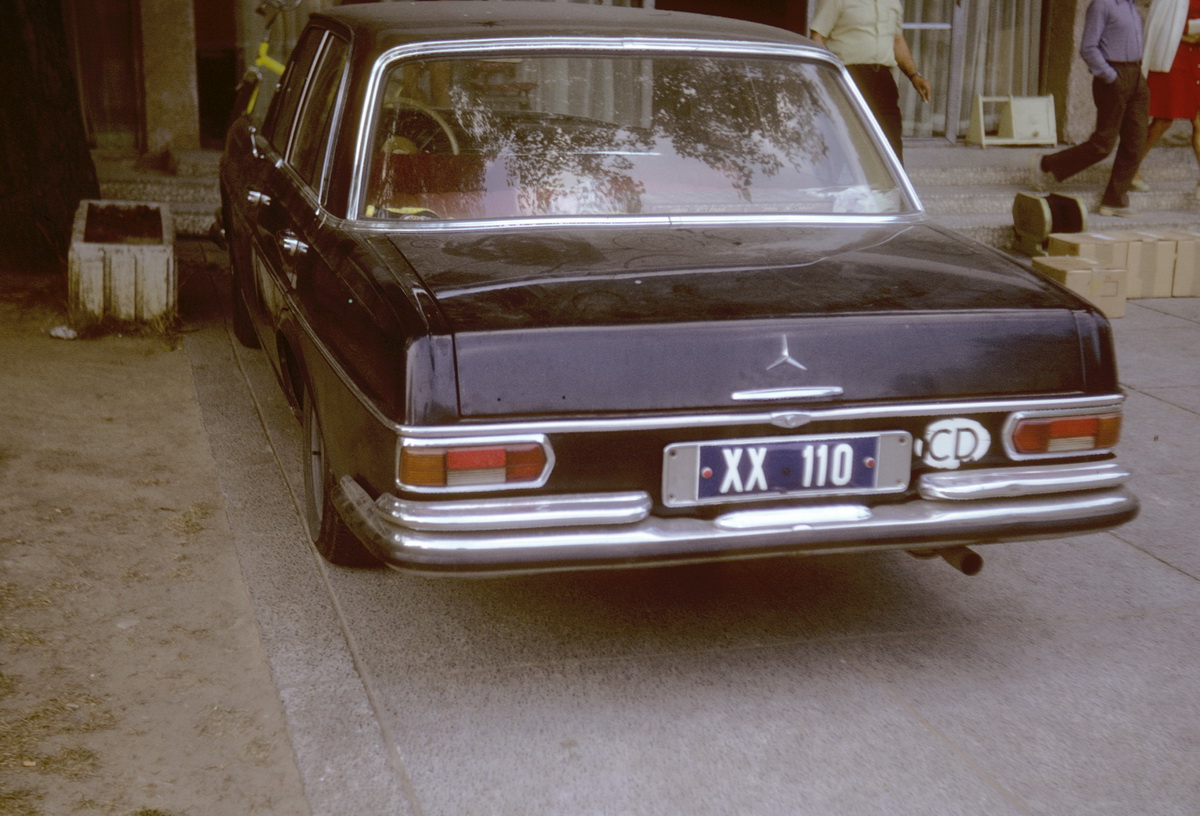
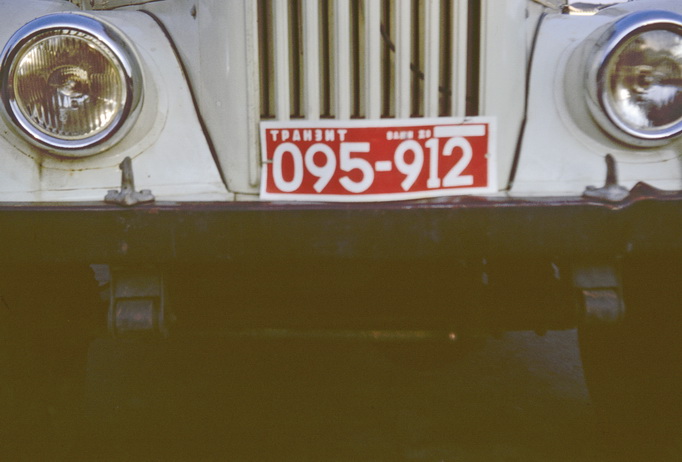
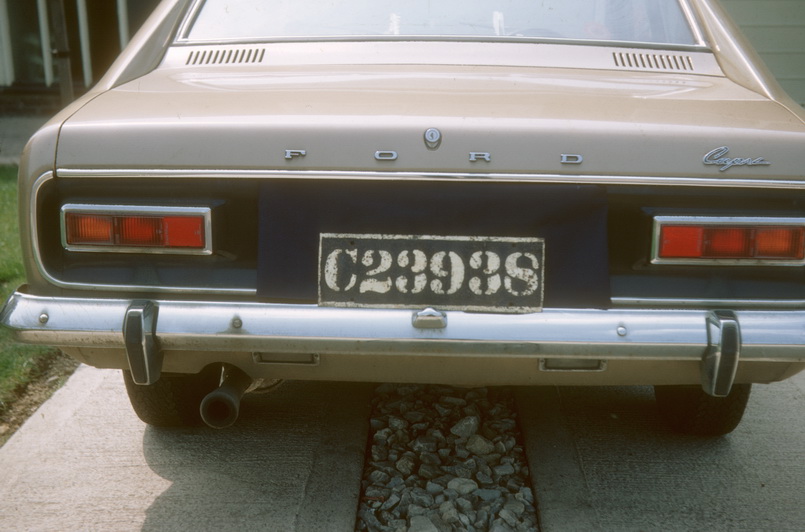
(BG)(tempimp)_XX 110_TG (BG)(transit)_095-912_TG (CAM 60-91)(cc)_IT 9175 CC_f_TG1970s (CB 30s-58)_C 23938_TG (CDN)(CdnfinEur)_5245_TG (CO 67-74)_C-07-87_r_TG1968

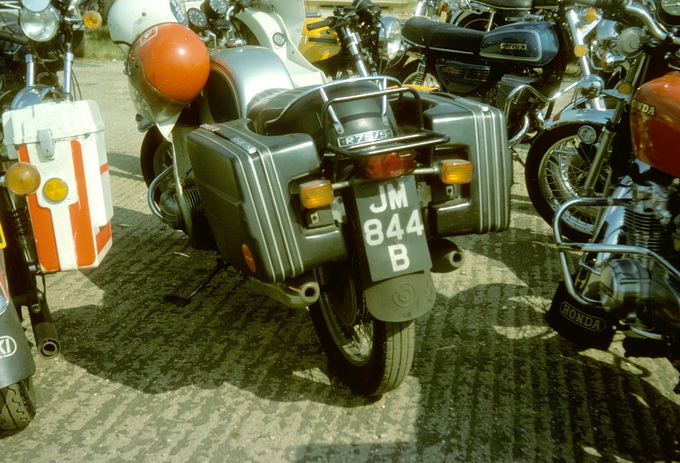
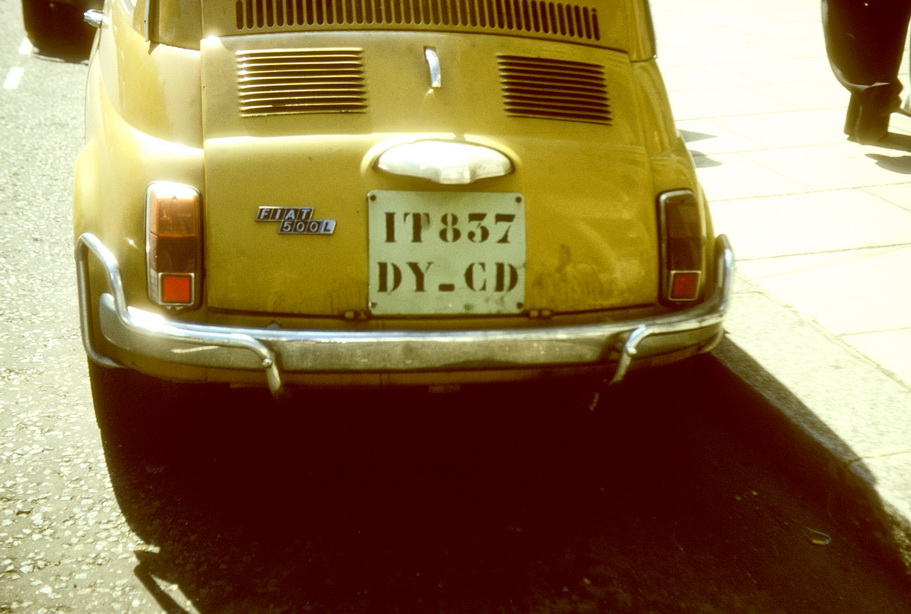
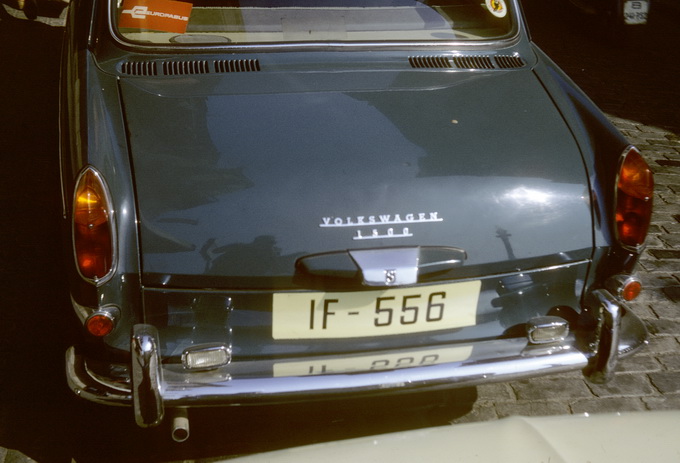
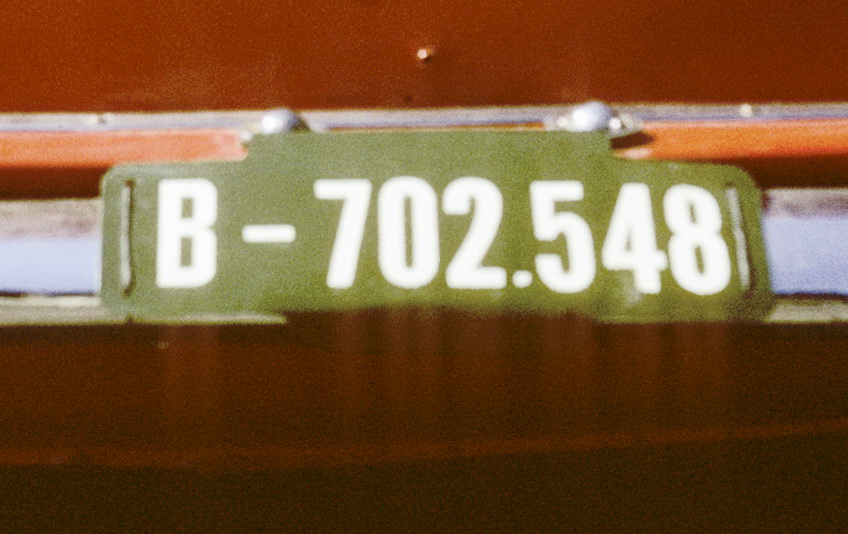
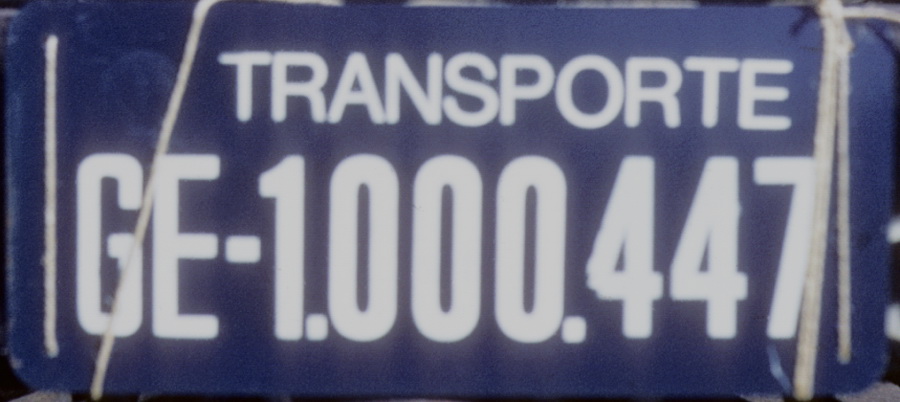
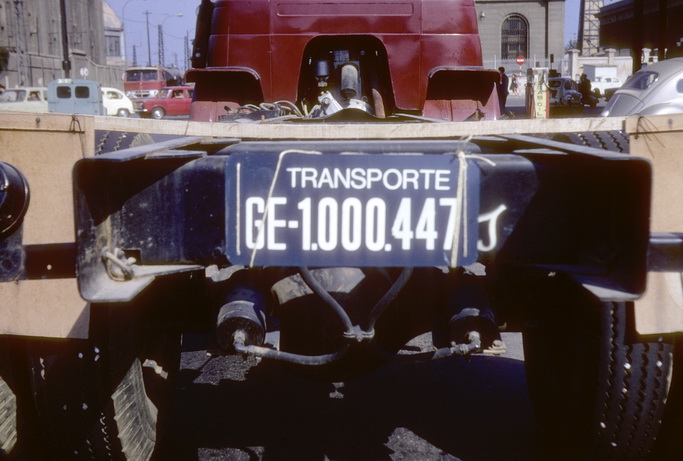
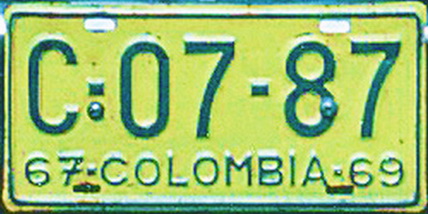
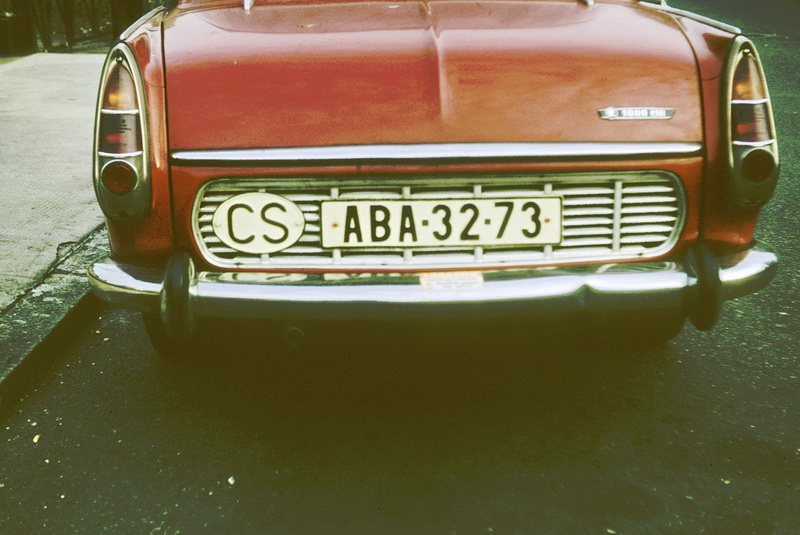
Remarkably, this MGB came to live in London for about a year in 1969, and remains the first and only sighting ever of a Colombian plate in England by Europlate.   Members Brumby, Thornley, Gray and Pemberton all reported it separately!   This is the 1967-74 series.(CS 66-85)_ABA-32-73_TG (D)(GBfinD)(mc)_JM 844 B_TG (DK)(dlr)_41 112_f_TG (DY 72-76)(cd)_IT 837 DY-CD_r2_TG (E 22-72)(ME)_ML-4037_TG (E 27-69)(EqG)(FP1)_FP-3721_c_TG (E 27-69)(SH)(Ifni)_IF-556_TG1960s (E 27-80s)(EqG)_RM 6018_TG (E 60s-70s)(prov)_B-702.548_c_TG (E 60s-70s)(prov.dlr)_GE-1.000.447_cu_TG (E 60s-70s)(prov.dlr)_GE-1.000.447_TG.
More Gray photos to follow………….and

if YOU have prints or slides of early or rare plates which you would like scanned for your own use and for the pleasure of other members’ viewing, write or email to Victor Brumby (vicbrumby@gmail.com) – or make a comment in the  Comments Box at the foot of this page.

And a quiz answer from a previous Post:

Which of needs THIS identifying?

Well – which of us needs THIS identifying?
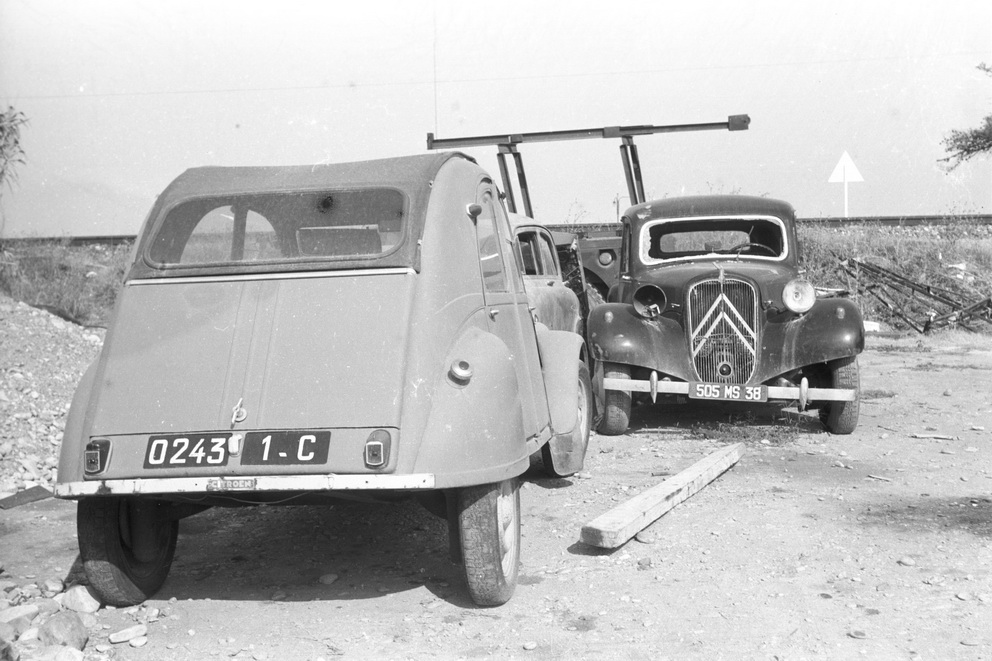
YOU do?   Try French West Africa......     VB archive

YOU do? Try French West Africa…… VB archive                                                                      Francoplaque’s  Jean-Emmanuel  is quite correct with his answer of  SENEGAL, until 1960 French West Africa/Afrique Occidentale Francaise) (AOF) .   The Citroen 2cv is from area 1 (Cap Vert (Dakar, capital city)) and the letter C is a serial letter, issued before independence in 1960, after which the letter ‘S’ was inserted  before the area number  (e.g. 0132 S 1 .C)                  Fascinating to think that, had the car travelled outside Senegal in those times, it would have carries the unseen(?) AOF international oval.   The photo is by non-member Murray Bailey in about 1973, in Dakar.          In the background, in a sad state, is a French-registered Citroen Light Fifteen Traction Avant, still carrying its French plates 505 MS 38 (from Isere).

Read the rest of this entry »


Spotting lists from 1950s show a different profile

August 18, 2013

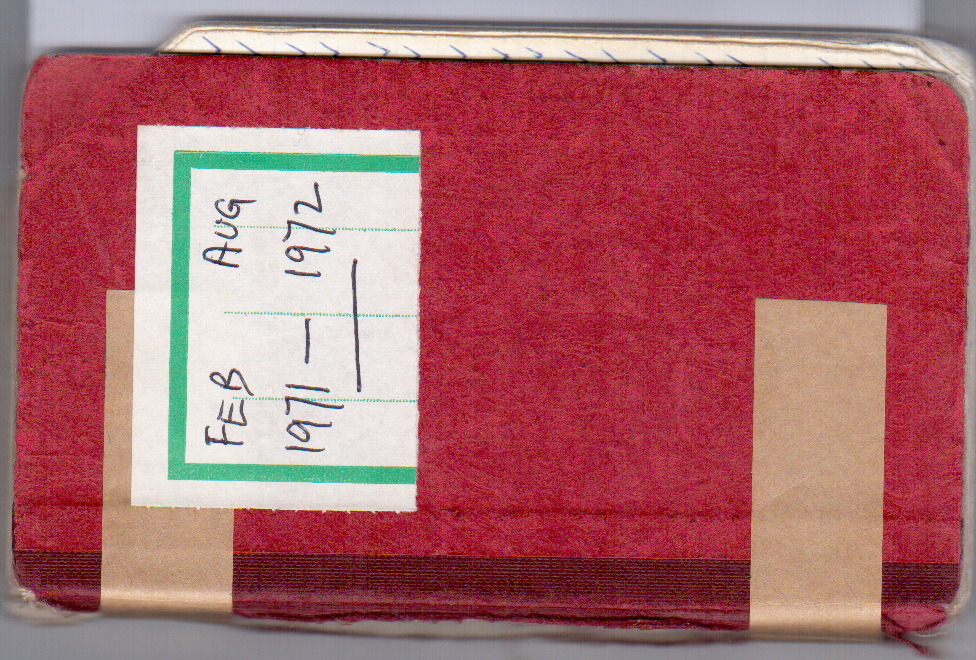
Below we see one of the 40 spotting books employed by EU member John Pemberton between 1955 and today.    He religiously noted everything foreign which came his way, mostly spotting in the East of England, in Suffolk, Norfolk and on occasional visits to London and the near Continent.      He would not take note of Belgians in Germany, or Germans in Holland, as there were too many to record, and he wasn’t interested in noting foreign forces plates in Europe or Britain, unless they bore normal plates from their place or registration.    An exception was made for the many SHAFE/SHAPE plates he noted, from Supreme HQ – Allied Forces/Powers-Europe.    And as with many of us, he may not have known that Spanish plates which bore a zero in the fourth numeric position from the right, were allocated to US Forces, Spain, because he has recorded a great number of them! e.g.

It becomes clear from analysing JP’s spottings, that the earlier the period, the more varied and unusual were the cars to be seen in circulation.    A day out in 1956 could garner a spotter vehicles from Ceylon, Nigeria, Cyprus, India, British Guiana, Formosa, Japan and the Straits Settlements.     To see any one of those in 2012, would be the high spot of a collector’s year!

His recent books (say, from 1980 to current) are still testament to John’s determined notation, but these modern sightings are all European plates, with rare exceptions.

Items which strike the writer, while cataloguing the longhand archive, are the surprisingly high number of vehicles from Algeria and Morocco, both before and after independence from France, the 10(?) cars he saw from Bermuda (though I never saw one in 55 years of spotting (well, one on Grand Turk years ago) and quite a few from Angola and Swaziland – very rare indeed.    He has captured the only known photo of British Somaliland on a car also bearing the SP oval representing the Somaliland Protectorate.     Similarly John has photographed the only known SM oval, the former code for Siam – and on a German HANOMAG car in Copenhagen, bizarrely, in the late 1940s….

I has been amusing for me to recognise some  parallel spotting between John’s notes and my own photo archive.     At least a dozen plates which he noted forty five years ago were captured for posterity in photographs I must have taken in the same period in which he saw them, although we were 200 km. apart and knew nothing of each other!    Here are two of them.

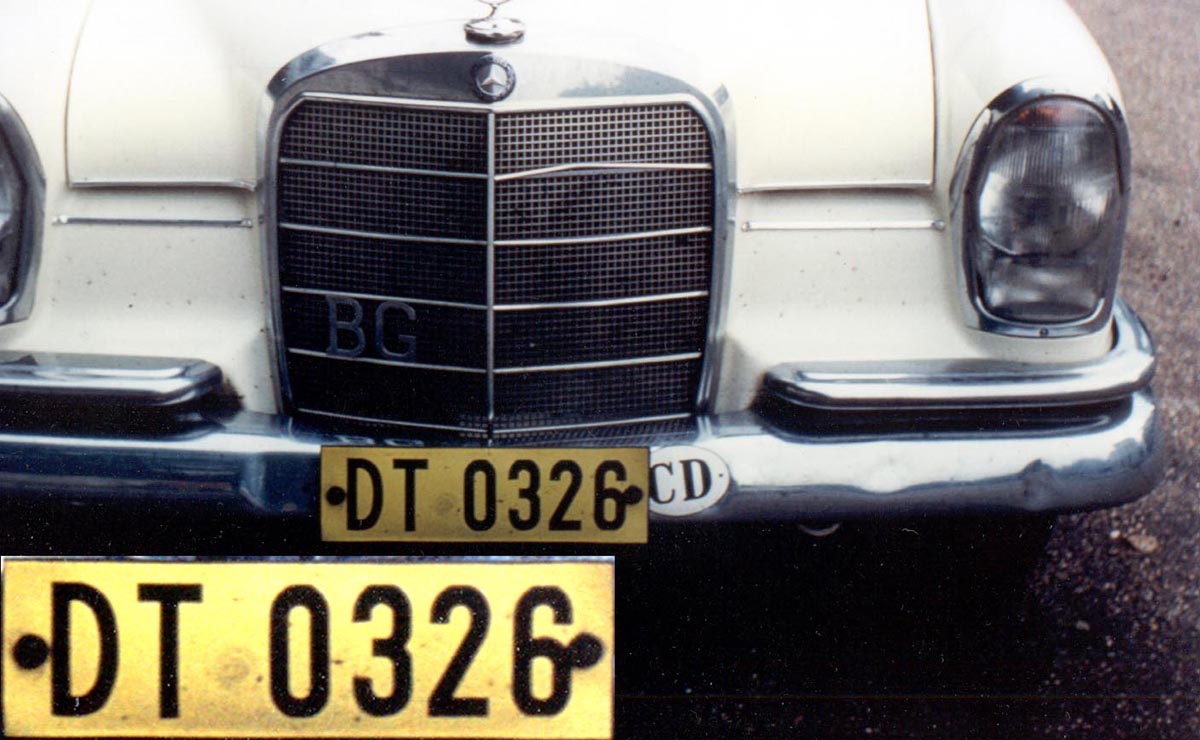
The Bulgarian diplomatic DT 0326 lived in Notting Hill in London for perhaps four years without changing these rare plates, and was also seen and photographed by members Terry Gray and Ivan Thornley.     This was the 1967-85 CD series.

(BG2)(cd)_DT 0326_comp_VB1969

(CO4)(67-74)_C-07-87_cu_VB1969_resize

The only Colombian plate ever seen in Britain, I suggest.   On an MGB in Kensington, London in 1968, with a 2-year validity plate (but no CO oval at the rear

A great archive, which I hope will  bring some happy moments to all who inspect the pages of the précis which will now be progressively published in the Blog as a Google spreadsheet document, as I work my way forward through the booklets.

NOTE DATED 18 AUG.    NOW STRUGGLING TO CONVERT THE ORIGINAL XLS SPREADSHEETS TO GOOGLE SPREADSHEETS SO THAT THEY CAN BE SHOWN HERE:     WORK IN PROGRESS AGAIN!

2013-06-15 17-27-52_0108 JP notebook 71-2

Some of John’s script resembles Farsi or Sanskrit – but usually turns out to represent the word  ‘London’  or  ‘July’  or  ‘ blue Peugeot’.     The orthographic decoding only held up the production of the typed form by a few months…….!

Here is the first of John Pemberton’s distilled (redacted?) spottings, from the earliest books he can find, dated 1955 and  ’56:         *********       Feb. 11 2014  addendum    —Technical snags have prevented the insertion of this file, but now it has been converted to a Google.doc, which you can read on-screen, or download to inspect at your leisure.      In a few days, it will be inserted HERE.

                                  (The additional data has been inserted by me, though much remains to be added – and I will be happy to receive your corrections and extra info if you can add to the sum of knowledge….)

*


Sailing St.Helena

July 23, 2013

Chris White, cousin of this Blogger, Victor Brumby (EU38)  is close to completion of his round-the-world sail with his wife and grown family.      Asked if  he would pay special attention to our specialist subject when they landed on Saint Helena, he has sent this set of shots from the South Atlantic (via the clever and simple system, DROPBOX).    Readers are recommended to use it  for sending  large quantities of data/pictures about – all free from the Web.
SAINT HELENA

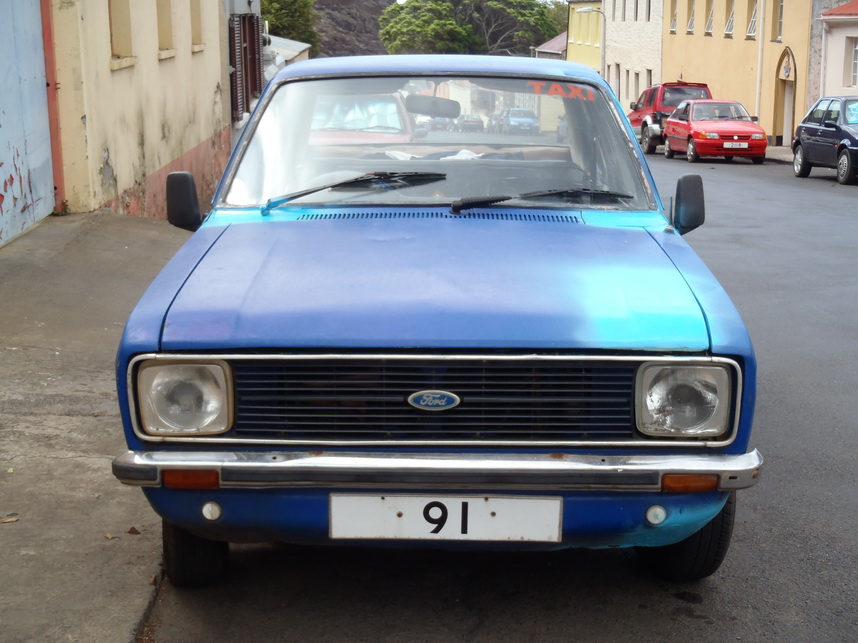
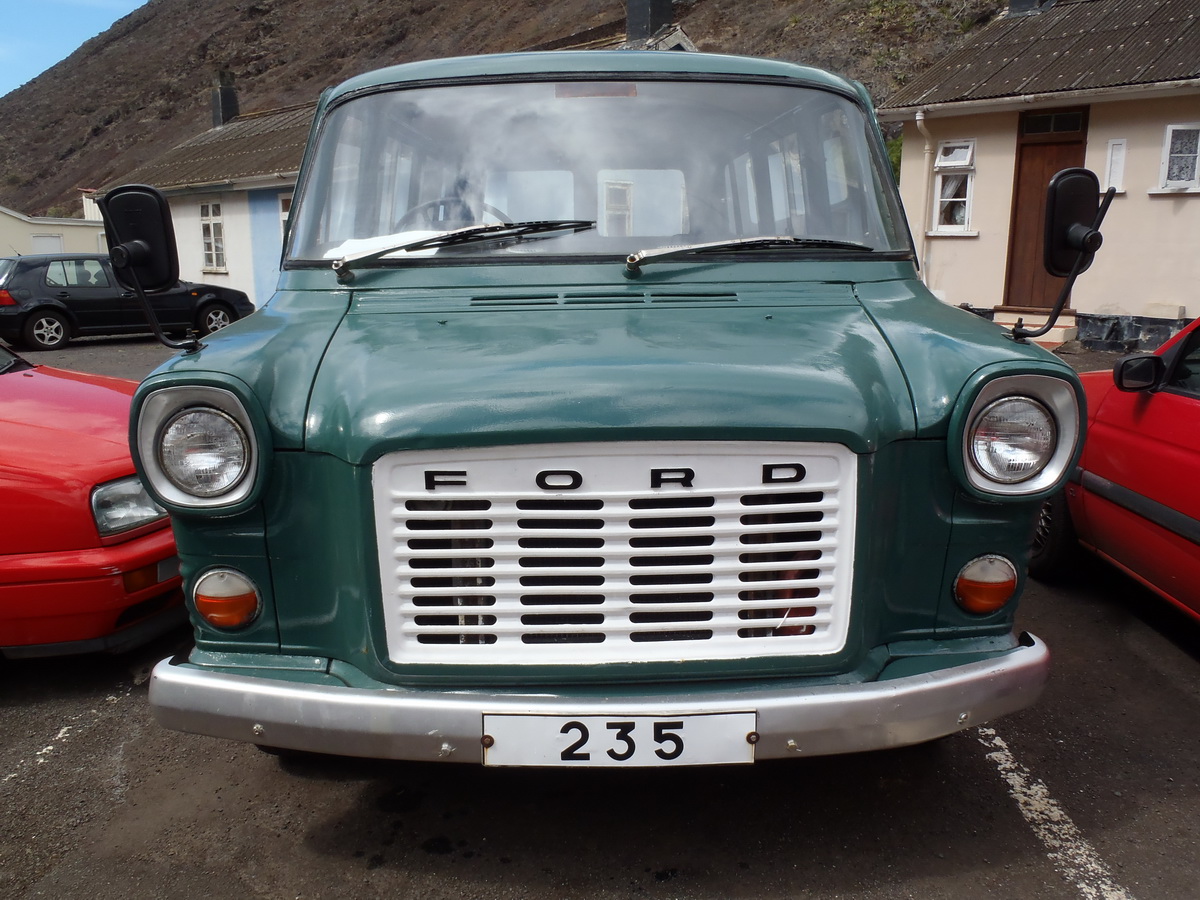
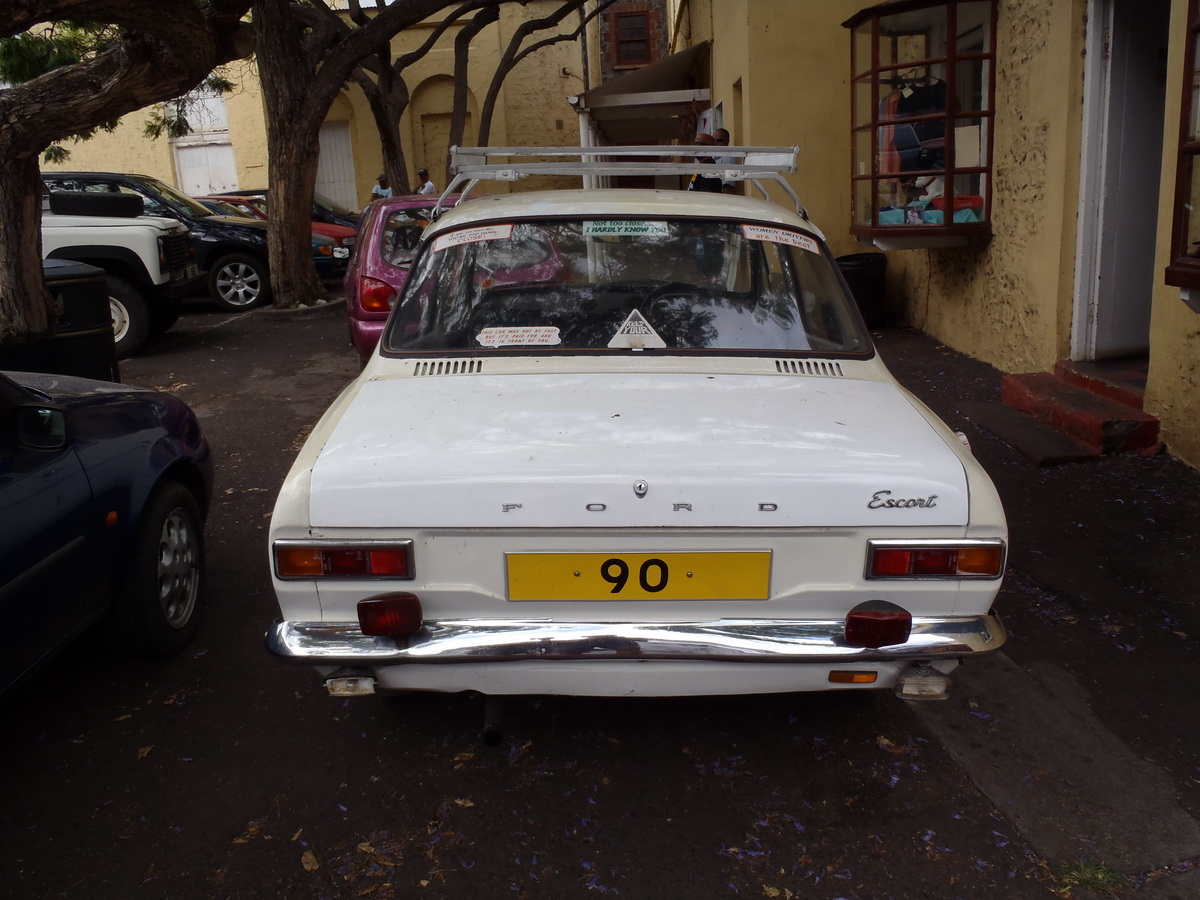
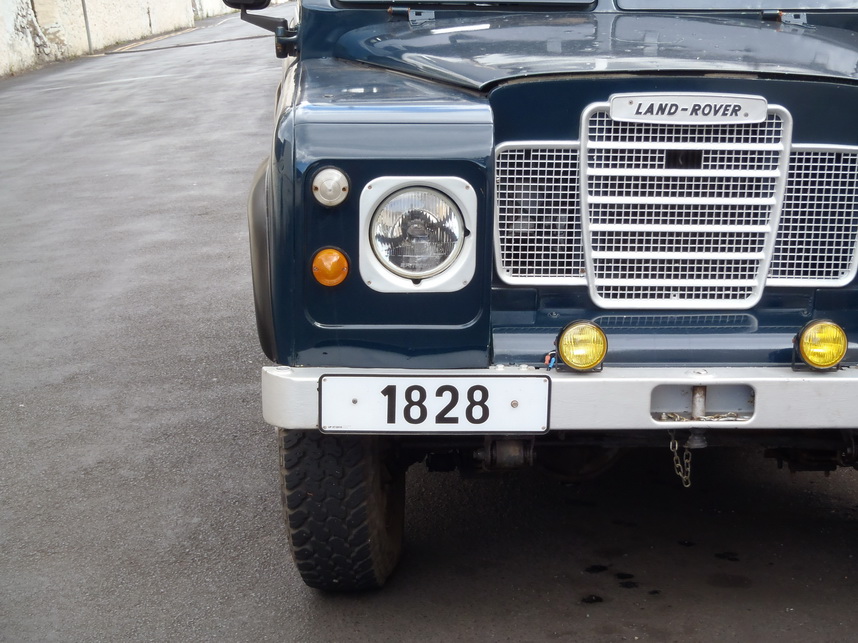
We see that the island is now registering in the 3000’s.   10 years ago, there were 2000 cars on the island, so it’s just possible that another 1500 or so have arrived in the meantime.      Sounds a bit crowded!      Apparently there is no wharf or harbour, and all heavy cargo has to be lowered from ships which come as close as they dare,  to small island craft to be brought ashore, presumably to a beach.

Most of these are models which have disappeared from British roads, due to age, but presumably, cars do such little mileage on this small island, with so few roads………

OLYMPUS DIGITAL CAMERA

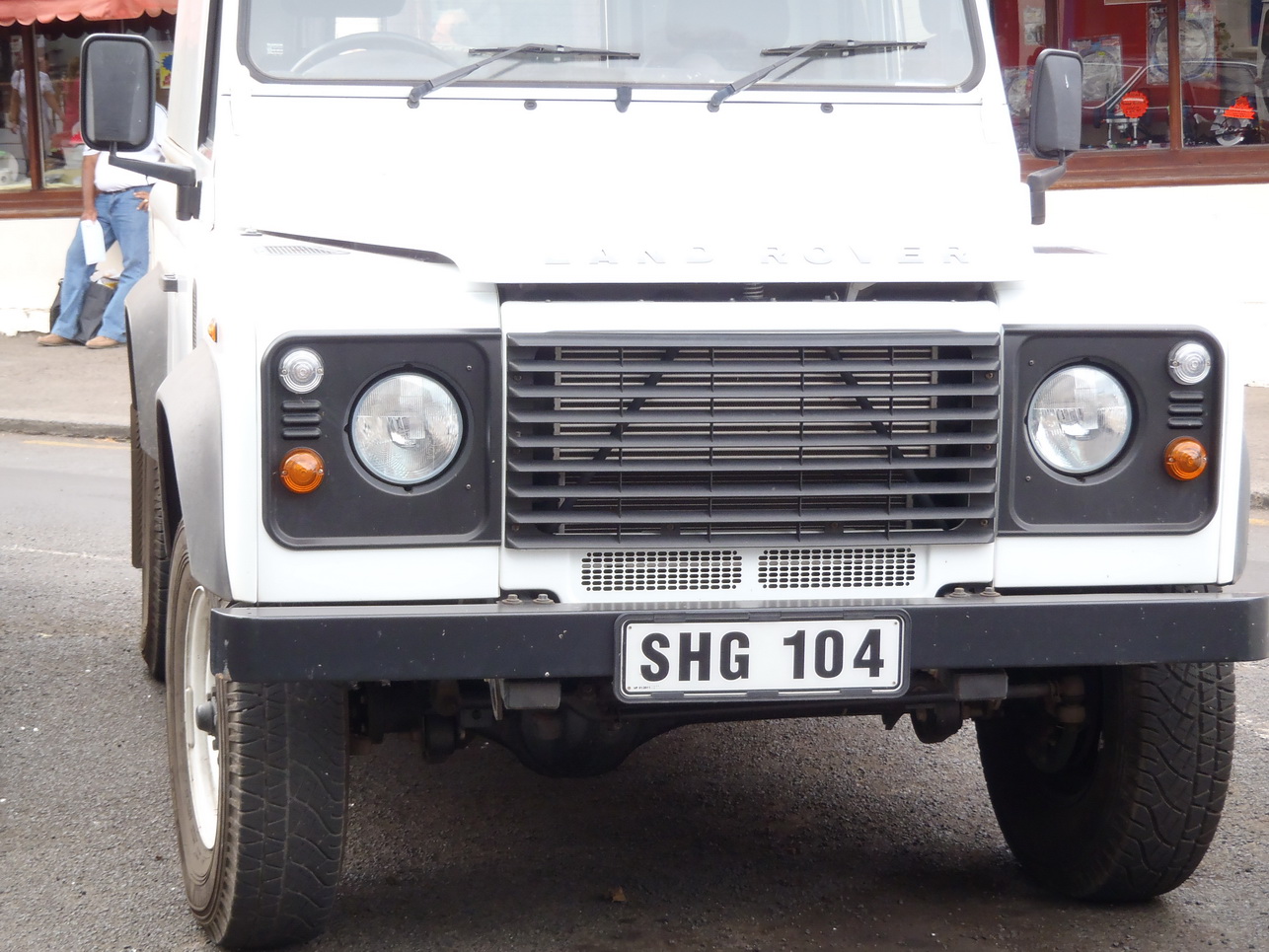
SG 104.       Our first picture of the most recent St. Helena Government series employing reflective white/yellow plates.

(SH'31)-26_comp_VB1980s

26      The only St. Helena plate ever seen by EU38 in England in the 1970s.   The Hillman Avenger (made 1970-76) belonged to the radio operator at the Government House on Ascension.    After such a two-year tour, such personnel were re-stationed elsewhere, usually at embassies or High Commissions, and their well-travelled private cars sometimes had a selection of odd plates in the boots!      Hanslope, near Northampton, was their home station and great spotting was to be had outside the high-security country house at going-home time.     (Brumby archive)

OLYMPUS DIGITAL CAMERA OLYMPUS DIGITAL CAMERA OLYMPUS DIGITAL CAMERA OLYMPUS DIGITAL CAMERA OLYMPUS DIGITAL CAMERA OLYMPUS DIGITAL CAMERA OLYMPUS DIGITAL CAMERA

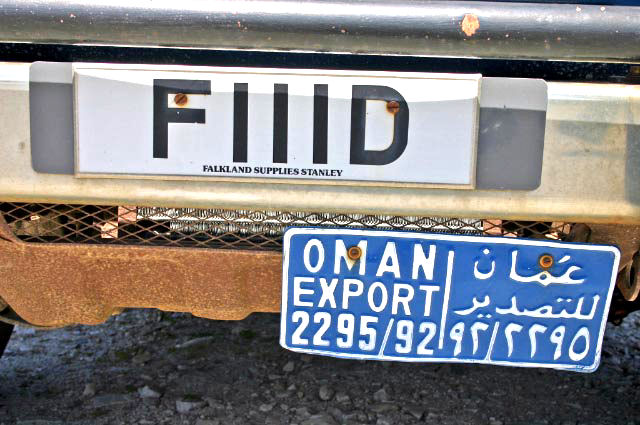
And while we’re in the South Atlantic, here are two of  Mike Oldham’s pictures from a visit to Falkland in 2011.   Until the serial letter was added to these plates in 1968,  they used identical number-only plates to those of St. Helena

(FI3)-1986-F111D-TR(141)

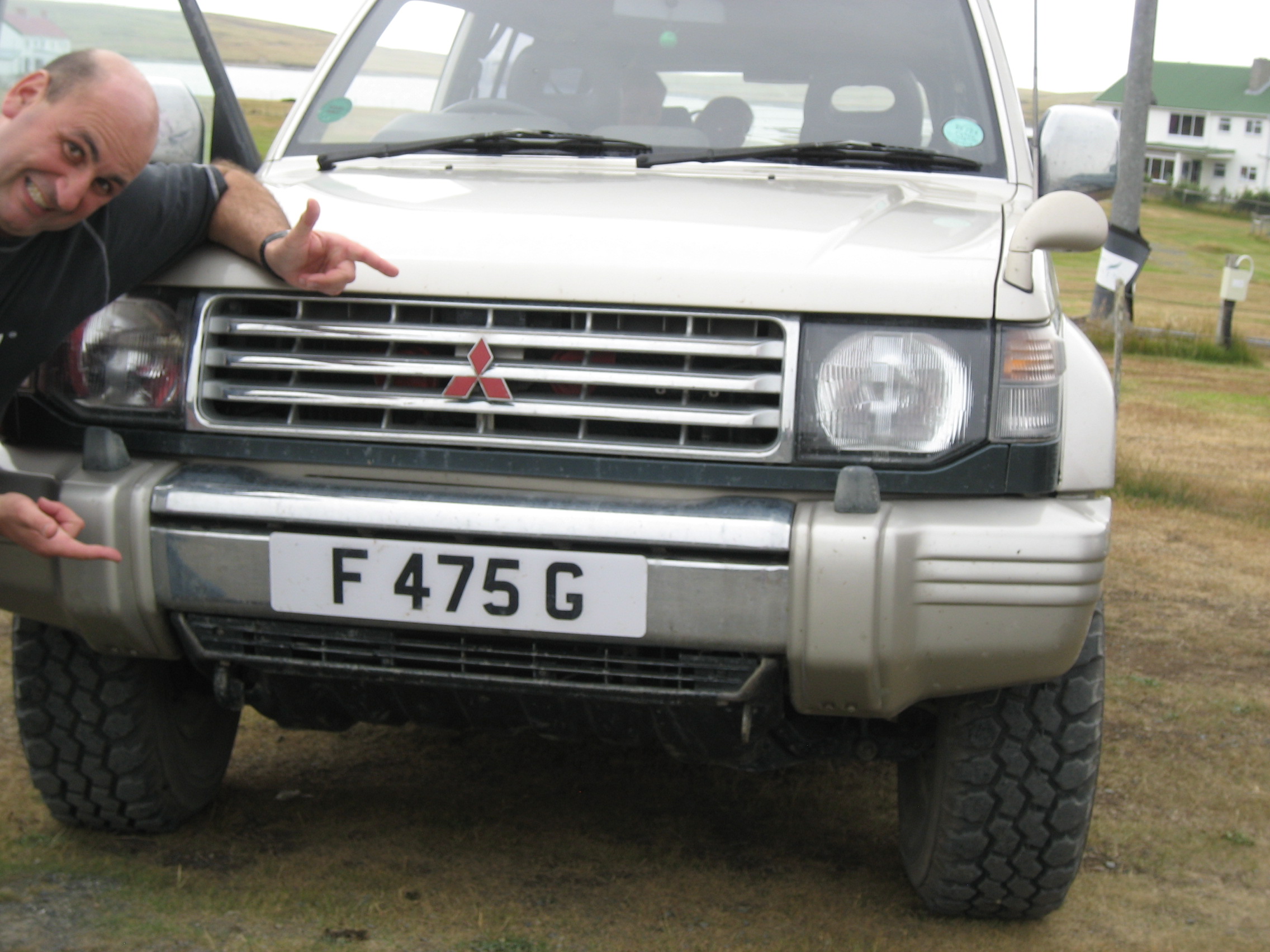
F 111 D has a bit of history behind it!      Brumby archive
(FI3)_F475G_fVBmo


Malaysia – next series and jottings

June 25, 2013

June 2013 – Su Ling, our stringer in Kuala Lumpur sends  information today  carried by the government website:   May 2014 – corrections in red.

http://www.jpj.gov.my/transaksi-percuma-no.-pendaftaran-terkini

The Wilaya (Federal Territory of Kuala Lumpur) is about to issue the last component of its three-letter, four-number series, with WYY 9999.   It is intended to move to W 1 A 1-9999. W 1 B 1-9999 etc.   It has rushed through its ‘W’ code, which only started in 1974 with WA-WY, then WAA=WYY, and it will have lasted just about 40 years…..    The other Malaysian states commenced their issues on or before 1934, first with their single state code letter and 1 to 9999, then adding a  one-letter A-Y suffix* to 9999, then most of them to double-suffix and to 9999.   * missing such as I, O & Z.

No other Malaysian states or territories are anywhere near exhausting their current 3L4N series – indeed, Perlis has not yet issued its first three-letter plates, being still at RJ 8187 this month!   (06/2013)    Even little Labuan, the Bornean island, has reached LE, having only started LA a few years ago.

Malaysia was one of the first jurisdictions to use plastic for its plates and there are many snapped, splintered ones to be seen.    They can be hard to photograph because of their shiny surface reflecting sunlight or flash.    Anyone can make these plates and the new slim characters have slowly replaced the big, British-style ones common to Malaya until the 1970s.    The blue Trade Plates are still pressed alloy in that earlier style and appear to be officially made and issued.    Many heavy lorries and trailers use pressed-alloy plates, because the plastic  plates are too easily breakable on rough terrain/building sites etc.     The most common font is almost identical to the former South Africa design.

I don’t like ’em!

(MAL1a)_TJ3079_VB_resize

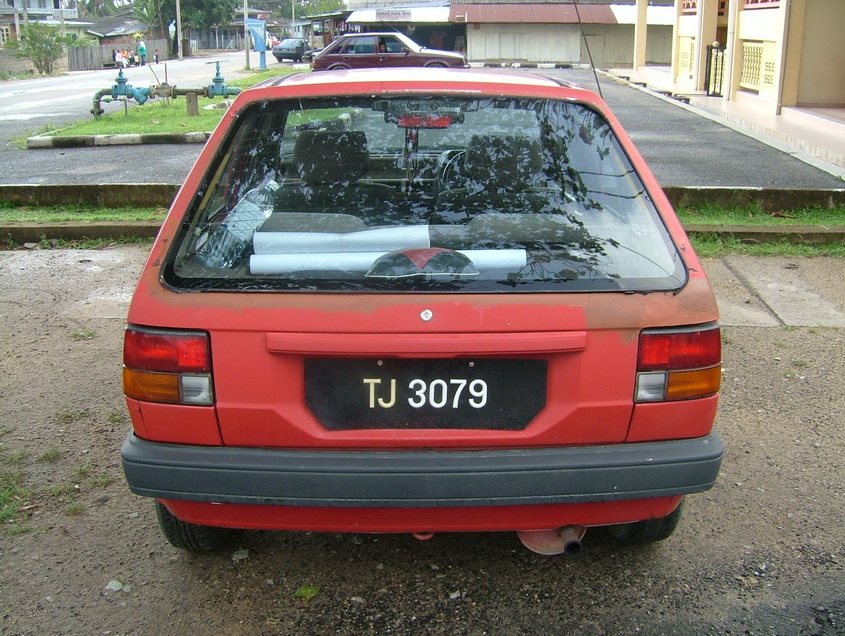
TJ 3079. Could be Transvaal-Johannesburg – but it’s from Trengganu.

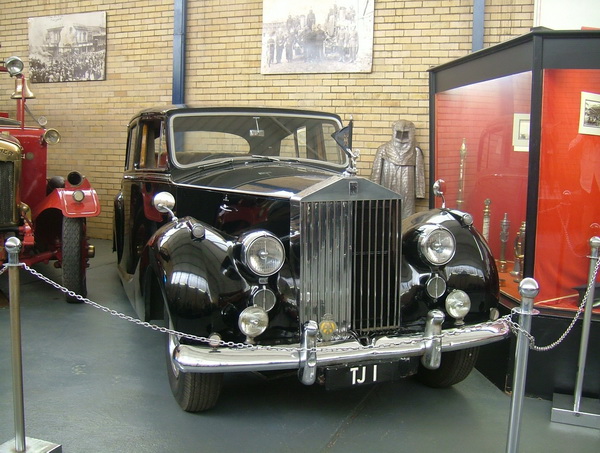
TJ 1 Belonged to the Mayor of Johannesburg,  Brumby archive

TJ 1 Belonged to the Mayor of Johannesburg,
Brumby archive
CA 6363. Could be Cape Town - but it's Pahang (seen in Penang)

CA 6363. Could be Cape Town – but it’s Pahang (seen in Penang)

NN 2625.   Could be from Newcastle (City) in Natal, but it's from Negri Sembilan.
NN 2625. Could be from Newcastle (City) in Natal, but it’s from Negri Sembilan.

UK has adopted the plastic plate, sadly, even for diplomatic and consular series, though still trade plates are officially manufactured and allocated  by the state.    Military vehicles can be seen with metal plates.   (Probably now made for us in China! )

~~~~~~~~~~~~~

SARAWAK

The information contained in the Malaysian Govt. website noted above, confirms the suspicion noted in the 25th. March Blog that Sarawak has adopted a suffix letter.     We showed this photo:

I may be behind on developments in Kuching, Sarawak, but I am surprised to see this apparent development in their system, in the addition of a suffix serial - and already at letter 'C'!   A is for Kuching, the capital; it is unlikely to to have spread to the other registration centres yet, I imagine....    VB in Kuala Lumpur 25/3/2013

I may be behind on developments in Kuching, Sarawak, but I am surprised to see this apparent development in their system, in the addition of a suffix serial – and already at letter ‘C’!     QA is for Kuching, the capital; this new suffix is unlikely to to have spread to the other Sarawak registration centres yet, I imagine…. VB in Kuala Lumpur 25/3/2013

Confirmed first sighting of Sarawak now using a suffix serial, C.    (Vic Brumby)

Confirmed first sighting of Sarawak  using a suffix serial, C.  and now as far as suffix ‘G’.                      (Vic Brumby)

For good measure,  let us finally note the simple transport employed by the wise leader of this Malaysian state.  It was the central vehicle in a noisy son et lumiére cavalcade of motorcycle outriders, dark-window’ed Range Rovers full of goons and an army Landrover or two, which accompanied him to his noodle  lunch one day at the pub I was staying at, near the Kuching airport.

His grandfather travelled by dugout canoe, collected shrunken heads and gave Shell a licence to explore for black gold!

A basic conveyance for the village headman in Kuching.

A basic conveyance for the village headman in Kuching.


Spotting notes from 1956/58 (No.2)

June 13, 2013

The second and third tranches of John Pemberton’s plate records cover the years 1956 Aug. to 1958 Aug.    Many extra details have been added to John’s basic entries of these selected from about 5,000 total entries for those years – but if  any reader can add details which are not yet showing, or correct errors, that will help to improve the science!     Even plate colours would be of interest in some cases.    Please just  ‘Comment’  below.

The selections were made from the thousands noted,  based on rarity at the time, interesting numbers, or unusual vehicles, but are otherwise arbitrary.      As European plates were predominant in John’s sightings, only odd examples and unusual series have been selected for these sheets.       We hope you will enjoy delving into these pages of history!

Copy these links in to your browser to view.    (Printable)


In this 1956-58 batch of  plates, two of the records which JP notes were also seen by EU38  and captured on film – quite a coincidence, you may agree.    Here are those common sightings:

Buick Eight in London during 1958, also noted by member Pemberton.   Brumby archive
55559 – Lebanese Oldsmobile Ninety-Eight in London during June 1958, was also noted by member Pemberton in July 1958.                    Brumby archive

When I saw this, I had to visit the library to find out where 'Aruba' was to be found on an atlas!.    Some weeks after seeing the Ford 100E Anglia at Hyde Park Corner, I saw VXD 44 parked in Fulham from the top of my RT double-decker.     Swiftly dismounting, I hunted the owner, in the sure belief it was the Aruban, recently re-registered in Britain.   It was, and the amused owner handed me one of his plates, which I still value among the most unusual plates in my collection.

When I saw A-6147  passing me, I was flummoxed.     I had to visit the library to find out where ‘Aruba’ was to be found on an atlas!   Some weeks after seeing it on the grey Ford 100E Anglia at Hyde Park Corner, I saw, from the top deck of my passing double-decker, an identical car bearing shiny, brand-new VXD 44 British plates, parked in Fulham.    Swiftly dismounting, I hunted the owner within nearby houses, in the sure belief it was the Aruban car, recently re-registered in Britain.   It  WAS – the previous week – and the amused owner handed me one of his Netherlands Antilles plates, which I still value among the most unusual plates in my collection.     Sadly, no picture ‘on the car’.       Brumby archive.

SUDAN
On the same day A-6147 was first sighted, I made another ‘country-catch’ on Ford Consul Mk.1 A 4167, which carried a cast-alloy black ET oval with ‘Anglo-Egyptian Sudan‘  printed round the perimeter.   (How bizarre that the registration was an anagram of the Aruban Ford! )    John Pemberton also saw this vehicle on another day visiting London, but neither of us got photos, unfortunately – particularly as the ‘A’ registration format did not match what I know of Sudan plates of the period.   Any thoughts?

There were to be several more joint sightings as the years progressed, which we will share with you as the Pages proceed…….


Terry Gray’s old slides found!

June 12, 2013

UPDATE 21-12-14

Terry Gray has located the pictures he took on colour transparency film from the 1960s/70s!     They were thought to have been lost in a house move, 30 years ago….

Your Blogmeister rushed them to                          www.corriejeffrey.com

in Southampton, who speedily transmogrified them into digital pictures which now we can all see – providing we have access to a computer….       This is another wonderful event for Europlate and platesmen worldwide, as a few more rare images of extinct series appear unexpectedly before us, on the Europlate Blog!

What with the recently-released photo gallery of John Pemberton, and now his notated spottings from 1954 (more to come) and the slow release(!) of Bernt Larsson’s early shots, the Gray archive becomes our latest link with the past days of xeno-autonumerology.      Many thanks to T.G. – early member (number 9)  for clearing the attic!

A taste of the period Terry covered, without editor’s notes:    (Later – a request has been received for picture notes to be added, so keep visiting the Page and you should see it happen progressively, starting now.)

(RUS)(SU)_05-10 ABT_TG_resize

David Powell explains:
I am fairly sure that the USSR plates with an ABT suffix were manufacturers’ plates for an organization called Autoexport who managed the export of Moskvich cars and vans.

Cedric Sabine adds:  The 1959 Soviet ABT series was for any vehicle travelling out of country and was issued by Moscow city. So, the export Moskvich cars would indeed have got them but other vehicles did too.

VB:  That would explain why Terry Gray pictured the Moskvich team in London, preparing for the start of the London-Mexico Rally in 1970.


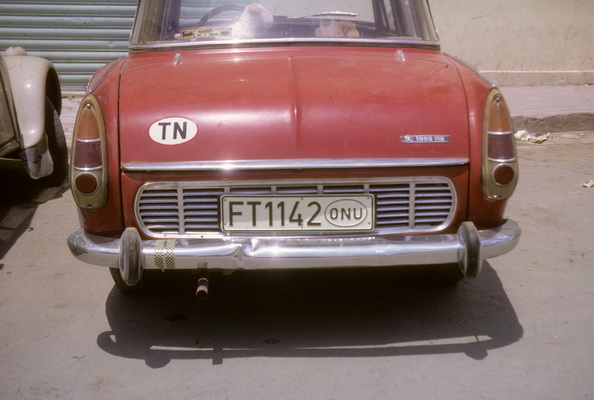
(TN)(56-70s)(for)(UN)_FT 1142_TG_resize

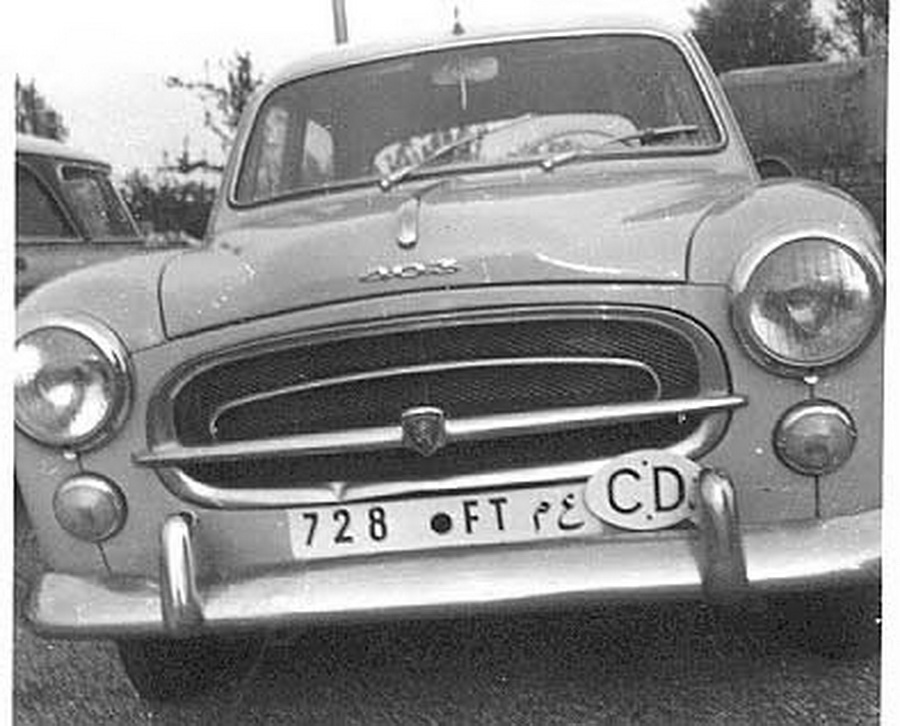
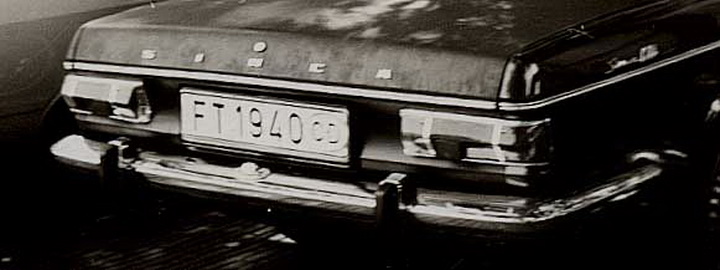
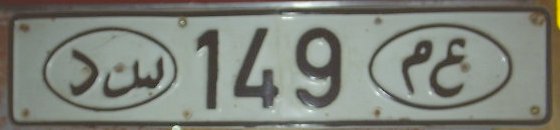
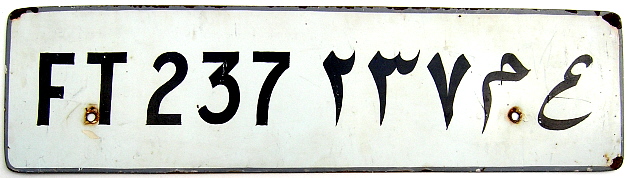
FT was the first prefix used in Tunisia after independence from France,in 1956, at which it had to establish a series for foreign residents, including diplomats in the new embassies in Tunis.    In this case, a member of the UN (ONU) had been accorded diplomatic status, to receive this plate.     FT abbreviated ‘Franchise Temporaire’ (Temporary Licence); such vehicles were allowed to enter Tunisia free of local duties, because they were to be re-exported at the end of the owners’ tours of duty. FT is thought to have run from 1956 to sometime in the 1970s.     Blogman knows only of FT 3 and FT 1142 which have been photographed in service.    Anyone else got a picture??  Terry Gray archive

June 25th.2013  Member Cedric Sabine writes that he has more pictures of this rare Tunisian FT plate series; we have asked if we might have his pictures to further illustrate this item……

21-2014       THANKS, CEDRIC!   What a batch!!

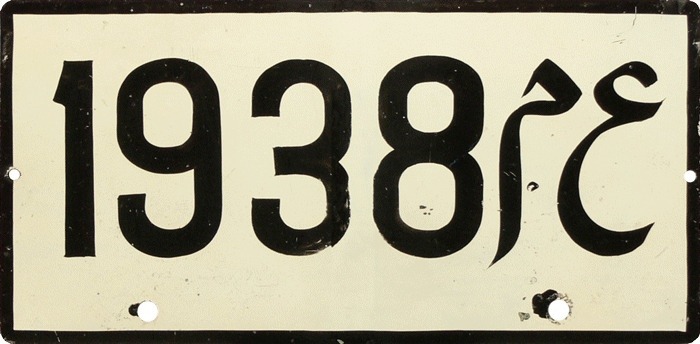
(TN 56-65)(for.res-cc)_FT 743_r_  longMV4-KM book 1963 (TN 56-65)(for.res-cd-GB)_FT 3_cu_VB (ex GB ambassador 1956) (TN 56-65)(for.res-cd)_FT 149_cur_ long pressedYL1 (TN 56-65)(for.res-cd)_FT 728-CS (TN 56-65)(for.res-cd)_FT 1940  CS1968) (TN 56-65)(for.res)_149_cuf_YL2 OLYMPUS DIGITAL CAMERA (TN 56-65)(for.res)_FT 718  longMV1 (red-white maybe) (photo 1968) (TN 56-65)(for.res)_FT 1938 HSexJF


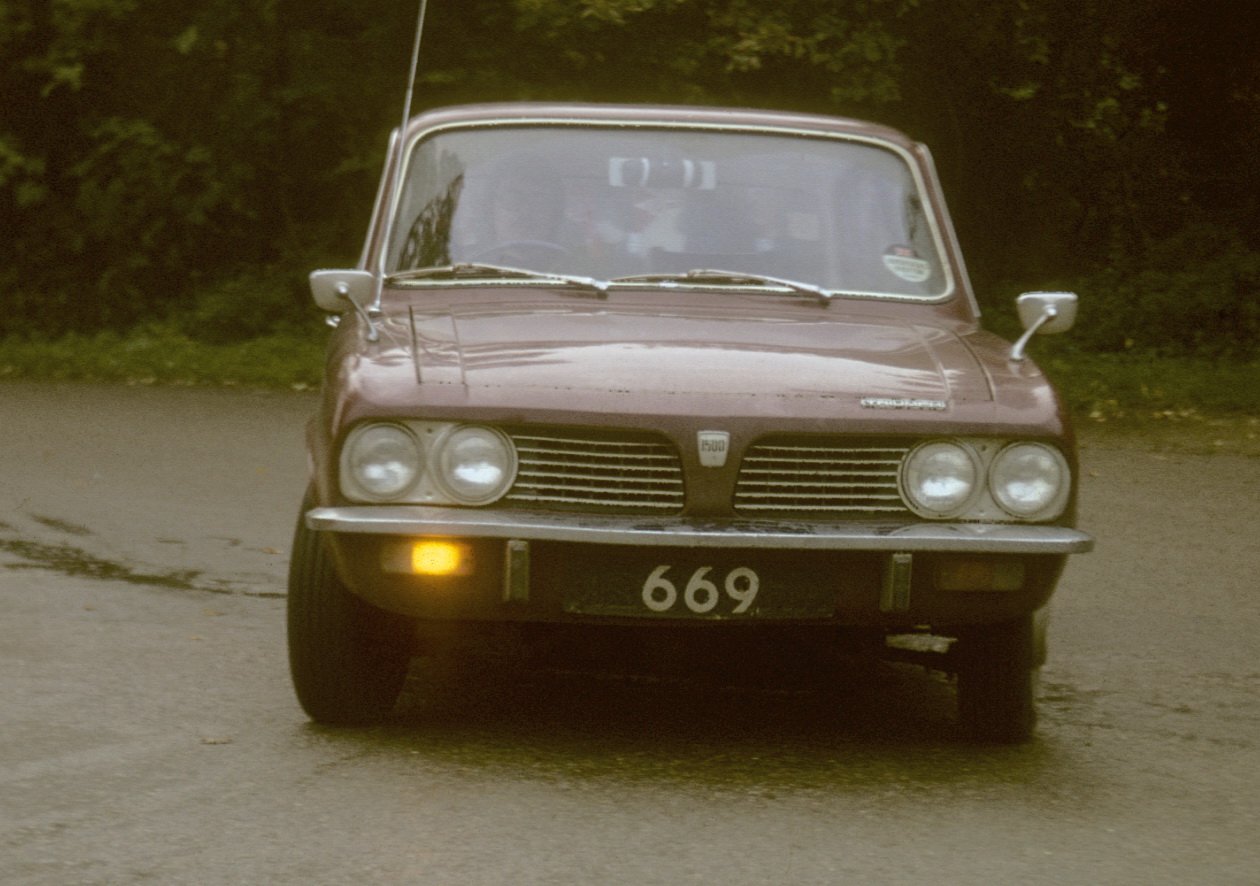
(StH)_669_TG

This Triumph Toledo(?) has been to Saint Helena and back(!), and was photographed in Northamptonshire on its Helenan 669 plates.    St. Helena has also been seen with an SH prefix.         The owners were British government officers involved in the administration of the Territory, and their cars were returned at the conclusion of their duty there..


(SYR)(psv)_2480_TH_resize

SYR 2480.    Between the 1950s and the 1970s, red plates in Syria were issued to public service vehicles including buses, which is what TG photographed in London in the early 1970s. Serials 2001-12000 were issued to Damascus. Long trip!


(SOM)_16564_ c_TG_resize

16564. One of very few 1960-1970s Somalian plates seen was photographed – also in Northamptonshire -on a Mk 3 Ford Cortina, circa 1974. These were oddly well-made plates for such a backward territory; perhaps they were made for them by an international aid process – possibly Italian, as the former colonial power?      In recent decades, the few Somalian vehicles seen in news broadcasts have generally run without bearing plates, as no registration system exists.     Breakaway Puntland (1998), Galmudug (2006) and Somaliland (1996) have established their own systems (see RPWO).


Somalia mini front plate, a la Italiano.

Somalia mini front plate, a la Italiano.


(SD)_SD 8016_TG_resize

SD 8016 is from the original Swaziland series running from the 1920s to 1979. This Mk. 1 Ford Cortina was seen near Brackley, England, during the 1960s.


(S)(trans)_M 4221_TG_resize

From 1937 to ?, these white on red Swedish plates were issued to vehicles temporarily imported.          Terry Gray saw this Fiat in Europe in the 1970s, carrying a normal Swedish plate of the period underneath.


The unusual sighting of this old Swedish tourist import plate was at a Morris Minor rally in Oxfordshire in June 2013!      (Brumby archive)

The unusual sighting of this old Swedish tourist import plate was at a Morris Minor rally in Oxfordshire in June 2013!                  (Brumby archive)


(RSM)(pol)_RSM 0013_c_TG_resize

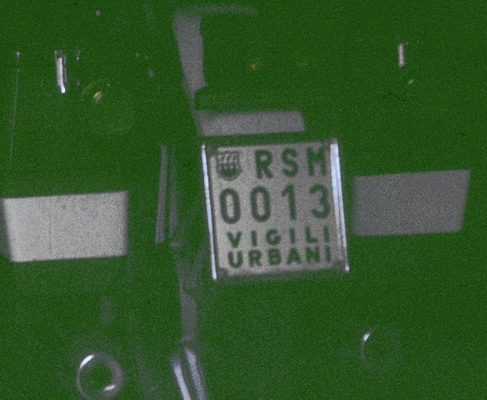
San Marino issued special plates to the city police in different sizes for cars and motorbikes.     A poor shot, unfortunately, but it must be kept for posterity, as so few were issued and ever fewer were photographed….. (Gray archive)


(RCL)_T.9895_TG_resize

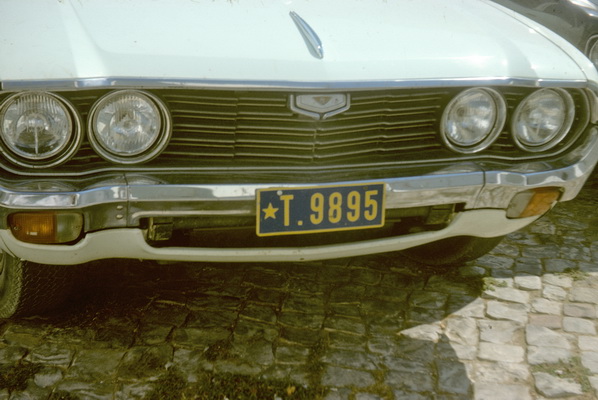
From 1958, while still the Belgian Congo, this Belgium-manufactured (Howoco?) series was introduced.     It continued from 1960 independence under the re-named ‘Rep. of Congo (Leopoldville)’ (oval RCL).      If this were a  Congo Belge (CB)-issue, the T would mean it came from Kasai province, but after 1960, the regional codes became simple serial letters.     Later two letters with three numbers LL-NNN superseded these L-NNNN plates. The provenance of this picture is presently unknown. (Gray archive)


(RA)_B 131859_TG_resize

From the 1960s to 1995, Argentina’s first countrywide series was issued, with a letter for the State and a up to 6 numerals.      B 131859 is from Buenos Aires (county).      Somewhat dull, in white on black, but a rare sight outside Argentina.      This Peugeot 404 in an odd colour is probably a car manufactured under licence in (RA), where a different colour range was available.                        (Gray archive 1970 London)

Yves Laussecq Comments below:

Regarding the 404 PEUGEOT picture, I’m quite sure it was the vehicle of Gaston Perkins during the 1970 LONDON-MEXICO rally


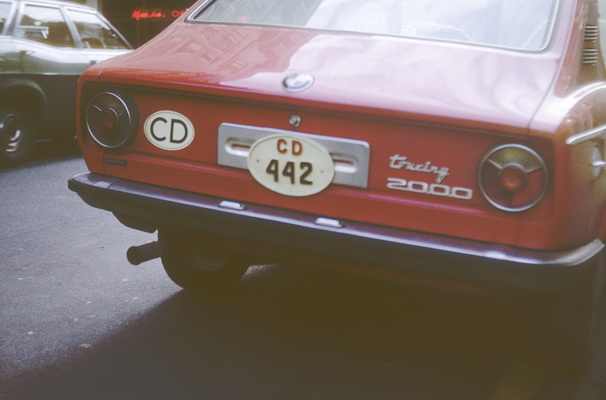
(R)(cd)_CD 442_r_TG_resize

Member pseudonym’d  ‘BlackVolga’  identifies the smart oval plate in red and black on white, CD 442 as for Roumania Diplomatic Corps from 1968 to  1992.      On a BMW 2000 ‘Touring’, a fine-looking car in its day.                (Gray archive)

These and hundreds of others were taken in Britain in the 1960s and 1970s and captured by Terry as slide transparencies, which are difficult to view except by old projectors, but  give a very clear and well-coloured image, when converted to computer  files (.jpg).

Any readers who have slides, might consider their conversion thus; the lady Corrie who did these being highly recommended AND economical!

More to follow in later Posts.    Updated 15062013


Spotting notes from 1955

June 4, 2013

As avid Blog-watchers will know, member John Pemberton handed the Club his photo album from times gone by, and we have been able to share his rare old pictures by scanning them in to the Blog.    (All still listed, if you have missed them – just open the previous Posts.)

From 1936, John kept an account of every foreign plate he saw – unless he was travelling abroad, when he would not record everything he saw – just foreigners.    Though the early years records are lost, John’s spotting-books from 1954 have also been passed to Europlate and   EU 38 Brumby has recently spent many happy hours selecting his most interesting sightings from 1955 to 1970, which is as far as I have got so far.  (It takes quite a time to decipher his hurried writing and to transfer to p.c.!)

Keen to set a few before you, for your delectation, I refer you to the first, 1955-56 (Aug), spreadsheet

(copy and paste into your browser):

https://docs.google.com/spreadsheet/ccc?key=0AkHUjn4lt2fKdEVhXzEybGpuY19LTXdYbUhfZm95RlE#gid=0


You will note that more cars, from more places, used to be seen in Britain and some parts of Europe, than we are used to today.    I recall Paris always being a fruitful visit in those days, with a fair chance of seeing something from the little-known French empire territories.     Here we see a predominance of British Empire sightings and plates we could never hope to see today.

Let me know if you like it, and would like to see John’s following years’ spottings, as they become available.

~~~~~~~~~~~~~~~~~~~~~~~~~~

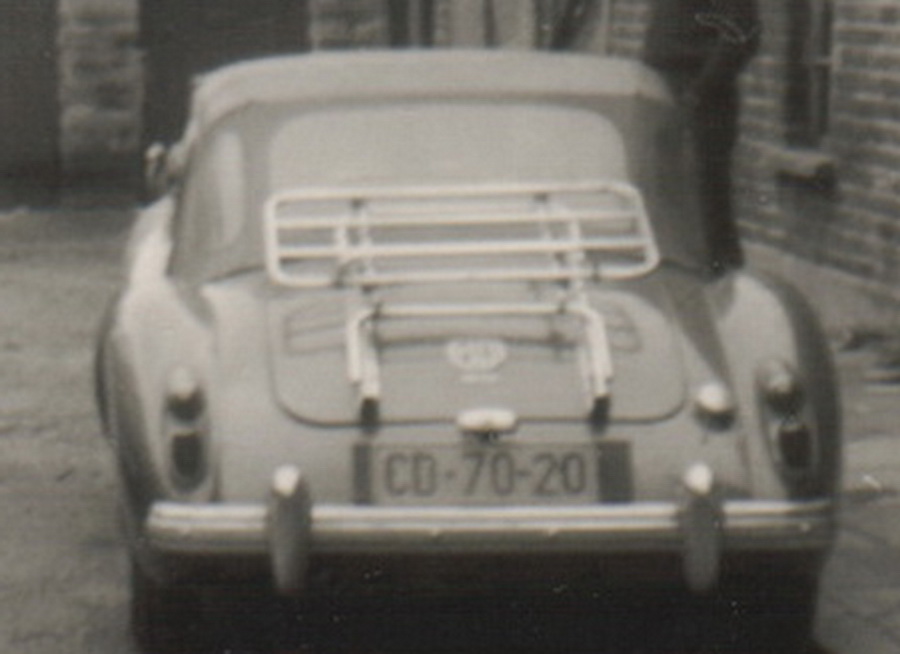
In passing, can anyone prove or disprove  that this MGA is carrying  a Yugoslavian CD?      It was taken in about 1962 in London, and is believed to have been either black or red on yellow.    If not, where IS it from?

Quiz plate - DID YU have a CD system like this??? Brumby archive

Quiz plate – DID (YU) have a CD series like this???
Brumby archive

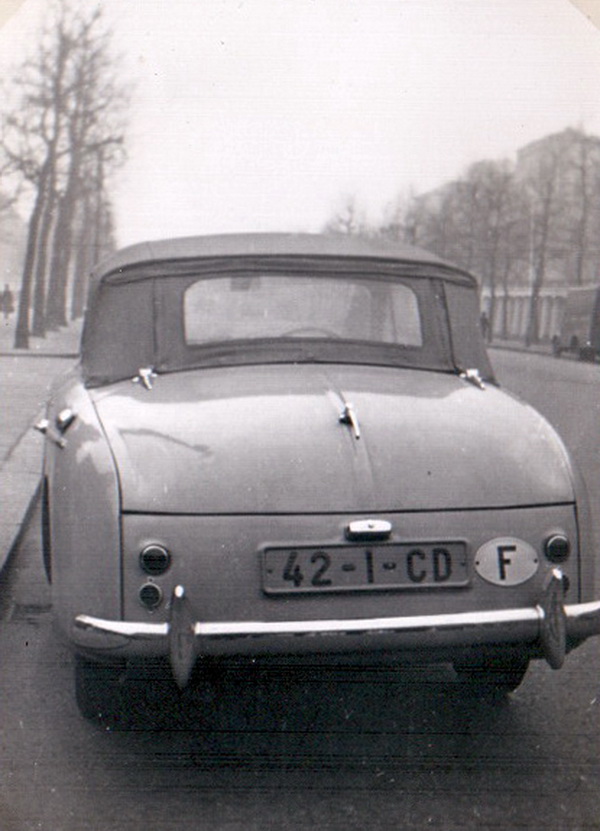
And still we have no identification by members of the diplomatic plate on this 1950s Austin A40 Sports.    The ‘F’ oval cannot be correct…….

Odd French diplomatic, 1940s-50s.

Odd French diplomatic, 1940s-50s.


Singapore 2013 checkover

April 19, 2013

SINGAPORE

April 2013.

Singapore’s plates continue as shown in RPWO and a wide variety of colours and codes are enough to keep a keen spotter occupied for some long time.     Two of the outer islands have been allocated their own plates – Sentosa and Ubin – and these cannot be used on the ‘mainland’ of Singapore.      If they must go over there, for repairs etc., they will carry SGP trade plates for the journey.

Sentosa’s colourful plates have been known to us since about 1998.

(SGP3)(Sentosa)(mc)_RU 1115Y_VB_resize

This Vespa RU 1115 Y is one of few two-wheelers registered on Sentosa.     Brumby archive 1987.

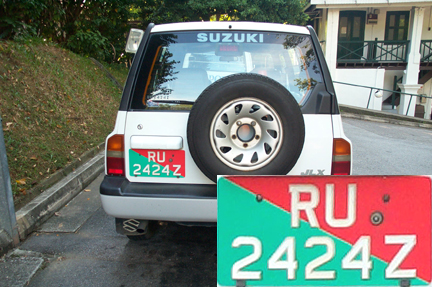
RU 2424 Z is the Restricted Use plate for Sentosa Island, a hundred metres off Singapore's coast.

RU 2424 Z is the Restricted Use plate for Sentosa Island, a hundred metres off Singapore’s coast.    Brumby archive 1987

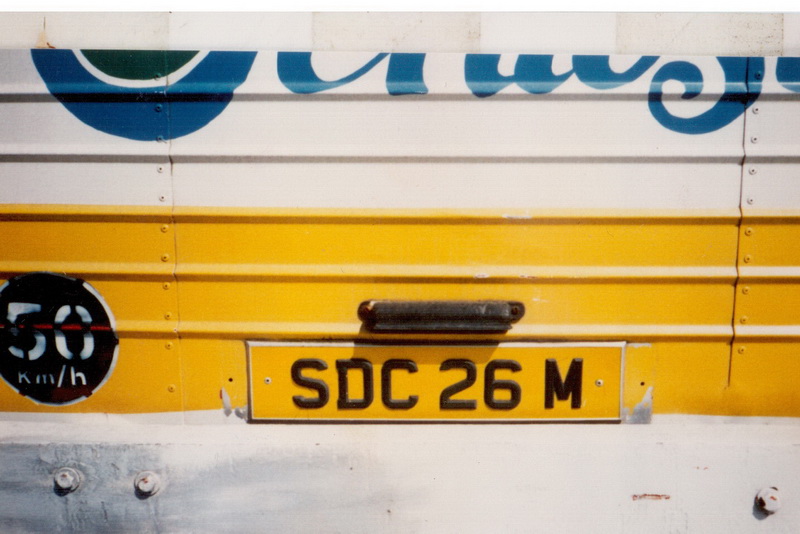
The Sentosa Development Corporation, whatever that is, has a few buses, which are allowed on and off the islet, and have a special SDC code issued!

SDC 26 M is one of the island buses, registered on the 'mainland'     Brumby archive

SDC 26 M is one of the island buses, registered on the ‘mainland’ .              Brumby archive 1987


UBIN

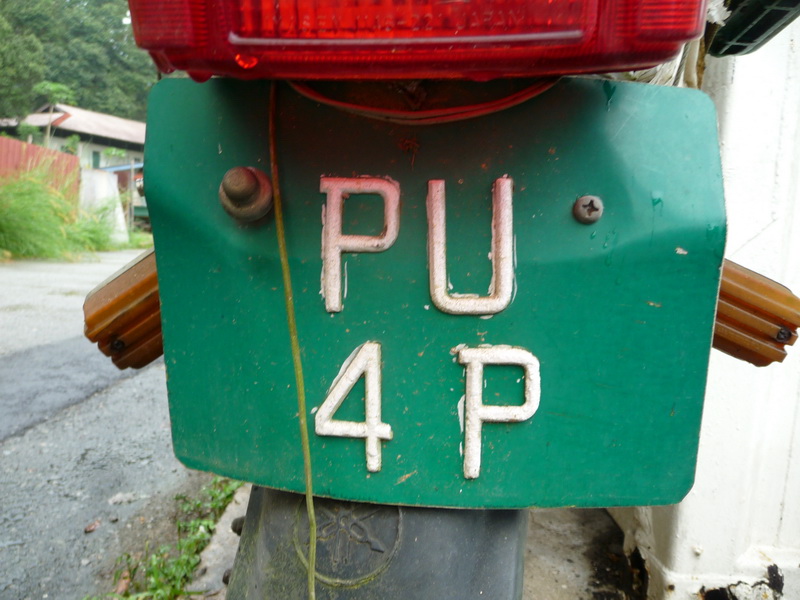
But we have only recently become aware of the special plate colour given to the few vehicles on Pulau Ubin (Ubin Island), which is a mile off the North-East coast of Singapore, by Changi airport.     The island is lightly populated by fishermen and kampong farmers and has completely escaped the rapid advance to the six-star first-world status now enjoyed by the Republic of SGP.     There are about ten mopeds on Ubin, of which half still work and about 15 minibuses, which carry the islanders and some of the weekend visitors along the narrow island roads to various camping sites and hiking/cycling trails, for which Ubin has become a popular, rat-race getaway.

(SGP3)(Ubin)_PU 4 P_VB2013_resize

The fourth motor vehicle registered on Ubin Island is a Honda moped, still in running order, PU 4 P.                                             Brumby archive 2013

(SGP3)(Ubin)_PU 104 J_cuf_VB2013

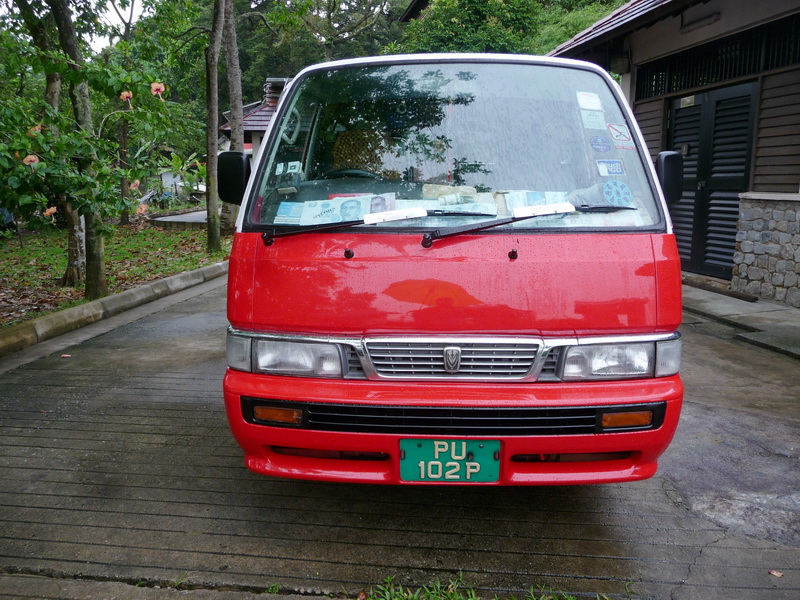
One travels to Ubin by bum-boat, for 3 ringgit ($1US) which takes fifteen people at a time on old vessels which you would not expect to be still in service, but which are the pride and joy of their rough-looking but friendly owners.     Since registrations started on Ubin, perhaps in 2000, and originally only for a few small motorbikes which had previously run plateless, about 135 total registrations have been made, of which perhaps 15 to 20 remain in use.    The system is that of the Singapore mainland, using the PU area code, a serial number (current highest 137) , and a check digit, all in white on a pea-green background.

One of the island minibuses, PU 102 P.     Brumby archive

One of the Ubin island minibuses, PU 102 P.                       Brumby archive 2013

PU 130 H is just seven off the highest number on Pulau Ubin, the. latest minibus being PU 137.      Note that all the plates are properly made, even though this island is quite primitive.... Brumby archive

PU 130 H is just six off the highest number on Pulau Ubin, the latest minibus seen, being PU 137.       Note that all the plates are properly made, even though this island is quite primitive….
Brumby archive 2013

There are a few special purpose vehicles on Ubin, such as Police Land-Rovers and a couple of biggish lorries for construction jobs, and as these are there temporarily, they retain their normal Singaporean plates.

QX 5045 K is a standard Singapore police plate, coded by the QX.    This is one of two allocated to the island - surely an easy posting for the island coppers!      Brumby archive

QX 5045 K is a standard Singapore police plate, coded by the special code QX. This is one of two allocated to Ubin island – surely an easy posting for the island coppers!                               Brumby archive 2013


Singapore Specials

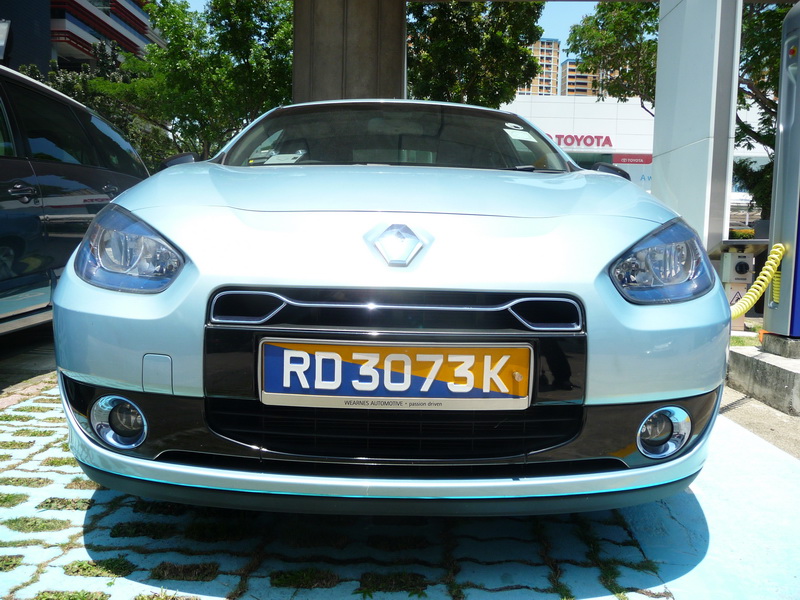
The SGP government is sponsoring experimentation in clean/non-emission vehicles and has allocated a dedicated ‘Research and Development’ numberplate to the handful of cars being tested on the island.

A Renault experimental electric car RD 3073 K, one of two seen at the Renault distributor in SGP.  Brumby archive

A Renault experimental electric car RD 3073 K, one of two seen at the Renault distributor in SGP.   April 2013.                                    Brumby archive 2013

RD 6096 A is carried on a Mitsubishi minicar and has a 100km range, recharging 80%  in 20 minutes.   It says here.     Brumby archive.

RD 6096 A is carried on a Mitsubishi minicar and has a 100km range, recharging 80% in 20 minutes.   It says here.         Brumby archive 2013.

There may be up to 50 vehicles on test, each of which is connected by wifi signal to a central office, in which its location, performance, battery-condition, range etc is transmitted every 5 seconds for analysis.

This category uses such high numbers that they must be split in some way, perhaps the first two or three numerals indicating a code for the few participating bodies in the experimentation.    Certainly there are not more than a hundred of  these low-emission category vehicles in the whole country, so 6096 seems optimistic….

~~~~~~~~~~~~~~~~~

It is of mild interest to note that Singapore vehicle owners can choose for themselves whether they plate their vehicles with the original silver/white on black plates, fore and aft, or Euro-style black on white (front) and yellow (rear).     About 20% favour white on black, I estimate.

Light goods vehcle codes seen here with both plate colour options.     Brumby archive

Light goods vehicle code G seen here with both plate colour options.         Brumby archive 2013

TR – Singapore trailers are now up to TRE, having exhausted TR and  TRA to TRD.

Another unusual SGP variant is the recently-adopted orange background to distinguish lorries wh.ich carry hazardous cargo, such as fuel and chemicals.     These cannot enter tunnels and need to advise police and fire when they need to access certain zones of the island.   The Y starter letter tells us that the truck exceeds 3 tonnes unladen; the M is serial.      Brumby archive.

YM 942 S – Another unusual SGP variant is the recently-adopted orange background to distinguish lorries which carry hazardous cargo, such as fuel and chemicals. These cannot enter tunnels and need to advise police and fire when they plan to access certain zones of the island.    The Y starter letter tells us that the truck exceeds 3 tonnes unladen; the M is serial.        Brumby archive 2007.

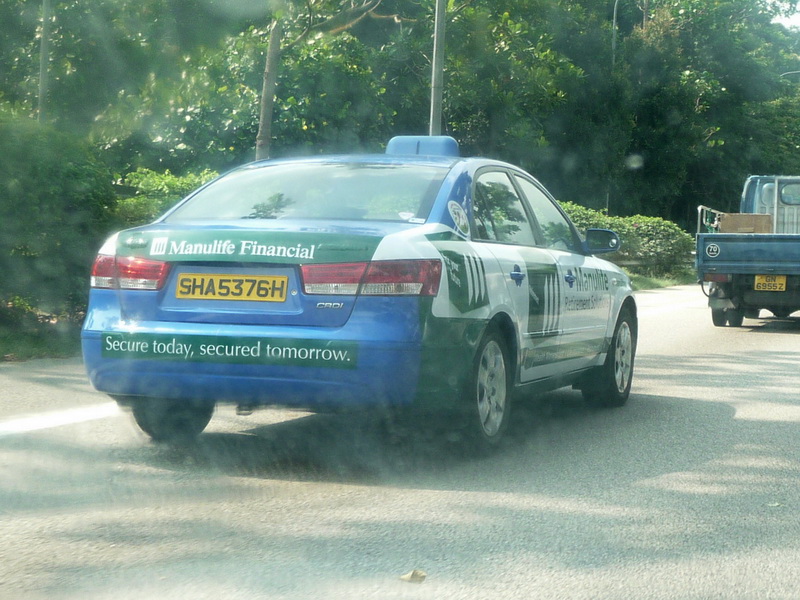
SH – Taxis have progressed to SHA, SHB and now to SHC.

SHA 5376 H is the Singapore Hire code with suffix serial A, on a typically smart, clean, new car, a credit to the taxi fleets.    Brumby archive.

SHA 5376 H is the Singapore Hire code with suffix serial A, on a typically smart, clean, new car, a credit to the taxi fleets.         Brumby archive 2013.

New private cars are up to SKJ, having jumped SH (kept for psv’s) and SI (‘I’ never used) and having presumably used up SJA-Z (though not seen).


Odd Chauffeur-drive/Private Hire possiblity.

We have believed that the special series for hire cars, SZ and SZA, had been long abandoned.   But now e find SZA 8 R, from the  current series on a chauffeur-driven/livery Mercedes, outside the Copthorne Waterfront hotel.   When questioned the driver claimed it was just a standard plate issued alphabetically in the normal series, but we know that Singapore is nowhere near 'S' inits alpha issue.   So perhaps there are a few (note this is only car 8) special-category registrations continuing to use the SZ prefix.     This was the only example seen.     (Brumby archive 2013)

We have believed that the special series for hire cars, SZ and SZA, had been long abandoned. But now we find SZA 8 R, from the current series, on a chauffeur-driven/livery Mercedes, outside the Copthorne Waterfront hotel. When questioned, the driver claimed it was just a standard plate issued alphabetically in the normal series, but we know that Singapore is nowhere near ‘SZ‘ in its alpha issue.      So perhaps there are a few (note this is only car 8) special-category registrations continuing to use a version of the old SZ hire/rental prefix.   (This was the only example seen.)    Brumby archive 2013

Here is SZ (Singapore Rental-Hire) carried on a new Toyota in 1968, seen at Singapore docks.     Brumby archive 1968

Here is SZ (Singapore Rental-Hire) carried on a new Toyota in 1968, seen at Singapore docks.                       Brumby archive 1968

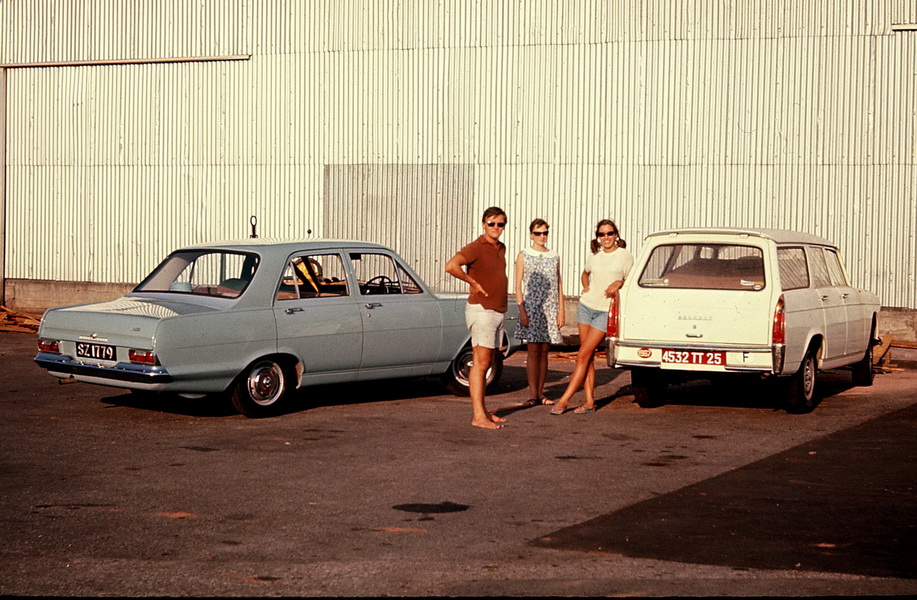
680224 3 _4532TT25 at docks_resize

The only other SGP hirecar plate I ever saw was on this Vauxhall Victor, SZ 1779, also at the docks in 1968, alongside the Peugeot 4532 TT 25 which we drove back to Britain over four months.         Brumby archive 1968

~~~~~~~~~~~~~~~~~~

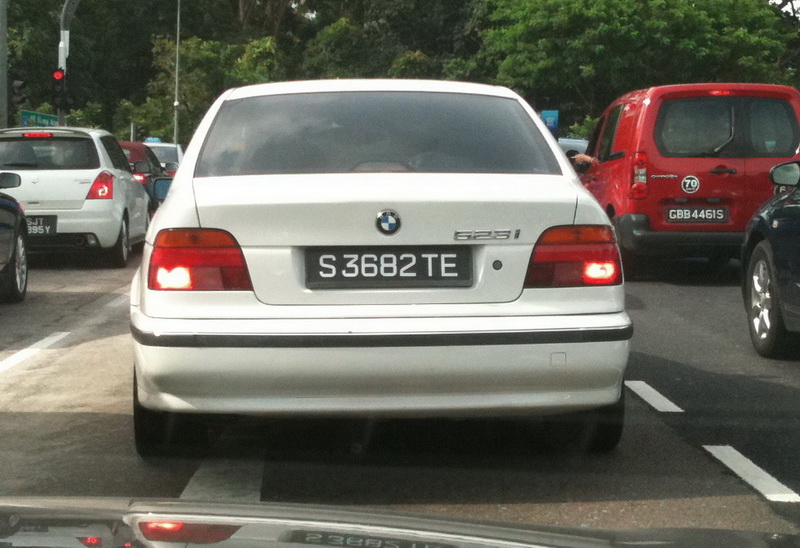
A very rare sight in Singapore is the semi-diplomatic plate allocated to foreign technical aid personnel.    TE is the suffix code for these ‘Technical Expert’ vehicles and this BMW 525 example is coded 36 for the Philippines.

S 3682 TE is a semi-diplomatic plate for foreign technical aid personnel.   Brumby archive

S 3682 TE is a semi-diplomatic plate for foreign Technical Experts personnel.   36 is used by the Philippine embassy.         Brumby archive 2012

The Consular Corps variant is also hardly-seen, but Taiwan had code 66 in this category (photographed there in 1993, so possibly not current).

Taiwan's mission code 66 seen on a Volvo given Consular, rather than diplomatic recognition, presumably due to pressure from PRC to sideline the territory they hope to recover some day.     Brumby archive.

Taiwan’s foreign-mission code 66 seen on a Volvo 240, given Consular, rather than Diplomatic recognition, presumably due to pressure from PRC to sideline the Formosa territory they vainly hope to recover some day.        Brumby archive 1993.

Motorcycles exhausted their two-letter FA-FZ prefix codes some time ago and current registrations, for every size of  2-wheeled bike, has re-started from FAA…..     Note that, against the trend, SGP still requires a front plate to be displayed, either double-sided along the front mudguard or a forward-facing plate adhering to the faring.

Examples of motorbike front plate mounting positions.    Brumby archive

Examples of motorbike front plate mounting positions.     Brumby archive 2013

The current motorcycle format now uses two serial letters, the leading F, designating 2-wheelers.    Brumby archive

The current motorcycle format now uses two serial letters, the leading F, designating 2-wheelers.                          Brumby archive 2013

There is an auxiliary police orce,it seems, but they use normal private m/c plates.  FBA 6232 B.     Brumby archive.

There is an auxiliary police force,it seems, but they use normal private m/c plates, as FBE 5246 A.                              Brumby archive 2013.

The author’s first visit to Singapore was in 1966, when the vast majority of the vehicles were made in Britain, from motorcycles to double-deckers.     I still enjoy finding the leftovers from that period and recognise that many owners are very proud of their cars, which are now collectors’ items!

A well-restored MG TC sporting the special, low-tax plates of the approved vintage and veteran cars and bikes in Singapore.    SCL 69 D is a normal registration issue, and it is the plate colour which gives the privileged status.    Brumby archive.

A well-restored MG TC(?) sporting the special, low-tax plates of the approved vintage and veteran cars and bikes in Singapore.    SCL 69 D is a normal registration issue, and it is the plate colouring which gives the privileged status.                                Brumby archive 2008.


Singapore Historic


About 1960, many British Army, Navy and Air Force personnel served in Singapore and it was a period of very heavy registrations, as most  purchased a car there or duty-free at home, to take out.    This Austin A40 Farina belonged to a Wing-Commander, whose daughter June, modelling here, now dwells in Ottery St, Mary and makes jam for the W.I.     Brumby archive.

SS 9806.   A plate from the former series.       About 1960, many British Army, Navy and Air Force personnel served in Singapore and it was a period of very many new registrations, as most of them purchased a car there – (or duty-free at home, to take out and register there).    This Austin A40 Farina belonged to a Wing-Commander, whose daughter June, modelling here, now dwells in Ottery St, Mary and makes jam for the Womens’ Institute.                Brumby archive-June Harvey.

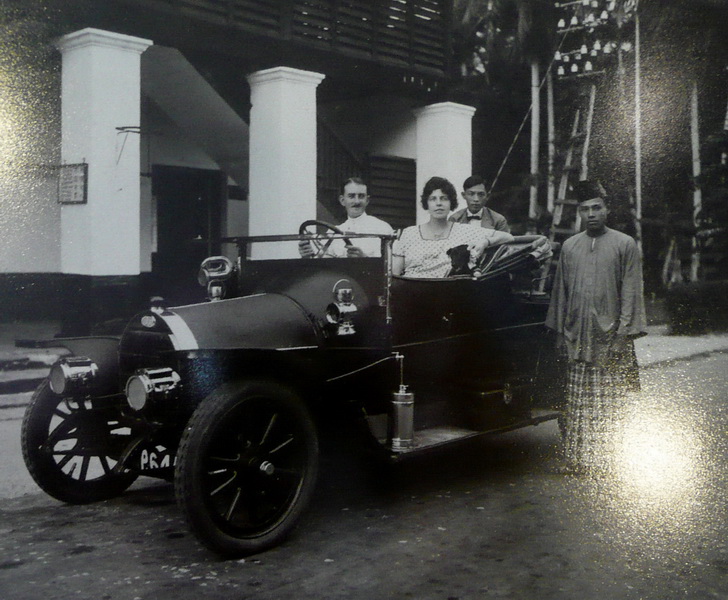
Finally, a photo which has materialised recently is certainly worth display.     Here is Singapore’s eighth car looking as  if it had just come off the ship from the Britton* motor factory in England.    Unusually for a British territory, Singapore used a dash or dot separator from inception to the mid-1930s; S-8 favours the dash.      The driver was known in those times, out east, as a syce – an archaic term for a horse-carriage driver/groom, which carried on into the age of the car.

*I can find no reference to the Britton marque after a quick search……..

S-8, among the very first automobiles to reach the Straits Settlement of Singapore, in 1911.    anon.

S-8, a Britton, among the very first automobiles to reach the Straits Settlement of Singapore, in 1911.     (No details seems to survive of this marque.)                   anon.

...and to conclude, another elegant car from another of the Straits Settlements, Penang no. 64n, the car of the Chief of Police there in the early 1900s.     June Bennett

…and to conclude, another elegant car from another of the Straits Settlements, Penang no. 64n, the car of the Chief of Police there in the early 1910s.     It may be a Stutz Bearcat.                       June Bennett

~~~~~~~~~~~~~~~~~~~~~~~~~~~~~~~~~~~~~~~~~~~~~~~~


Seychelles

April 10, 2013

SEYCHELLES


Never one to shirk La Dolce Vita,  my plate-researcher’s soul was ever  drawn to warm, safe places and I felt  it could be left to other, bolder members to deal with Chechnya, DRC, CAR, North Korea, Nigeria and New Guinea.   In modern times, Mr Ralidis appears as a heroic figure, who chances life and limb to snatch plates from the jaws of  cruel zones such as Iran and Pakistan.    A medal may one day be his.      The islands of the Indian Ocean always seemed to appeal on hedonistic  grounds, and save, now,  for the marauding bandit sea-pirates off the Somali coast, it remains one of the world’s fine zones.

British Airways catapulted me to Mahé Island, and to the capital village, Victoria in 1991.     For a tiny place,  it had a pleasing variation of plates, designed after the style of the British, who controlled the islands from 1903 until independence in 1976, when they fell under the stultifying spell of Russian communism.    From the first cars there, about 1937, straightforward white/silver on black plates with an S prefix followed by up to four serial numbers were, and remain, the normal private series (though now using five-digit serials).

Most plates were properly made, but here is a painted variant.    Brumby archive

Most plates were properly made, but here is a painted variant. Brumby archive

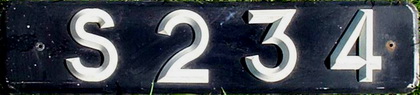
S 234 is a plate from the Mas collection

S 234 is a plate from the Mas collection

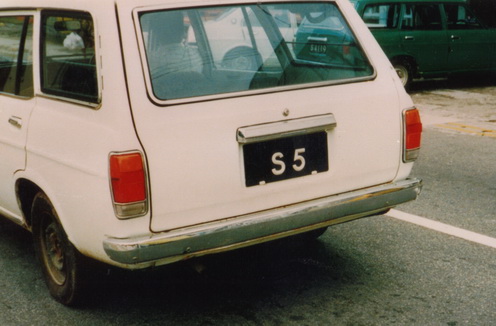
Seychelles permits retention of voided numbers and low numbers are always re-used.    Brumby archive

Seychelles permits retention of voided numbers and low numbers like S 5  are always re-used.    Motor cycles use normal car plates, but smaller.         Brumby archive

Musician/Beatle George Harrison had invested in a grand hotel project with Peter Sellers and others on Mahé – and in the British rowing town of  Henley-on-Thames, where he lived, near my home, I saw his gold Rolls-Royce Corniche  convertible on Seychellois plates AND sporting an SY oval – clearly a souvenir of the islands which he had had flown home!     Sadly no photo – he was driving the other way – and George was no slow driver!   Among his many quick cars was one of the first V12 6-litre F1 McLaren streetcars.

Taxis carried normal plates, supplemented by this specially-manufactured Hire Vehicle plate with its unique authorising number.     Brumby archive

Taxis carried normal plates, supplemented by this specially-manufactured Hire Vehicle plate with a unique authorising number.       Brumby archive

Seychelles Government employ a serial from the national series, on black, using a G prefix.    Brumby archive..

Seychelles Government plates employ a serial from the national series, on black, using a G prefix, removable when withdrawn from service..    Brumby archive..

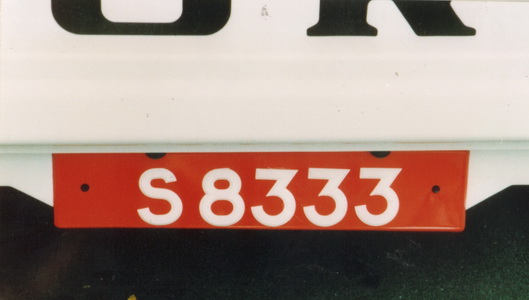
Government vehicles used the same series, but with a red background, repainted black when sold in to private use.    Brumby achive

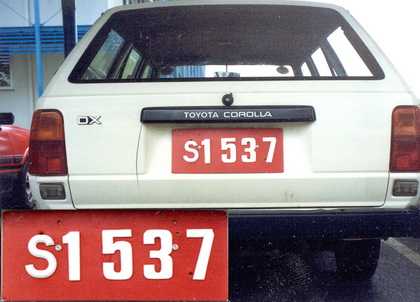
Parastatal (semi-government) vehicles used the same series, but with a red background, repainted black when sold in to private use. S 1537.  Brumby archive

(SY1)(para)_S 8333_VB1991_resize

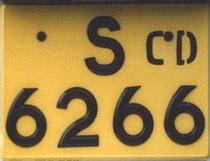
Diplomats plates were also taken from the main system, but yellow-backgrounded, and with CD or CD appended to the plate in a random way.    Brumby archive

Diplomats’ plates were also taken from the main series, but yellow-backgrounded, and with CD or CC appended to the plate in a random way.   S CD 6266.   Brumby archive

Uncoded CD 2046 CD

1991. Uncoded Seychelles Diplomatic Corps  S 2064 CD

the less-fequently-sen Consulat variant, CC S 1884.    Brumby archive

The less-frequently-seen Consular Corps variant,                 CC S 1884.       Brumby archive

the very rare sight of a UN variant UN S 6993 is characterised by a green background - a change from UN Blue!

The very rare sight of a CD  UN variant UN S 6993 is characterised by a green background – a change from UN blue!     Brumby archive.

A handful of motor dealers exist on Mahé island only and use test plates to legally move untaxed vehicles.    What a fine plate!      Brumby archive

A handful of motor dealers exist on Mahé island only and use red  Seychelles  Test plates to legally move untaxed vehicles.    What a fine plate!      Brumby archive

end…


A Private Collection

April 9, 2013

I have promised myself that, this summer of 2013, I will uncover my small plate collection from the depths of my garage and make sure that it is photographed for posterity.     I started collecting by accident in 1957  and continued in a casual way until the 1970s, when, with a few hundred, I had enough for a double-garage display to amuse and confound visitors.

Downsizing garages upon retirement, the collection was wrapped up and stored in suitcases.    Perhaps I though that when The Revolution came, I could make a quick dash for the airport and be gone with my half-ton of metal without coming to the attention of the rampaging proletariat.      As it happened, peace has reigned and the world at large has shown an indolent disinterest in my secret hoard, a few African items from which are below:

A Fiat 600 appeared in Kensington circa 1963, carrying Katanga plates and a properly-manufactured KAT oval.     It  re-registered before long, and the kindly owner gave me one plate, 650 C, which of course, I still have.

A Fiat 600 appeared in Kensington circa 1963, carrying Katanga plates and a properly-manufactured KAT oval.    It re-registered in GB  before long, and the kindly owner gave me one plate, 650 C, which of course, I still have.     Sadly I lost the photo of the whole car, which showed that unique KAT oval.     Brumby archive.

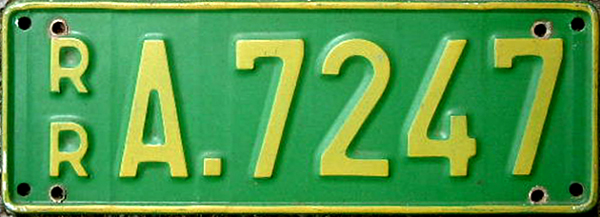
(RWA1)_A7247_cu_VBpl

Circa 1964, a green 380 Mercedes overtook me one evening on my way home from work, carrying this, the first and only Rwanda plate I ever saw in Europe.    A was the code for the capital, Kigali.   It also carried a RWA plastic adhesive international oval.   I followed it home and the charming Indian owner invited me in for tea and told me of its provenance.   He had been the importer in Kigali for The Distillers Company and for Imperial Tobacco. (Booze and Baccy!)   This made him an important, popular, and, I suppose, wealthy, man; his Mercedes was apparently the best car in the village.   The then-president of newly-independent Rwanda had only a black Peugeot 504 saloon, which he felt was not the best set of wheels for impressing the village girls, and so he would send his men round to our Indian friend late at night, to ‘borrow’ the Merc.      Import permits and favourable duty estimates for his expensive products were authorised in those times, and there was no reason to discourage the Top Lad enjoying a night out from time to time – though the Benz was never returned. The following morning, our owner would have to send his own staff round the village to find where rr A.7247  had been dumped at close of play – either at a bar or somewhere near Gubmint House….and  frequently damaged.    However, an empathetic accommodation had been established between all and sufficient funds for repair and replacement  seemed ever there..
He didn’t say what happened to disturb the equilibrium, but suddenly, there was our entrepreneur , living smartly in London and the former president was probably ‘helping police with their enquiries’.     Things can change quite quickly in Central Africa, and seldom for the better – but nothing which a thousand years cannot correct…..      Brumby archive

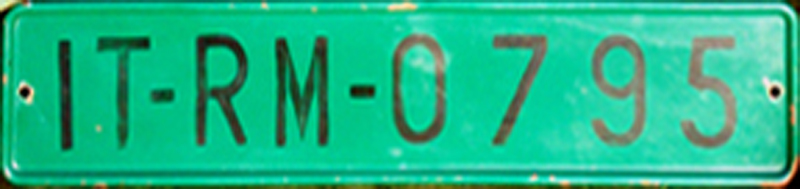
(RMM1)(ti)_ITRM0795_cu_VBpl

A visit to Mali in 1973 (don’t ask) involving another flight from Paris Le Bourget – a pretty basic aerodrome then – allowed a visit to Timbuctoo and to Bamako, where I found a dumped Citroen DS with this IT-RM-0795 rear plate still attached – but not for long. To my astonishment my Malian guide had it off in a split second, moments after I had shown a keen xeno-autonumerological interest in it, yet the subject was one of which he could have had only limited knowledge.
Originally I took it to be a Malian diplomatic, but the absence of CD on the plate shows that that it was a temporary duty-free importation as used by non-dip. embassy staff, technical aid personnel and N.G.O.’s. (which had not been so invented and named in 1973!     They were Aid Organisations.).  Even then the country was full of foreign aid people, with shiny new 4wd cars and special plates, while the indigenous Touareg went quietly about their never-changing lives, resistant to the cultural changes being proposed by countries which mistakenly felt sorry for them.   I was surprised to see an ageing Humber Super Snipe in Bamako, the capital, one day, and wondered how on earth such an inappropriate, luxury car could have made its way to a deep desert zone……  Perhaps an ex-CD car – or a stolen one from Cote d’Ivoire?  Brumby archive

CNV00019

A 1970s picture of some of the collection at the time. Gazing upon them now, I recognise that some have been lost in the intervening years.     I have never been careful with my things……Brumby archive

A Mk1 Ford Zephyr visited a pleasure park in our home town in 1960 carrying these colonial-era Belgian Congo plates.    The owner offered to snd the plates to Nip Thornley and the writer when he changed to new English plates imminently. - and so he did, bless him!    They were  simply stencilled on to mild steel sheet and for the first few years of ownership, we didn't take note that they were rusting away!    Eventually, to my horror, Nip took a paintbrush to his plate and refurbished it, with none of the skills of the Italian or Dutch Masters.

A Mk1 Ford Zephyr visited a pleasure park in our home town in 1960 carrying these colonial-era Belgian Congo plates. The owner offered to send the plates to Nip Thornley and the writer when he changed to new English plates imminently. – and so he did, bless him!    They were simply paint-stencilled on to mild steel sheet and for the first few years of ownership, we didn’t take note that they were rusting away! Eventually, to my horror, Nip took a paintbrush to his plate and refurbished it, with none of the skills of the Italian or Dutch Masters.

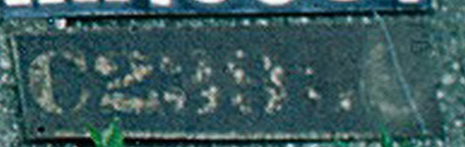
My plate was left in it's original state, but deteriorating steadily.   One day after about 40 years, I realised that there remained not one single speck of paint on my rusty tin sheet.    Now only I know that I once had a Belgian Congo plate!    This photo was taken after only 15 years, and one can almost see the registration C23938 (C was for Léopoldville, named for the eccentric King Léopold to whom the vast country had personally belonged.

My plate was left in it’s original state, but deteriorating steadily. One day after about 40 years, I realised that there remained not one single speck of paint on my rusty tin sheet.    So much for retaining originality!     Now only I know that I once had a Belgian Congo plate!   This photo was taken about 1970, and one can almost see the registration C 23938 (C was for Léopoldville, named for the eccentric King Léopold to whom the vast country had once personally belonged).   It is now Kinshasa and no-one knows to whom DRC belongs.     Brumby archive.

A Nigerian pre-1976 plate from Sapele, which look s as if it might have some history...     Brumby archive

A Nigerian pre-1976 plate from Sapele, which look s as if it might have some history… Brumby archive

More to be  added later………….