Former Spanish series re-introduced

November 26, 2013
CON. Spanish series from  "construcción" cars

CON. Spanish series from “construcción” vehicles

Carlos from Spain writes:

Sometime ago, I saw two licence plates with the E euroband on the left, which prefixed with CON, but I thought that they were from a private system.     But recently, on a public street of my city, I have seen three or four of them.    I had the good fortune to talk with one of the workers about this type of licence plate and he told me that this system consists of the three letters CON (which means “construcción“) followed by some numbers.   He told me too, that they were formerly used by public *companies on construction sites.    One of the photos, CON 1031 was seen inside one of these sites.    (*Formerly public/state companies, nowadays privatised(Ed?) companies).

CON 1031

CON 1031

This category of registration is sometimes described as ‘Plant/Machinery’ and is seen on cranes, road rollers, and other self-propelled machinery which can move between working locations using the public roads for short distances.

Interesting new find, Carlos!    And a warm welcome to the RPWO Blog!


Beetlefest

November 24, 2013

VWVWVWVW

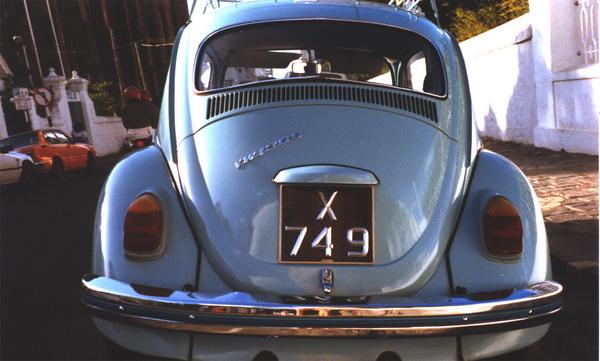
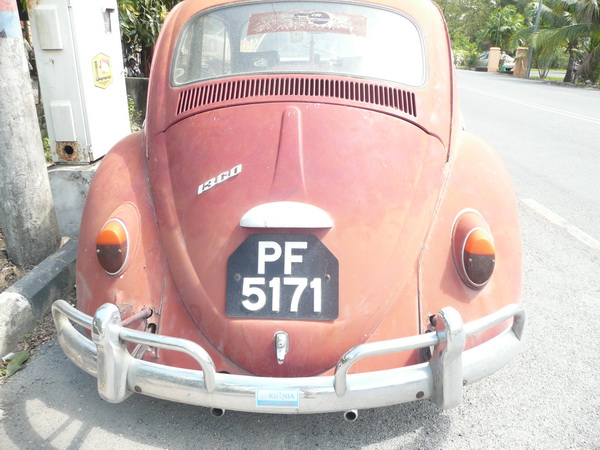
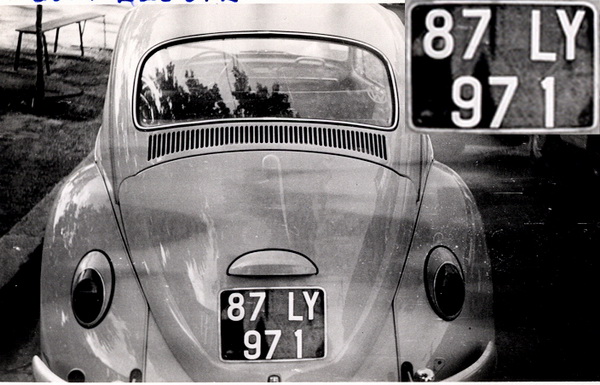
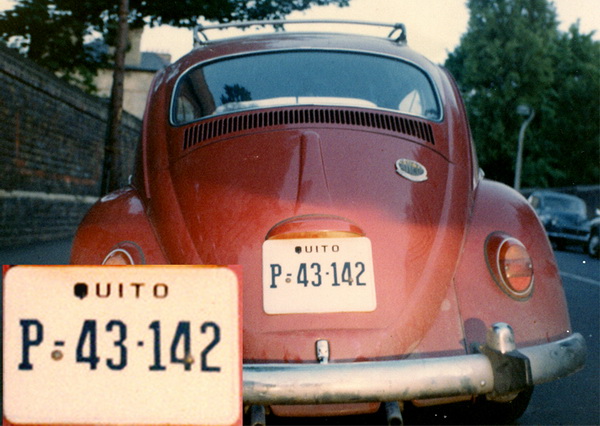
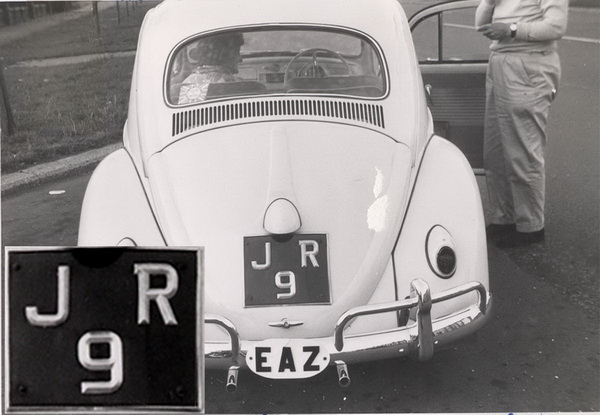
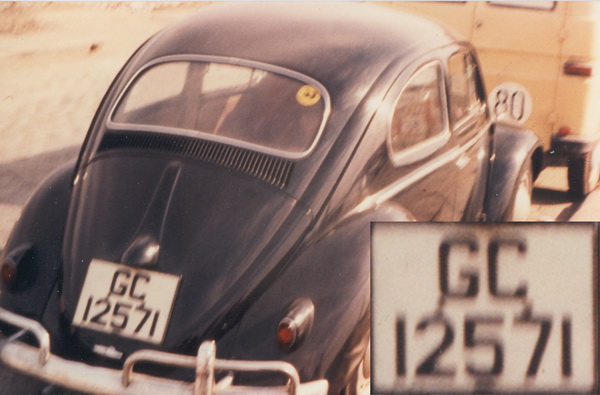
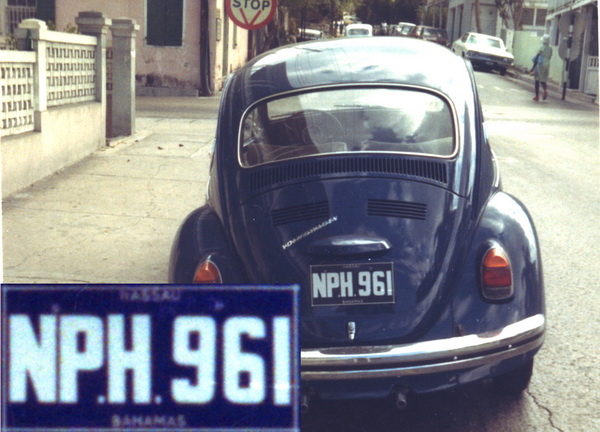
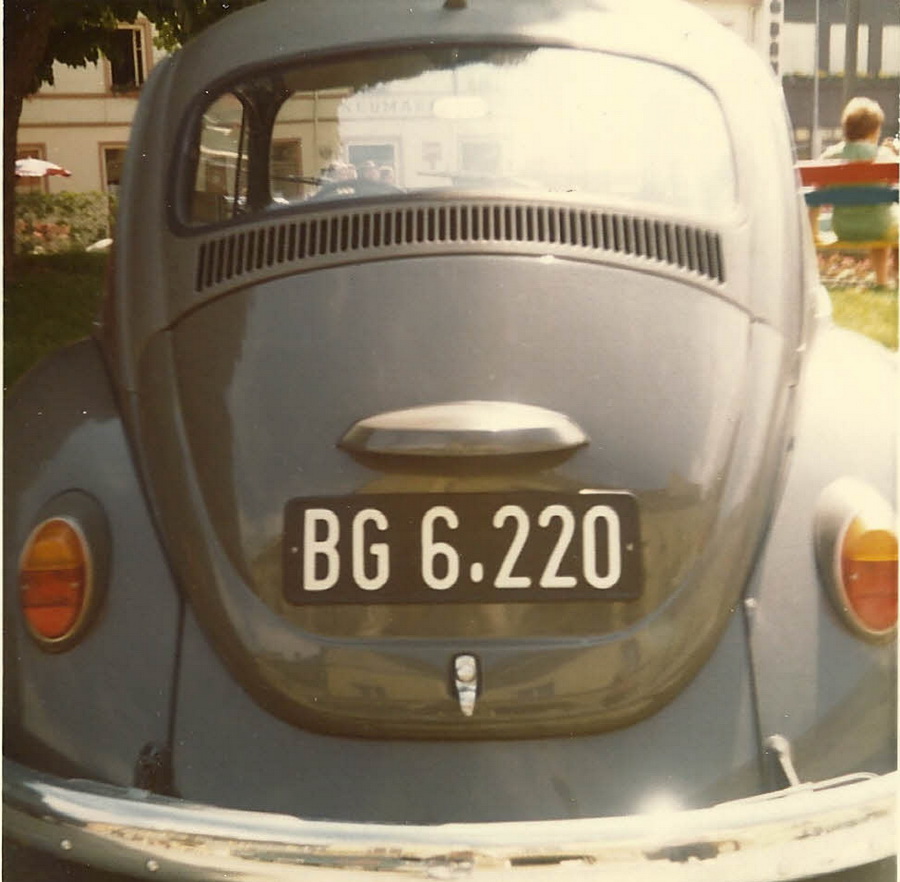
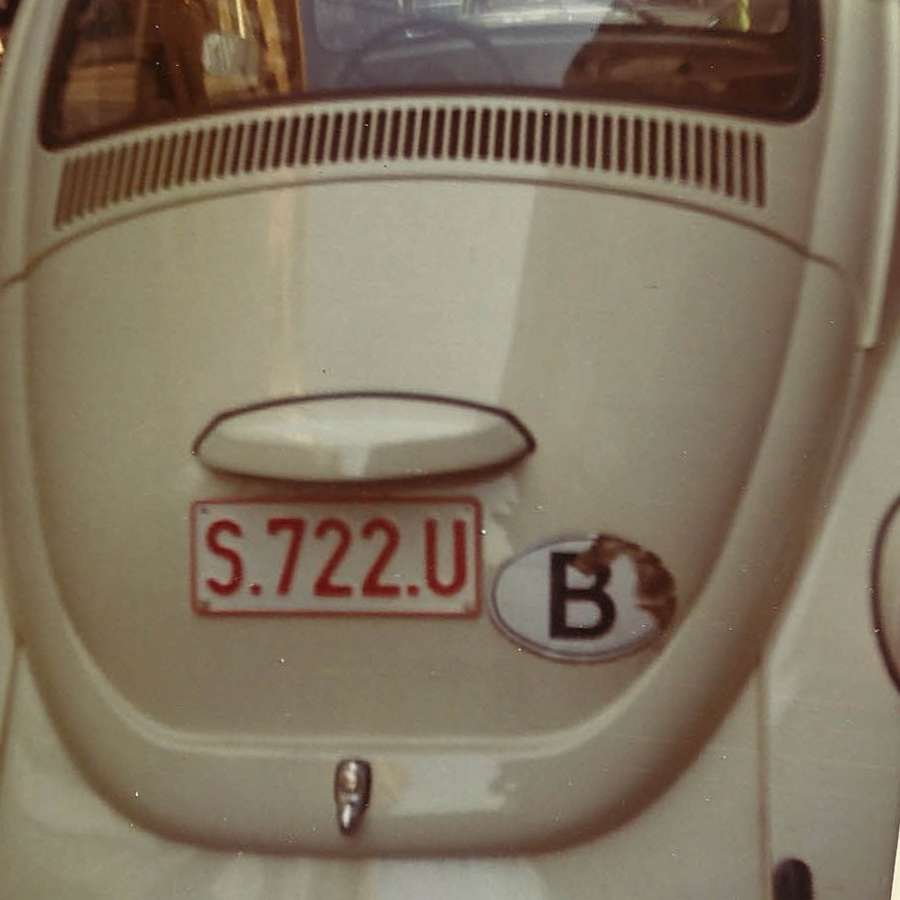
Was the VW Beetle the most ubiquitous World Car?      This brief selection appears to support the idea.     Have Bloggers any un-represented counties they could add?

It would be quite something to display one from each jurisdiction on the planet………………….

The shots below are from Victor Brumby’s archive, except where noted.

 Nov 25 2013 –  By request, some clues have now been added, to aid identification – without making it too easy, we hope!

10 Dec 2013 – A few new pics have been sent in and added, and the donors acknowledged.

Dec. 29 2013 –   9 new additions, not yet annotated, so send in your identifications via ‘COMMENTS’ below!      From Terry Gray’s archive.

26 March 2014Stephan Feuk adds his Beetle collection……

(E)MA-1925-norm-SH 565.v-BL

SH 565 ..      The amazingly rare 1925-75  Spanish Sahara.   (possibly taken when BL was plotting the route for the first Paris-Dakar rally??)                   (Bernt Larsen archive)

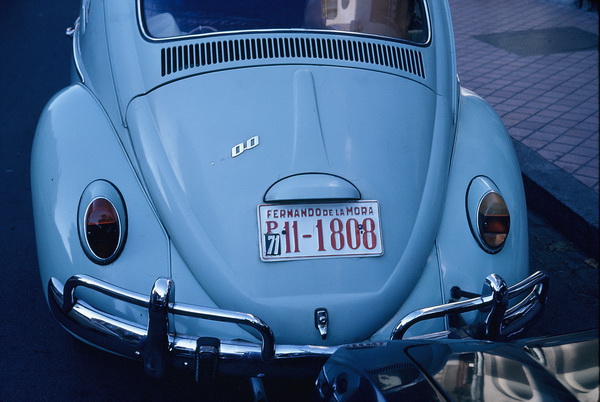
(PY)_P111808__resize

P11-1808 ..  These Paraguayan plates seen in 1971 London,  are still believed to exist with a collector somewhere – where?    Fernando de la Mora is a small city within metropolitan Asuncion, the capital.   (Brumby archive)

(GR)(tt60s)_3936_Pireas_photo_Stephan_Feuk_archive_Pieter_Lommerse_Nov_2005_full_picture_resize

ELEUTHERA CRISES / 3936 / EI-TELoneio PEIREIUS   =                                    (FREE USE/(tax-free use?) /3936/ CUSTOMS. PIRAEUS).                                     The date of issue is usually shown on these Greek customs-issued temporary plates, but not in this case.    The small one-piece rear window was fitted to VW Beetles produced between March 1953 and August 1957, so this was already an old Beetle  by the time early Europlate member Stephan Feuk  photographed 3936 at the Monte Antenne campsite in Rome in 1971 or 1972.


Paul Lommerse gives us this Roy Carson shot of yet another variant of the Greek customs-issue temporary plate from 1964

Pieter Lommerse gives us this Roy Carson shot of yet another variant of the old Greek customs-issue temporary plates, with 36 from 1964, reading ‘E.X.Thessaloniki’ Possibly issued to a U.S. Serviceman’s car after transfer from the US Zone of Germany (identified by the unique U.S. Forces in Germany oval) and now posted to the U.S. Forces base in Greece, where it would later be issued the dedicated USfGR special plates (illustrated elsewhere).


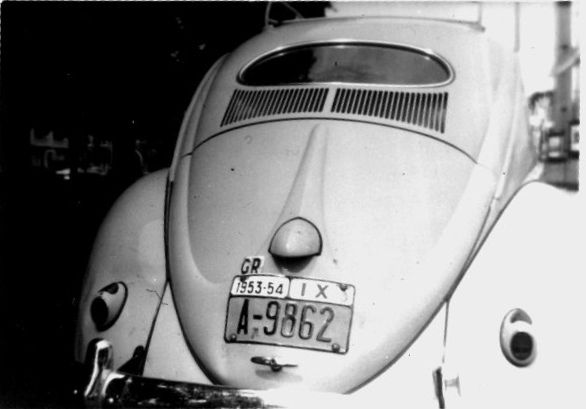
A-9862Another mighty rare on-car picture of the 1952-55 Greek plates, from Athens, from Paul  Lommerse.    These had yellow plates, akin to the American style/size.

A-9862  ..    Another mighty rare on-car picture of the 1954-56 Greek plates, this one from Athens (A), from Pieter Lommerse.       These had black on white and yellow plates, akin to the American style/size.        (Although they read 1953-54, they covered the years 1954 to 1956 – WHY, anyone?)

Comments from ‘BillyEurope’ on 15/6/2014 (below) add this important info:  

Yellow plates with 53-54 mark, were used from early 1954 to 1956 and not from 1952. Yellow plate “Π-250″ (below) stands for the city of Patras and not Piraeus. 

For more detail, we see Jim Fox' plate of the series.

P-250  —  For more detail of the Greek 1952-55 series shown above, we see Jim Fox’ s actual  PATRAS (not Piraeus!) 250 plate of the short-lived normal  series.


Greece, in common with a few other countries, marked the cars which belonged to foreigners coming to live in Greece for more than just a short holiday.     The Greek letter 'X' abbreviated 'Xenos' (alien/ foreigner/outsider/qafir) and the A was the regional identifier for Athens.   This black-on-white series was issued between 1963 and 69.    XA/5158, and no dating shown on this series.

XA / 5158  —  Greece, in common with a few other countries, marked the cars which belonged to foreigners coming to live in Greece for more than just a short holiday.      The Greek letter ‘X‘ abbreviated ‘Xenos’ (alien/ foreigner/outsider/qafir) and the XA series was used by personnel of Foreign Missions.  This black-on-white series was issued between 1963 and ’69.  ,        (no dating shown on this series)     Lommerse archive

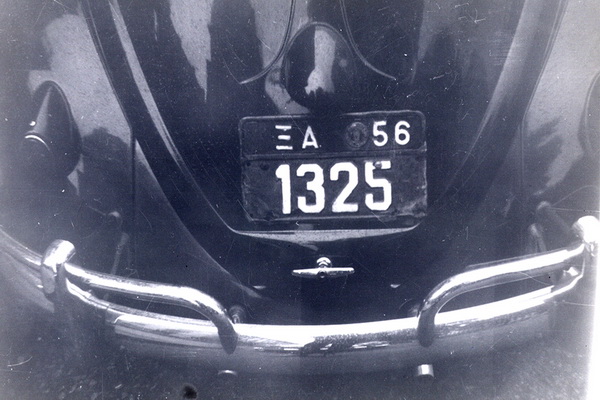
As for the “ΞΑ” (XA) plates, this stands for Foreign Mission (Ξένη Αποστολή)(Xenos ???) so the A letter is not about Athens, after all.


(GR3)(forres56-9)_XA1325_VB_resize

XA 1325 — Greece Foreign Missions (Ξένη Αποστολή) 1956>.     Brumby archive 


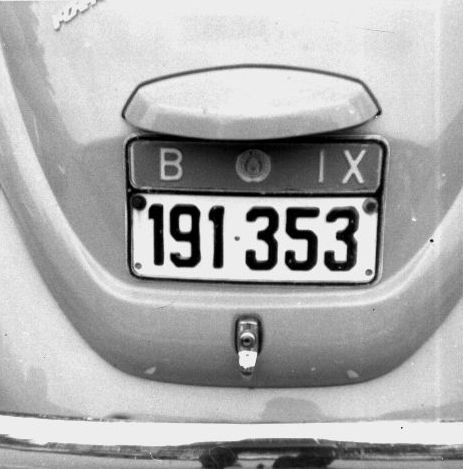
GR private 1963-72 Volos 191353 archive Roy Carson PL

1963-72 Greece normal. B=Volos. I X=IDIOTIKES ChRESIS=Private Use.              Pieter Lommerse archive


GR private 1956-59 Thessaloniki 156709 archive Roy Carson PL

Th 56 IC / 156-709  —  A 1956-59 Greek series for Private Use, reading Thessaloniki (19)56 IDIOTIKES ChRISES.    Lommerse archive


(SUD1)( )_2438Kh_cu_VB_resize

2438 KH, seen in Khartoum during the 1970s.    Brumby archive

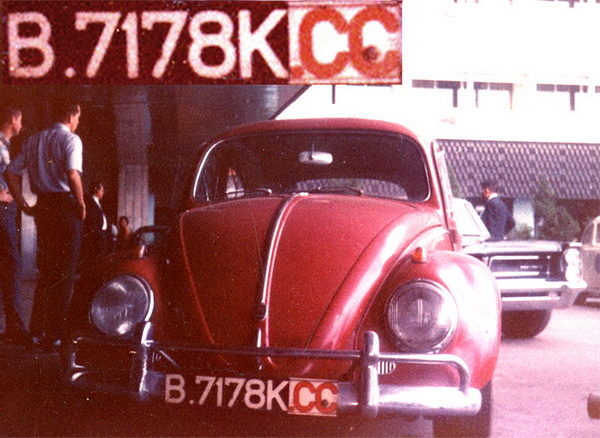
(RI)(cc)_B7178KCCcomp_resize

B.7178K  —  B=Batavia, seen in Jakarta during the 1980s.   A Normal registration with consular supplementary tag in red on white.    Brumby archive 

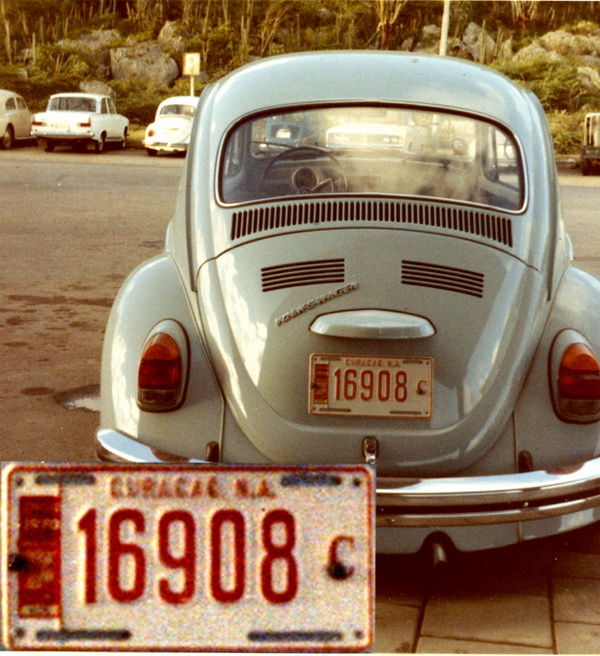
(NA)(CU70)_16908C_comp_VB_resize

Netherlands Antilles C 16908  —  Red on white = 1969-71.      Brumby archive

(IS)_JO215_comp_VB_resize

JO = American civilian staff of N.A.T.O. forces established at Keflavík air base between 1951-88.    The J and O are mis-spaced.   JO 215      Brumby archive

(IR)(oos)_11000comp_resize

11000 —   IRAN OOS – Out-Of-State.     A Foreign Travel plate mounted over an original, domestic plate, (which was in the Farsi form of arabic script  – thus not legal for international circulation).   All the various Iranian export/out-of-state travel issues have been in dark green on white since at least the 1940s.     Beetle in 1960s London.                Brumby archive

(I)(usf)_C14078comp_resize

C=Civilian attached to US Forces in Italy 1956-68.    Brumby archive

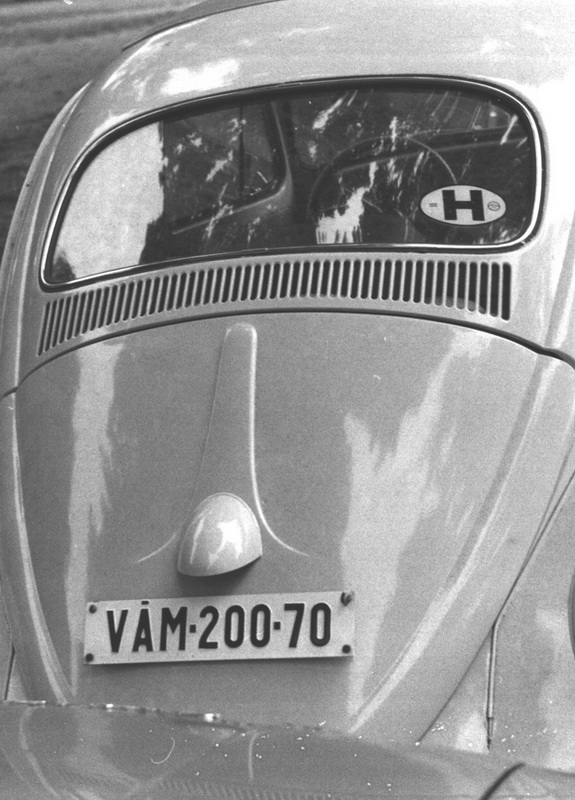
(H)(dlr70)_VAM20070_VBmb_resize

First thought to be a Hungarian temporary importation issue for 1970 (70). VAM in red.    Taken in Hungary on 1970.      (What does VAM abbreviate?)        Feb 2014: Dietrich replies: VAM is the name of the Hungarian Customs agency.       So – IS it a duty-free import?    A Customs-owned vehicle?    A cross-border plate?                            Brumby archive

(Mac2)(of)(Prov.Govnr)_GP_comp_VB1977_resize

GOBERNADOR PROVINCIA of Macao, seen there in 1977.    Brumby archive

(F)(ttfz)_3804TT0W_comp_resize

3804 TT 0W  —  Border Zone Franche between France and Switzerland.      Zero W is for Gex, one of two registration district of the ‘Zones Franche’.   (Where franche (like France) means free).                        Brumby archive

(F)(false)_724901_comp_VB_resize

Thierry de Francoplaque  recognises London-photographed 72 4901 as a French forces in Germany plate, though in a non-standard font and background colour (it should be blue).   The second numeral (2) registers this VW in Freiburg up to 1999.         Brumby archive, 1971

(E)(tt)_1M0081comp_resize

1-M-0081  —  From July 1963, a new Spanish duty-free series commenced and this seems to be Madrid’s 81st. issue, set to expire in month IV (April) 1964.

(EAK)_KFN146_comp_VB_resize

KFN 146  —  KFA-KFZ hailed from Nairobi from 1950 to the mid-70s, when regional identification second-letters (as ‘F’ here) were dropped.    This Dung-Beetle is pictured in London about 1959, shot by Vic Brumby

(EAU2)_UFJ760_comp_VB_resize

From 1952-99, F was the code for Kampala.     The small rear window dates this early insect to 1953-57.   UFJ 760 was noted by member  John Pemberton on 30th. July 1965 and photographed separately by Vic Brumby in London in September that year, 52 years before the  two members first met.

(D)(USfg)_T4710_comp_VB_resize

Two Americans in Paris when it was safe to show their country of origin.     The red on white USfD 1962-1966 series, in which T 4001-5900 was for Banberg and D 2801-7300 was allocated to Hanau.       Brumby archive

(D)(tt)_818Z9349_VB_resize

818 Z-9349  –  New cars bought in Europe for export often displayed the international oval of the country to which they were eventually bound.     Hamburg-Ericus issued German Customs codes 418, 518, 818 and 918 from 1951 until 1967.      This unusual oval plate series continued until 1988.     Brumby archive

(D)(GBfD2)_9132BZ_comp_VB_resize

1949-51 saw the third format of plates for the British zone of Germany, nnnn BZ.    Unusually, this example 9132 BZ  has GB-manufactured plates rather than the characteristic German fonts of the British, Dutch and Belgian Zones (and other military entities) for the ensuing many years.   Brumby archive


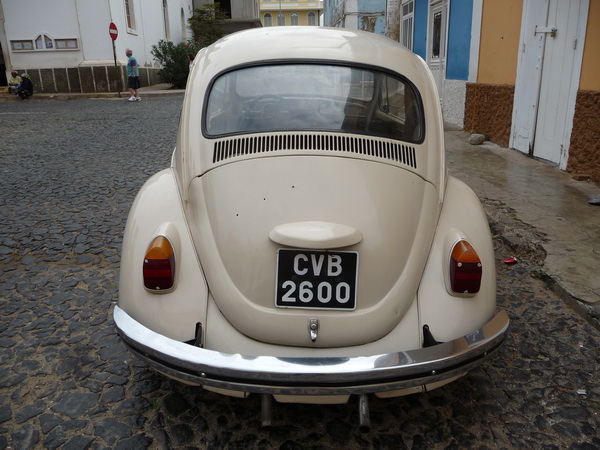
(CVI1)_CVB2600_VB201201_resize

CVB 2600  —  B = Ilhas Barlavento (Windward Islands) of Cape Verde.       This series is now obsolete, but was still in use in Mindelo on Sao Vicente in 2011.

(CL3)(58-9)_2 1176_r_VB2008_resize

2 1176  —  The SRI symbol was added to plates in Sri Lanka in December 1956.        It comes from the Sanskrit for  ‘holy/resplendent/prosperous/jolly good’.      Which Ceylon probably was, in 1956.   (Lanka is a transliteration of the Sanskrit for Island.)      Code 2 was issued for cars and m/cs in 1958 as an early example of the new series which ran from 1956-99.    (Brumby archive 2008)

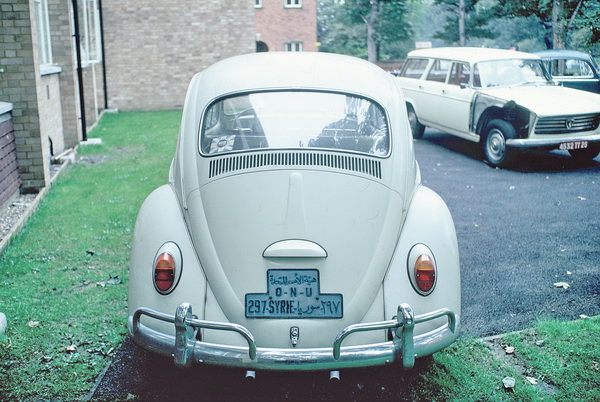
(SYR 60s)(un2)_ONU 297_VB1968_resize

In the 1960s, the U.N. went to various places round the world, to bring light where there was darkness.     Where would we be today, if they had not brought civilisation to such places?     Note the Visitor To Britain window-sticker, then very common on visiting vehicles, perhaps in the futile hope of keeping the newly-introduced parking wardens etc. away from our visitors.    O.N.U.297  —  The whole plate is written/abbreviated in French, although issued by the UN.     Wonderful, T-shaped plates….       We don’t know the duration of this series.           (PAK)(cd)_CD2230.VB_resize

CD-22-30  —  Although this Beetle’s oval claims German provenance, its plates are seen in 1966 outside the newly-built Pan-Am office in Islamabad (Peacetown). (Who said they don’t have a sense of humour?)      22 IS indeed  for the German legation.       The Pan-Am shop is now a kebab stall with a plan to rebuild the roof when the Taliban allow.     Brumby archive

(AAL4)_AL6304_comp_VB_resize

This owner has fought to overcome his identity crisis with a few clues …

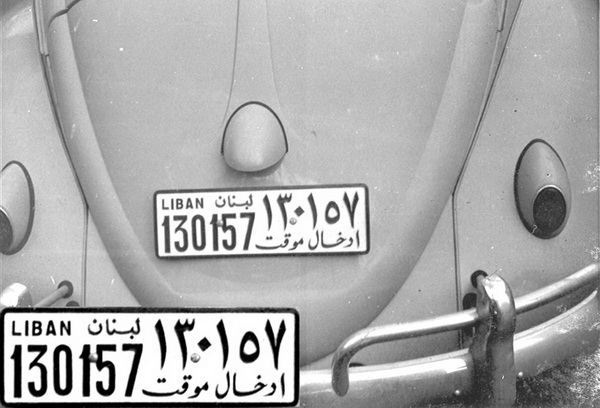
(RL)(exp)_103157comp_resize

130157 — An export/temporary import series issued for a spell in the 1960s, then dropped.     They all began with 130.     London 1966, V Brumby

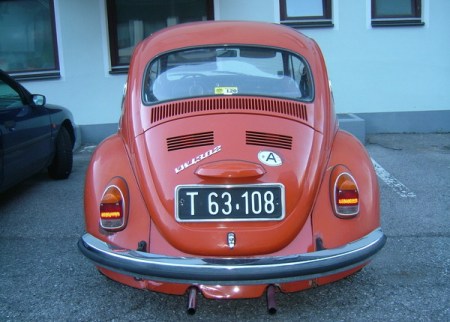
(A1)_T63108_VB_resize

T 63.108 — An Austrian 1947-90 series plate on a Tirol Beetle, seen there in recent years.      Area code 63 is not given in the Tirol list – so where is this VW from??                        Brumby archive.          Apr.2014 – Platepeter writes;  Numbers T 63.000 – 63.999 were formerly for the district of Imst in Tirol.     From 1990 the new code is ´IM´.          Thank you Plate Peter.

(ZA2)(GP1)_MJH880GP_VB_resize

MJH 880 GP — Gauteng Province (formerly Transvaal) seen in Johannesburg.

(ZA)-Limpopo_Prov_resize

BGJ 228 N  —  South Africa’s new Northern Province used these interim yellow plates from 1995-97, then white to 2003, while awaiting the colourful new background series now in use.     During this time, the province re-named itself Limpopo and the suffix letter ‘N’ on the plates changed to ‘L’.             Brumby Cape Town 1997

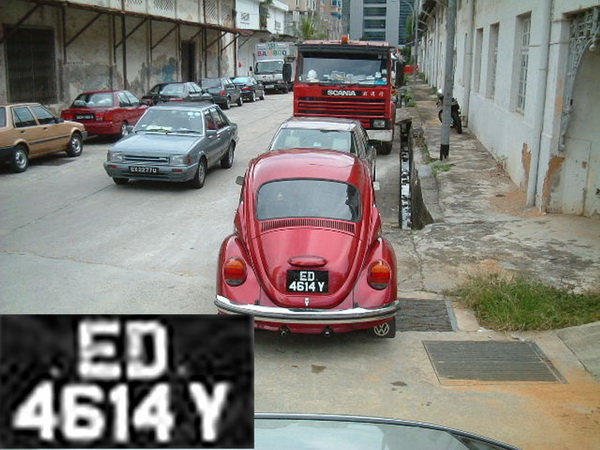
(SGP)_ED4614Y_comp_resize

Singapore replaced its long-standing S* 1234 plates with this format in 1972.   (It started with EA – why not AA??)       ED was reached by March 1974; this VW was seen in SGP during 2001.                Brumby archive

(ZA)(Mp) VB20131025 0038_resize

If you can pronounce Mpumalanga, you can pass as a real African in theatrical auditions. ZA 2013.

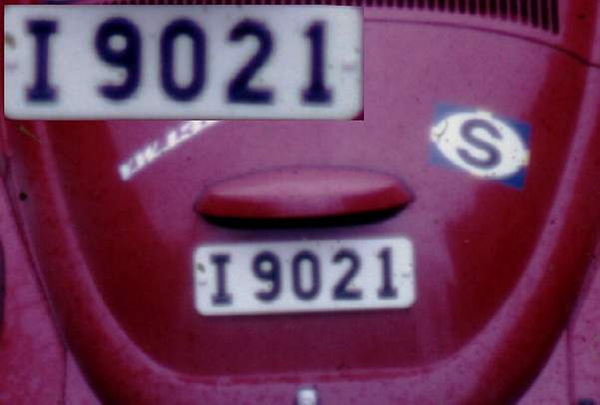
(S)_I9021_comp_VB_resize (RA)_135919_comp_VB_resize (PR)_958164comp_resize

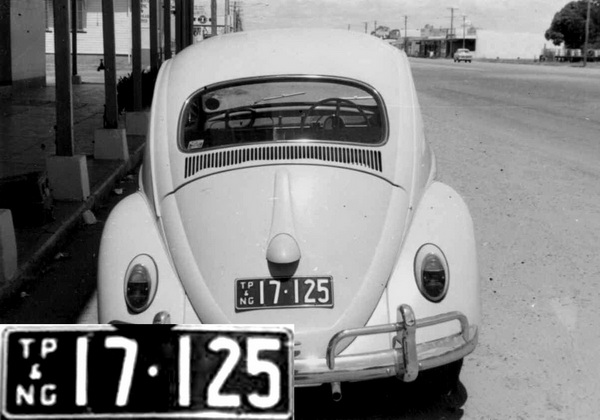
(PNG)_17125_comp_VB_resize

The Dream Hitch-hike. On a remote track in 1966 Queensland, the only vehicle to come by in 2 hours, was this Beetle, on which I made my country-catch of Papua-New Guinea!    The sea-captain driver took me a long way south, regaling me with tales of his Papuan houseboy, who kept chickens in the ice-box. TP & NG 17-125 from the 1951-73 series.

(PI)(cd77)_BG479_VB_resize

E indicates Exempt from Philippine Tax/Import Duty, for an Italian diplomat in 1977 Manila. 8G 479 — Green on white.

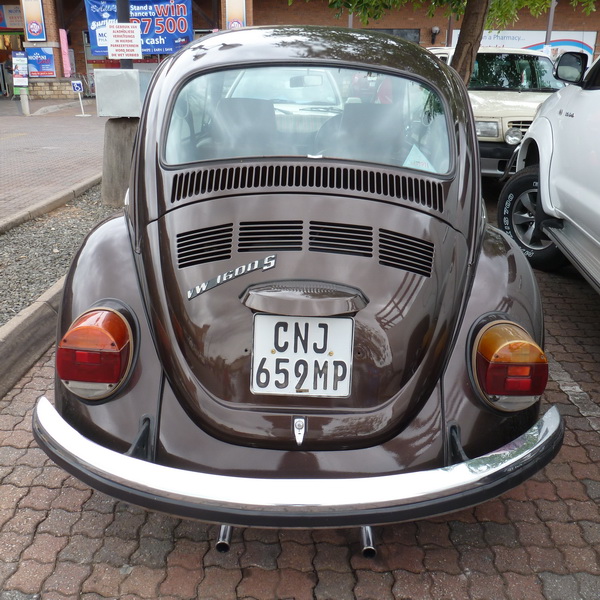
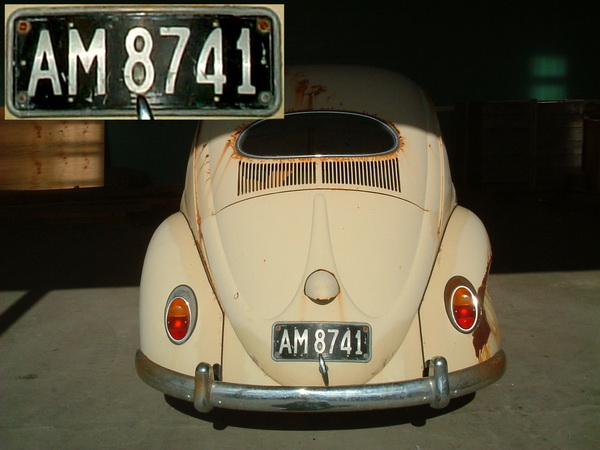
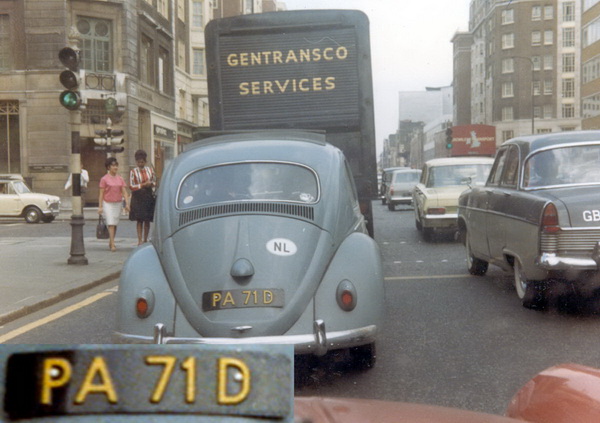
(P3)(37-92)_LC5589_VB2010_resize (NZ)_AM8741_comp_VB_resize (NL)(gfi)_PA71Dcomp_resize (MS3)_X749_VB_resize (MAL1a)_PF5171_VB_resize (MAL1a)_KB6656_VB_resize (MAL) 100314 Penang Beetle_resize

(M2)_26932_comp_resize

1916-79 could be one of the world’s longest-running plate series for private vehicles.     Malta used this simple format throughout, including 15 years after 1964 independence fro GB.       From 1924-66 Malta used GBY as the international oval, and in 1967 changed to ‘M‘.       This London shot of 26932 is from 1960.

(I)_TR27494_comp_resize (H)_CE8466_VB_resize (FL1)(0tax)_FL9043Z_VB_resize (F)(SB)_971SB806_VB_resize (F)(GUA3)_87LY971_cu_VB_resize (EC)_P43142comp_resize (EAZ)_JR9comp_resize (E)(GC)_GC12571_resize (D)(CDNfD)_BV88_comp_VB_resize (BS)_NPH961_comp_VB_resize (AUS)(ACT)_YBM73R_comp_VB_resize

(AND)(tt)_MT892_comp_VB_resize

MT-892Temporary Matriculation (one-year-valid, duty-free-use plate, for a foreigner in Andorra), from the 1958-63 export series.    London 1964.    The 64 gives the date of expiry, so the plate would have been issued in 1963, and be among the last of this type.

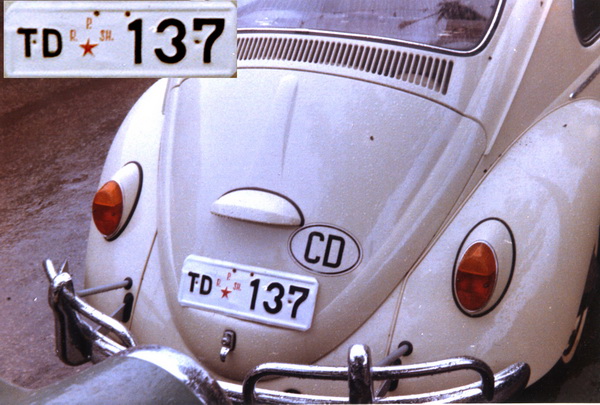
(AL1)(cd)_TD*137_comp_ITvb_resize

TD R.P.SH. 137  —  TD=Tirana Diplomat , Popular Republic of SHQIPËRIA – in London,1965.  (What a diplomatic posting!!)


(AFG2)(txi)_T4047_VB_resize

T 4047 – KBL taxi-hire in Afghanistan 1965.

An RSM new entrant kindly sent in by AISTA member MT

(RSM 63-76)_RSM 4350_MT2

RSM 4350 — 1963-76 San Marino series from…… Marcello Taverna archive

Below:  Here are a few more culled from the Terry Gray collection.   Can you identify them all?

(D)(mil)_98839_wee.TG (TR)(USfinTR)_A.0291_TG (SF 62-72)_KTL-47_TG (S)_BA 90025_TG (LAR 69-)_14913_TG (OM3)(70s-86)_12814_TG

(P -76)(Timor)_TP-14-60_TG

Here is one of the rarest-ever plates – on a Beetle from Portuguese Timor. Captured in Portugal by Terry Gray at night during the 1960s.

(PL 56-76)(cd-AFG)(cd-AFG)_WZ-17-31_TGvb

Poland issued a ‘Z’ for many years, to show that the vehicles belonged to a foreigner in Poland. Foreign diplomats were included in the code, but their registration was painted in lemon yellow, rather than the normal white (on black). Here is WZ-17-31 shot by Terry Gray in the 1970s, place unknown. 17 was for the Afghan embassy in Warsaw. Thought to be from the 1964-76 series

(CH)(exp75)_ZH-29008_2TG1975

Now – send YOUR Beetle photos in to this growing collection – we want a Beetle  picture from every country!

March 2014 – Stephan Feuk contributes a new selection below;   

(A 47-89)_W 621.675_SF (A)(of 67~)(pol)_BP 60.046_SF (A)(of 67-05)(gend)_BG 6.220_SF (B 58-75)(cd)_CD.90.S_SF (B 71-73)_S.772.U_SF

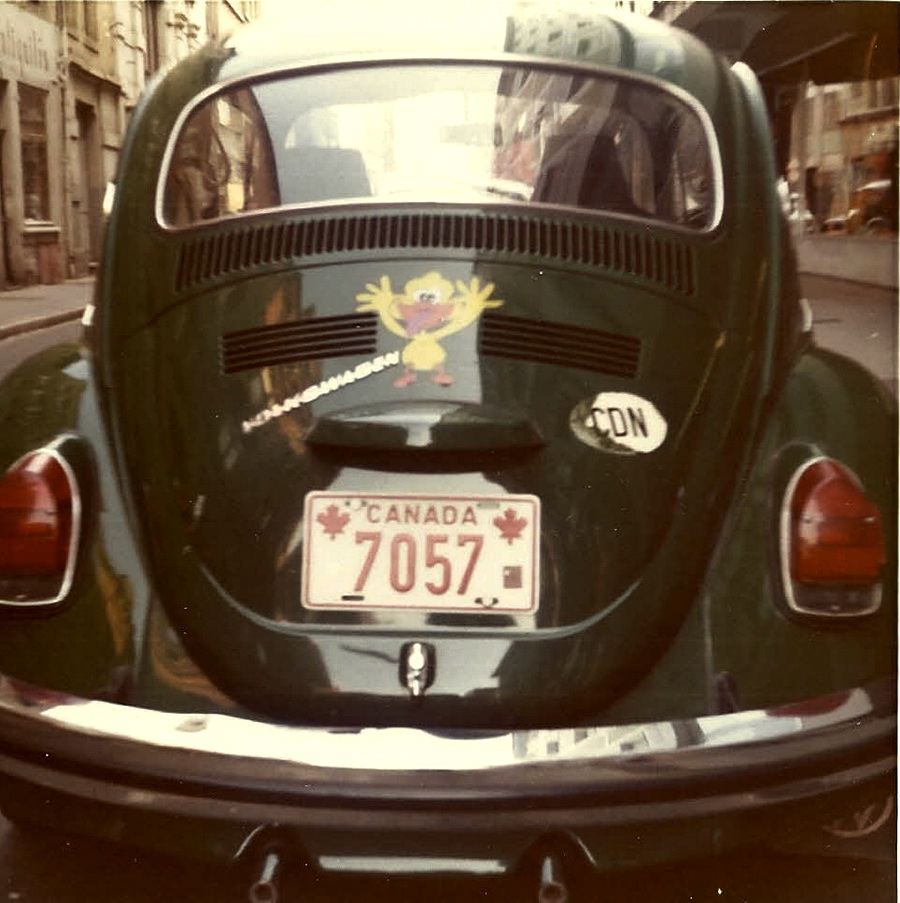
(CDN)(CfEu)_7057_SF

? Can you identify the series dates etc. of this CDN forces in Europe plate?? (Having no letters)  Apr.14 – Mike Montgomery fills us in:    5245 is the first of the 1970 series, which initially has all-numeric serials.   Subsequently issues had a single letter followed by numbers. The general design is still in used today; the maple leaves have been dropped, and there is an expiration sticker in the middle of the serial, which consists of two letters and two numbers. This plate is still in use today in Ramstein Airbase and Geilenkirchen Airbase, both in Germany. It was also in use in Heidelberg (Joint Command Center – NATO HQ, Campbell Barracks) until last summer, when the NATO HQ deactivated


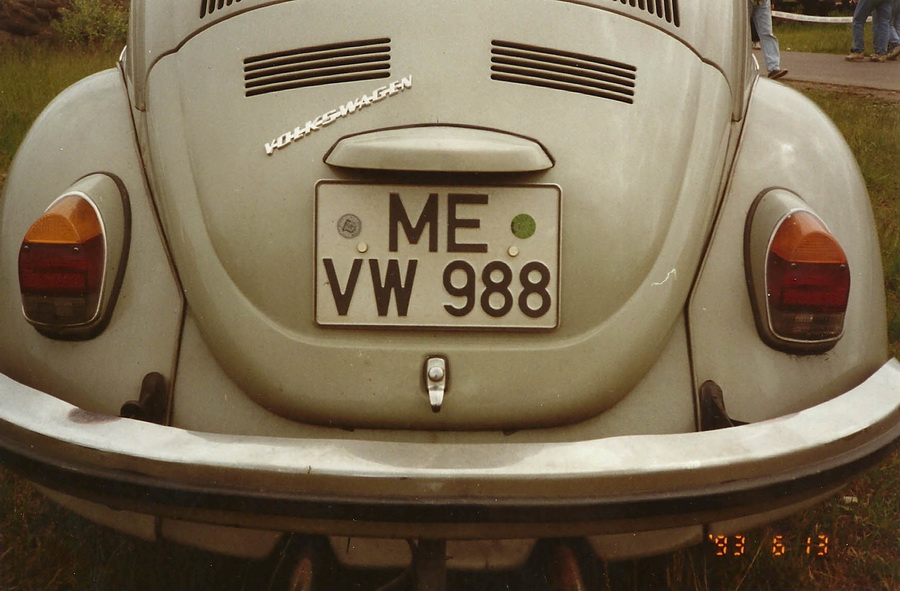
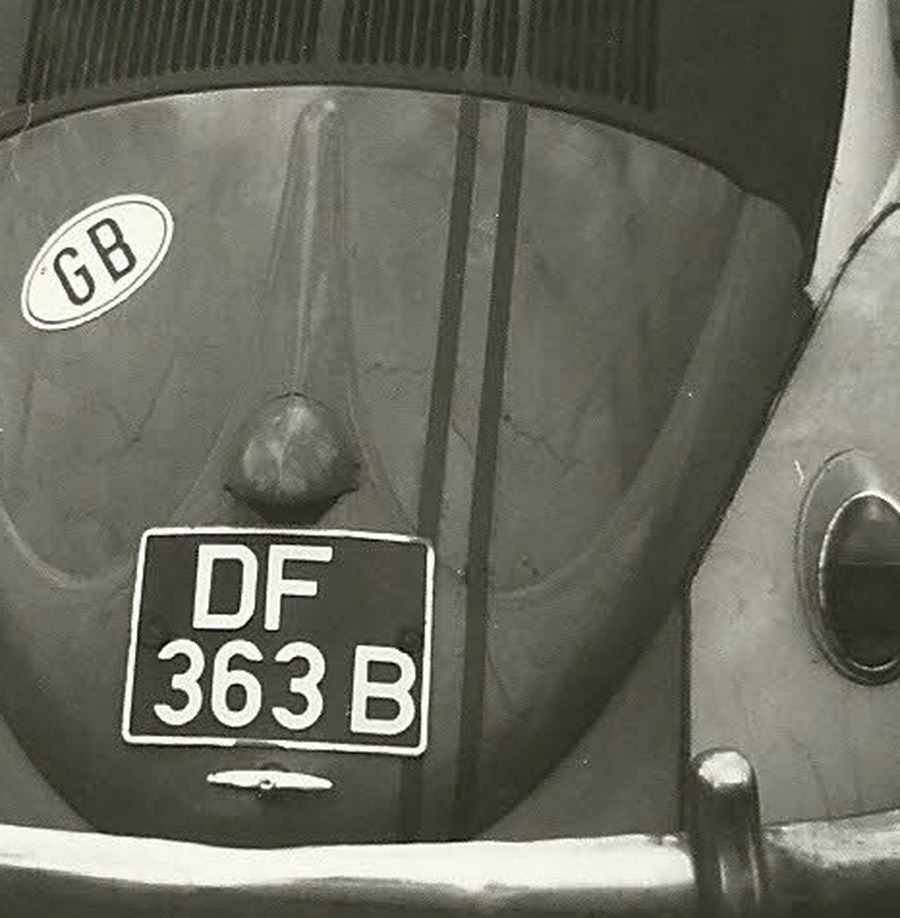
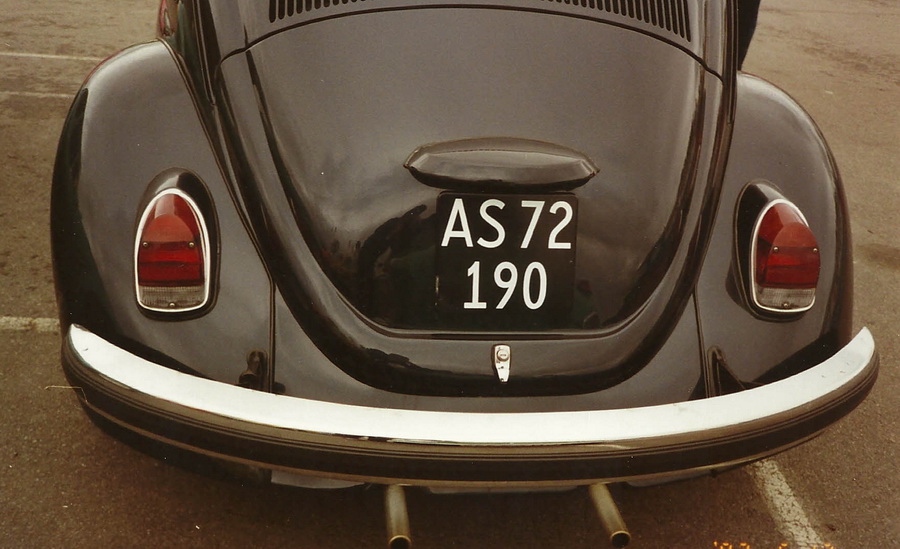
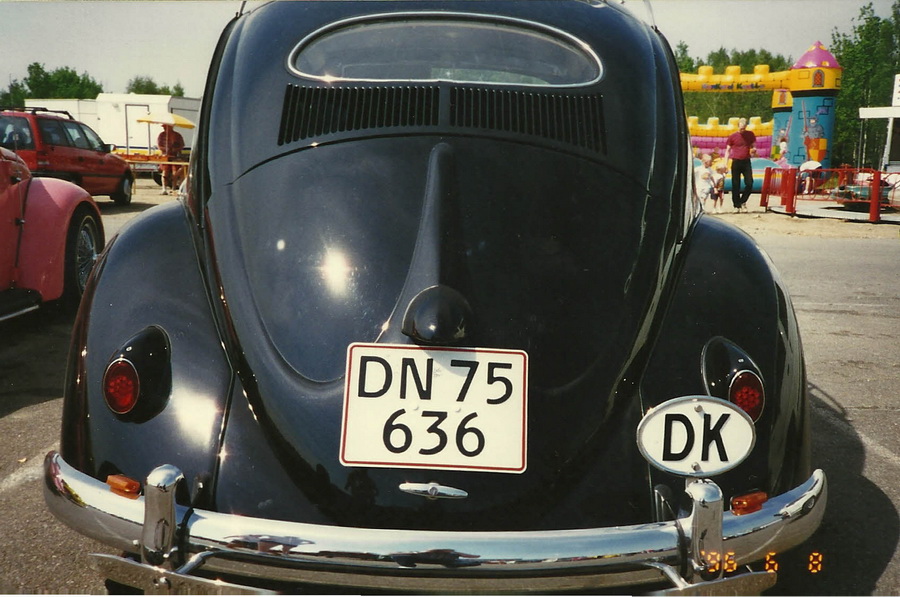
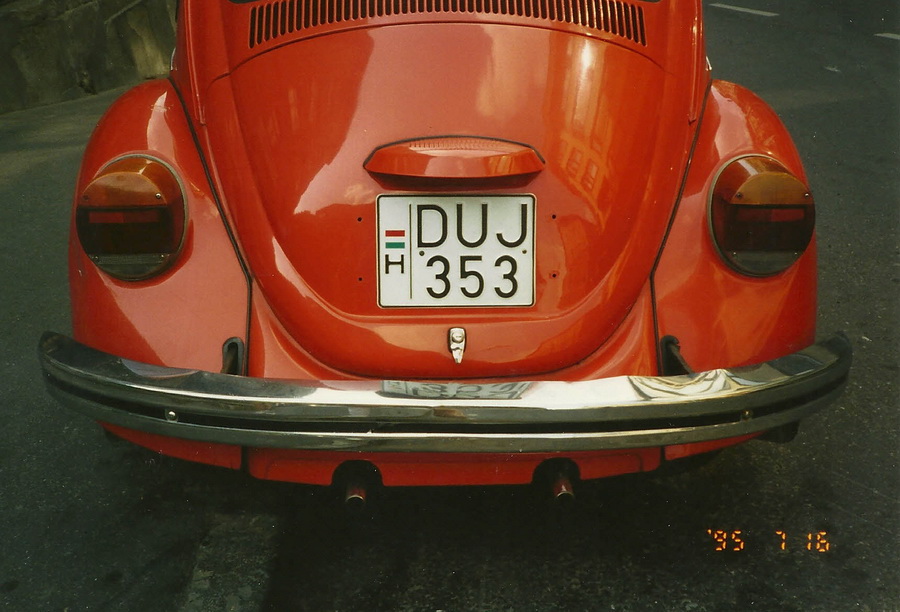
(CH 32-73)_ZH 73021_SF1974 (CH 73~)_ZH 178 177_SF1973 (D 56-95)_ME VW-866_SF1993 (D)(GBfD 63-81)_DF 363 B_SF (D)(GBfD 82-8)_ADN 93 B_SF (DK 19-58)_#U 812_SF2003 (DK 50-58)_E 8851_SF (DK 50-58)_T 6277_SF2003 (DK 58-66)_AS 72 190_SF (DK 58-66)_T 12.344_SF2003 (DK 58-66)_XA 26 663_SF1993 (DK 76-09)_DN 75 636_SF1996 (GR 60s-70s)(timp)_3936_SF1971 (GR 60s-70s)(timp)_4193_SF (H 90-04)_DUJ 353_SF1995

There are some more to come from Stephan, when time allows……

Come on, photographers – DO send in your Beetle pictures, for all to enjoy!!


African Oddities

November 22, 2013

African checkout

A recent run round southern, central and northern Africa unearthed a few unexpected plate sightings, which Bloggers may like to share.     A car-park in Nelspruit, Mpumalanga (formerly Northern Transvaal) presented the remarkable photo opportunity to compare the latest Mozambique plate with the current MP local plate.     The background colours of the MOC Maputo Province help to identify them from the mainly black on white South African MP series – but remembering that the two places share a national border, it does seem odd that such similar formats were adopted.

Mpumulanga at left and Mozambique (Maputo Province to the right.

MP and MP  –  Mpumulanga at left and Mozambique (Maputo Province) to the right.

*********************************************************

The ZANZIBAR Post from this trip  is already up on the Blog and the ETHIOPIAN page will come shortly.

*********************************************************

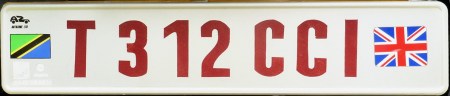
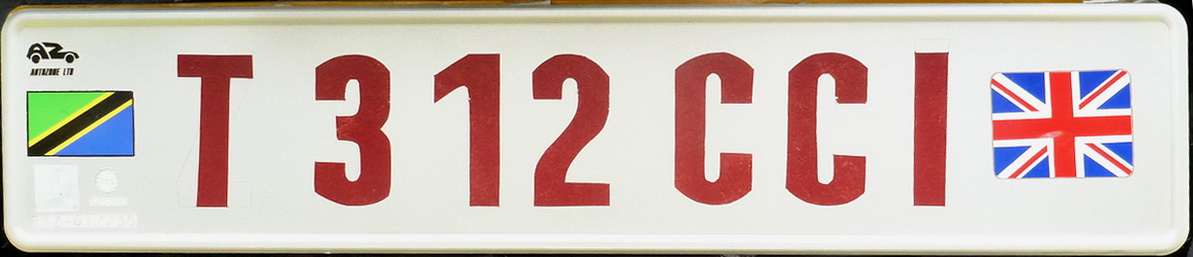
BELOW:  Non. 2013.    Just leaving Zanzibar for Ethiopia, I glimpsed a new Range Rover parked off-road  in a secure compound, carrying a quite new plate type,     T 312 CCI  .    Unusually, the guards on the gate  didn’t display the usual paranoia and let me slip in to get a shot.    Later, The Venerable Neil found a Google reference to CCI  under  http://www.homeless-international.org, which seems to pin this hundred-thousand-dollar car to a homeless persons’ charity in Tanzania.     Nice design, anyway.

T 312 CCI  -  Identified by Neil Parker and Google, as an NGO in Tanganyika.

T 312 CCI – Identified by Neil Parker and Google, as an NGO in Tanganyika.

ETHIOPIA

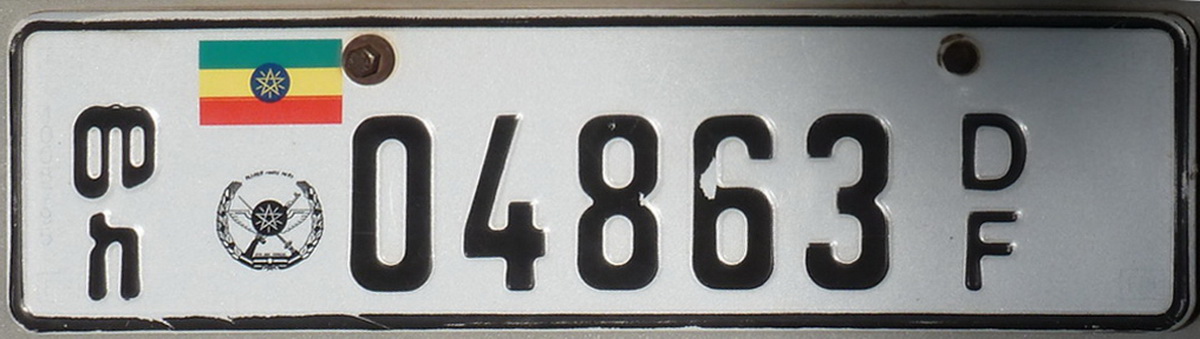
One of the first oddities seen in Addis Ababa – and not surrounded by spooks – was this military vehicle with a good condition plate.

Ethiopian Defence Force 2013

Ethiopian Defence Force 2013

At the former palace of Emperor Haile Selassie, now the University Ethnological museum in Addis, was a photo of his 1940s Ford V-8 convertible, on Harar plates.    A rotten shot of an old photo, but a rare image of an Abyssinian plate of the period – and from a jurisdiction other than  the capital.

HA 14ll - The characteristic font of early Ethiopian plates.....

HA 1411 – The characteristic font of early Ethiopian plates…..

(ETH 36-41)_HA 1411_cu_VBmuseum2013

BELOW:    This was a costly shot.     A plate seen up a side-street,  from the corner of my eye, through the vibrating window of my 17th.-century LADA taxi,  I commanded my driver to stop for a photo-opportunity, believing it to be a Saudi plate in Addis Ababa.    Up-close, the delight at identifying my first current-system Sudani was unbounded!

However, a bod in a dish-dash thought there might be a security issue with a western pensioner flashing his camera at a parked car, and with many a warning in Amharic (which is not a strong card in my pack of languages) and much waving of his night-stick, he did all he could to obstruct my photo-capture.       Within a few minutes, the local police force was upon me, sporting their side arms and arresting both myself and my poor cab-driver, who had come over to try to spring me.

Frog-marched a kilometre or so across some open waste ground  we reached the police station, a few ramshackle tents with an open fire for the ubiquitous Ethiopian coffee pot.   Officers of ever-increasing rank were brought to judge me and my ridiculous story and none were convinced of the innocence of our noble pursuit, although they couldn’t quite see what we might be up to.   Eventually, in a fit of diplomatic legerdemain, I presented them with an opportunity to release us without loss of face – or  paying the usual dash which overcomes all in most places.    I can’t remember how.

Here, then, for your amusement, is the result of that hour’s investment in time and fear.    (Noting that the ‘4’ is the 100,000’s prefix to the serial no. 22477, making this Khartoum car 422477, isn’t it unbelievable that this poorest of all countries should have registered so many cars in the four years this series has been extant?  Over a hundred-thousand a year!!!!)

(SUD 2009~)_4 KH 22477_cu_VB2013

*********************************************************

Meanwhile, other snippets from recent times and varied sources:

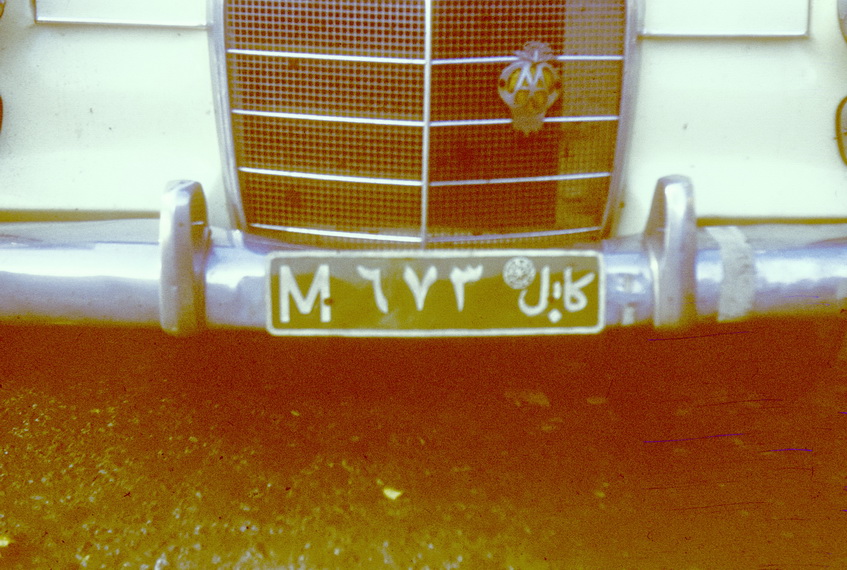
(AFG 74-04)(ndes)_M 673_f_weeTG

Mowqati’ 673KBL  –  (temporary/foreigner) in Afghanistan between 1974 and 2004.   Among the users of this plate type, were non-diplomatic embassy staff.       Note this Merc 180, seen in UK, sports an overseas AA badge, once a frequent sighting on used imports to GB.        Terry Gray archive.

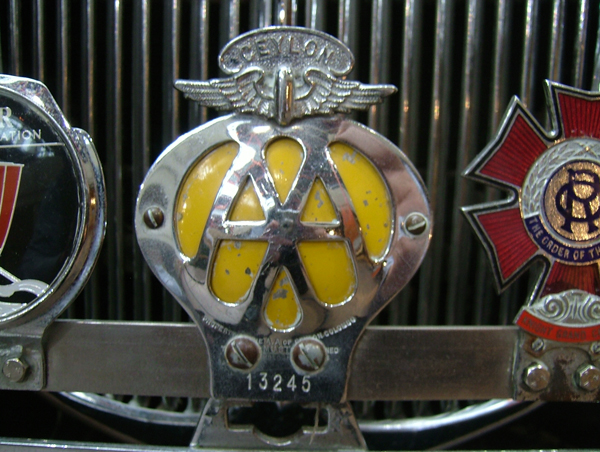
Here is a typical overseas British Automobile Association radiator badge of the type created for all or most of the Commonwealth countries.

Here is a typical overseas British Automobile Association radiator badge of the type created for all or most of the Commonwealth countries.   These make a good collector’s subject.     Brumby archive

(B)(cd)_CD AD715_weeVB2013

The new dip. through the windscreen in Belgium during September 2013.      Brumby archive

(IND5)_TN22CY 0648_c_VBmo2013

Mike Oldham saw this Tamil Nadu in Cyprus during October 2013!!!

Someone important in Malaya.

United Nations in Afghanistan, but identical to other theatres of operation, too.

UN 00438  –  United Nations in Afghanistan, but identical to other theatres of UN operation, too……..     Brumby archive

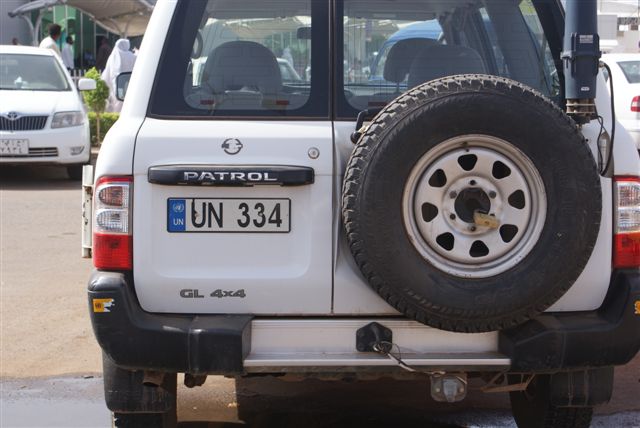
here's a pretty similar UN in Sudan...

UN 334  –  ……..here’s a pretty similar UN in Sudan…

Historic corner

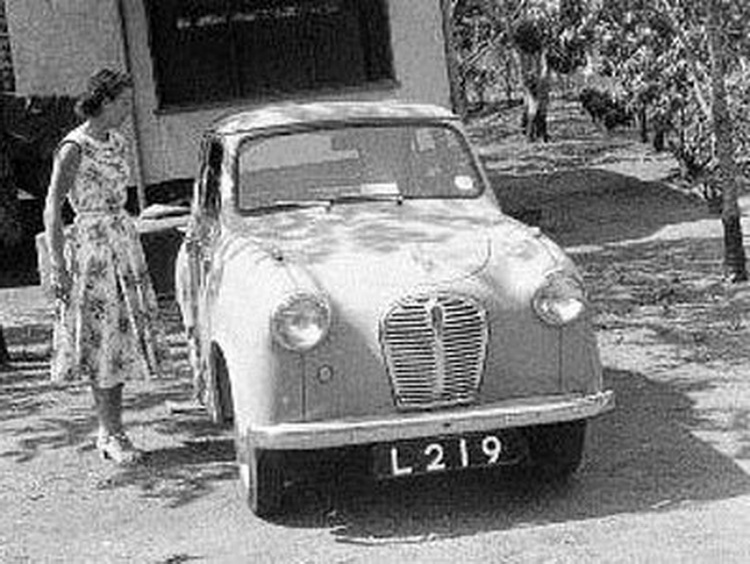
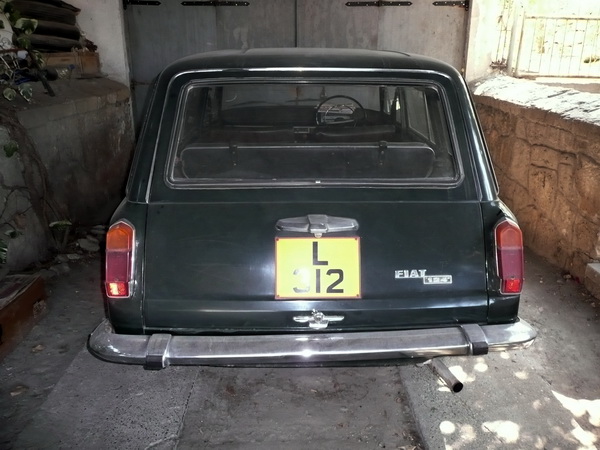
This Austin A35 circa 1960, hails from Northern Rhodesia.   L and 3 numbers in the GB style could just as easily come from Aden or Cyprus, or Fiji or Labuan.....

L 219  –  This Austin A30 circa 1958, hails from Livingstone, then Northern Rhodesia and now Zambia.      In the 1950s,  L and 3 numbers in this GB style could just as easily have come from Aden or Cyprus, or Fiji or Labuan!

For example:

Another Austin, an A40 model, retired to an outdoor museum in Kota Kinabual, Sabah, but sporting 1960s plates from Labuan Island.

Another Austin, an A40 model, retired to an outdoor museum in Kota Kinabulu, Sabah, but sporting 1960s plates from Labuan Island.

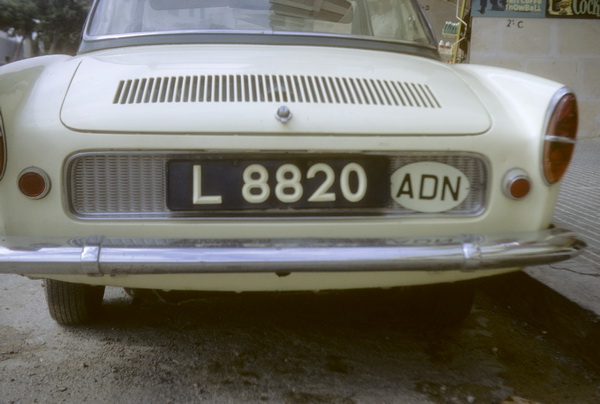
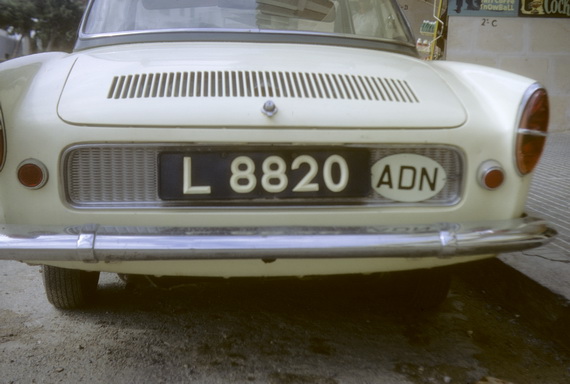
Four numbers this time, but three were issued in Aden Colony in the 1960s.

(ADN60-63)_L 8820_TG_resize

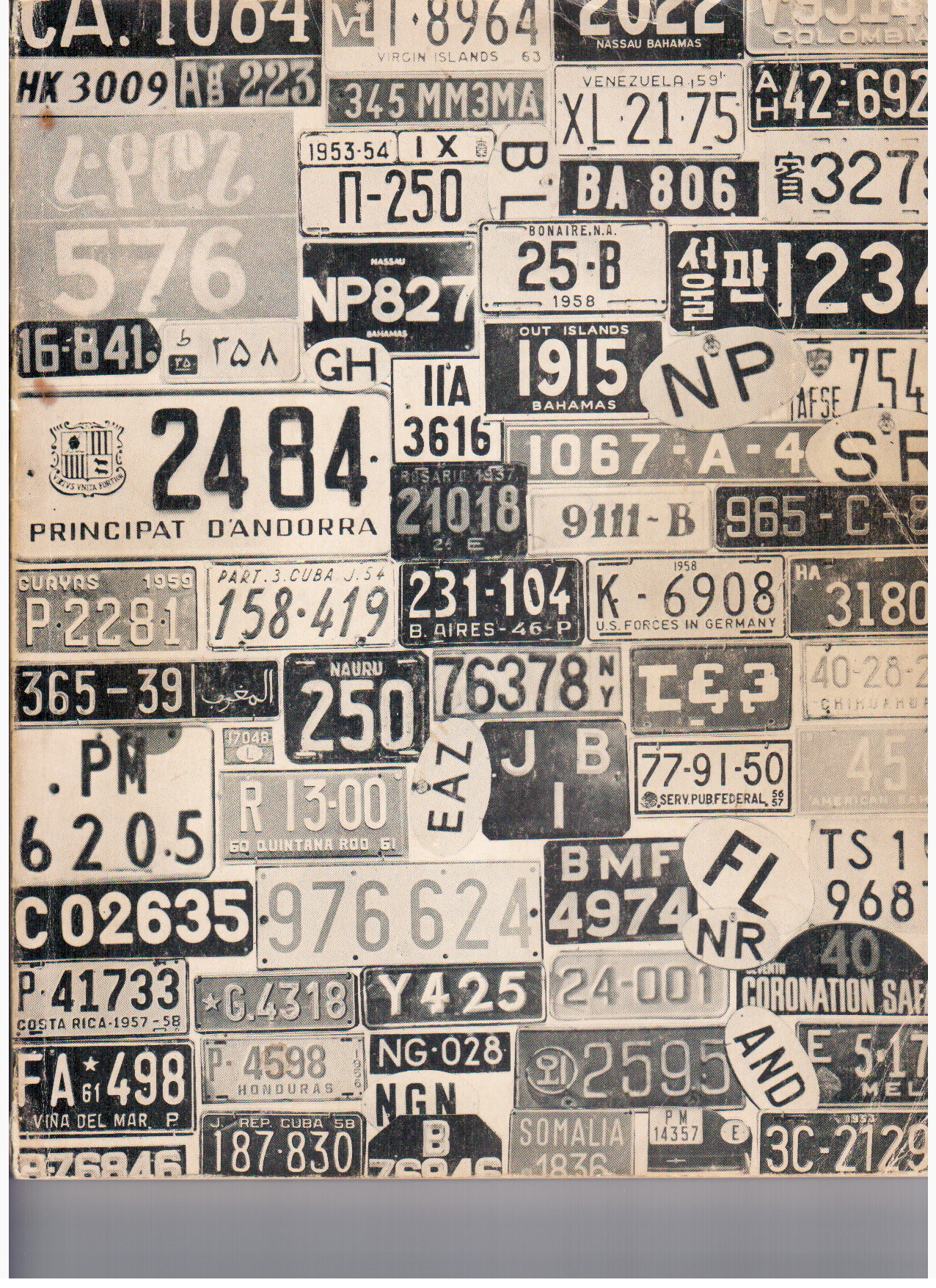
A Keith Marvin Aden  image from his 1960 book, 'License (sic) Plates of the World' - possibly the first volume dedicated to xeno-autonumerology!

A Keith Marvin Aden image from his 1963 *book, ‘License (sic) Plates of the World’ – possibly the first volume dedicated to xeno-autonumerology!

Ah – AND Turkish Northern Cyprus (still current)

(CYN2)(83-97)_L 312_weeVB

Keith Marvin's rare book, which brought mant worldwide collectors to each others notice, and helped to form associations.

 *Keith Marvin’s rare book, which brought many worldwide collectors to each other’s notice, which in turn,  helped to form long-standing associations.   A famed and very prolific writer on automobilia in the US, he died only about 2011, aged over 90.

AUF WIEDERSEHEN……….


A Little More Pemberton

November 13, 2013

The things John Pemberton saw in the 1940s and 1950s!     (We MAY have shown some of these in earlier Pemberton Posts…..)

OK for the reader to make the identifications?

A prompt response from Richard Mathers (EU871) is given in COMMENTS below

(F)(SN)(AOF)_7081 1.A_JPvb

7081 1.A   –   It is particularly odd that a British car – an Austin A40 Devon – should have been seen on French West Africa plates, as all French overseas territories were strongly wedded to cars and lorries of French manufacture.        Senegal became independent of France in 1960; this photo is estimated to have been taken in Britain during 1953, when the international identification letters for the whole territory were AOF – Afrique Occidentale Francaise. Our Austin boasts only a modest ‘F’.   Another oddity is the light background and dark digits of the plate, when normal plates were simple white on black.      At independence, a preceding ‘S’ was added to the zero or 1 codes which marked the Senegalese sector of AOF – where 1 represented Dakar.    (7081 S1.A)       Pemberton archive.

(CL 1947-8)_CY 3533_JP1951c

Ceylon‘s 1947-8 code CY adorns this American Mercury? Eight, photo’d in London, possibly in 1952.          NOTE: The CL international oval is of the large 300mm x 180mm (12 x 4.75″) specification, as determined by the early Conventions.            Pemberton archive


(EAT)_DSD 770_JPvb

DSD 770 – The Peugeot 203 was produced from 1948 to 1960.    DS = Dar-es-Salaam, the capital of Tanganyika, issued suffix D from Sept. 1950 to Jan. 1952.   Photographed in London in the early 1950s for the  Pemberton archive.         Note the unique style employed by the British East African territories of Tanganyika, Kenya and Uganda, in the use of brackets round the code letter for each of the three administrations – EA(T), (K) and (U)….    (Nyasaland is said to have been allocated EAN, but  there is no evidence of its use – unless YOU have a photo!)

(NP)_BT 2999_JPc1937

BT 2999 – 1930s Hillman Minx from Blantyre, Nyasaland.   Also using the massive 12″ I.I.P.            Pemberton 1940s archive

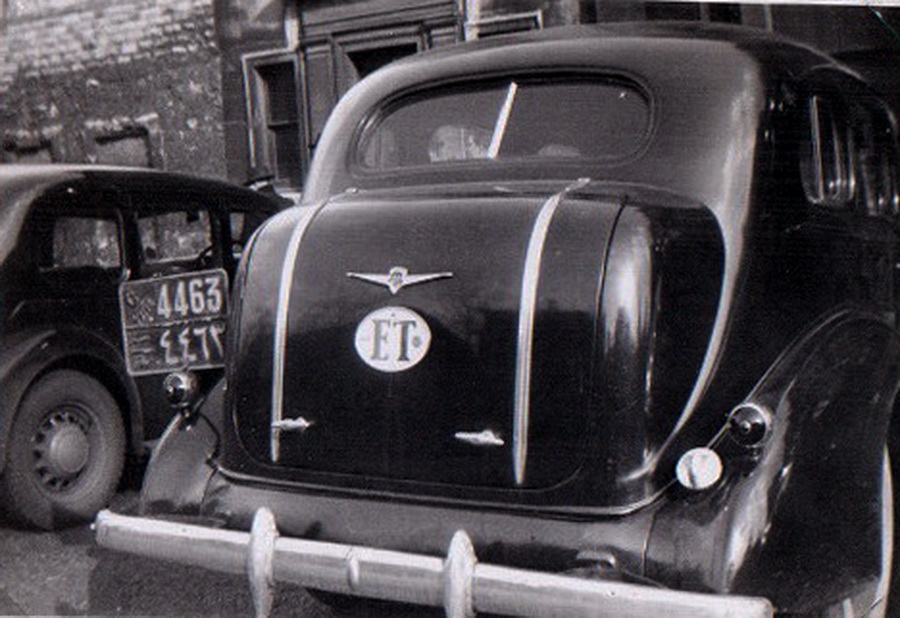
(ET2)(13-c56)_C 4463_JP1938vb

C Privé 4463 on a heavy US anonymous machine.    Is it a Packard??   From the 1913-1956 series, with C for Cairo.      Pemberton archive.

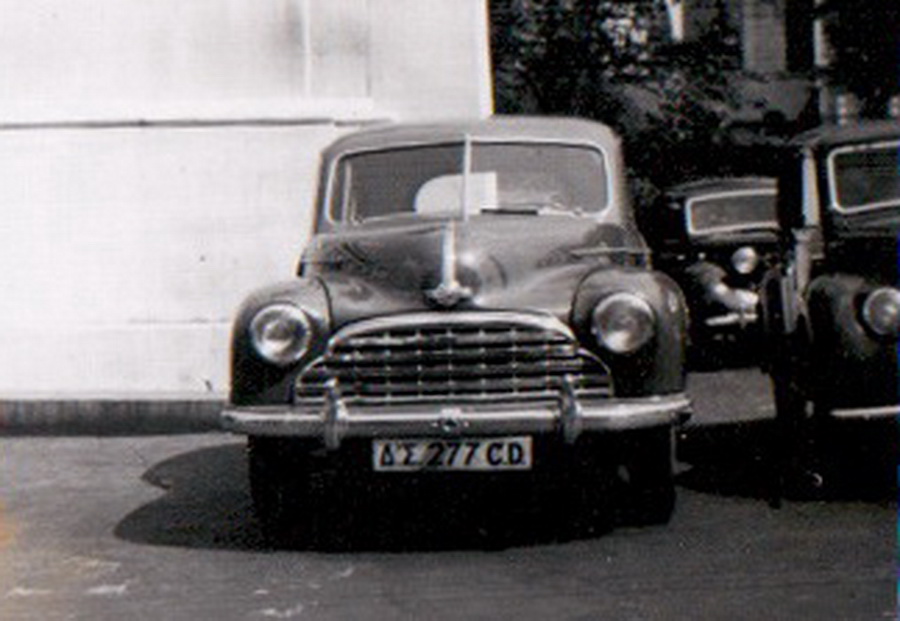
(GR)(cd)_DS 277 CD_JP1950s

DS 277 CD – Greek Diplomatic series from 1930s-1952 on a circa 1949 Morris Oxford in Oxford in 1950.       The DS, here translated from the Greek, abbreviates Diplomatikos Soma – or Diplomatic Body.   Though ‘CD’ was internationally accepted, there were no French usages in the home of Homer!       Pemberton archive

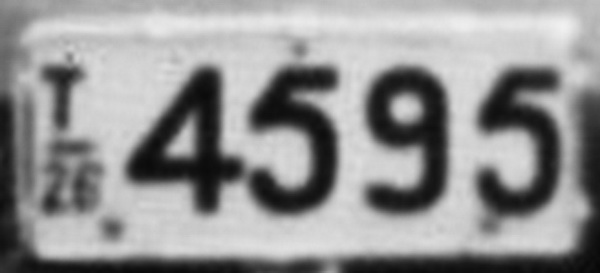
(IR)(oos)_T 26 4595_JP1947

T/26 4595  –  The Farsi/Dari area code letter and validity year/serial numerals of the Persian plates were changed to western characters only if the vehicle was to leave the country. This 26-dated T-Teheran out-of-state plate refers to the Persian year 1326, corresponding to our Gregorian calendar year which was from March 1947-March 1948.       The US car model is unidentified, the shot taken somewhere in England in 1948/9.      Pemberton archive

(IR)(oos)_T 26 4595_cu_JP1947

(KT)(rh)_50_JP1950s

The red and white Flag plates of the Kuwaiti royal household, shot in London by John Pemberton on Aug. 6, 1956.    Plate 50 on a Cadillac

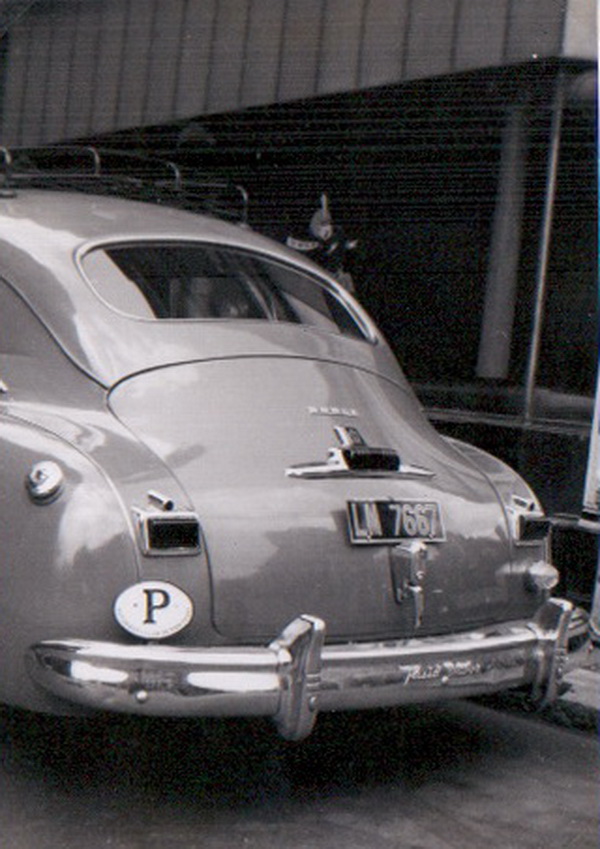
(MOC)_LM 7667_JPvb

LM 7667  –  Mozambique – Lorenzo Marques, which could have used the MOC oval, but was only seen with Portugal’s  P.         A Dodge Fluid-Drive, made from 1947-9, seen in London about 1950, before the dash separators became  standard for Portugal and its overseas possessions.          Pemberton archive c1950


Zanzibar at last

November 3, 2013

ZANZIBAR Island & Archipelago
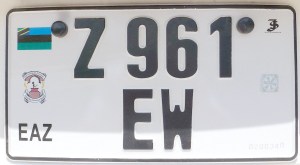
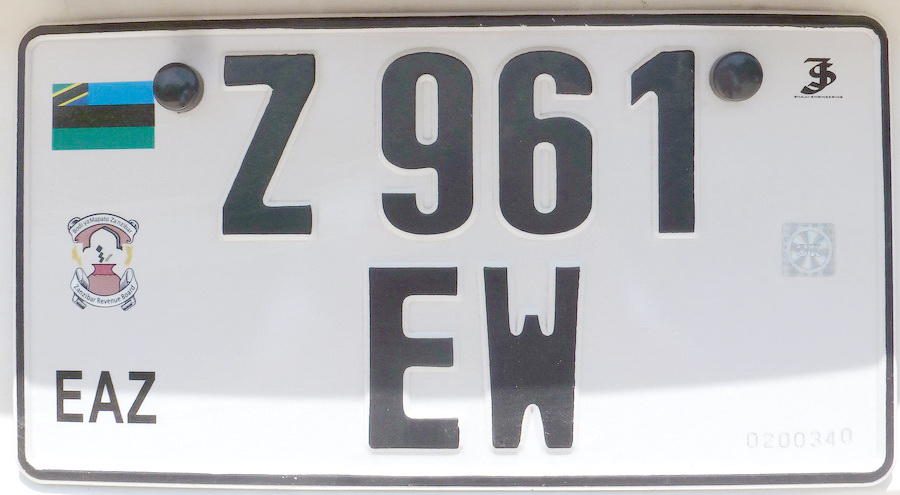
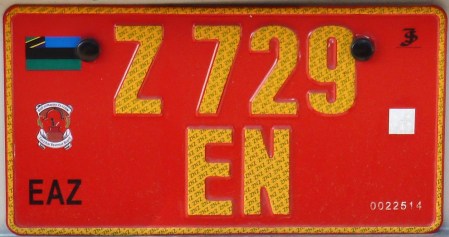
(EAZ 2010~)_Z 961 EW_cu_VB2013_exposure

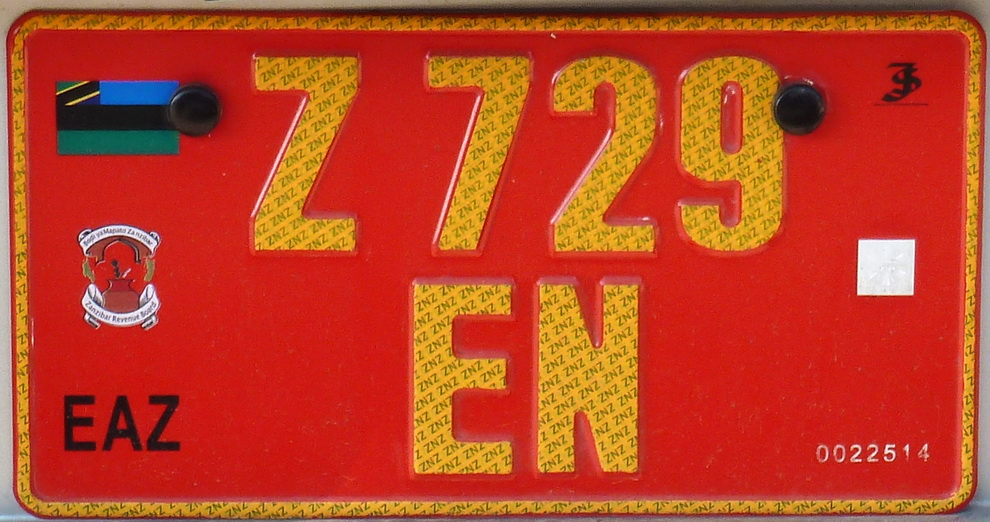
Although the new design of Zanzibar island plate only commenced in 2008, there are none of the previous ZNZ  series left in circulation.    Every running vehicle was obliged to re-plate within a year.      Three dumped cars were seen from the former ZNZ series.    Sad to say, PEMBA island has lost its dedicated (PBA) plates since the 2008 series was introduced, so that both islands now have indistinguishable registrations.

About three years ago, possibly with financial assistance from an external assistance scheme, the two main roads, north and south of the capital,  were well re-made  (not just re-surfaced) and plate-spotters with a will to penetrate the far corners of Zanzibar can now travel the 180km from end-to-end in a (tiring) day, in their hired Suzuki 4wd with bald tyres and afro air-conditioning, at the handsome fee of US$50 p.d.       Petrol costs the same here as anywhere else (about US$2 per litre).    A policeman earns US$320 a month, to give an idea of how relatively expensive it is in this distant place, where every single thing has to be imported and the only income from exportation is a little fish and some spices such as cloves and pepper.

   The long arm of the law tends to hide under an avocado tree and bound out as the simple foreigner approaches, that arm now raised in the way of a highwayman.     A brief debate ensues, often concerning the prospects for Chelsea or Manchester United and, the grateful peeler’s paw being now stuffed with 1,600 Tanzanian shillings, or, better, a US dollar, our driver is able to proceed to the next stopping-point, where only the change of football club disturbs the interview format.     

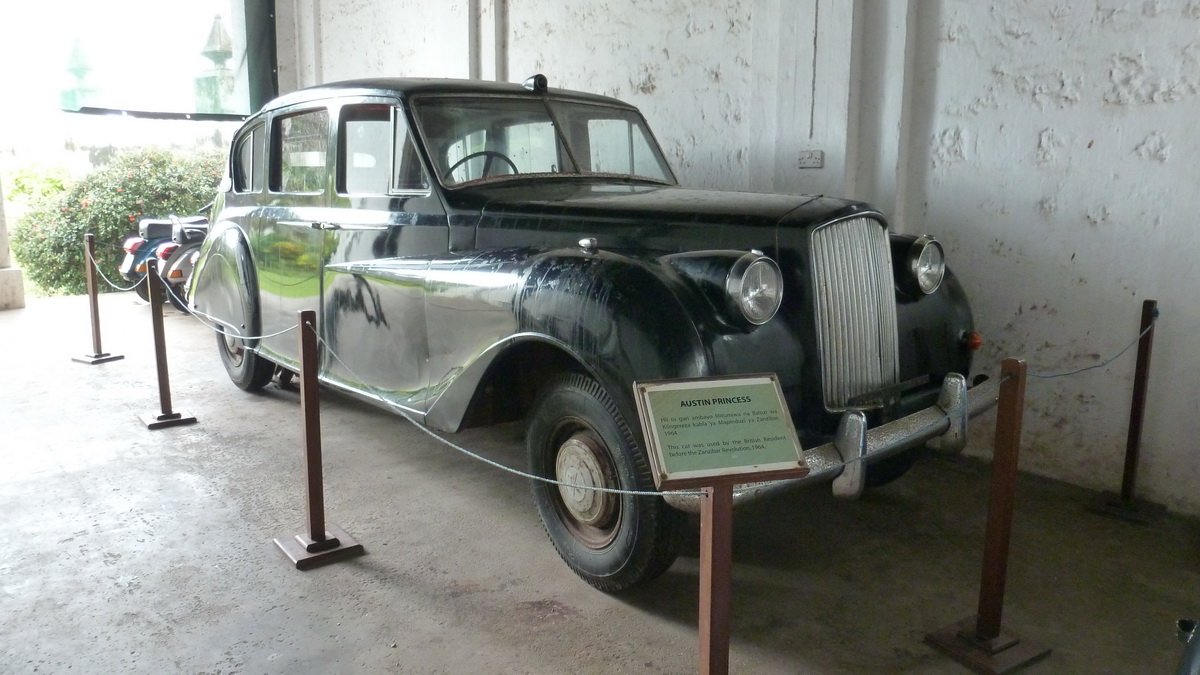
From 1890 to 1963,  Britain ran the islands of the Zanzibar archipelago as a Protectorate, with a British Resident who guided the ruling sultans in matters of  governance.    The last Resident’s Ford Zephyr car is stored in a Stone Town Museum called The House Of Wonders and my ambition to witness it in the flesh was frustrated by the building’s closure and imminent collapse due to maintenance ‘difficulties’.     It is to be re-opened when the UNESCO (or anyone) has found a willing cultural donor to settle the bill for the new roof, as obviously, it isn’t thought to be the duty of Tanzania to correct the matter.    In an adjacent building outhouse, lies a 1951 Austin Princess ceremonial landaulette limousine, unplated, the grand transport of the Resident of that earlier period.
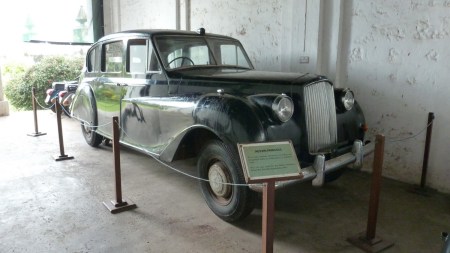
A preceding Resident (Governor) of the 1950s left this Austin ceremonial limo for his successors.    Brumby archive

A preceding Resident (Governor) of the 1950s left this Austin ceremonial limo for his successors. Brumby archive

R.     The Ford Zephyr left by the last Resident, during the violent 1964 revolution which followed Zanzibar's Independence in 1963.   The independent island was subsumed into Tanzania only three months later, but remains semi-autonomous.      (Brumby archive)

R.      The Ford Zephyr left by the last Resident, during the violent 1964 revolution which followed Zanzibar’s Independence in 1963. The independent island was subsumed into Tanzania only three months later, but remains semi-autonomous. (Brumby archive)
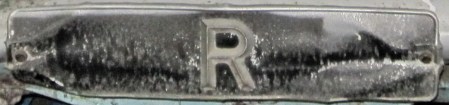
R = Resident.   A Bluemels-manufactured plate for Zanzibar.

R = Resident. A Bluemels-manufactured plate for Zanzibar.

FORMER SERIES – circa 1983 – 2008.

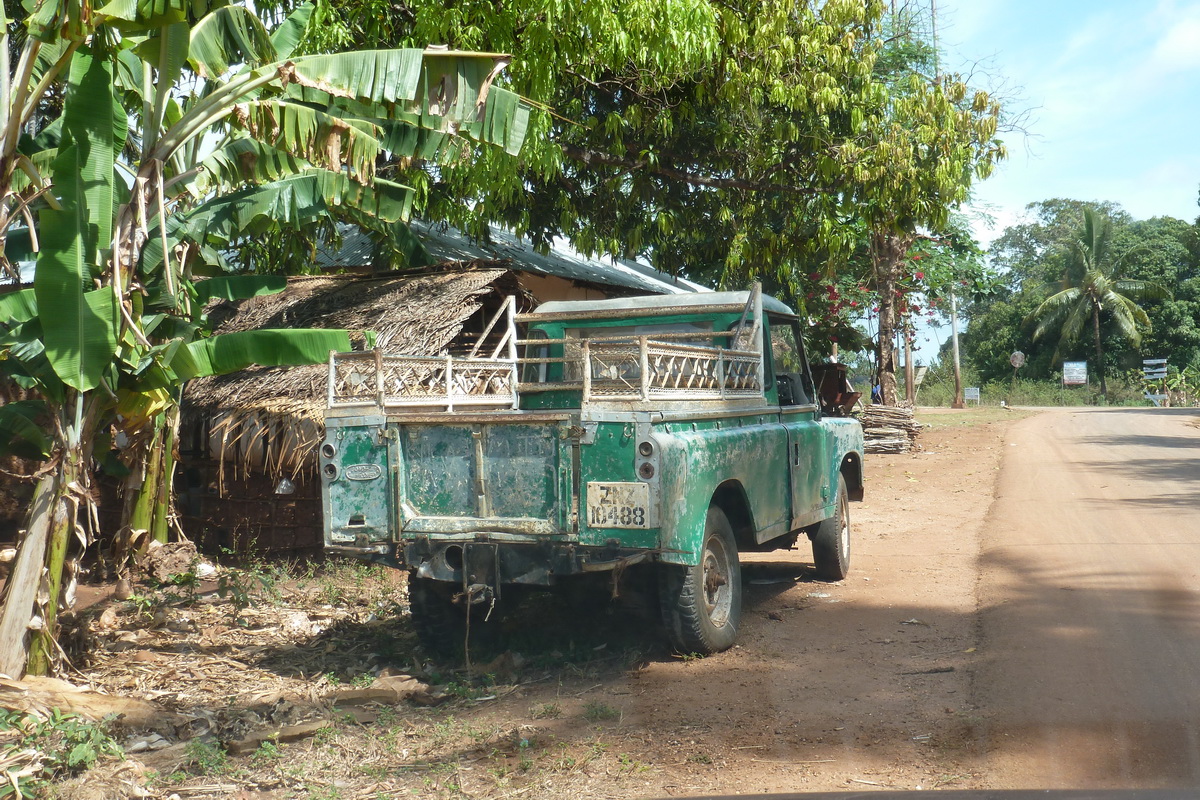
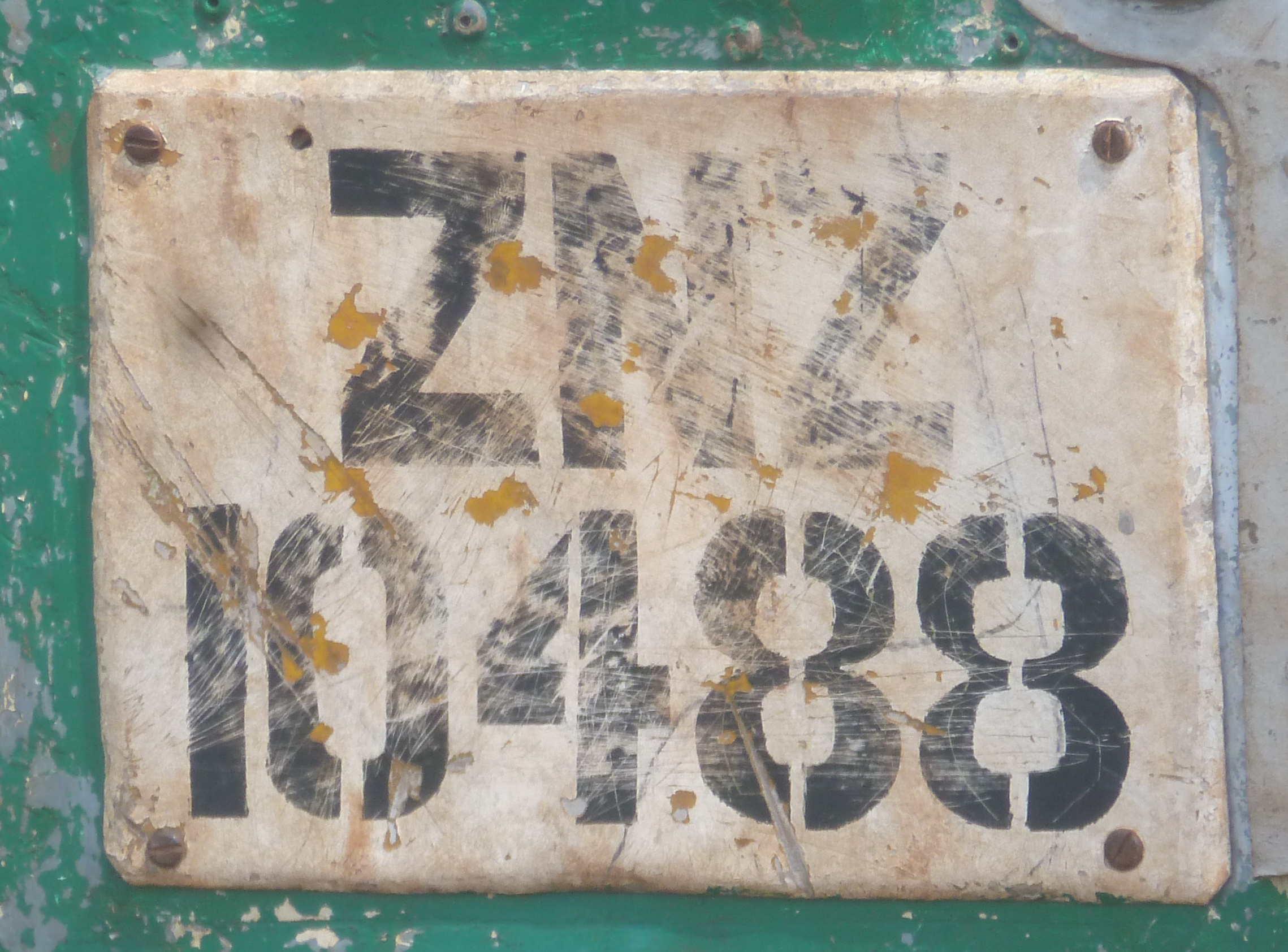
Although the new design of Zanzibar island plate only commenced in 2010, there are none left in circulation.    Either every vehicle was forced to re-plate, or there is no pre-2010 rolling-stock still working.    I believe the first is the case, even though some of the roads are predictably badly surfaced and there is little in the way of garage servicing which could extend their lives.     I cannot locate any new-vehicle dealers, from whom I might have grabbed a shot of a Trade Plate.     Here is a dumped Land Rover in a country spot, still sporting the ZNZ private vehicle series, which ran from the 1980s to 2010.

Here is a dumped Land Rover in a country spot, still sporting the ZNZ private vehicle series, which ran from the 1980s to 2008.
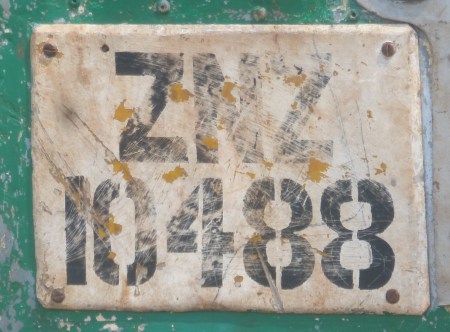
(EAZ 80s-2010)_ZNZ 18488_cu_VB2013

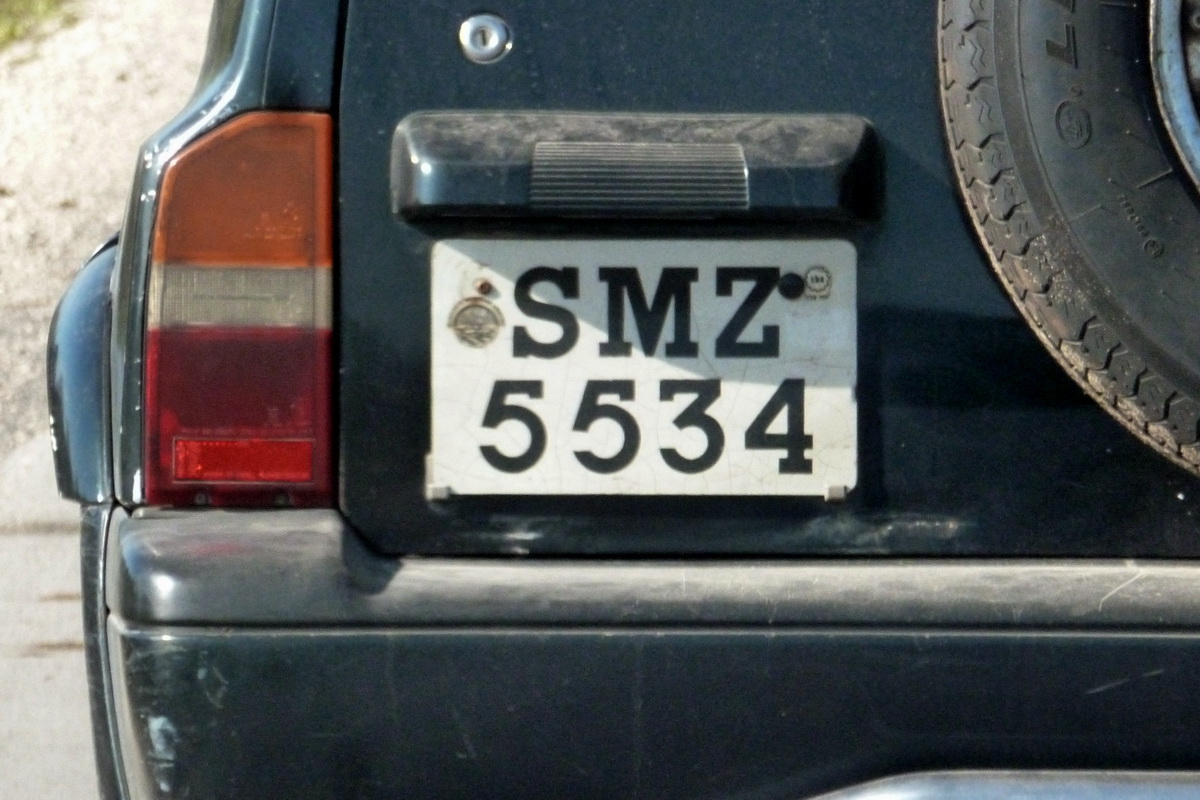
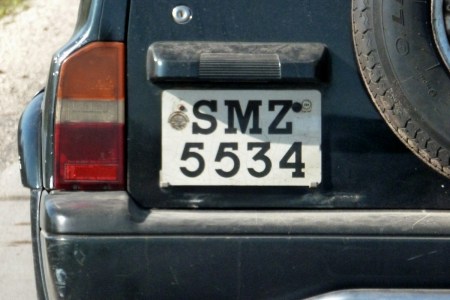
In the case of the island government plates, there are still examples of the pre-2010 to be seen, as here with SMZ 5534, the letters abbreviating the Swahili for 'Revolutionary Government of Zanzibar'.     The island has a measure of self-government separate from Tanganyika, its mainland partner in Tanzania; mainland government plates also circulate on the island and these are of the Tanzanian Union format, usable in either place.    It is said that Zanzibar vehicles may not be used on the mainland, unless they change to the T-prefix Tanganyika type.

In the case of the island government plates, there are still examples of the pre-2008 series to be seen, as here with SMZ 5534, the letters abbreviating the Swahili SERIKALI MAPINDUZI ZANZIBAR for ‘Revolutionary Government of Zanzibar’.     The island has a measure of self-government separate from Tanganyika, its mainland partner in the union of Tanzania; mainland government plates also circulate on the island and these are of the Tanzanian Union format, usable in either place.    However,  Zanzibar vehicles may not be used on the mainland, unless they change to  mainland plates!

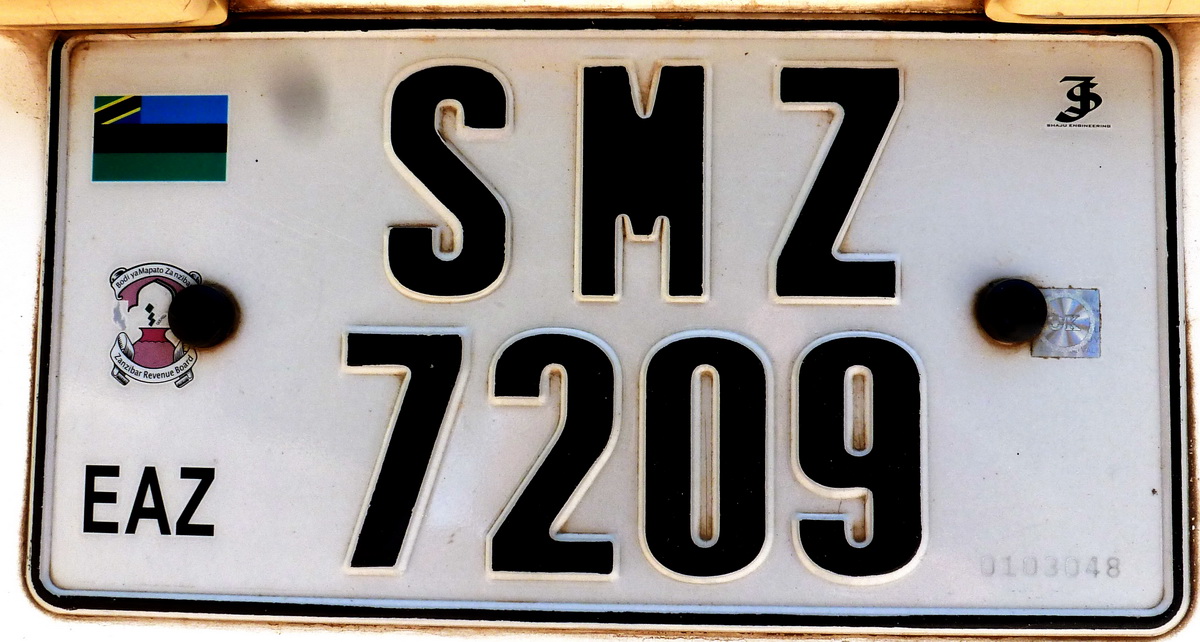
SERIKALI MAPINDUZI ZANZIBAR.  (Swahili for: Revolutionary Government of Zanzibar)         More recent SMZ government plates are being manufactured using the new Utsch equipment, though continuing the 4-numeral serials, as with SMZ 7209.

More recent SMZ government plates are being manufactured using the new (2008) Chinese equipment, though continuing the 4-numeral serials, as with SMZ 7209.    Possibly this series is, or has been, re-issued when a number became voided through scrappage of the previous vehicle.
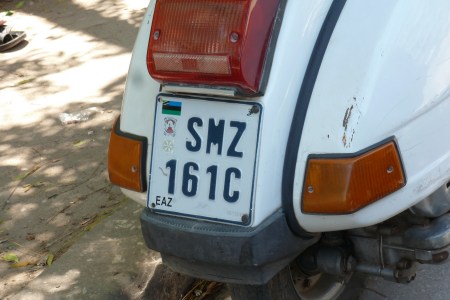
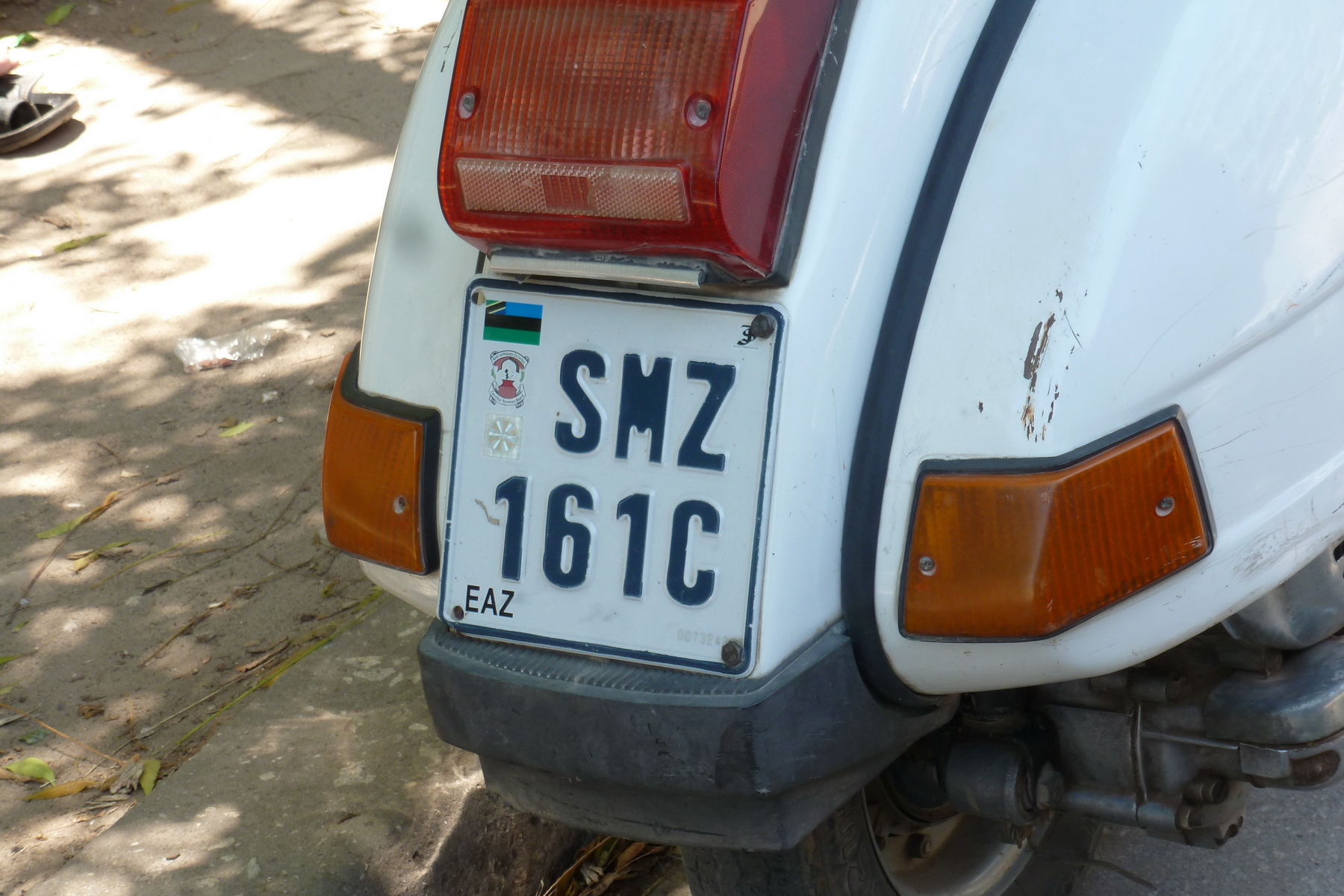
Current government issues have developed to three numerals and a serial letters, presumably because the previous system reached 9999.    There are hundreds of Vespas in Zanzibar - far more than there are light motorcycles, which woud have thought were much more suitable for the poor roads......   SMZ 151 C here/

SERIKALI MAPINDUZI ZANZIBAR.  (Swahili for: Revolutionary Government of Zanzibar)         Former SMZ-NNNN government issues have progressed to three numerals and a serial letter, presumably because the previous system reached 9999.     There are hundreds of Vespa scooters on Zanzibar – far more than there are light motorcycles, the bigger wheels of which one would have thought were much more suitable for the poor roads……….. SMZ 161 C here.
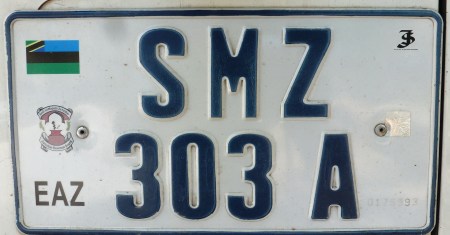
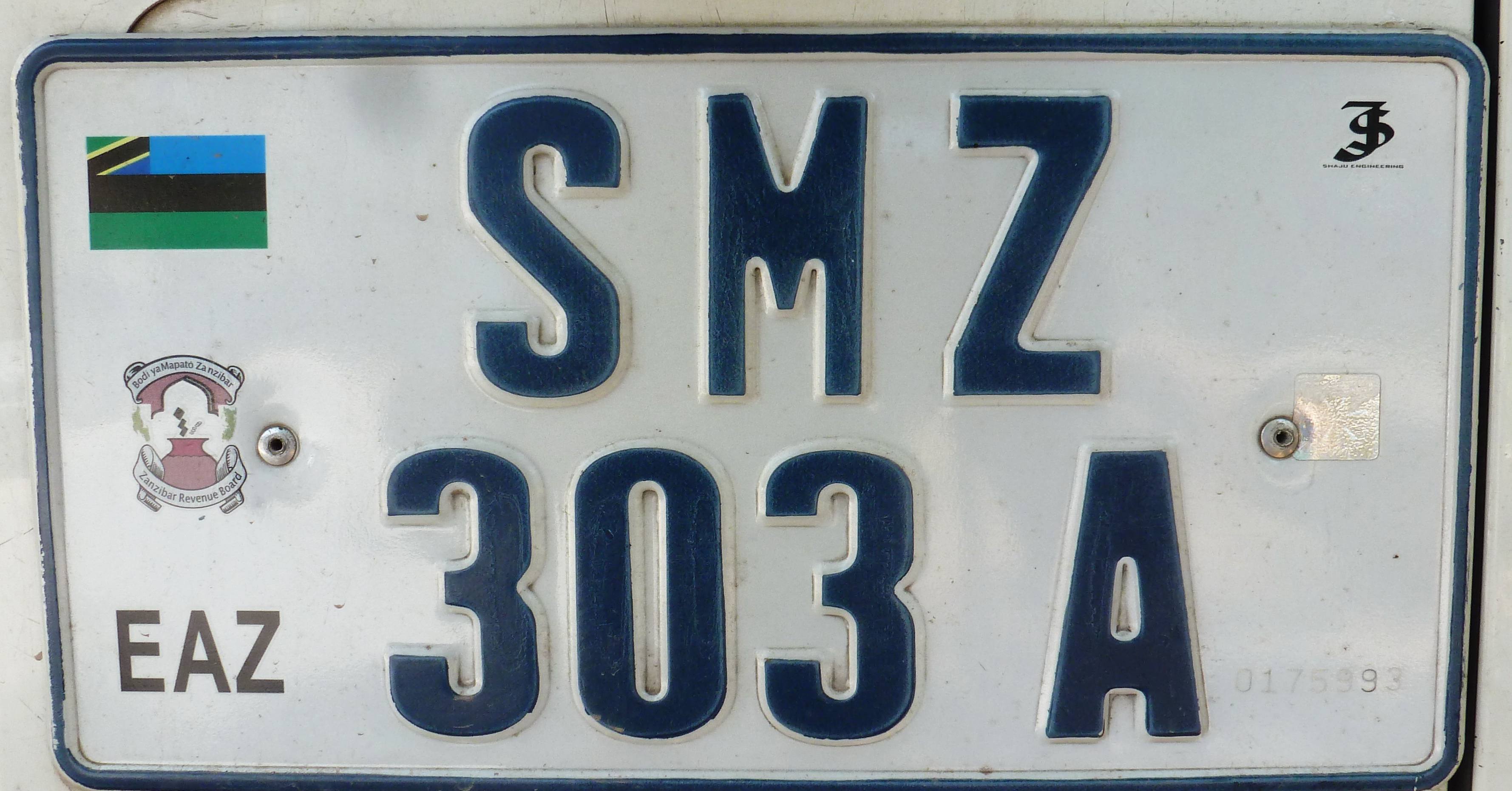
and the new style on a Land Rover - SMZ 303 A.

…….and another new-format island government plate on a Land Rover – SMZ 303 A.
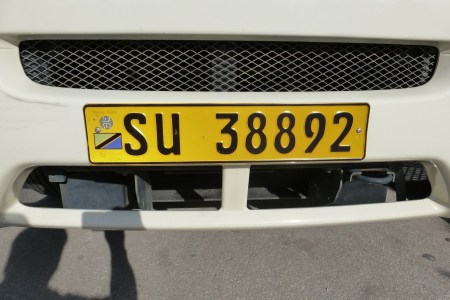
'Union' official series which are used both on Zanzibar and in Tanganyika, include the SU plates, issued to Para-Statal (semi-government) bodies.    Here is the only example seen, on a new light bus in Stone Town, the ancient arab capital town of the island.

SHIRIKA ya UMMA   (Agency of ?the State?)      This long-used  ‘Union’  official series which is used both in Zanzibar and in Tanganyika, is issued to Para-Statal (semi-government) bodies. Here is one of only three examples seen, on a new light bus in Stone Town, the ancient arab capital town of the island.    Note that these SUs run up to five numerals, as did the old TZ civilian plates on the mainland (and the ZNZ ‘s on Zanzibar).
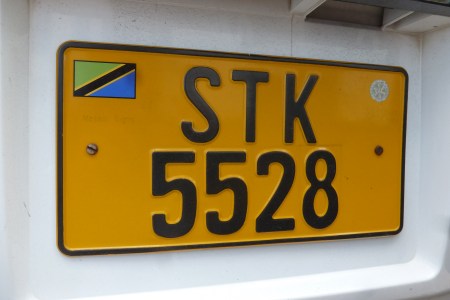
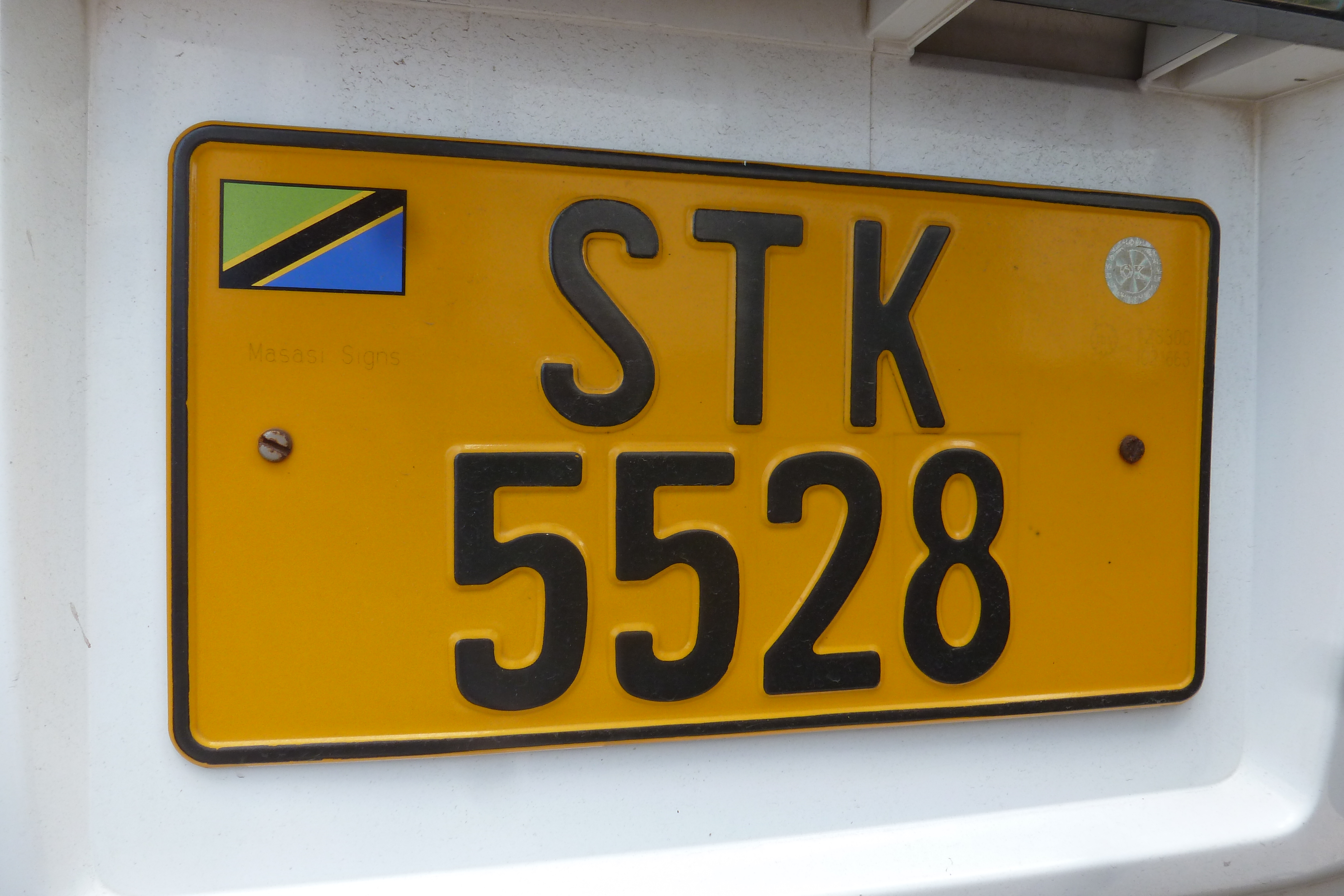
The more common government vehicle plate uses the ST prefix, which ran to 9999 and then took a letter suffix between the ST code and the serial number, as with STK 5528.    K appears to be the latest suffix reached.

SERIKALI TANZANIA (Tanzania (union of) Tanganyika and Zanzibar archipelago Government)       These, quite common, Union government vehicle plates use the ST prefix, which first ran to 9999 and then took a letter suffix between the ST code and the serial number, as with STK 5528.   K appears to be the latest suffix reached, at November 2013.                                Note the slight variation in the design of the flags, between Tanganyika and Zanzibar.                                        Brumby archive
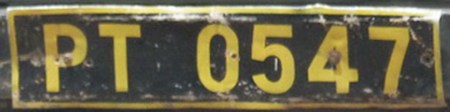
A new find seems to be the yellow on black speacial series for Police Tanzania.    They DO NOT like to have their kit photographed!

PT 0547:   A new discovery seems to be the yellow-on-black special series for Police Tanzania.   Take care – they DO NOT like to have their kit photographed!        Brumby archive

(EATZ)(pol)_PT 2086_VB2013.jpg

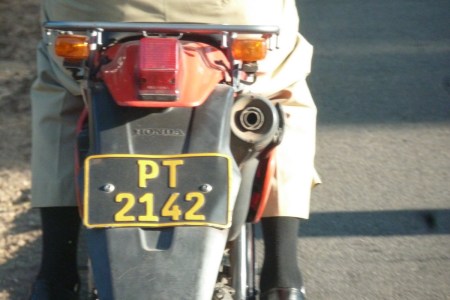
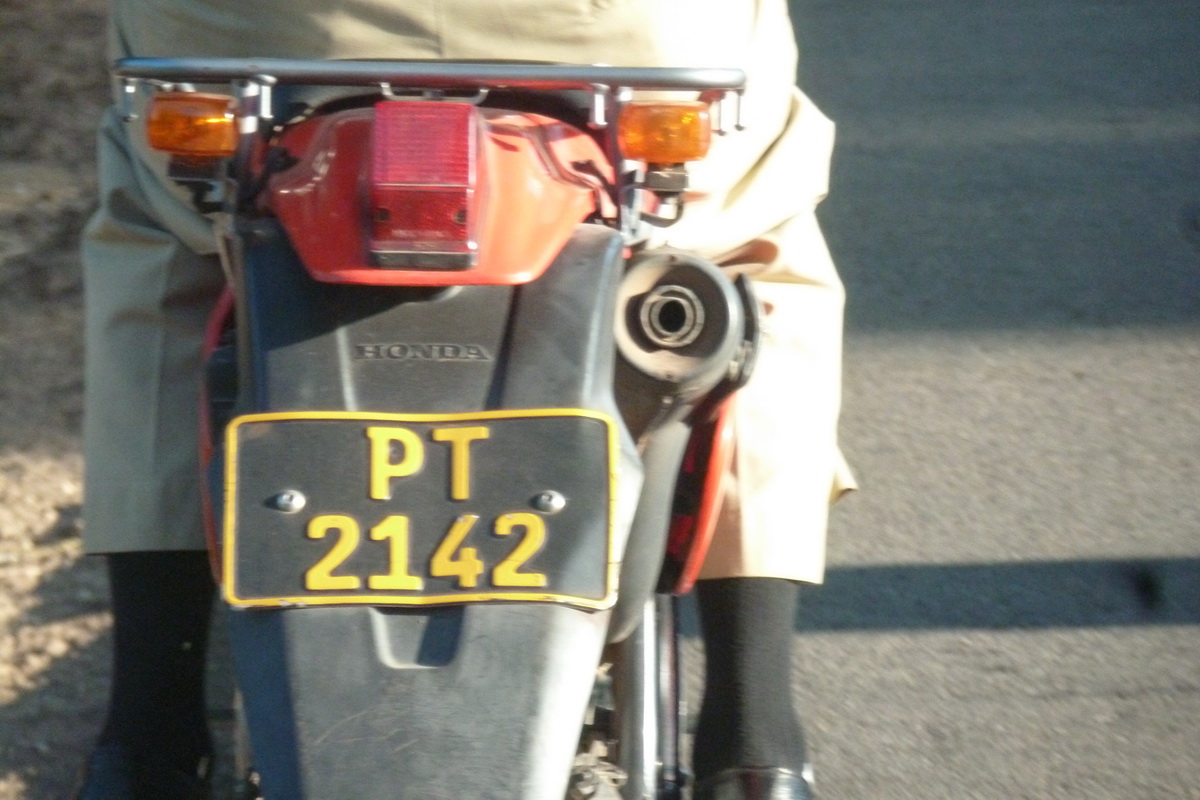
Properly-pressed motor-bike version for police, using an unusual font.

PT 2142:    Properly-pressed motor-bike version for Tanzania police, (using an unusual font).                    Brumby archive

Fire Brigade, Army volunteers and ‘Navy’ series have been photo-captured by a variety of subterfuges and these will be added here shortly, along with any other items of interest.

MISSING TRADE SERIES

I cannot locate any new-vehicle dealers, from whom I might have grabbed a shot of a Trade Plate.    LATER:   I learn that the Trade Plate series has not been issued since 2007 and that there MAY be a re-introduction in 2014.

There is no car hire business in Zanzibar – thus no plate series.     If one needs a rental car, private owners met in an alley will walk for a week if US$50 a day is suggested to them by way of recompense for handing over their wheels, but the condition of the vehicle can cause the tourist to do plenty of walking, too.

Our Suzuki actually kept going for a week, but the rental fee was greater than the value of the car!

20131030 40400 EAZ_resize

The car I bought!

~~~~~~~~~~~~~~~~~~~~~~~~~~~~~~~~~~~~~~~~~~

Some Zanzibar official series:

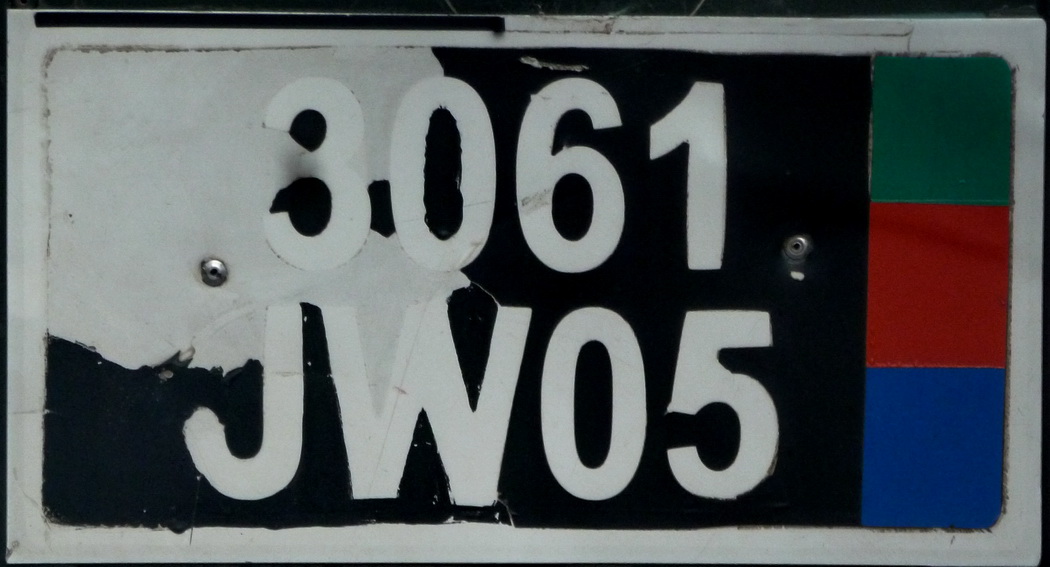
Tanzania union army JESHI WANACHI (Citizens' Force) registered first in 2005.    Brumby archive

8061 JW 05   Tanzania union army JESHI WANACHI (Citizens’ Force) registered first in 2005.                        Brumby archive

The Fire Brigade

KIKOSI cha KUZUIAMOTO (Group to Prevent fire) – The Fire Brigade.        Used only in Zanzibar.                                 Brumby archive.
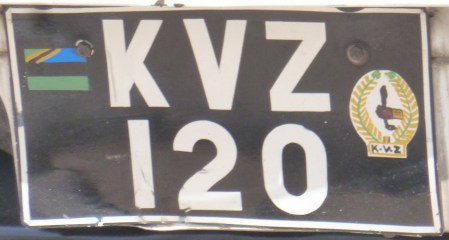
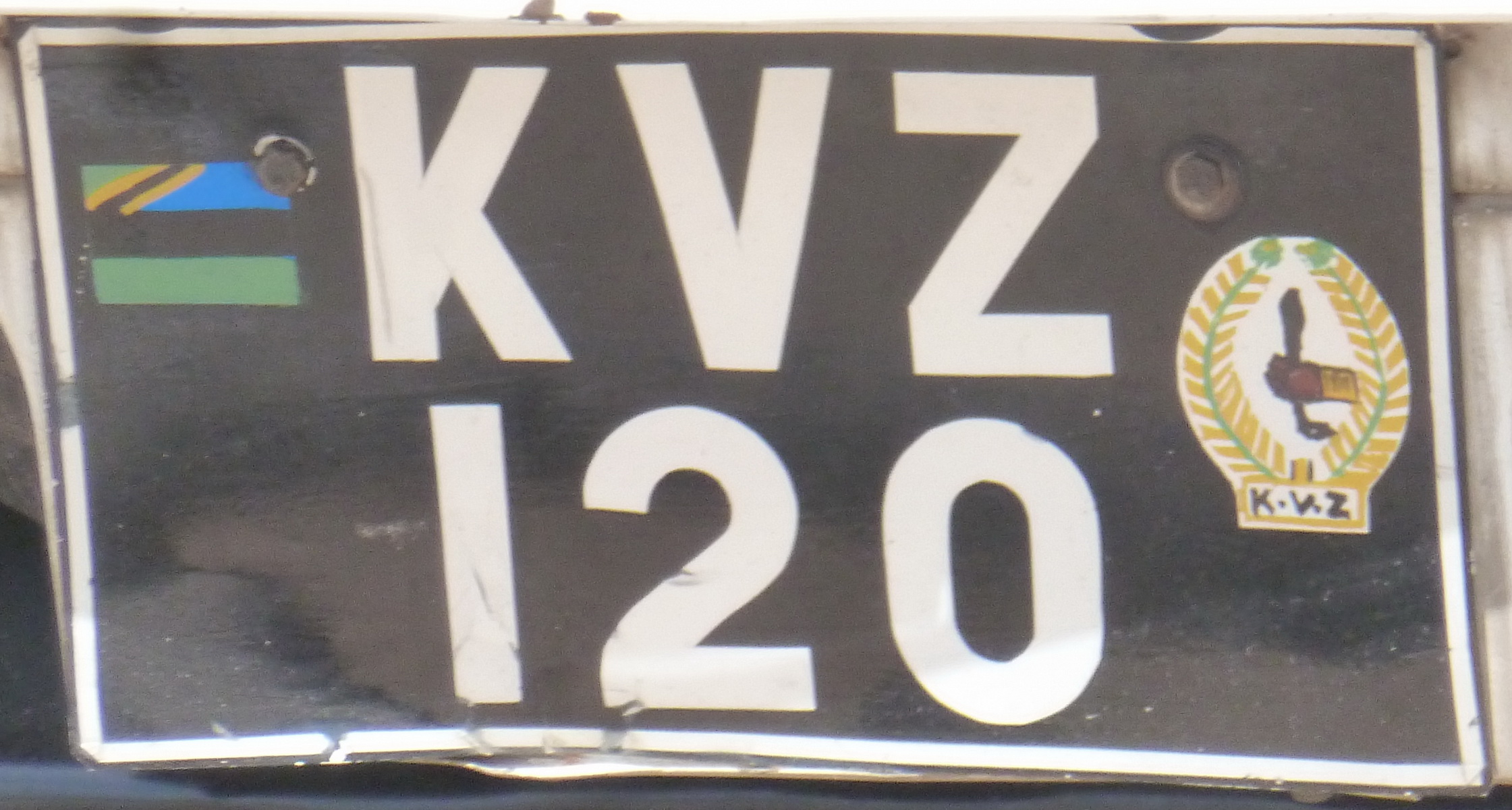
Volunteer emergency force under the military control.

KVX 120 – KIKOSI VALANTIA ZANZIBAR – (Zanzibar Volunteer Group) for deployment in emergencies under military control – Zanzibar use only.  (Perhaps we might say Civil Defence)       Brumby archive

Tanzania Navy, sometimes seen with a yellow anchor on the plate.

KIKOSI cha KUZUIQ MAGENDO – (Group to Prevent Smuggling) there being no EAZ navy, and used on Zanzibar archipelago only.   Sometimes seen with a yellow anchor on the plate.   (Perhaps the better description might be Coastguard.)             Brumby archive

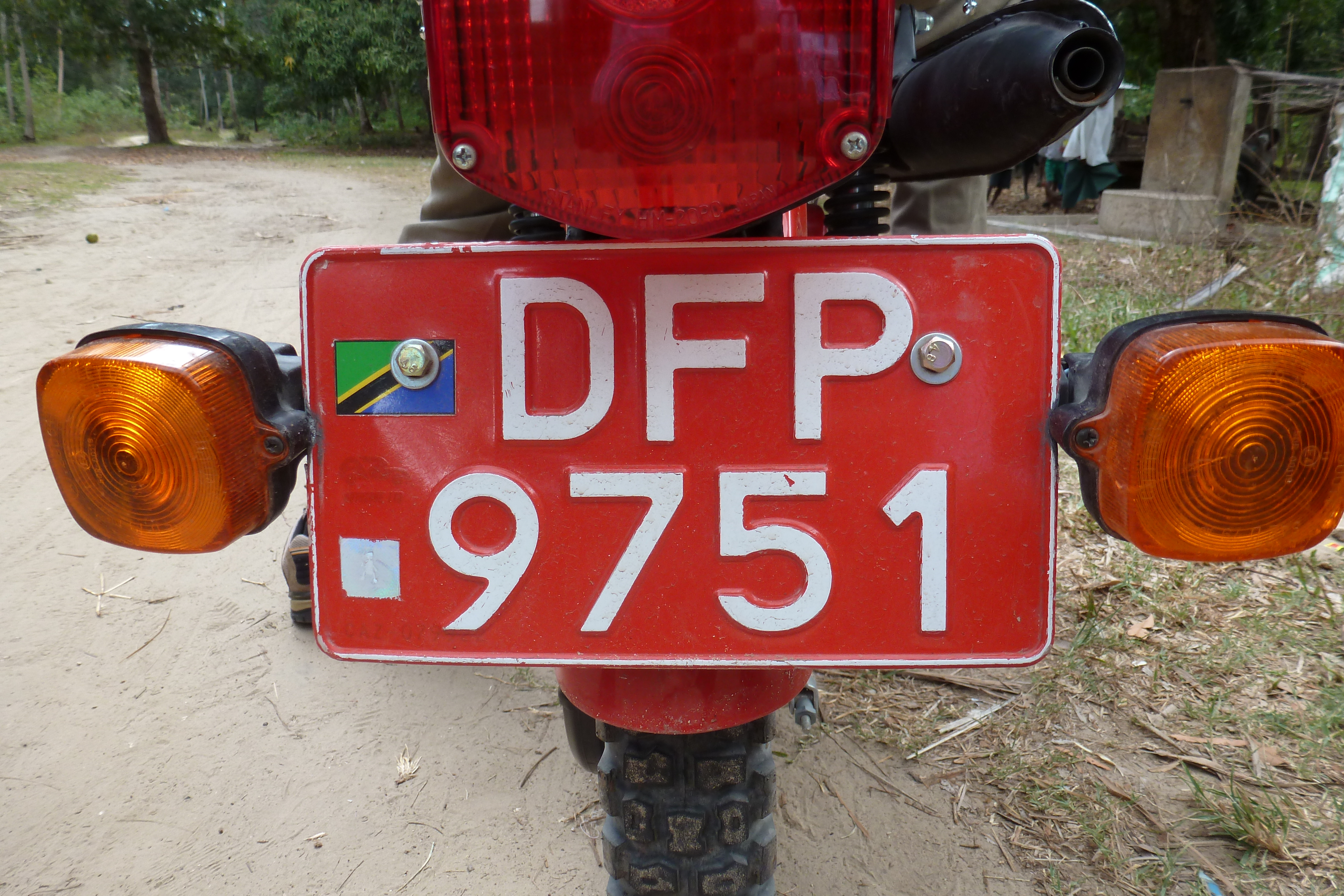
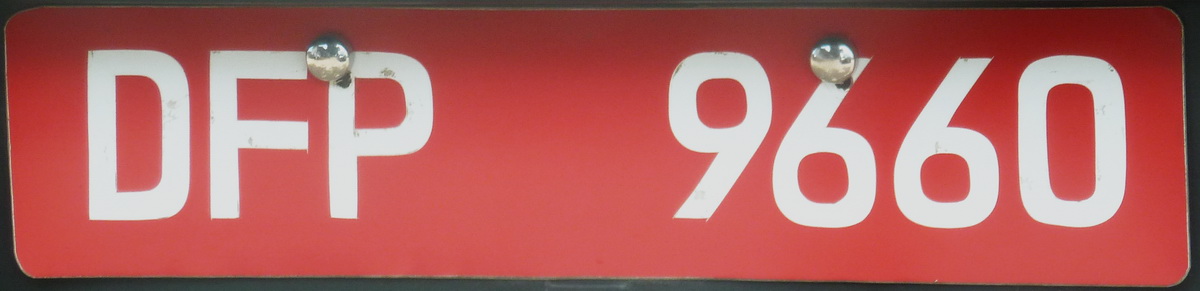
Ambulances and Health Ministry transportation is marked by (usually painted) red plates with the white code DFP and up to 4 numerals,  representing Donor-Funded Projects, using vehicles of all types imported free of duty.

DFP is for Donor-Funded Projects, by which vehicles are imported free of duty for humanitarian duties.

DFP is for Donor-Funded Projects, by which vehicles are imported free of duty for humanitarian duties.

(EATZ)(gv-Moh)_DFP 9640_VB2013

Donor-Funded Projects such as Malaria Prevention, Vaccination programmes etc. run by local MoH and foreign assistance.         Brumby archive
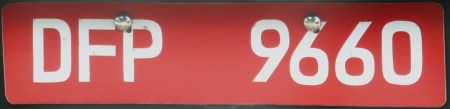
(EATZ)(gv-Moh)_DFP 9660_cu_VB2013

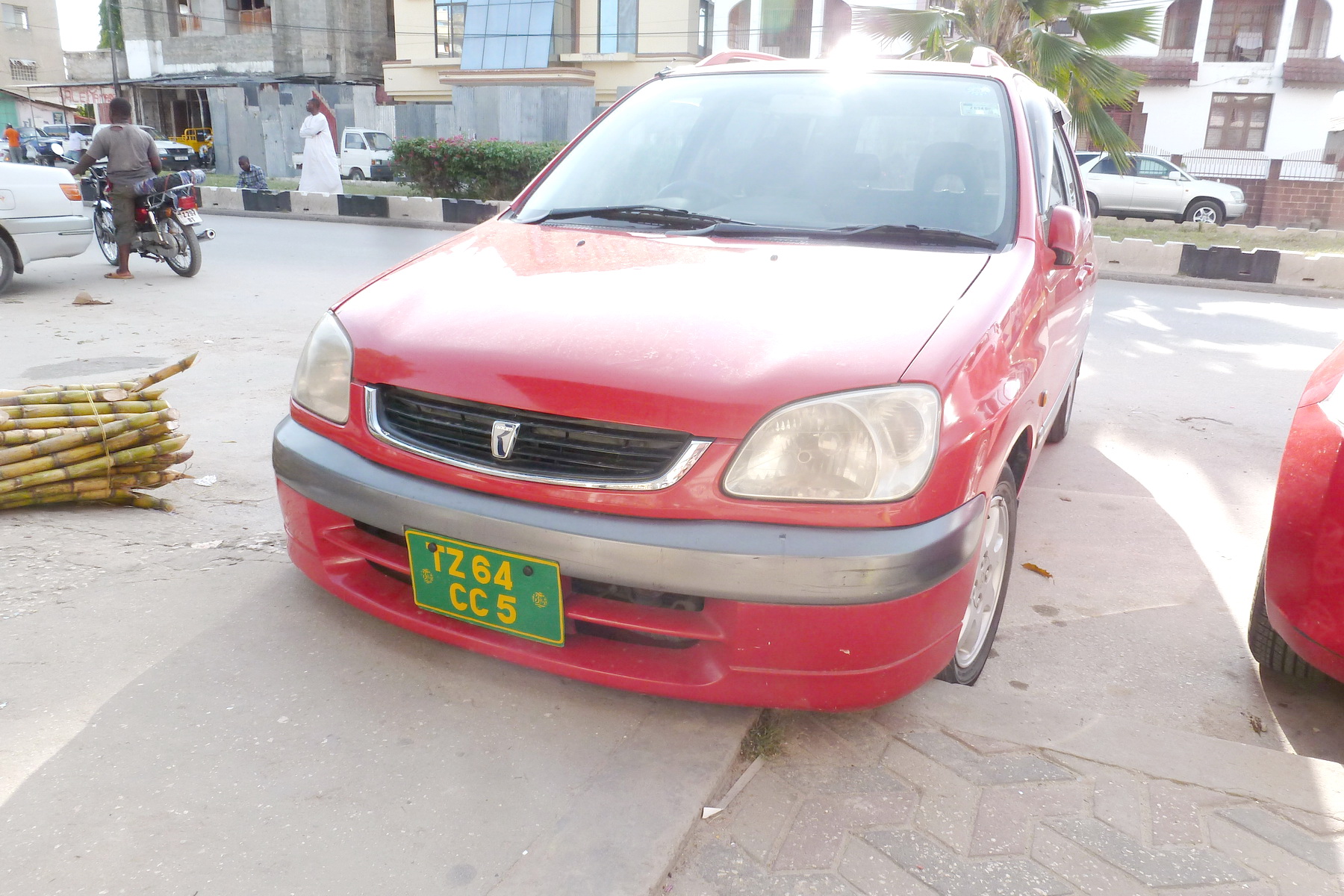
BELOW:   A handful of Consulates work in Stone Town, the principal diplomatic functions occurring in Dar-es-Salaam.    Here is a CC example, showing the extra ‘Z’ which possibly differentiates it from the mainland consular series, which uses ‘T’ only.
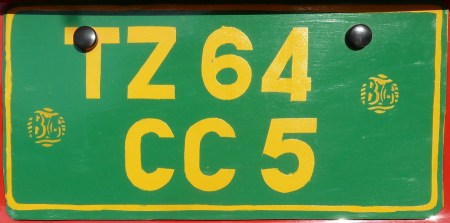
Embassy code 64 is presently unidentified.

Embassy code 64 is presently unidentified.

(EAZ)(cc)_TZ 64 CC 5_VB2013

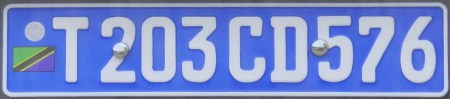
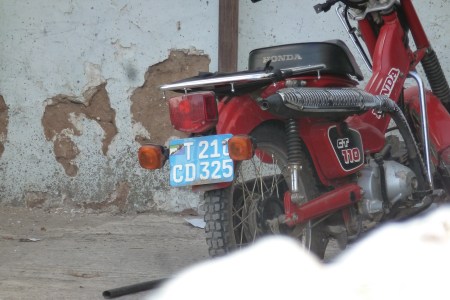
BELOW:   From the mainland, but working in Zanzibar, with no alteration to the plates, are some UN diplomats with their characteristic blue plates, rather than green for normal diplomats.   203 is for UNDP, but agency 210 is unlisted.

(EATZ)(io-UNDP)_T 203 CD 458_VB2013 (EATZ)(io-UN)_T 210 CD 378_VB2013 (EATZ)(io-UNDP)_T 203 CD 576_cu_VB2013 (EATZ)(io-UN)(mc)_T 210 CD 325_VB2013

First notification of a new EAT NGO series.   CCI is an Non-Government Organisation in Tanzania.  see http://www.cci.or.tz/     Seen in Zanzibar Oct 2013.

T 312 CCI.   First notification of a new EAT  NGO series. CCI is an Non-Government Organisation in Tanzania. see http://www.cci.or.tz/       Seen in Zanzibar Oct 2013.

~~~~~~~~~~

THE OFFICERS OF GOVERNMENT

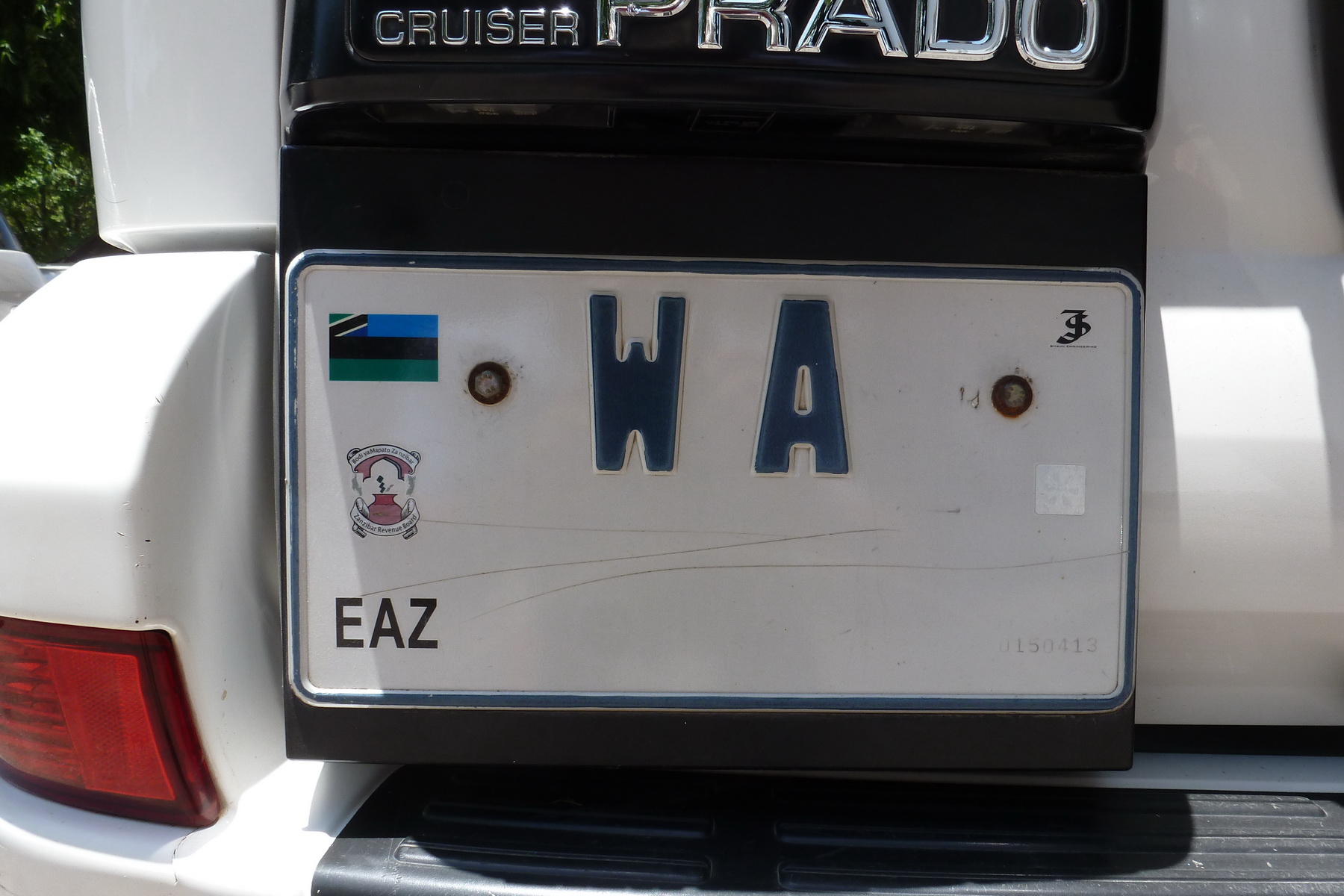
BELOW:     The world’s government officials enjoy the display of their authority via special plates (see Western Samoa) and Zanzibar is no exception.     Here are some Island Government Ministers’ plates – more code explanations will follow when my Swahili sharpens up…….
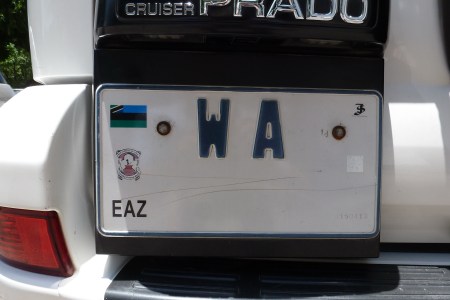
(EAZ)(gvmin)_WA_cr_VB2013

WA=WIZARA wa AFYA (Minister of Health)
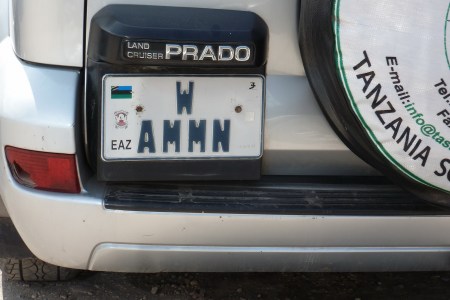
(EAZ)(gvmin)_W AMMN_cr_VB2013

W AMMN = WAZIRI ya ARDHI, MAJI, MAKASI & NISHATI            –           Minister of Land,Water, Housing and Energy                          Brumby archive

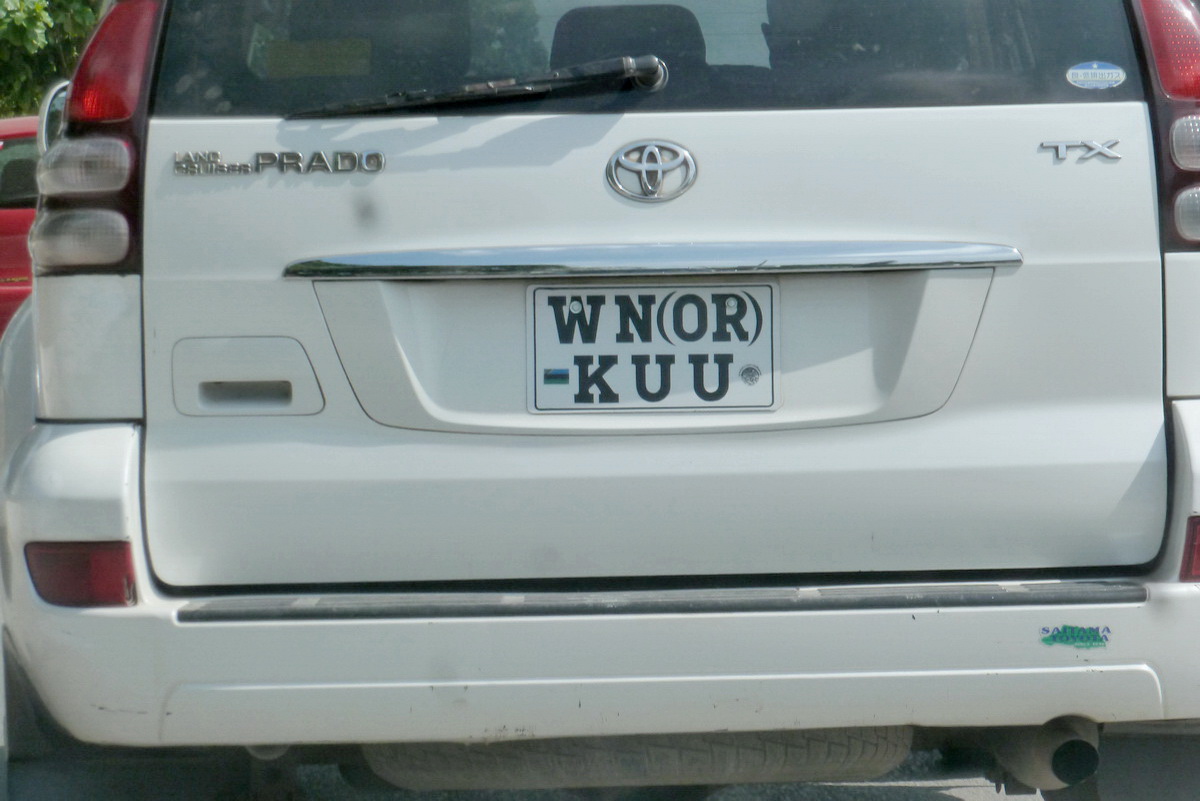
(EAZ)(gvmin)_WN OR KUU_VB2013

WN(OR) KUU = WAZIRI wa NCHI OFISI ya RAIS KAZI na UTUMISHI wa UMA:   Secretary of State in the President’s Office of Public Service Works.                    It is good to use abbreviations, when your job description is as lengthy as this!        Brumby archive
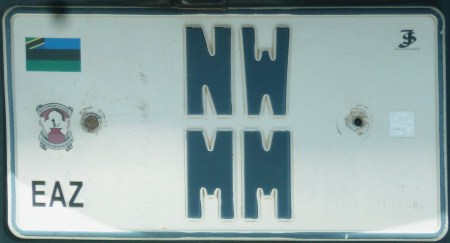
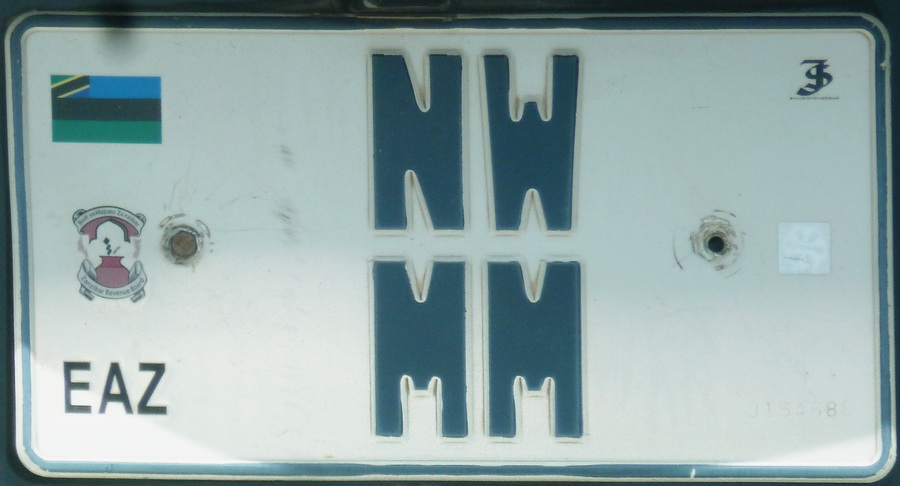
NW - Deputy (N) Wizara of an unknown department of government.

NW – (NAIBU WAZIRI wa MAJI  MALVADILO) –  Deputy Minister of the Depts. of Water and Agriculture

~~~~~~~~~~~~~~~~~~~~~~~

Then there are District and Regional Commissioners, also with new 4wd transport, to help them do their kindly duty to the peasantry.
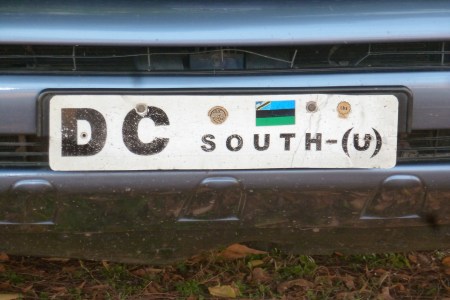
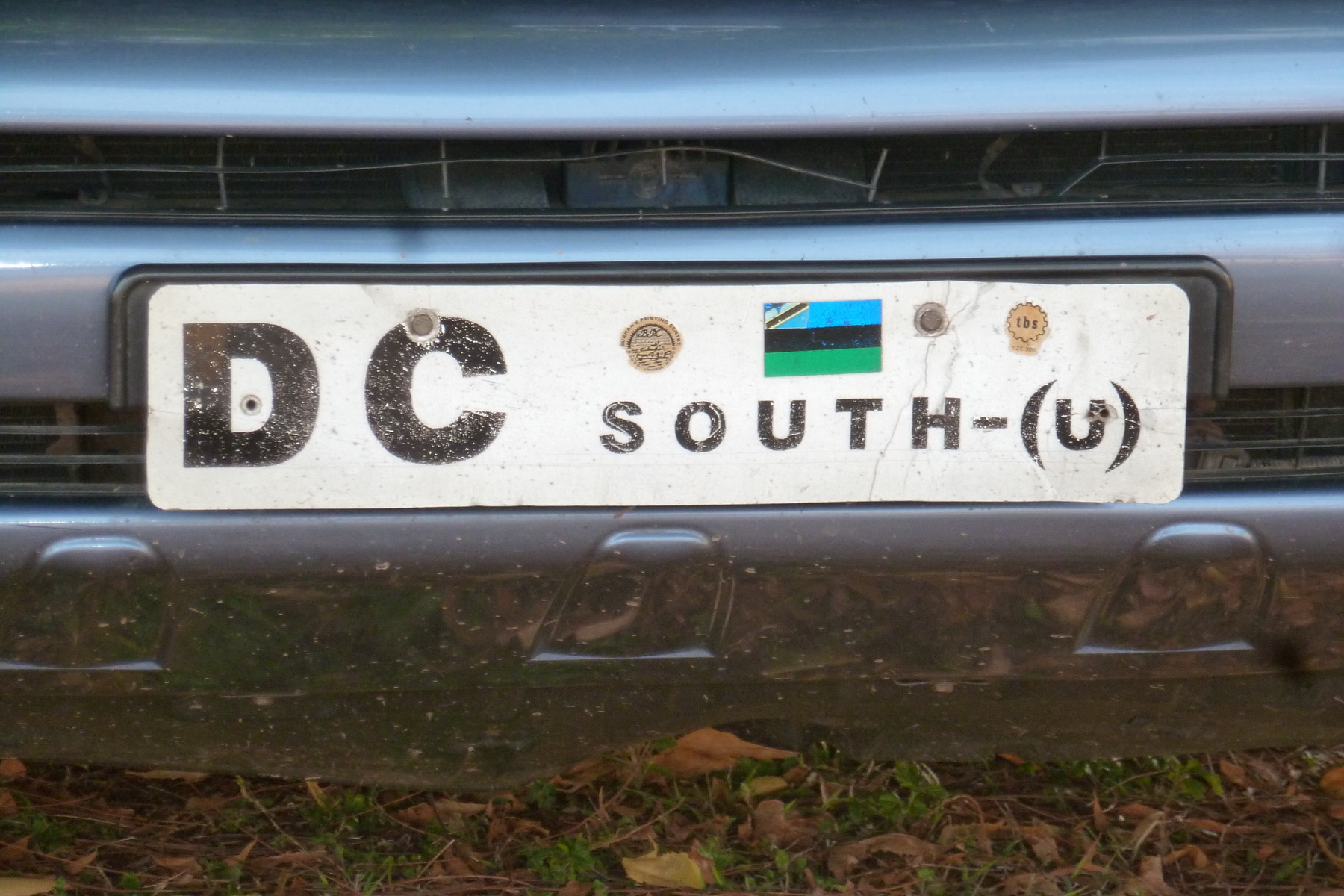
(EAZ)(gv)_DC south-(u)_cf_VB2013

DC = District Commissioner for Southern (Urban) Zanzibar
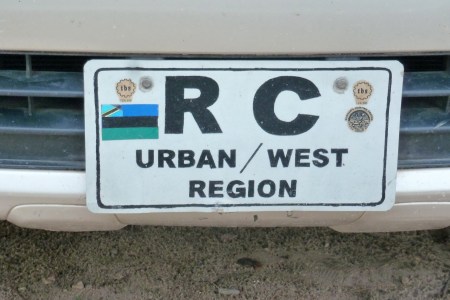
(EAZ)(gv)_RC Urban West_cf2_VB2013

RC = Regional Commissioner for Western (Urban) Zanzibar

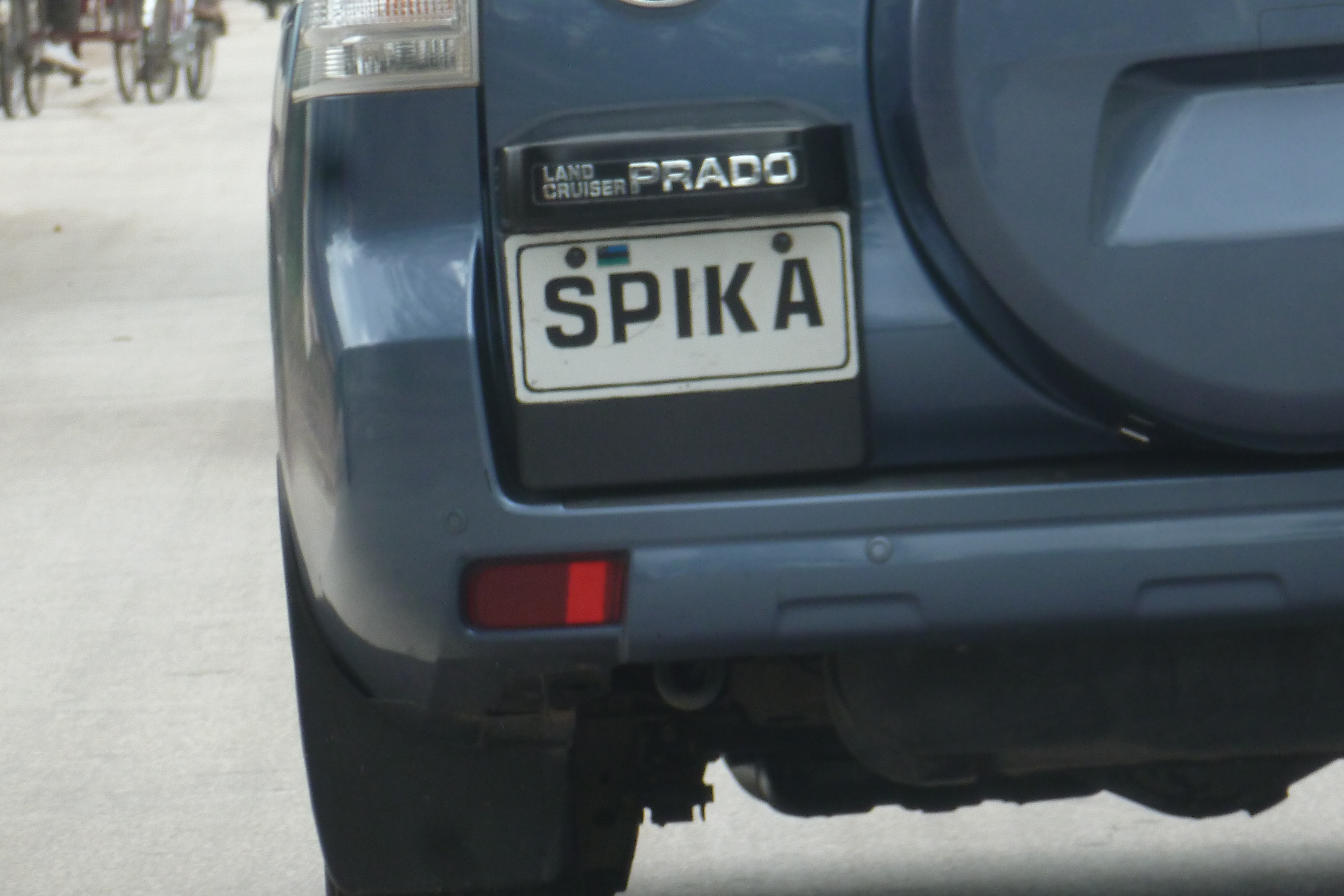
The Speaker of the House, presumably, speeding through the Stonetown traffic en route to deliver a stirring oration.       Brumby archive

The Speaker of the House, presumably, speeding through the Stonetown traffic en route to deliver a stirring oration++.                     Brumby archive

P1040951_resize

~~~~~~~~~~~~~~~~~~~~~~~~~~~~~~~~~~~~~~~~~~~~~~~~~~

The normal system, from 2008:

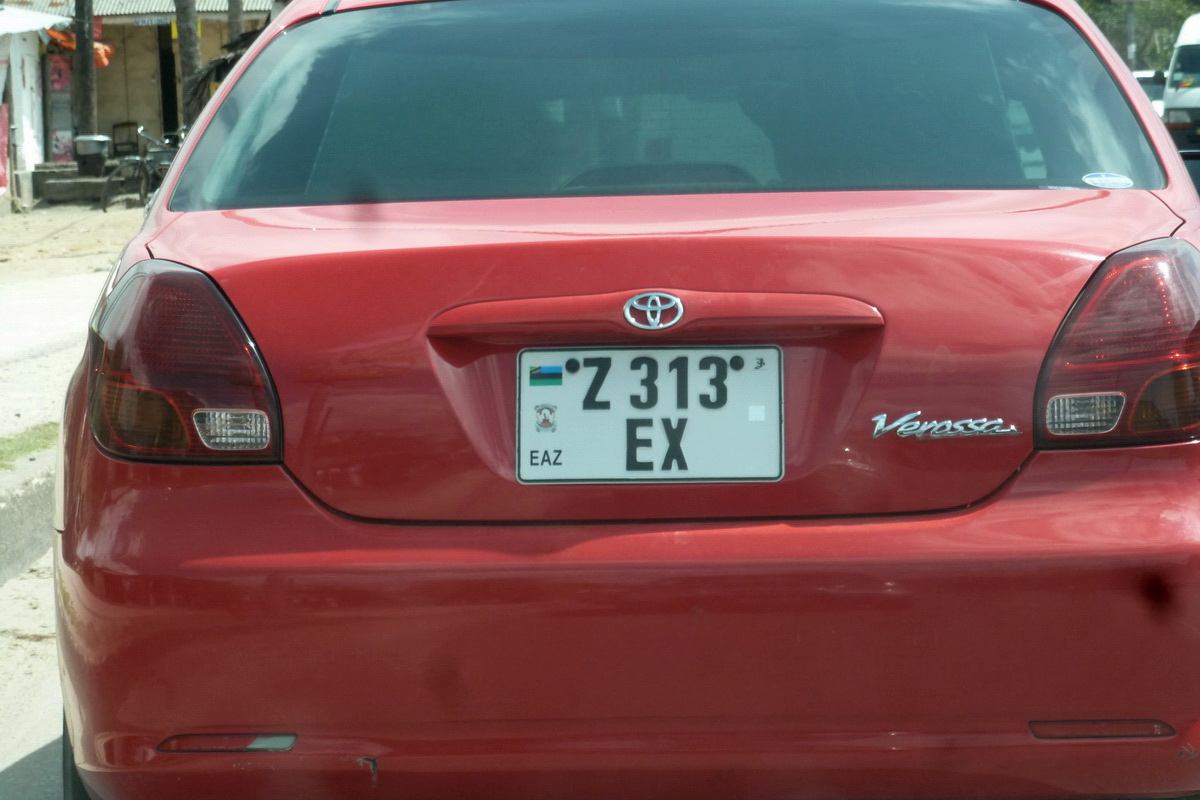
EX is the latest serial to be issued (Nov. 2013)   All vehicle types use the same series, but the plate colour changes according to the vehicle use  - Private (all vehicle types) Taxi, Tourist Taxi, Cargo/public carrier.

EX is the latest serial to be issued (Nov. 2013)      All vehicle types use the same series, but the plate colour changes according to the vehicle use – Private (all vehicle types), Taxi, Tourist Taxi, Cargo/public carrier.
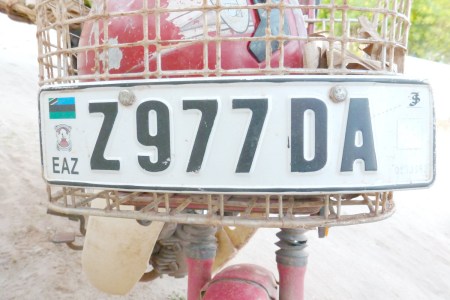
Motorcycle front plate in pressed alloy, for bikes which have somewhere to mount a long plate.    Otherwise, they use an adhesive sticker plate.

Motorcycle front plate in pressed alloy, for bikes which have somewhere to mount a long plate. Otherwise, they use an adhesive sticker plate.

The adhesive plates are particularly useful for the many Vespa scooters which are found on Zanzibar, and mount on the front apron.

The adhesive plates are particularly useful for the many Vespa scooters which are found on Zanzibar, and mount on the front apron.

Adhesive plate Z 830 AB mounted on a Vespa apron.      Brumby archive

Adhesive plate Z 830 AB mounted on a Vespa apron.       Brumby archive

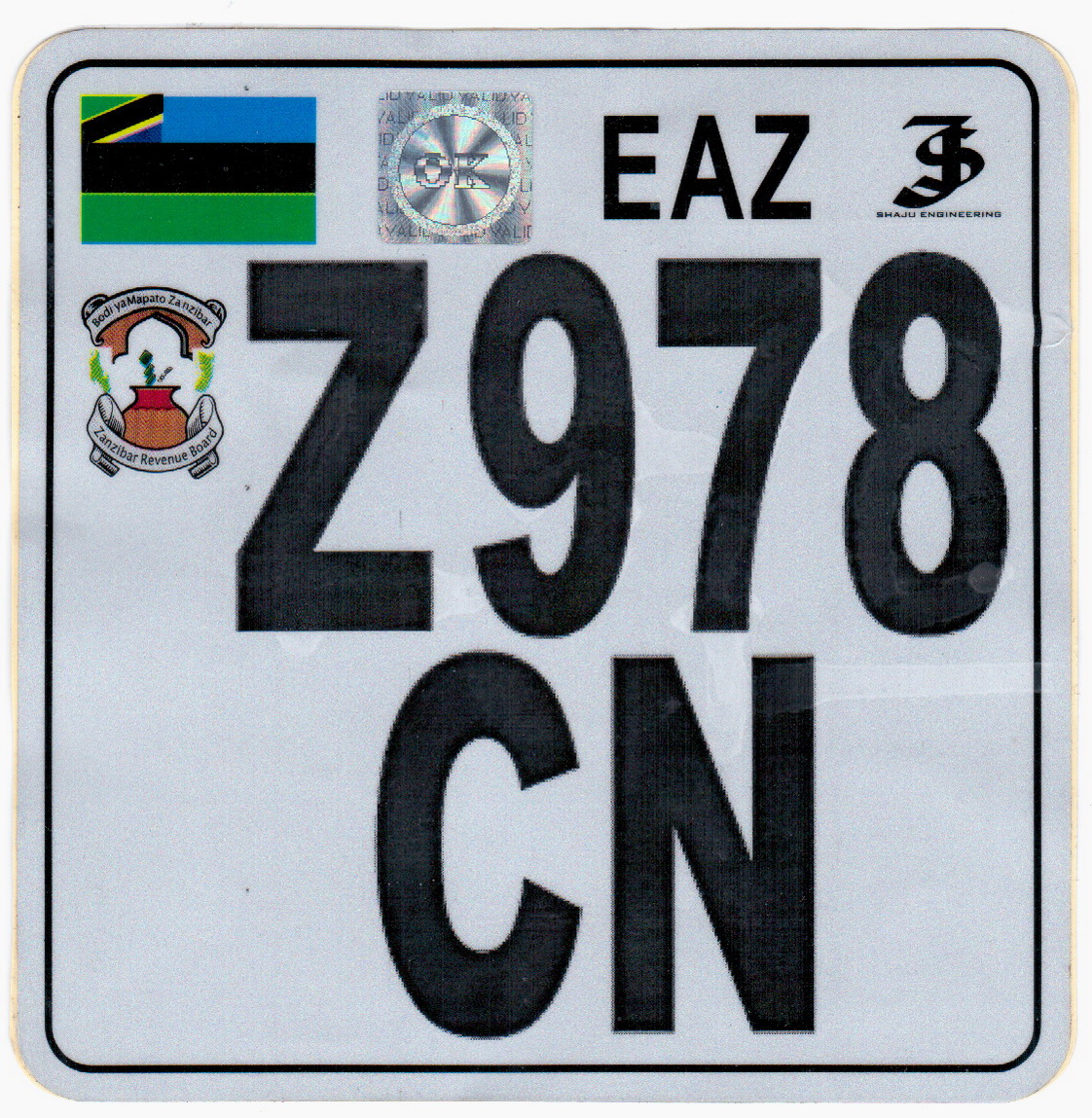
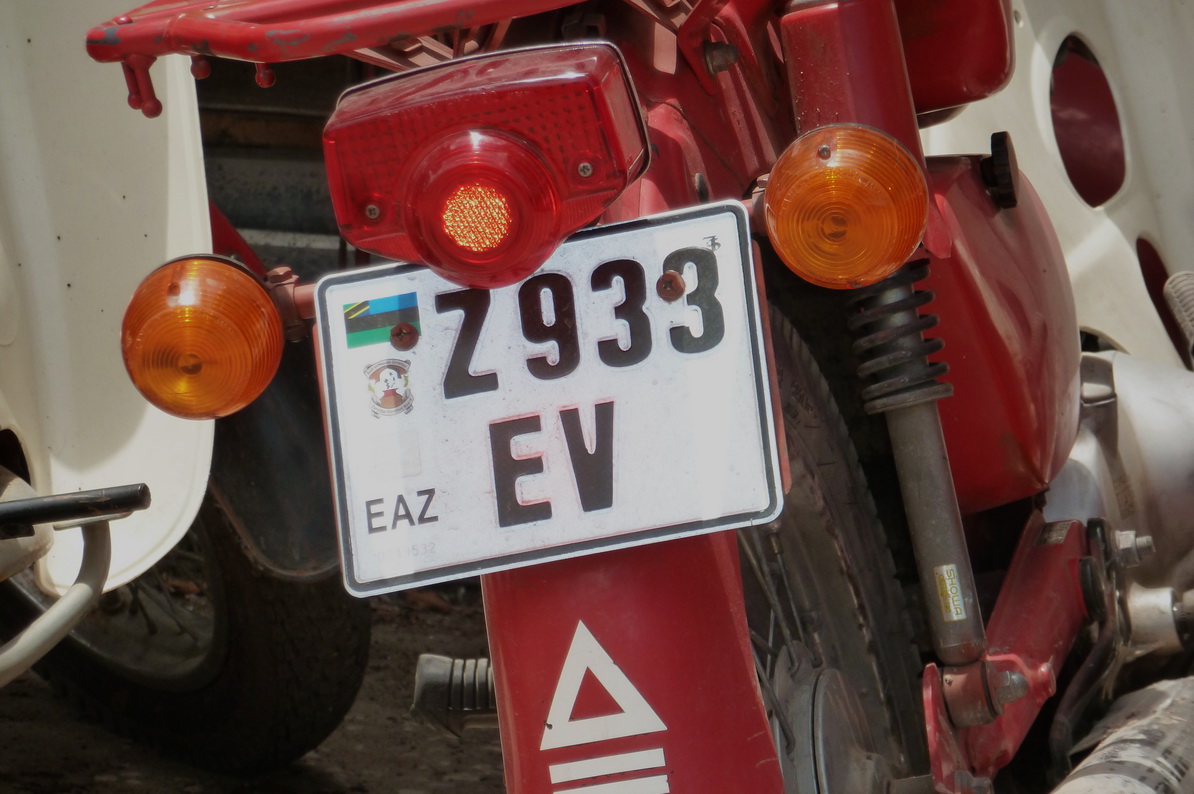
Pressed metal rear plate layout for all 2- and 3-wheelers

Pressed metal rear plate layout for all 2- and 3-wheelers

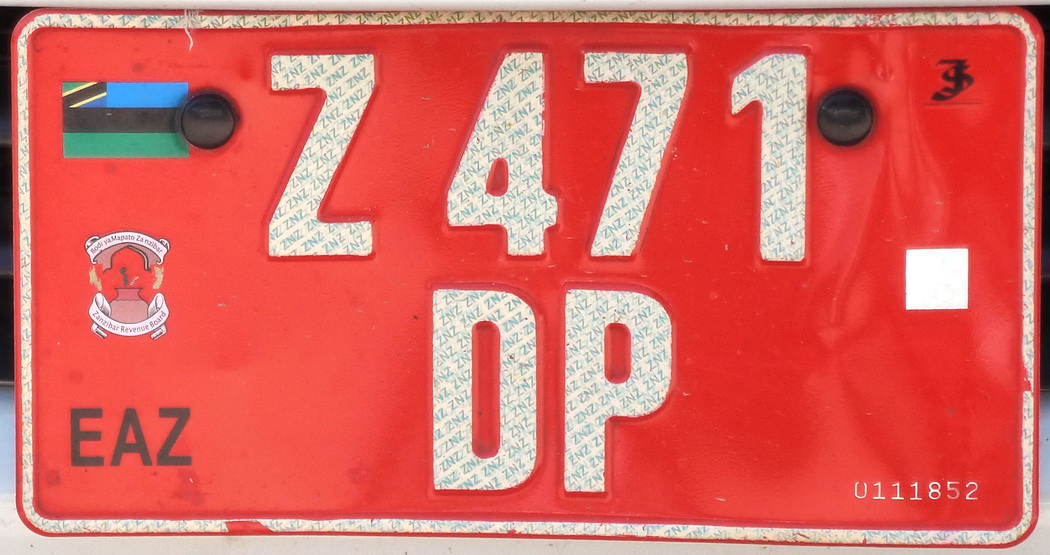
Normal taxis can be rather decrepit and receive these white on red alloy plates since 2008.     Newer, safer cabs use the same red background, buth with yellow digits,

Public Buses and normal taxis (which are rather decrepit) receive these white on red alloy plates from 2008.        Newer, safer cabs suitable for foreign visitors use the same red background, but use yellow digits     Brumby archive
Tourist Taxi using yellow on red pressed plates.

Tourist Taxi using yellow on red pressed plates.

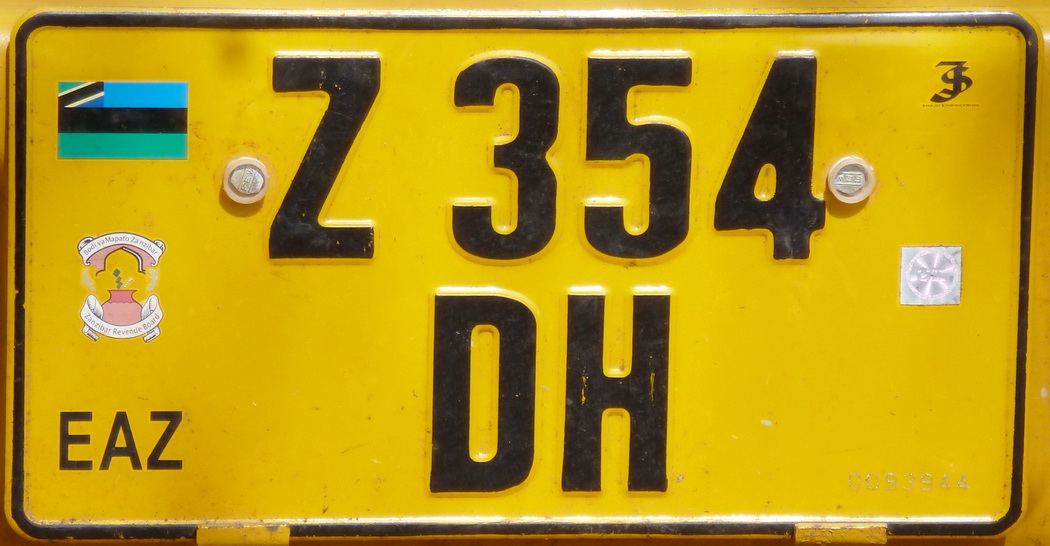
Lorry plates, for carrying goods for hire and reward, use a dark yellow plate with black digits, from the normal registration system.

Lorry plates, for carrying goods for hire and reward, use a dark yellow plate with black digits, the serials from the normal registration system.

It is interesting to note that EAZ uses white plates for private vehicles and yellow for commercial, whereas Tanganyika, the mainland component of Tanzania 20 minutes away by ferry, uses the reverse – white for commercial trucks and buses, and yellow for private vehicles……..    Vive la difference!   

~~~~~~~~~~~~~~~~~~~~~~~~~~~~~~~~~~~~~~~~~~~~~~~~~~~~~~

STAR PRIZE.      As a post-war car buff, I give the Medal of Zanzibar to this surviving Austin A35, carrying its plates from the c.1983 series. - - though not in use.     Who knows what previous series plates it may have previously botne?????      Brumby archive
STAR PRIZE. As a post-war car buff, I give the Medal of Zanzibar to this surviving Austin A35, carrying its plates from the c.1983 series. – – though no longer  in use.     Who knows what previous series plates it may have previously borne?????       It would have been the AA 6 type or the next, MYP 123 format (Both in British size/digits.)                             Brumby archive
One of the world's rarest plate sights............

One of the world’s rarest plate sights…………


The Rhodesias on camera

September 9, 2013

SR oval SOUTHERN RHODESIARSR oval 2 RHODESIAS-SOUTHERN RHODESIA


ZW oval ZIMBABWE

Southern Rhodesia to Zimbabwe

B is an early registration from Bulawayo on a Ford 'T', up-country!

B 89  —   is an early registration from Bulawayo on a Ford ‘T’, up-country!

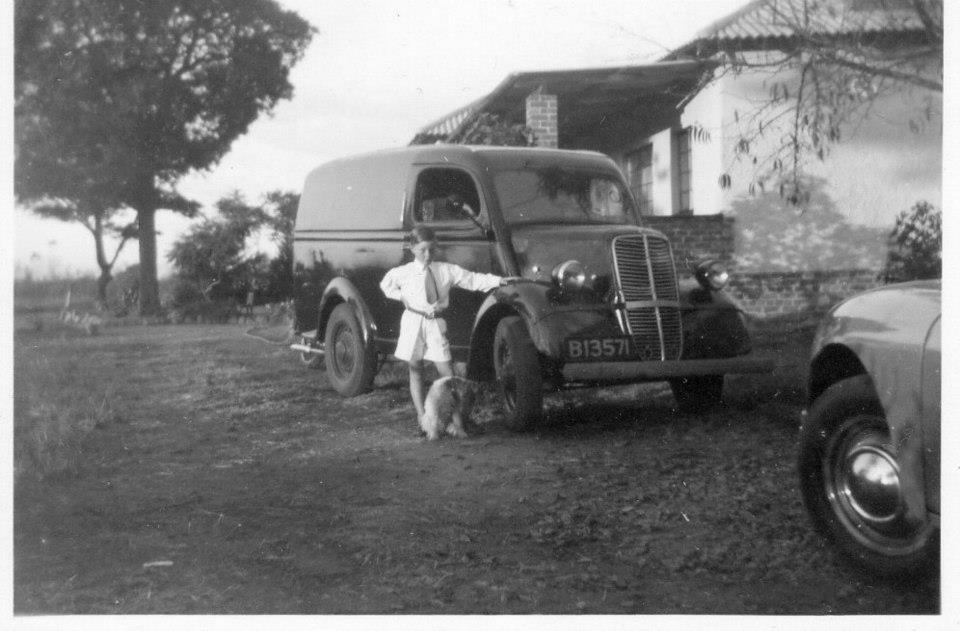
(ZW 28-60)(SR)_B 13571 _VBweb2013

B 13571 — The Fordson 10cwt. was the bumpiest ride you could get in 1952 – on good tarmac! In Rhodesia, it must have been known as The Dentist’s Friend.

(ZW 28-60)(SR)_B 374_r_VBweb2012

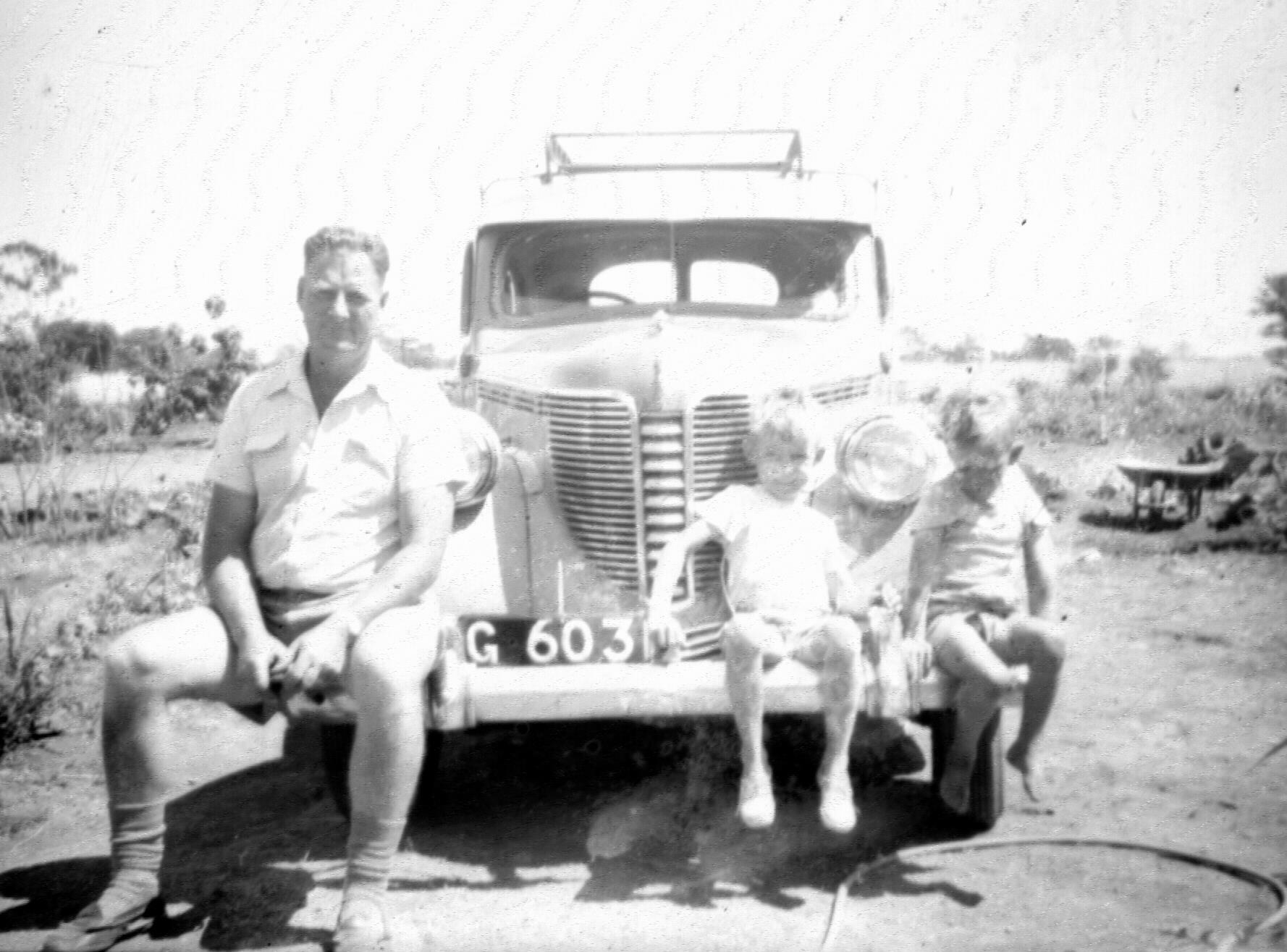
(ZW 28-60)(SR)_G 603_VBweb2012

(ZW 28-60)(SR)_U 573_VBweb2012


(ZW 28-60)(SR)_V 3748 _f_VBweb2012

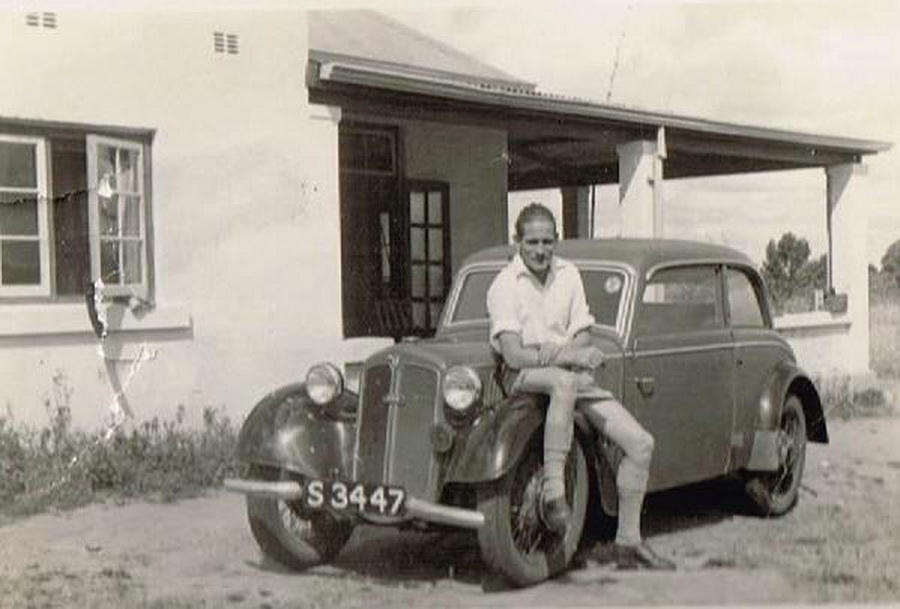
(ZW 28-60)(SR)_S 3447_VBweb2013

(ZW 28-60)(SR)_S 4172_VBweb(ZW 28-60)(SR)_B 31444_VBweb2012

(ZW 28-60)(SR)_S 28403_VBweb2012

(ZW 28-60)(SR)(mc)_S 977 C_VBweb2012


(ZW 28-60)(SR 58q4)_S 24661_disc_VB

A Morris Six in Salisbury about 1953.

S 19944 (SR) – A Morris Six outside City Hall in the capital, Salisbury, about 1952.    These cars were more often badged as Wolseleys and those were the standard British police car of the era.
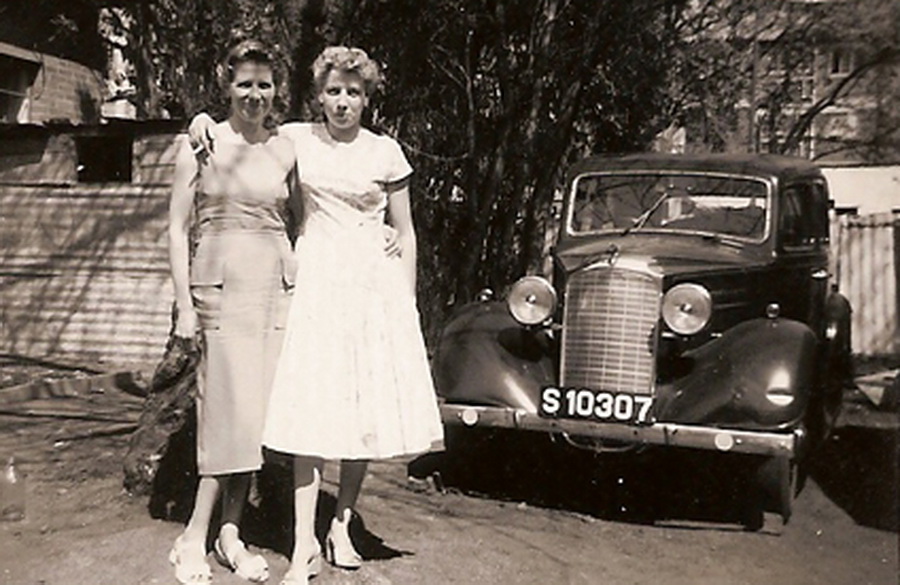
Vauxhall 14 circa 1946, also in S. Rhodesia about 1950.

S 10307  (SR) –  a Vauxhall 14, built 1939-46, also in Southern Rhodesia, about 1950.  (anon)

(ZW2)(28-60)(SR)(comv)_B 11888_VBweb2012

Commercial vehicles in Southern Rhodesia used reversed shades on their plates – This Leyland Octopus carries B 11888 in a black on white plate, about 1951.    This reverse was common in several British Commonwealth countries, though never used in Britain.      Anon

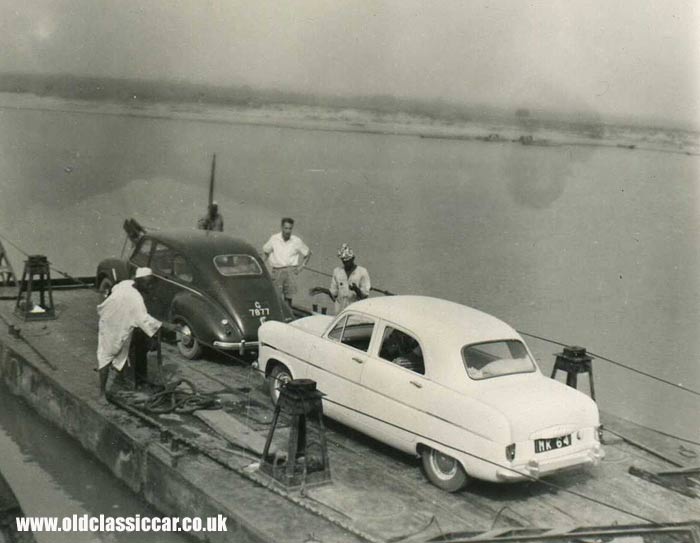
(ZW2)(SR)_G 7877 VBweb

These two plates were a bafflement at first, but are now agreed to be         G 7877 at the front of the river ferry, on an English Jowett Javelin of about 1950 vintage, from Southern Rhodesia. where G=Gwelo.       The (circa) 1952, Mark 1 Ford Zephyr behind, NK 64, is from Kitwe, Northern Rhodesia (in the 1929-63 registration series.)       It is difficult to establish where this ferry was, even having checked with Old Rhodesia Hands!!
Picture courtesy of Old Classic Car.

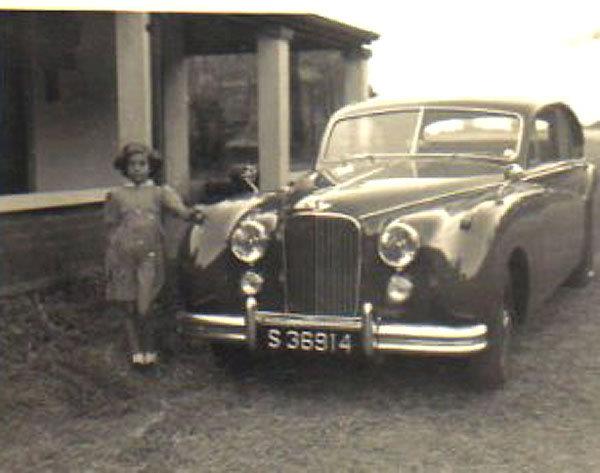
576789_498977626833832_66301402_n (1)

S 36914    A Mark 7 (or 8?) Jaguar registered in Salisbury, Southern Rhodesia, now Harare, Zimbabwe, shot in the mid-1950s.      In Jan. 1969, the S prefix was supplanted by RS (Rhodesia-Salisbury) and when reaching RS 9999, a serial letter commenced with RSA.   Gwelo, Bulawayo and Umtali offices also registered enough vehicles to warrant the adoption of that third, serial letter – RGA, RBA, RUA.  (anon)

The colonial government instituted a quite detailed system for registering state-owned vehicles, using a GT stacked prefix followed by a department code, in this case, PS for Police Service. After Ian Smith announced the Unilateral Declaration of Independence in 1965, no British vehciles could be sold to the regime and any supplier who would break the sanctions was a welcome help. Thus the previously inconceivable prospect of a foreign brand in use by the administration of a British overseas territory. Formasl independence was reluctantly granted in 1975 after which any brand of vehicle was to be sold in the new Zimbabwe. Brumby archive

The S. Rhodesian colonial government instituted a detailed system for registering state-owned vehicles, using a GT stacked prefix followed by a department code, in this case, PS for Police Service.      After new Prime Minister Ian Smith announced the Unilateral Declaration of Independence in 1965,  sanctions were applied and no more British vehicles would be supplied to the  ‘breakaway’ regime.      Any alternative supplier-nation which would break the sanctions was a welcome help – and plenty did.      Thus the previously inconceivable prospect of a foreign brand in use by the administration of a British overseas territory was at an end and such as this Alfa Romeo Giulia G/T PS 174 could be seen in government service.
Formal independence to the breakaway régime was reluctantly granted by London in 1975, after which any nationality of vehicle was to be available in the new Zimbabwe.       Brumby archive

This is thought to be a Rhodesian District Commissioner plate seen on a dumped Peugeot 504 at Kariba airfield in the 1990s. Brumby archive.

DC 371.     This is thought to be a Rhodesian District Commissioner plate, seen on a dumped Peugeot 504 at Kariba airfield in the 1990s.     However, the French brand was unlikely to have been used during the colonial period, so this would have been bought by the UDI régime after 1965…….The 504, launched in 1968, was also built in Kenya and Nigeria , which could have been other sources for this car.       Brumby archive

S 42605 (RSR). A few Rhodesian cars visited Britain until the 1970s and this Riley RM 1.5 litre was photgraphed in Earls Court, London, in 1960, wearing the RSR oval which had replaced the original SR. Brumby archive
S 42605 (RSR).       Quite a few Rhodesian cars visited Britain until the 1970’s.    This Riley RM ‘One-and-a-Half) model was photographed in Earls Court, London, during the 1960s, wearing the new RSR oval which from 1960 to 1979, had replaced the original SR, applied since the 1920s..        Brumby archive

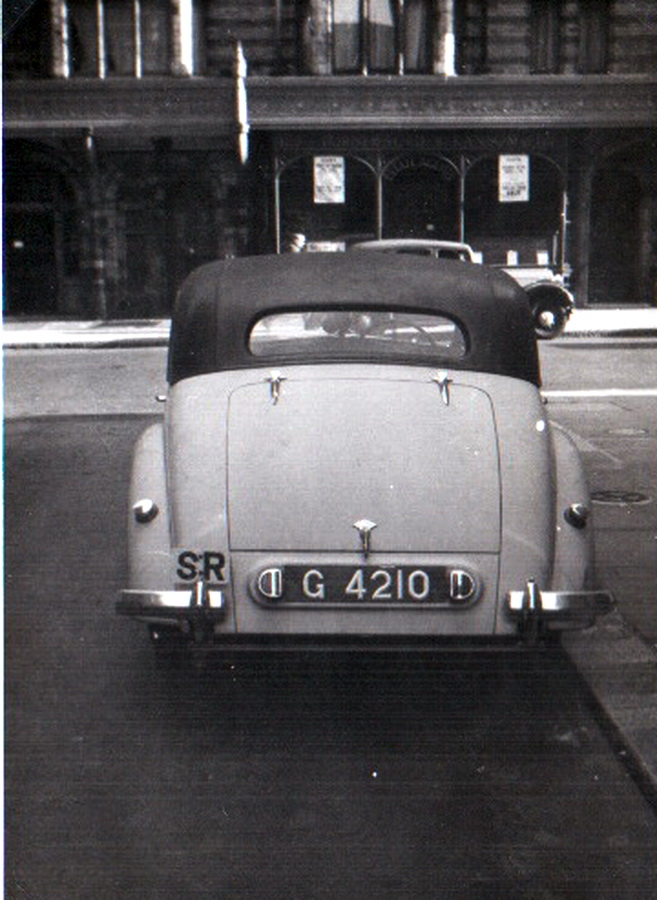
G 4210 is another Riley RM from Gwelo, seen in London in the 1960s. From th3 1928-1080 series. Brumby archive

G 4210 (SR) –  is another Riley RM, this one from Gwelo, seen in London in the 1950s. From the 1928-1970 registration series.         (Pemberton archive)


Northern Rhodesia (now ZAMBIA)

OLYMPUS DIGITAL CAMERA

OLYMPUS DIGITAL CAMERA(aa1 Z oval - ZAMBIA


Thus 2947 shot in Northern Rhodesia depicts an American car which readers might be able to identify. (Flickr)

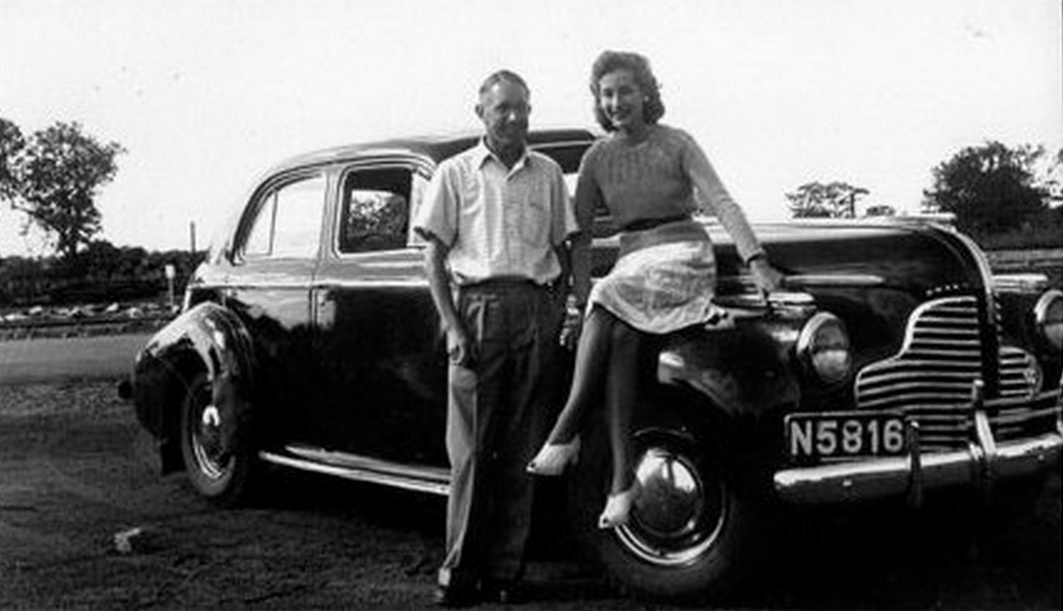
N 5816 (NR) – This  July 1947 shot in Northern Rhodesia depicts an American car which reader Karl identifies as a 1941 Buick..  Until 1947, N  was the code for N’dola District, when NN became the new code       (Flickr)

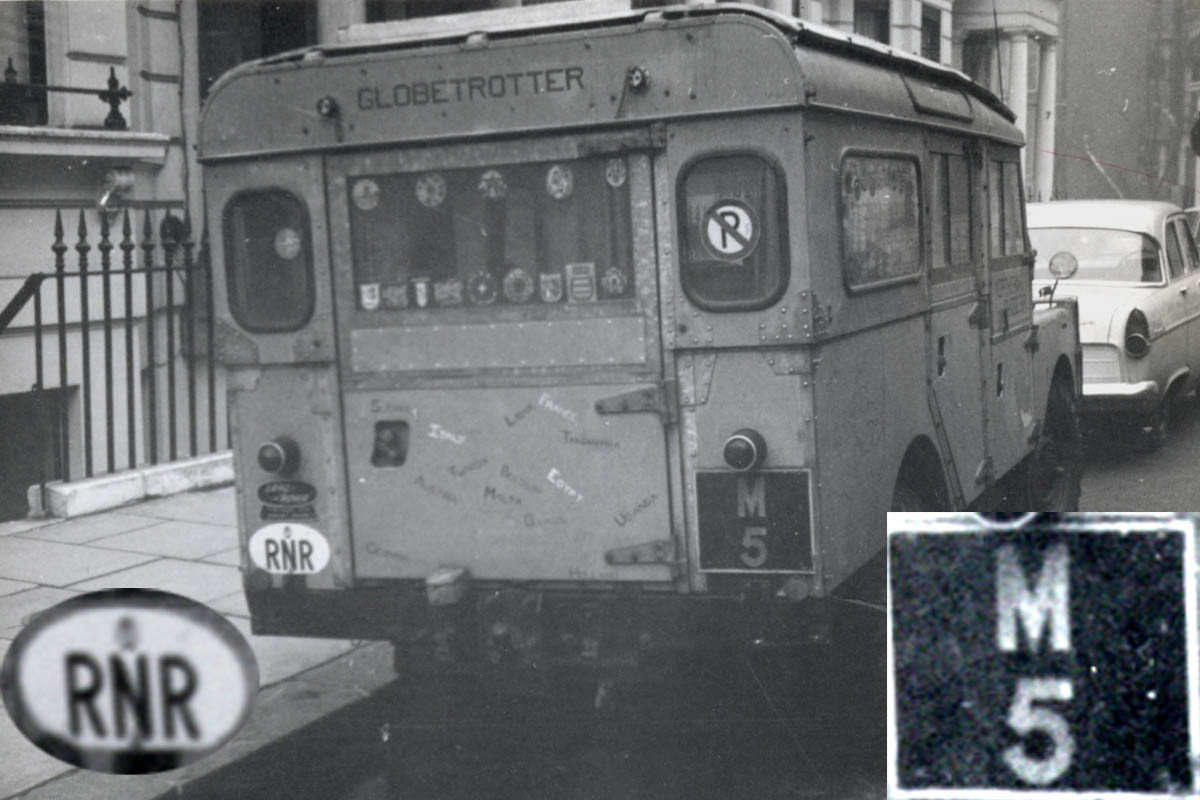
This Land Rover had driven from Rhodesia to London in 1962, with its low number M 5, from Fort Roseberry and Kawamba districts.

M 5 (RNR) —  This lwb Land Rover had been driven from Rhodesia to London in 1962, with its low number,   M 5, from the Fort Roseberry and Kawamba districts.         1938-60 was the duration of the (NR) international oval, then from 1960-65, (RNR), then (Z) was adopted, and is still in use today.     Independence came to Zambia in 1964.     Brumby archive

NRG was the code for the Northern Rhodesian Government and this is a rare, surviving picture of a Triumph police motorcycle. (Anon)

NRG was the code for the Northern Rhodesian Government and this is a rare, surviving picture of a the official plate on a police-operated Triumph motorcycle.  (model?)      (Anon)


A pair of Triumph enthusiasts received almost consecutive numbers in 1960s Northern Thodesia, to become indpeddnt Zambia in 1964, under

EA 7936 and 8  —  A pair of Triumph enthusiasts received almost consecutive numbers in 1960s Northern Rhodesia, shortly to become independent Zambia in 1964, under Kaunda who became its long-time dictator.   Rather as Hitler and Amin were foreigners in the countries they led, Kenneth Kaunda was a Malawian.       And a waste of space.


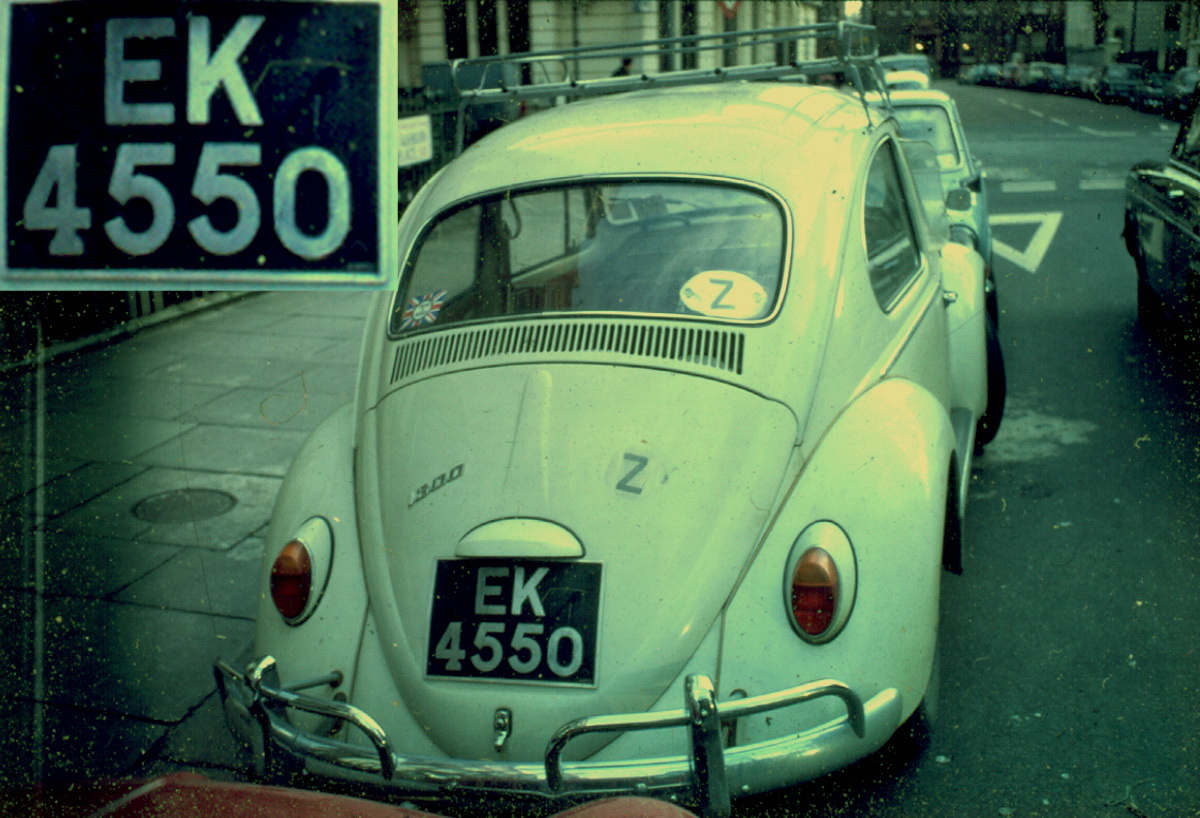
Also seen in London, but after 1965, because the RNR oval has been changed to the new Z code, signifying the new country name of Zambia. The 'EA, EK and ET' prefixes marked the town of Kitwe, centre of the copper belt. Brumby archive.

EK 4550 (Z)  —  Seen in London, but after 1965, because the RNR oval has been changed to the new Z code, signifying the new country name of Zambia. During 1964-75 the ‘EA, EK and ET’ prefixes marked the Western area including N’dola. Brumby archive 1973


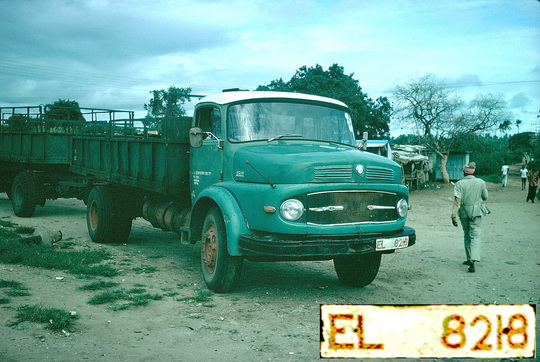
Zambian commercial vehicles used red on white plates, as this Mercedes truck photo'd in Nairobi in the 1970s. Brumby archive

EL 8218 (Z)   From 1964 and independence, Zambian commercial vehicles have used red on white plates, as this Mercedes truck photo’d in Nairobi in 1976.     Brumby archive

For a fee, or if you know Someone, It is possible to request an old registration to be re-issued; this Toyota pick-up is seen in South Africa in the 1980s. K had been the first letter used in Lusaka, in the late 1920s and early '30s. Nirther the font nor the colours are correct for the earlier period, however. Brumby archive.

K 323 (NR)  –  For a fee, or if you know ‘Someone’, It is possible to request an old series registration to be re-issued; this Toyota pick-up is seen in South Africa in 1992.     K had been the first letter used in Lusaka, in the late 1920s and early ’30s. Neither the font nor the colours are correct for the earlier period, however.        (Brumby archive.)

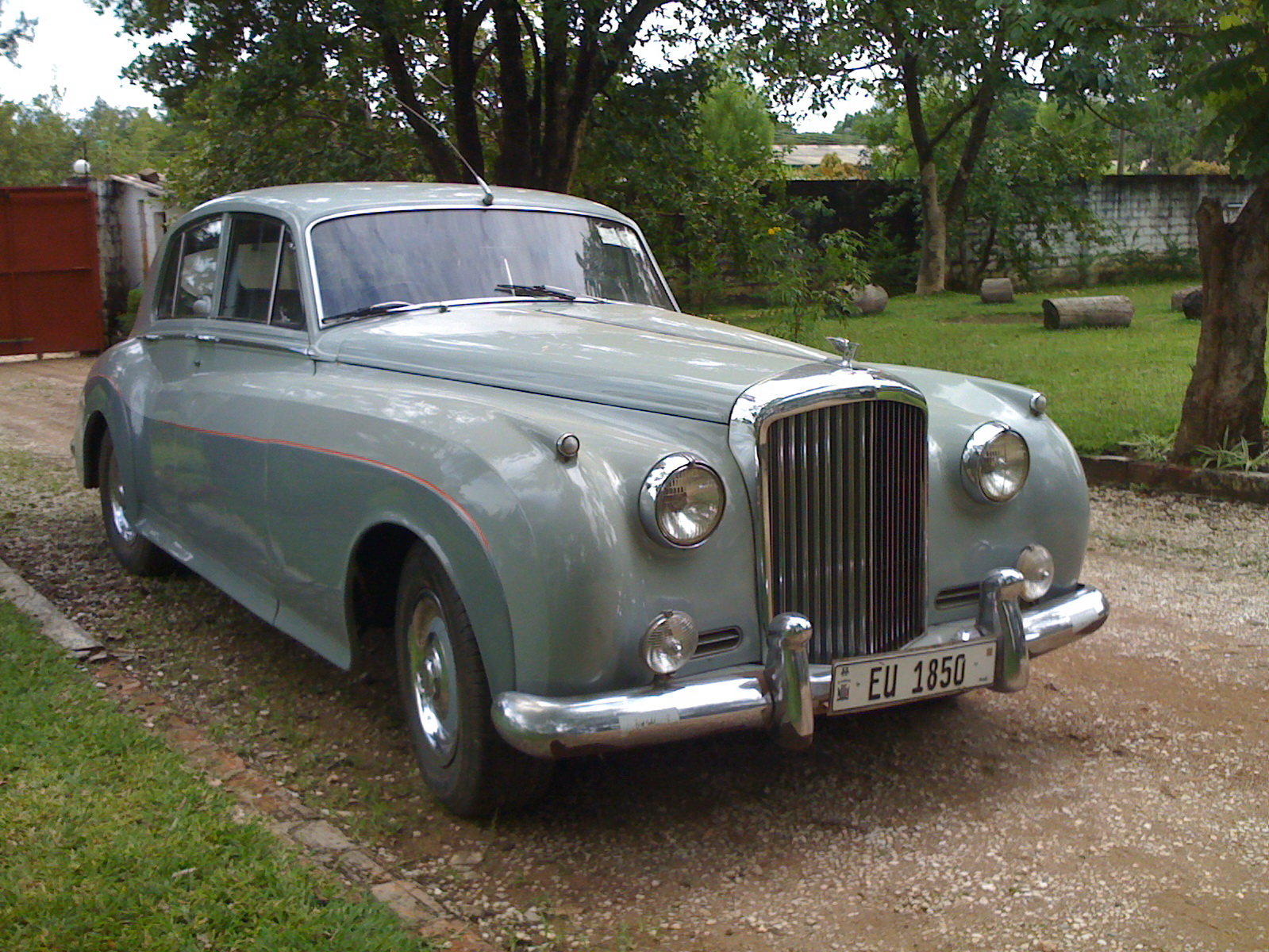
A yet newer adoption of an earlier=series registration is EU 1850, borne on a Bentley S3 from the '60s. EU would originally have been issued on the British design of plate, in white on black, but has been re-issued using the current Zambian format.

A yet newer adoption of an earlier-series Central (Lusaka) registration is EU 1850, borne on a Bentley S3 from the ’60s.      Code EU would first have been issued in the 1960s-75, using the British design of plate, in white on black, but has been re-issued using the 2000-and-on  Zambian backplate and colouring.


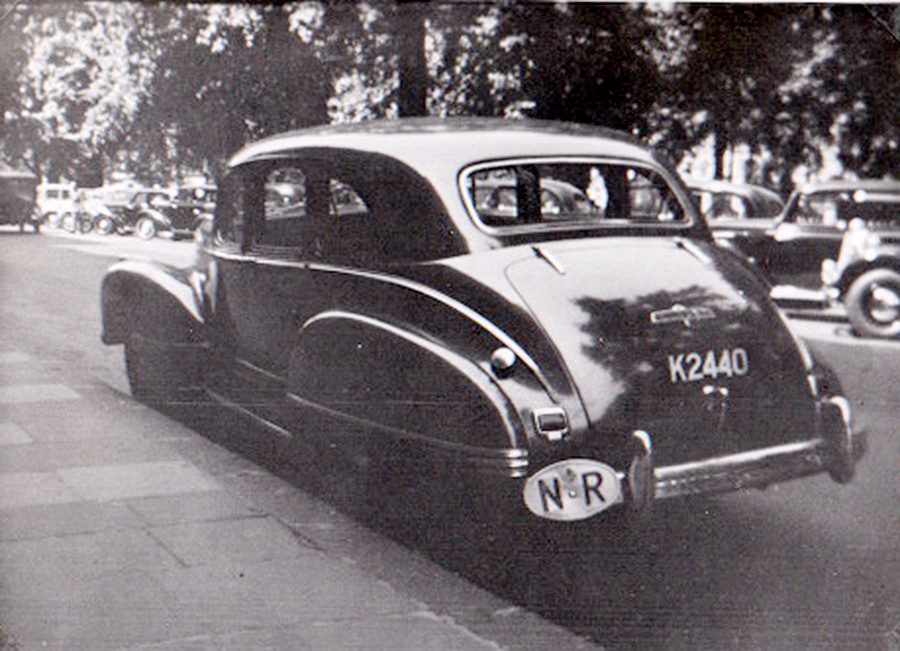
Here is the NR code 'K' of the period, seen borne on a vehicle in London by John Pemberton just before or just after the war. What a massive oval NR! (Pemberton archive)

K 2440 (NR)      Here is the Northern Rhodesian code ‘K’ of the 1930’s period, seen borne on an American 1941-6 model Hudson (Karl) in London and photographed  by John Pemberton just before or just after the war.     Note the massive NR plate; such ovals’ dimensions were firmly set by international law!          (Pemberton archive)

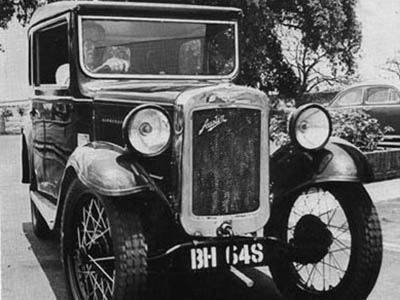
An early registrant in Broken Hill district was this 1930 Austin Seven BH 648.

An early registrant in Broken Hill district was this 1930 Austin Seven BH 648.

NK 6749 is carried by a Daimler Conquest Century, an unusual car for Africa, one surmises. These used preselector gearboxes - and lots of interior walnut trim! NK=one of the codes for Kitwe.

NK 6749 is carried by a Daimler Conquest Century, an unusual car for Africa, one surmises. These used preselector gearboxes – and lots of interior walnut trim!    Note the AA badge, surmounted by the name of the country in which it was a member.   Such badges are now extremely rare.       NK=one of the codes for Kitwe.   (anon)

At independence in 1964, diplomatic recognition became the responsibility of the new government. By 1992 when this was taken in South Africa, Botswana (embassy code 22) seemed to have six cars registered at the Zambian capital. Brumby archive.

22 CD 6Z  —  At independence in 1964, diplomatic recognition became the responsibility of the new Zambia government.    By 1992 when this shot was taken in South Africa, Botswana (embassy code 22) seemed to have six cars registered at the Zambian capital.        Brumby archive.


From 2000, Zambian plates are long or square and use LLL NNNN format with a national symbol. Like many countries, their plate system is designed and implemented by a German specialist company, Utsch.

From 2000, Zambian (Z) plates are long or square and use LLL NNNN  format with a national symbol.   Reflective white, front and rear.     Like many countries, their plate system is designed and implemented by a German specialist company, Utsch.  The white front plates are similar to those of  neighbouring Zimbabwe – see next……   Brumby archive


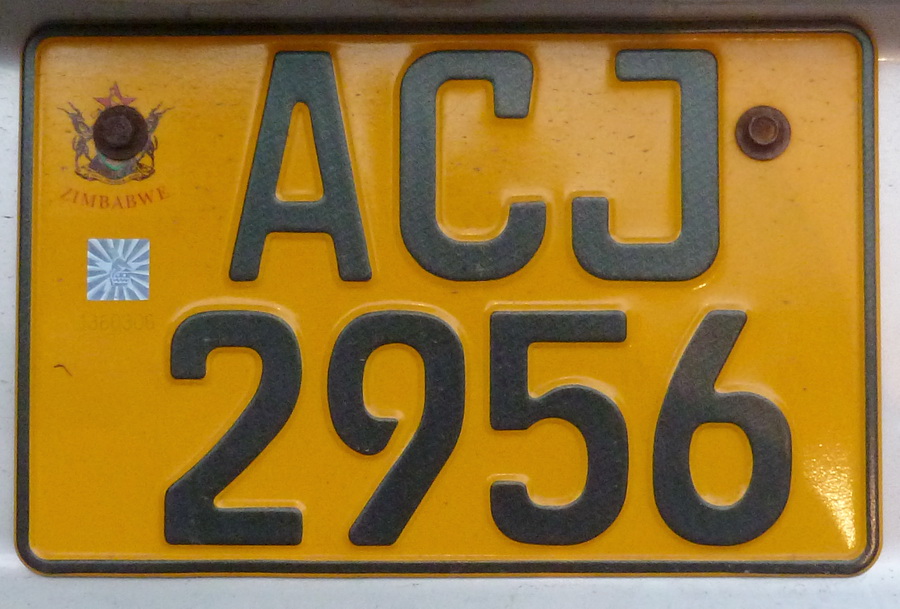
The 2006 Zim series. It uses a different font to the Zambian and a similar, but different symbol.

ACJ 2956  —  (ZW) – The 2006> Zim series.     It uses a different font to the Zambian and a similar, though different, symbol and is yellow, front and rear.


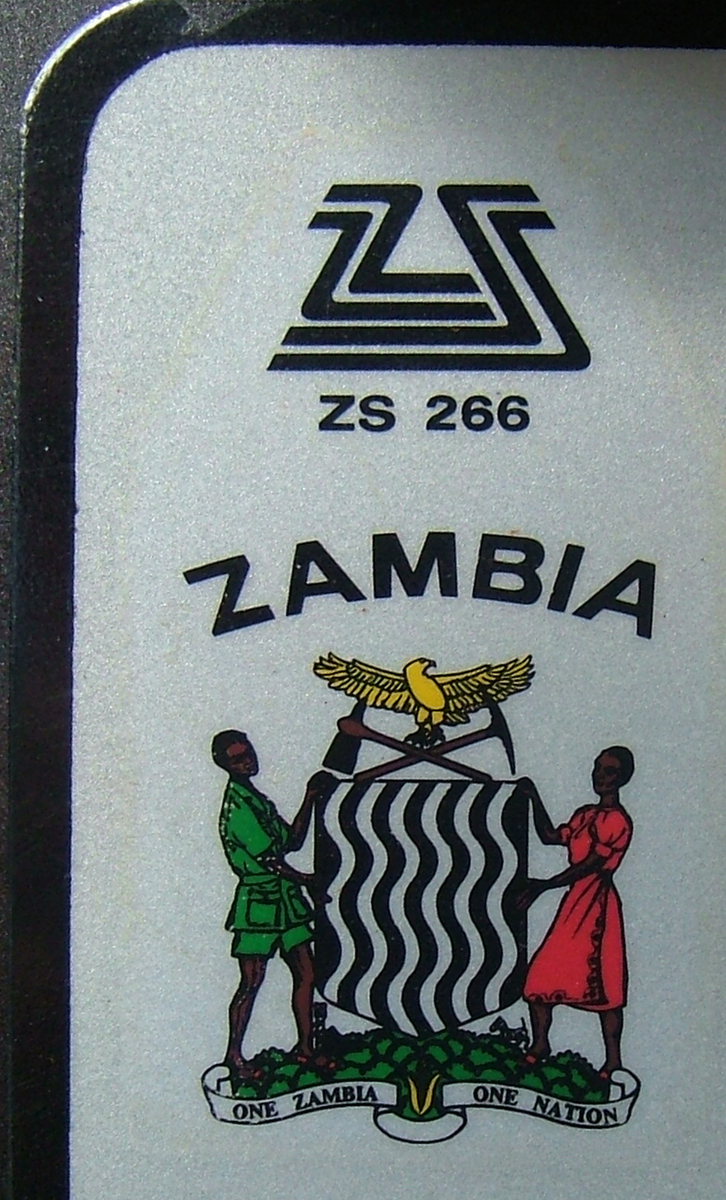
Detail of the current Zambia symbol

Detail of the current Zambia symbol

~~~~~~~~~~~~~~~~~


Terry Gray’s slides come to life

August 18, 2013

There will be a fuller account of the great period shots gathered by early founder-member  Gray, when time permits.     For now, just relish a few picked at random from his newly-digitalised photo transparency slides.

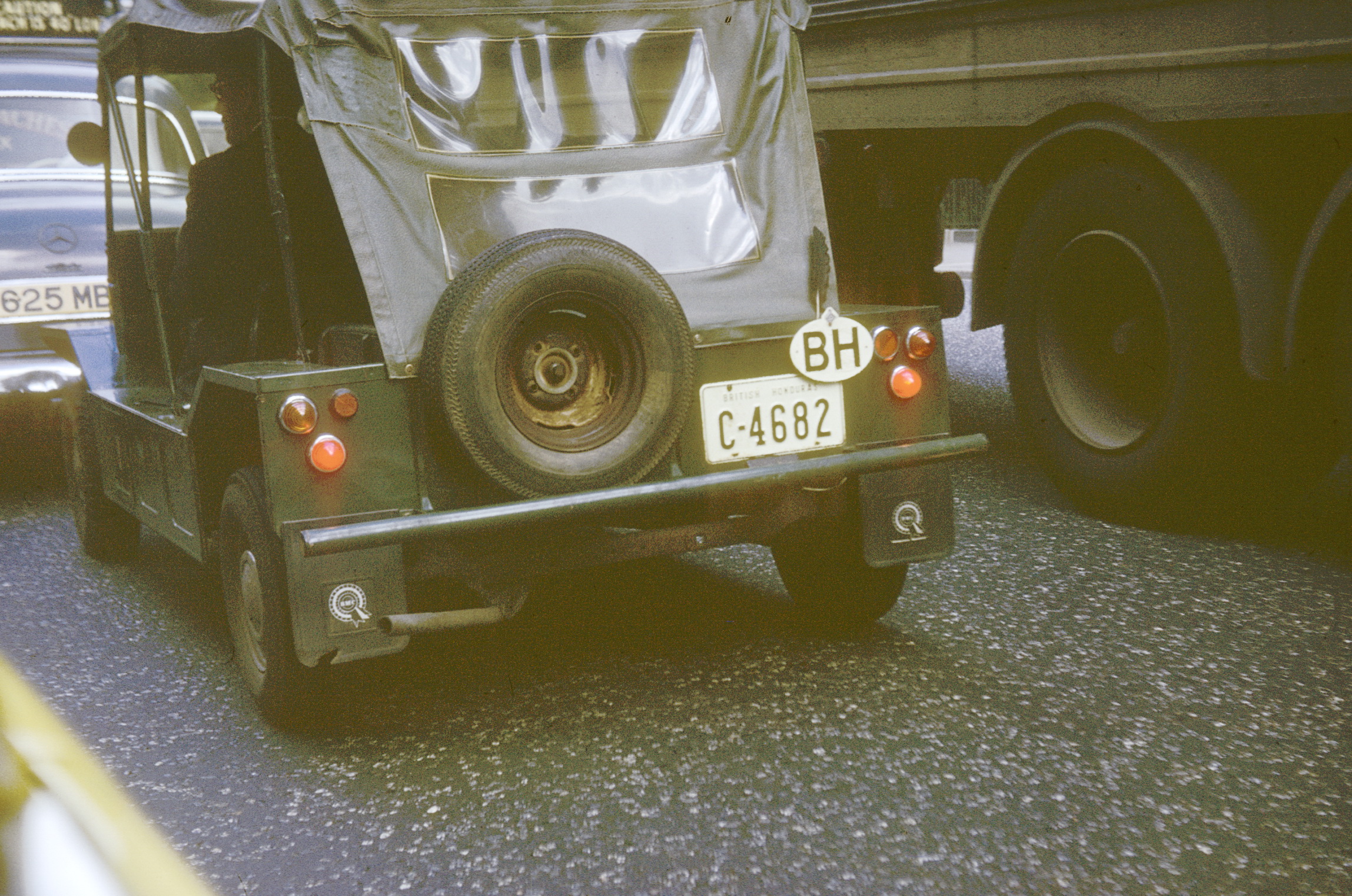
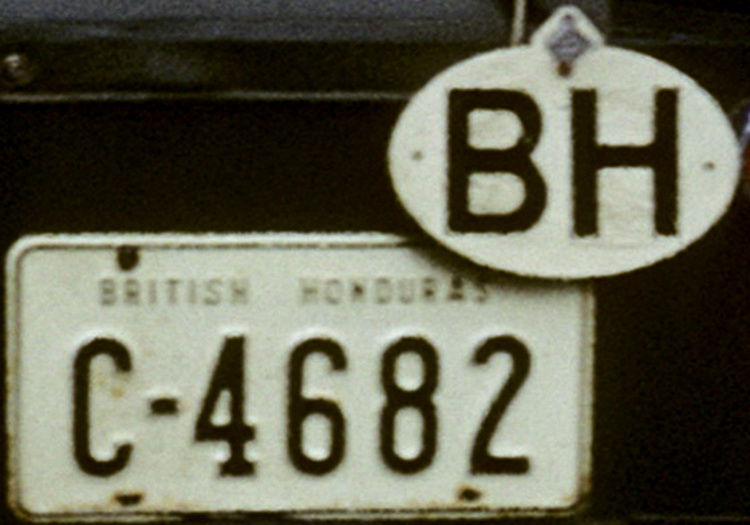
A mini-Moke in London in the 1960s with the ultra-rare pre-Belize series for British Honduras.   C=Corozal.    AND a BH oval, properly manufactured by the RAC.   Bet they didn't sellmany of them!    Gray archive.

A Mini-Moke in London in the 1960s with the ultra-rare pre-Belize series for British Honduras. C=Corozal.      AND with a BH oval, properly manufactured by the RAC.     Bet they didn’t sell many of them!                        Gray archive.

(BZ 65-73)(BH5)_C-4682_cu_TG2

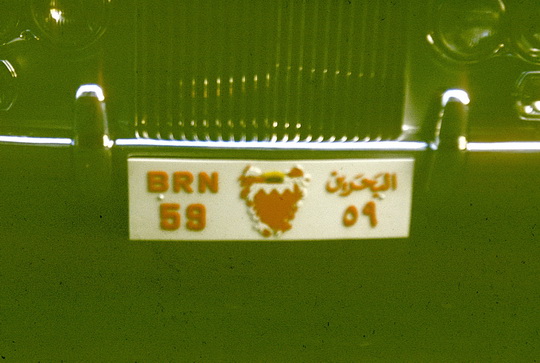
Soon after the Rolls-Royce Silver Shadow was launched about 1968, this Bahrein emir brought his new car to London.    Gray archive

Soon after the Rolls-Royce Silver Shadow was launched about 1968, this Bahreini emir brought his new car to London. Gray archive

A Venezuelan export plate seen in London in circa 1969.   Gray archive.

YV – 105    A blue Venezuelan export plate seen in London in circa 1969. Gray archive.

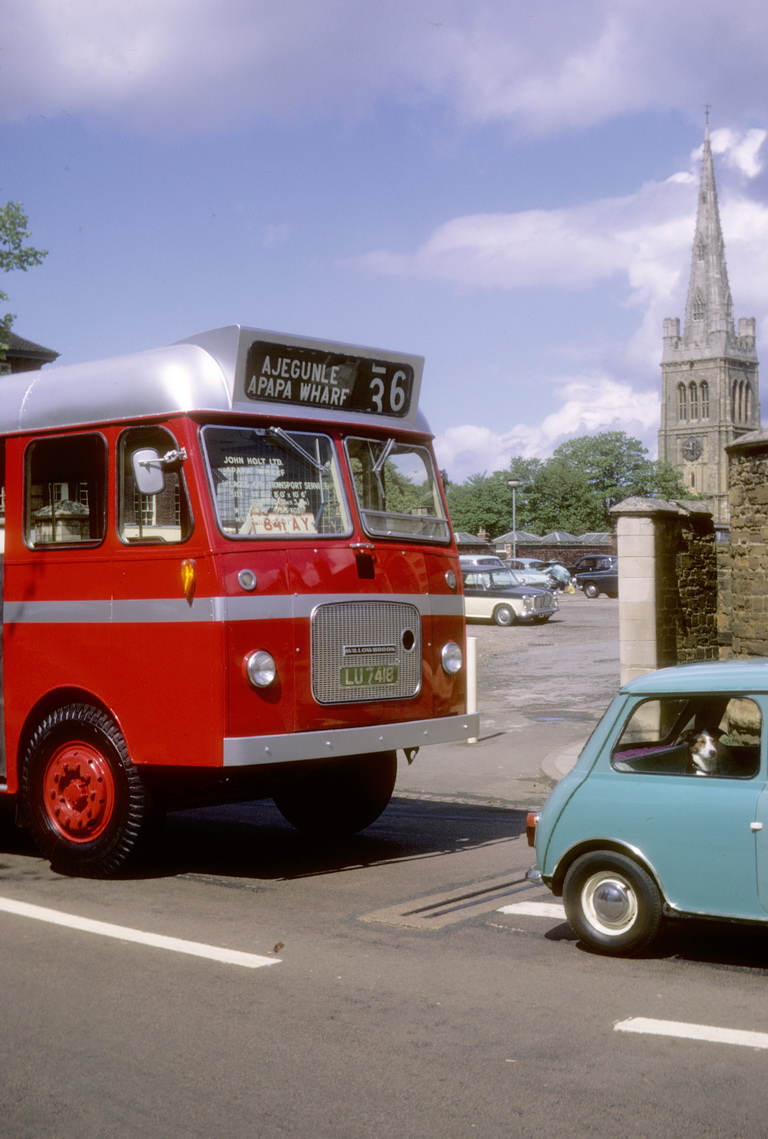
A batch of new buses passed Kettering in the late1960s in transit to the docks and their passage to Nigeria.    Already plated for use in Lagos, and using a green background not usually associated with WAN plates.    Gray Archive

WAN Nigeria – LU 7416.    A batch of new  Willowbrook-bodied Leyland Comet buses passed through Kettering in the late 1960s in transit to London docks and their sea-passage to Nigeria.     Already plated for use with the Lagos City Transport Service, and using a green background not usually associated with WAN plates, they were running on Leicestershire AY trade plates.       (NOT Alderney!)            Gray Archive 1968c

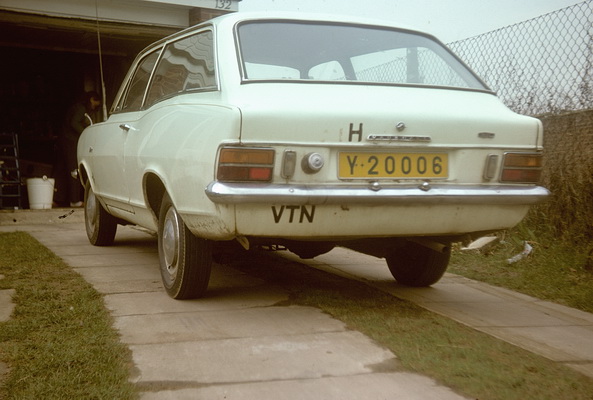
Y-20006, a Vauxhall Viva estate car from  the British embassy in Saigon during the 1970s.     See in England, carrying an unofficial 'oval' of (VTN).   I seems that the car had previously been posted in Budapest with its diplomat owner.     Gray archive

Y+20006, a Vauxhall Viva estate car from the British (definite) embassy in Saigon  during the 1970s.     Photo’d in England in 1976, carrying an unofficial ‘oval’ of (VTN). it seems that the car could have previously been posted in Budapest with its diplomat owner.   (See postscript 29 Sep.2013)       Gray archive

P.S.   I now learn from Ivan Thornley that the Vietnamese Vauxhall Y 20006 had not previously been registered in Hungary (H), but in Ethiopia (ETH)!     The owner had not finished removing his home-made IRC stickers.     (Those would have been fine plates to see on-car………)

Here another GB embassy plate, this time on a Land Rover in Saigon, 1970s.  Brumby archive

Y+00137   Here’s another VN GB embassy plate, this time on a Land Rover in Saigon, 1970s.     Brumby archive

Mowqati 673, and Afghan Foreigner (M and green) on a Mercedes 190 in Britain did not escape TG's eye or camera.      A very rare sight indeed.  Gray archive

Mowqati 673, an Afghan Foreigner (M and green) from Kabul ,on a Mercedes 190 in Britain did not escape TG’s eye or camera.    A very rare sight indeed.        The overseas-issued Automobile Association badge is of interest, but the country of origin crest is illegible.     Gray archive c.1972

Aden was a moderately-frequent 'spot' in the 1960s, due to the commercial and military establishments in that then-British colony.     After the India-issued ADN series were changed in the 1950s, L, M, and N became the serials used in the Aden Colony.    Independence and the amalgamation with South Yemen closed down sightings and info from that hot zone, for many years after.    The car is a French Renault Floride, seen in GB.     Gray archive.

L 8829 ADEN     Aden was a moderately-frequent ‘spot’ in the 1960s, due to the active commercial and military establishments in that then-British colony.    Aden was administered from British India from the 1910s and employed the BI system, with code ADN.    Under later colonial administration, it changed in the 1950s, first to the prefix 2ADN, when, reaching 9999 again, L, then and N became the leading letters used in the Aden Colony.   (No-one knows why those letters were chosen).    Independence and the later amalgamation with South Yemen closed down sightings and info from that hot zone, for many years after. The car is a French Renault Floride, seen in GB.       Gray archive.

(A)(exp73)_G90.803_TG1973

AUSTRIA FOREIGN RESIDENT/EXPORT SERIES.      Graz is the registration area for this German-built Ford Taunus 17M, photo’d in Austria in 1973 before leaving for its ultimate export destination.     Most European countries offered a facility to purchasers from abroad, to collect their new European car, tax-free, from factory or dealer, to tour Europe for up to 6 months and then return it to the supplier for shipment to their country of origin – or even drive it home themselves.     With their acquired mileage they could be imported to their home countries as second-hand cars, so that their local import duties would be lower.      Tens, if not hundreds  of thousands of vehicles were supplied under these tax-free schemes.        Gray archive.

May 2014 q.           Can anyone say whether this Austrian series was used both for export and for identifying foreigners who came to live in Austria for extended periods, perhaps even with tax-free status?    There have always been too many of them around to be only for vehicles awaiting export, it seems……..

2015  — marcellotaverna@alice.it writes:    The blue plates with a red dated band are called “temporary registration marks” and they are issued, on request, to “anyone not having his main residence, or legal seat or main facilities in Austria, upon exhibition of the required documents….”. Further “if the vehicle comes from abroad, a valid foreign approval document will be accepted”   It seems that these plates are issued to foreign persons or companies, both for export or for temporary import.


~~~~~~~~~~~~~~~~~~~~~~~~~~~~

Some additions at Sept. 29th. – notes to add later

(AND 60-80)(exp75)_MT-6282_TG1975

MT-6282  —  Andorra’s duty-free foreigner export series valid to 1975.     MT =  ‘Temporary Matriculation’.                                   Gray archive 1974

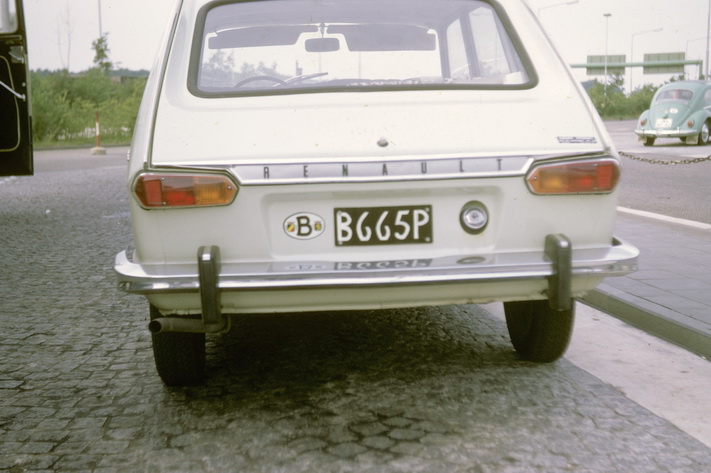
(B 58-07)(BfinD)_B.665.P_TG
This Belgian Forces in Germany car has replaced the official white on red plate with a home-made one. B.665.P.                                                            Gray archive, pictured in Germany circa 1974

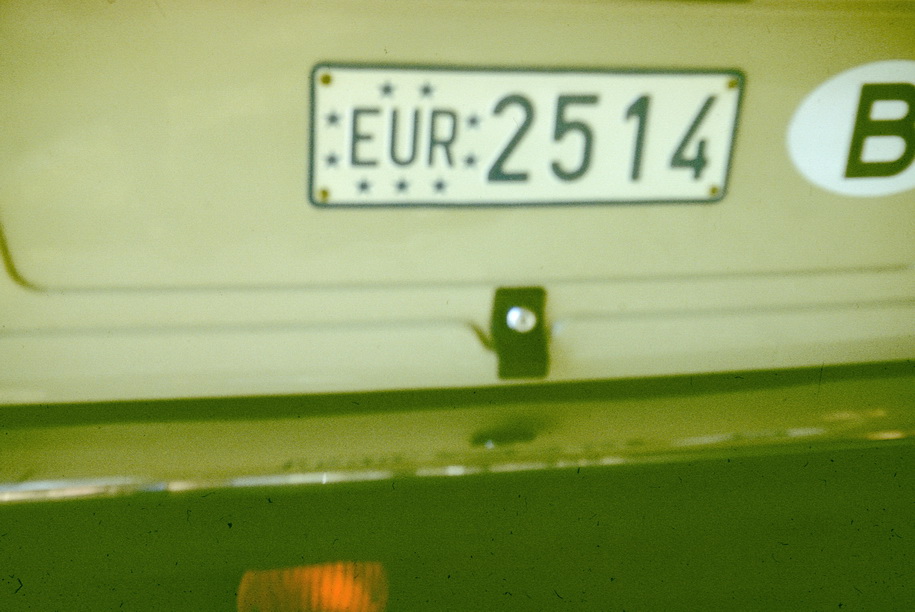
(B 75-00)(Eur)_EUR 2514_TG

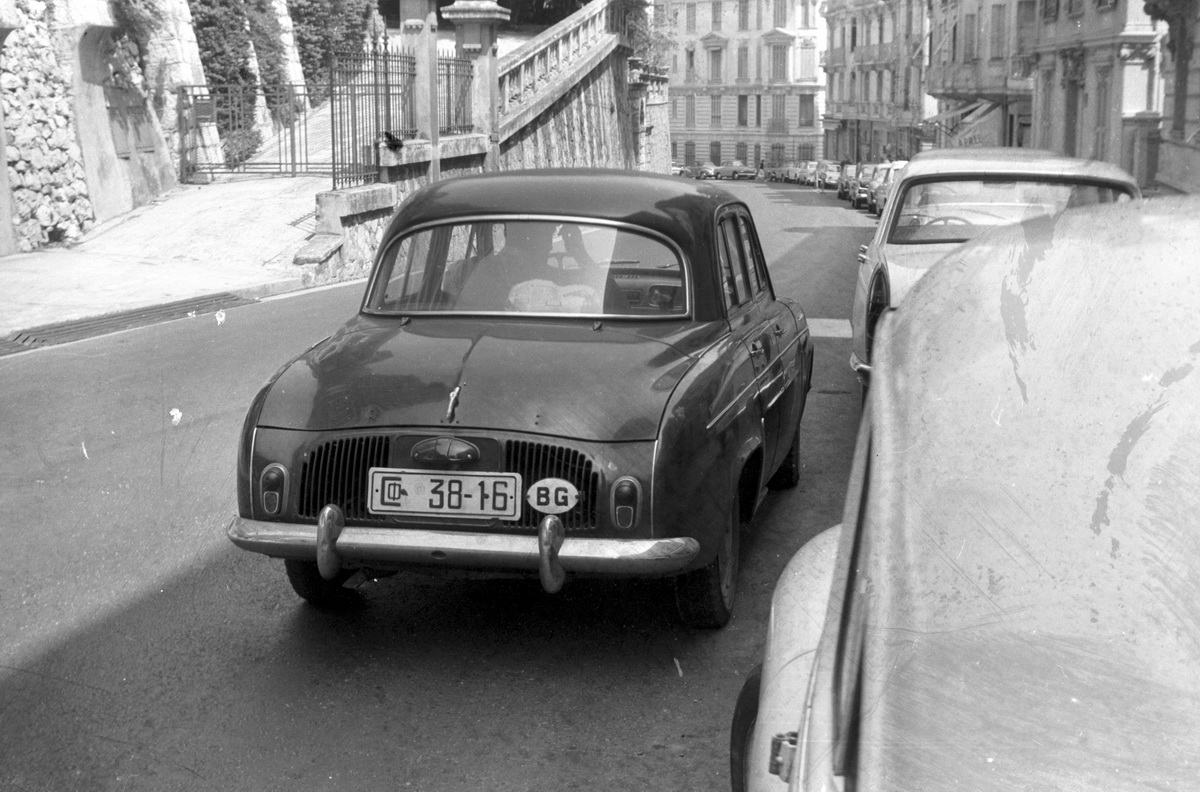
White plates were issued to privileged Party members in pre-democratic Bulgaria.    This fortunate citizen had a modern car and was allowed a passport to travel to Monte Carlo, where this picture was taken

Sf 38-16  —  White plates were issued to privileged Party members in pre-democratic Bulgaria.     This fortunate citizen had a  Sofia-registered Renault Dauphine and was allowed a passport to travel to Monte Carlo, where this picture was taken by member Terry Gray in the 1960s.   The series used the Cyrillic alphabet and  ran from 1958-85.

(CH)_ZH_300 723_TG

ZH 300 723     This is a puzzler.    A rear Swiss plate with no canton shields?    And in a poor (un-Swiss) condition.        And mounted in an odd place.      Was it perhaps a trade plate of the period (1960s) Any help, readers?    Gray archive  (silence May 2014!  Help!)

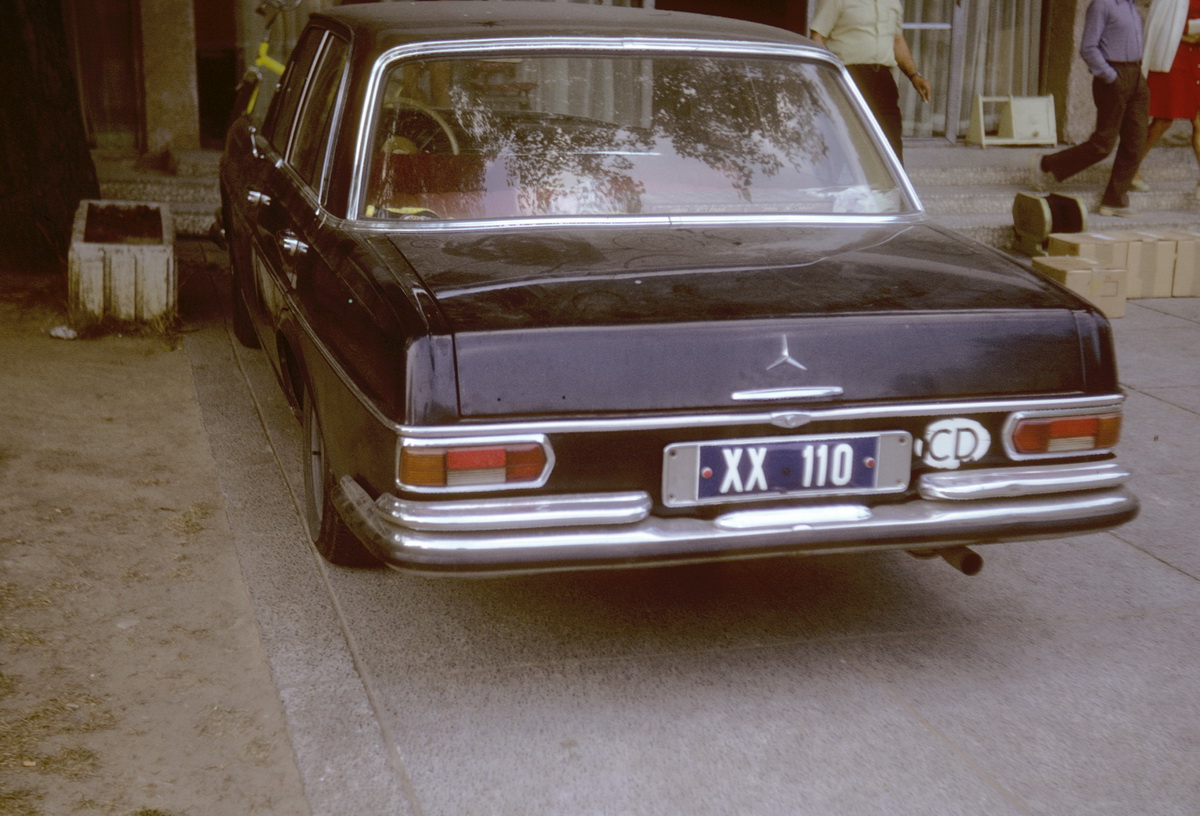
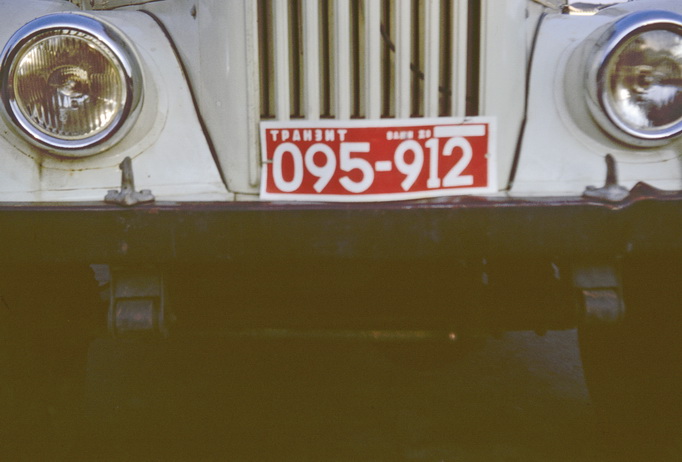
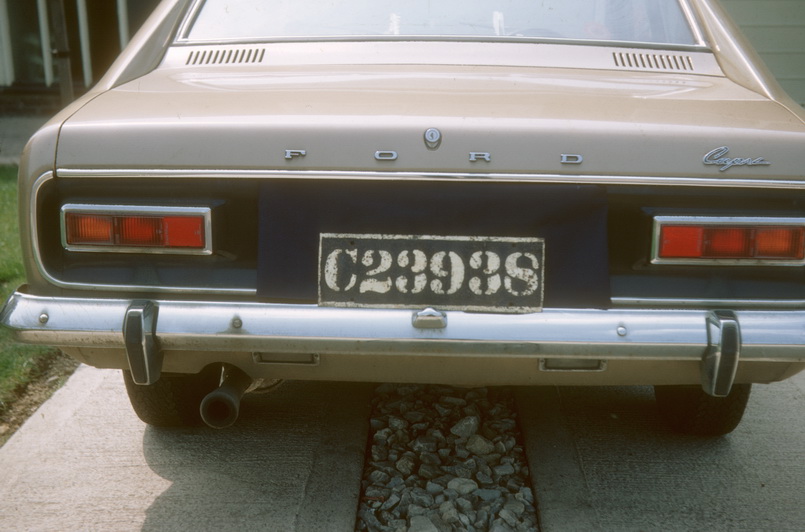
(BG)(tempimp)_XX 110_TG (BG)(transit)_095-912_TG (CAM 60-91)(cc)_IT 9175 CC_f_TG1970s (CB 30s-58)_C 23938_TG (CDN)(CdnfinEur)_5245_TG (CO 67-74)_C-07-87_r_TG1968

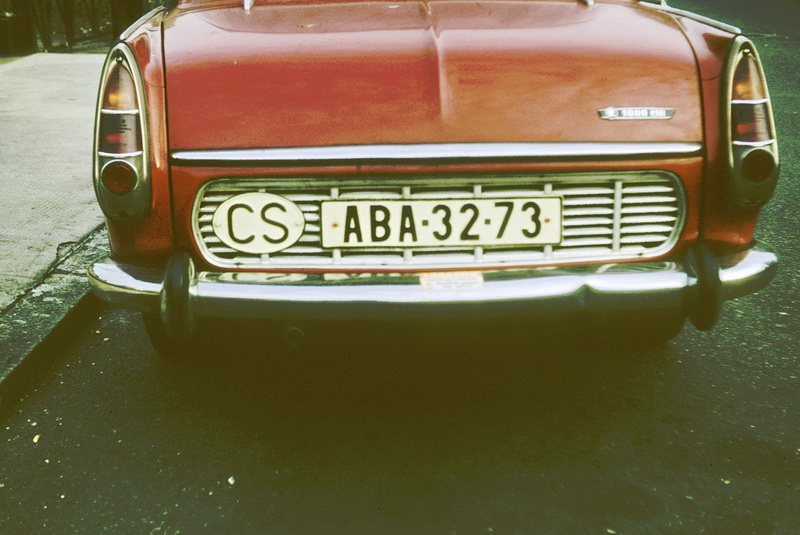
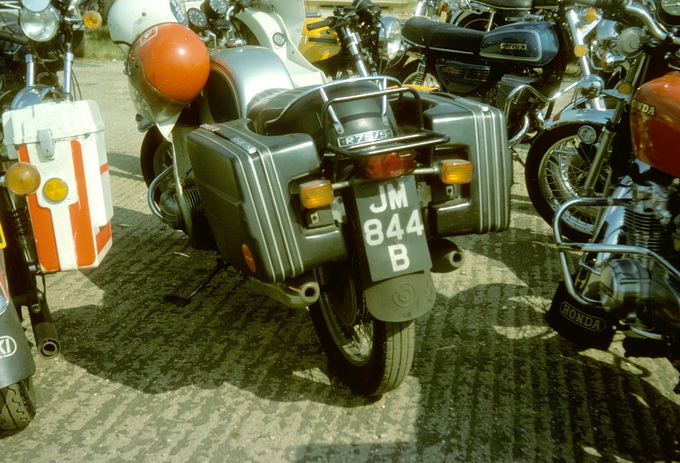
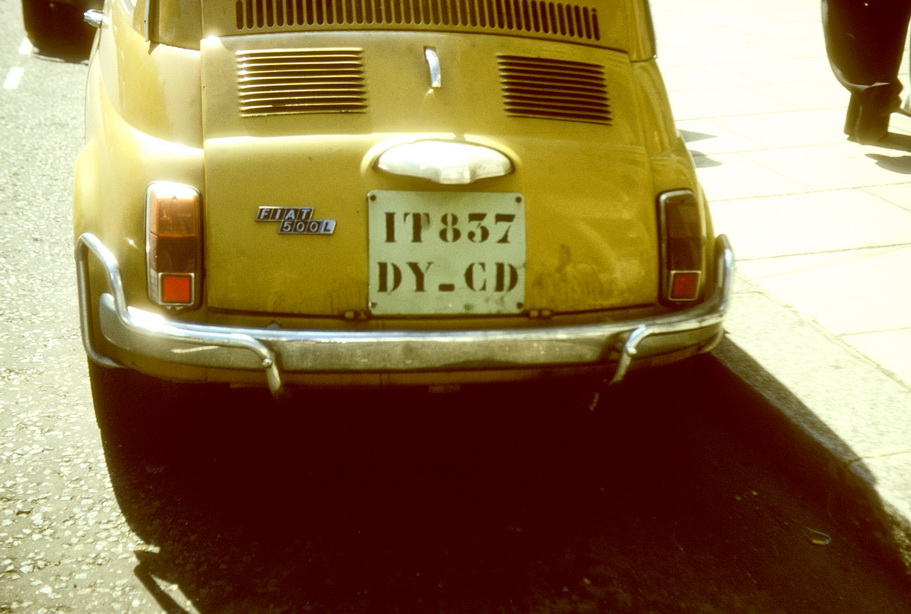
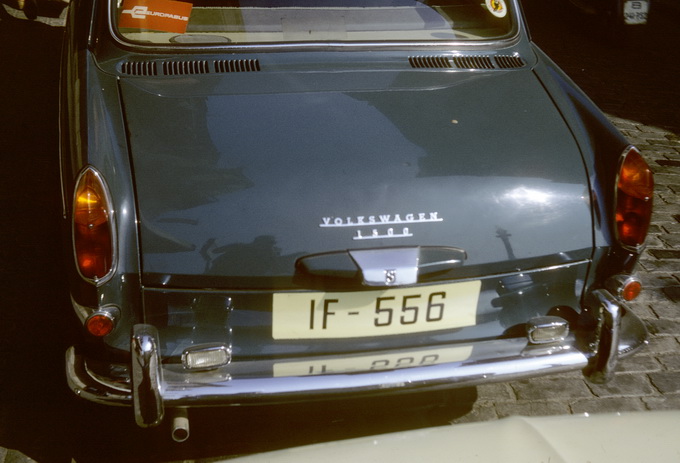
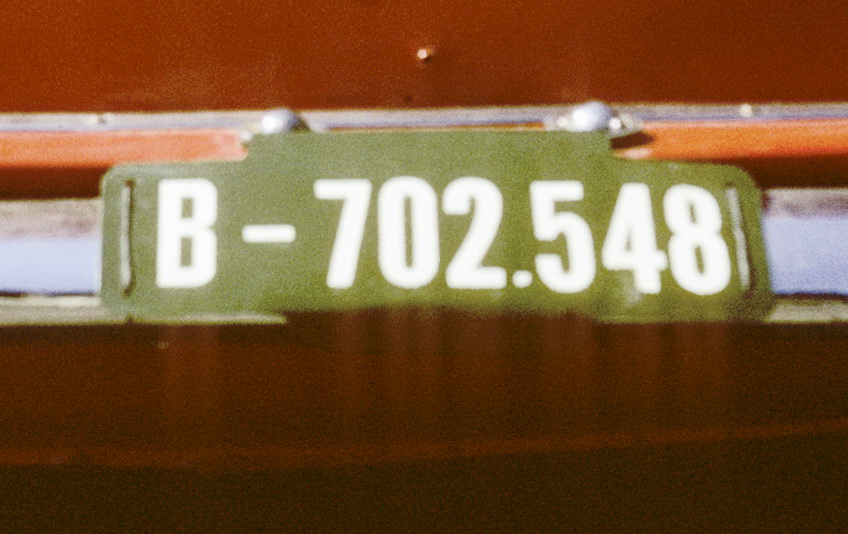
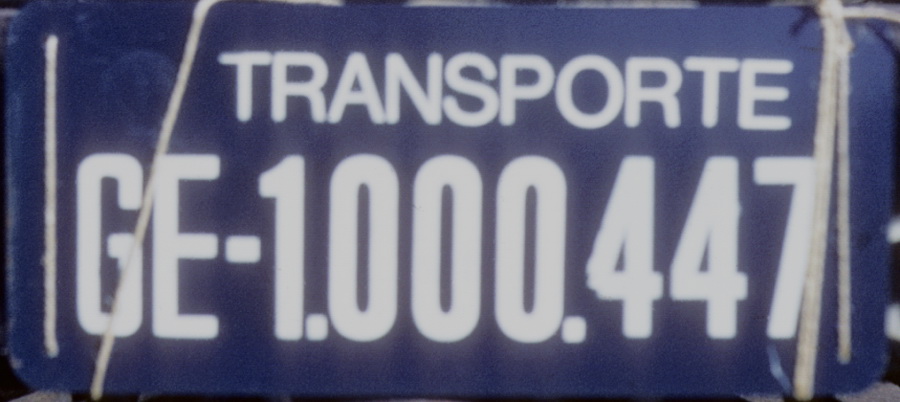
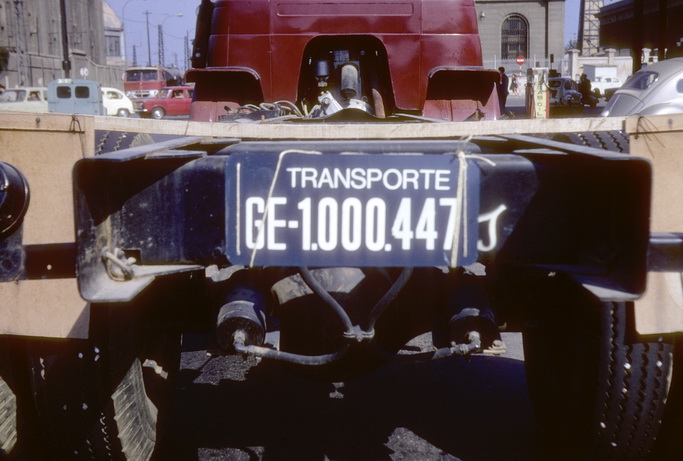
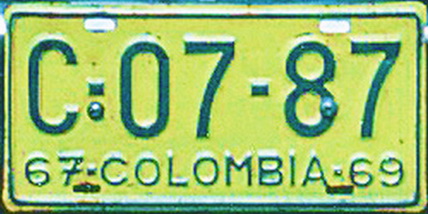
Remarkably, this MGB came to live in London for about a year in 1969, and remains the first and only sighting ever of a Colombian plate in England by Europlate.   Members Brumby, Thornley, Gray and Pemberton all reported it separately!   This is the 1967-74 series.(CS 66-85)_ABA-32-73_TG (D)(GBfinD)(mc)_JM 844 B_TG (DK)(dlr)_41 112_f_TG (DY 72-76)(cd)_IT 837 DY-CD_r2_TG (E 22-72)(ME)_ML-4037_TG (E 27-69)(EqG)(FP1)_FP-3721_c_TG (E 27-69)(SH)(Ifni)_IF-556_TG1960s (E 27-80s)(EqG)_RM 6018_TG (E 60s-70s)(prov)_B-702.548_c_TG (E 60s-70s)(prov.dlr)_GE-1.000.447_cu_TG (E 60s-70s)(prov.dlr)_GE-1.000.447_TG.

More Gray photos to follow………….and

if YOU have prints or slides of early or rare plates which you would like scanned for your own use and for the pleasure of other members’ viewing, write or email to Victor Brumby (vicbrumby@gmail.com) – or make a comment in the  Comments Box at the foot of this page.

And a quiz answer from a previous Post:

Which of needs THIS identifying?

Well – which of us needs THIS identifying?

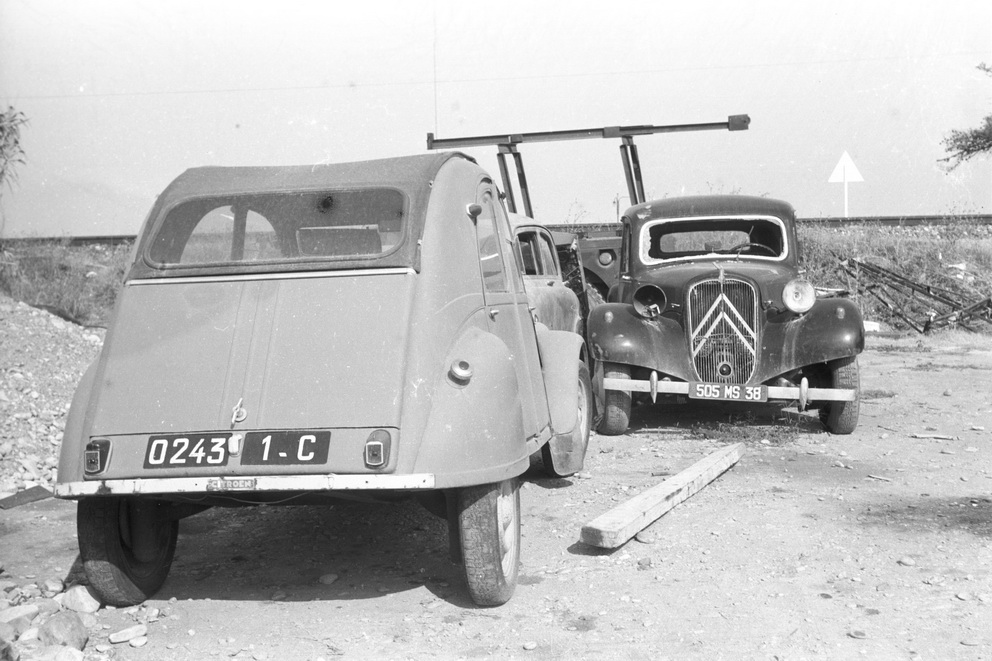
YOU do?   Try French West Africa......     VB archive

YOU do? Try French West Africa…… VB archive                                                                      Francoplaque’s  Jean-Emmanuel  is quite correct with his answer of  SENEGAL, until 1960 French West Africa/Afrique Occidentale Francaise) (AOF) .   The Citroen 2cv is from area 1 (Cap Vert (Dakar, capital city)) and the letter C is a serial letter, issued before independence in 1960, after which the letter ‘S’ was inserted  before the area number  (e.g. 0132 S 1 .C)                  Fascinating to think that, had the car travelled outside Senegal in those times, it would have carries the unseen(?) AOF international oval.   The photo is by non-member Murray Bailey in about 1973, in Dakar.          In the background, in a sad state, is a French-registered Citroen Light Fifteen Traction Avant, still carrying its French plates 505 MS 38 (from Isere).

Read the rest of this entry »


Spotting lists from 1950s show a different profile

August 18, 2013

Below we see one of the 40 spotting books employed by EU member John Pemberton between 1955 and today.    He religiously noted everything foreign which came his way, mostly spotting in the East of England, in Suffolk, Norfolk and on occasional visits to London and the near Continent.      He would not take note of Belgians in Germany, or Germans in Holland, as there were too many to record, and he wasn’t interested in noting foreign forces plates in Europe or Britain, unless they bore normal plates from their place or registration.    An exception was made for the many SHAFE/SHAPE plates he noted, from Supreme HQ – Allied Forces/Powers-Europe.    And as with many of us, he may not have known that Spanish plates which bore a zero in the fourth numeric position from the right, were allocated to US Forces, Spain, because he has recorded a great number of them! e.g.

It becomes clear from analysing JP’s spottings, that the earlier the period, the more varied and unusual were the cars to be seen in circulation.    A day out in 1956 could garner a spotter vehicles from Ceylon, Nigeria, Cyprus, India, British Guiana, Formosa, Japan and the Straits Settlements.     To see any one of those in 2012, would be the high spot of a collector’s year!

His recent books (say, from 1980 to current) are still testament to John’s determined notation, but these modern sightings are all European plates, with rare exceptions.

Items which strike the writer, while cataloguing the longhand archive, are the surprisingly high number of vehicles from Algeria and Morocco, both before and after independence from France, the 10(?) cars he saw from Bermuda (though I never saw one in 55 years of spotting (well, one on Grand Turk years ago) and quite a few from Angola and Swaziland – very rare indeed.    He has captured the only known photo of British Somaliland on a car also bearing the SP oval representing the Somaliland Protectorate.     Similarly John has photographed the only known SM oval, the former code for Siam – and on a German HANOMAG car in Copenhagen, bizarrely, in the late 1940s….

I has been amusing for me to recognise some  parallel spotting between John’s notes and my own photo archive.     At least a dozen plates which he noted forty five years ago were captured for posterity in photographs I must have taken in the same period in which he saw them, although we were 200 km. apart and knew nothing of each other!    Here are two of them.

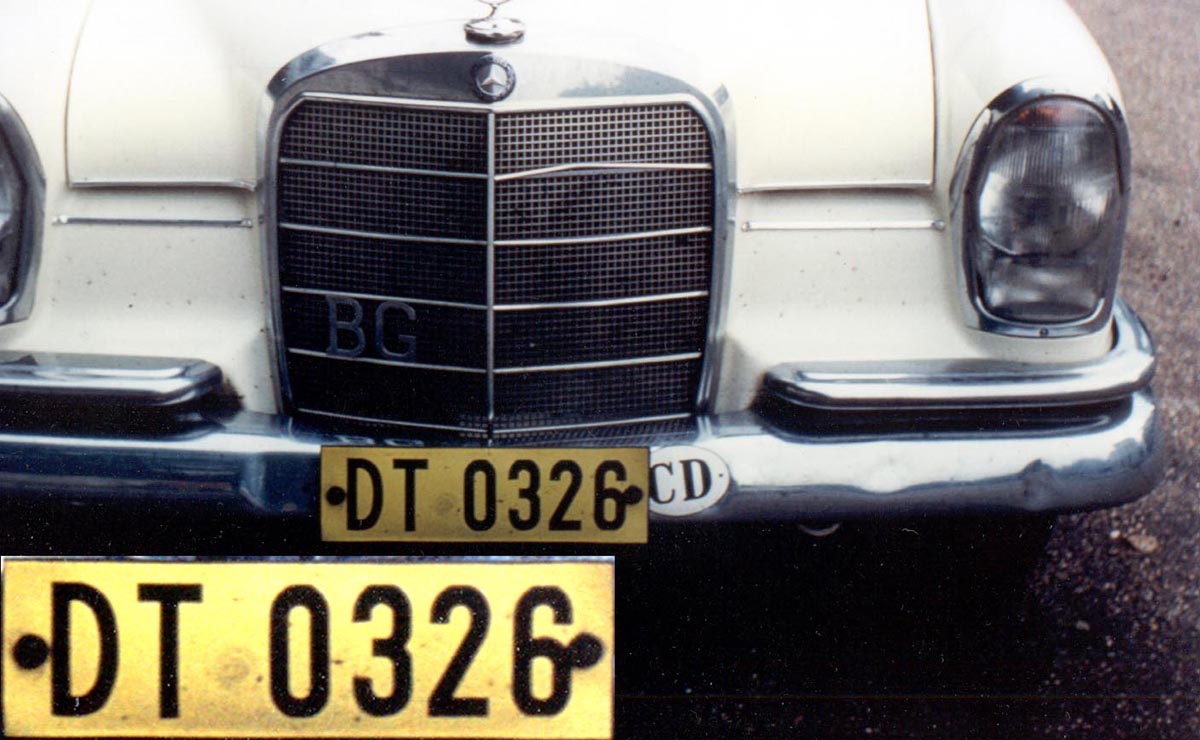
The Bulgarian diplomatic DT 0326 lived in Notting Hill in London for perhaps four years without changing these rare plates, and was also seen and photographed by members Terry Gray and Ivan Thornley.     This was the 1967-85 CD series.

(BG2)(cd)_DT 0326_comp_VB1969

(CO4)(67-74)_C-07-87_cu_VB1969_resize

The only Colombian plate ever seen in Britain, I suggest.   On an MGB in Kensington, London in 1968, with a 2-year validity plate (but no CO oval at the rear

A great archive, which I hope will  bring some happy moments to all who inspect the pages of the précis which will now be progressively published in the Blog as a Google spreadsheet document, as I work my way forward through the booklets.

NOTE DATED 18 AUG.    NOW STRUGGLING TO CONVERT THE ORIGINAL XLS SPREADSHEETS TO GOOGLE SPREADSHEETS SO THAT THEY CAN BE SHOWN HERE:     WORK IN PROGRESS AGAIN!

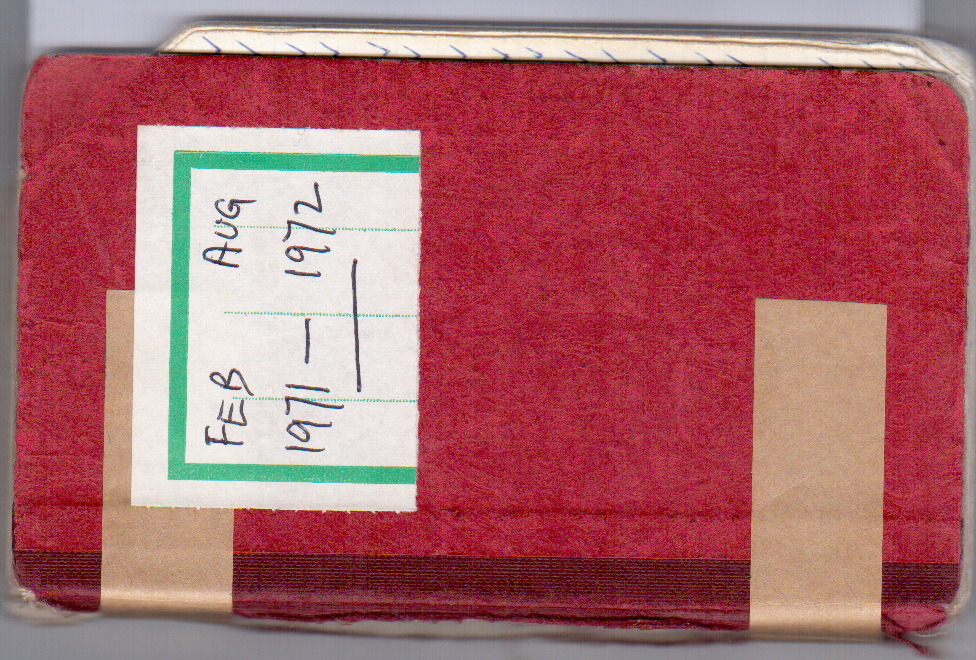
2013-06-15 17-27-52_0108 JP notebook 71-2

Some of John’s script resembles Farsi or Sanskrit – but usually turns out to represent the word  ‘London’  or  ‘July’  or  ‘ blue Peugeot’.     The orthographic decoding only held up the production of the typed form by a few months…….!

Here is the first of John Pemberton’s distilled (redacted?) spottings, from the earliest books he can find, dated 1955 and  ’56:         *********       Feb. 11 2014  addendum    —Technical snags have prevented the insertion of this file, but now it has been converted to a Google.doc, which you can read on-screen, or download to inspect at your leisure.      In a few days, it will be inserted HERE.

                                  (The additional data has been inserted by me, though much remains to be added – and I will be happy to receive your corrections and extra info if you can add to the sum of knowledge….)

*


Sailing St.Helena

July 23, 2013

Chris White, cousin of this Blogger, Victor Brumby (EU38)  is close to completion of his round-the-world sail with his wife and grown family.      Asked if  he would pay special attention to our specialist subject when they landed on Saint Helena, he has sent this set of shots from the South Atlantic (via the clever and simple system, DROPBOX).    Readers are recommended to use it  for sending  large quantities of data/pictures about – all free from the Web.

SAINT HELENA

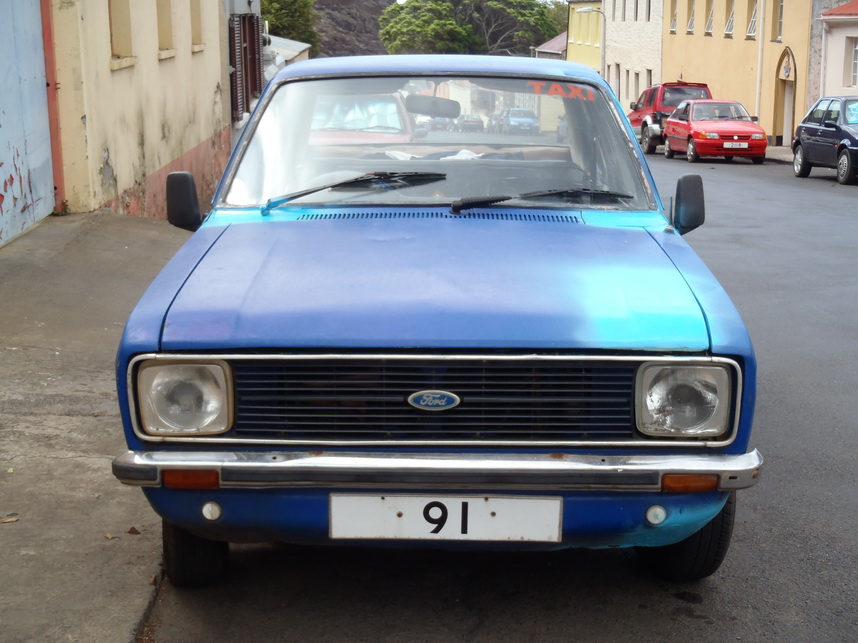
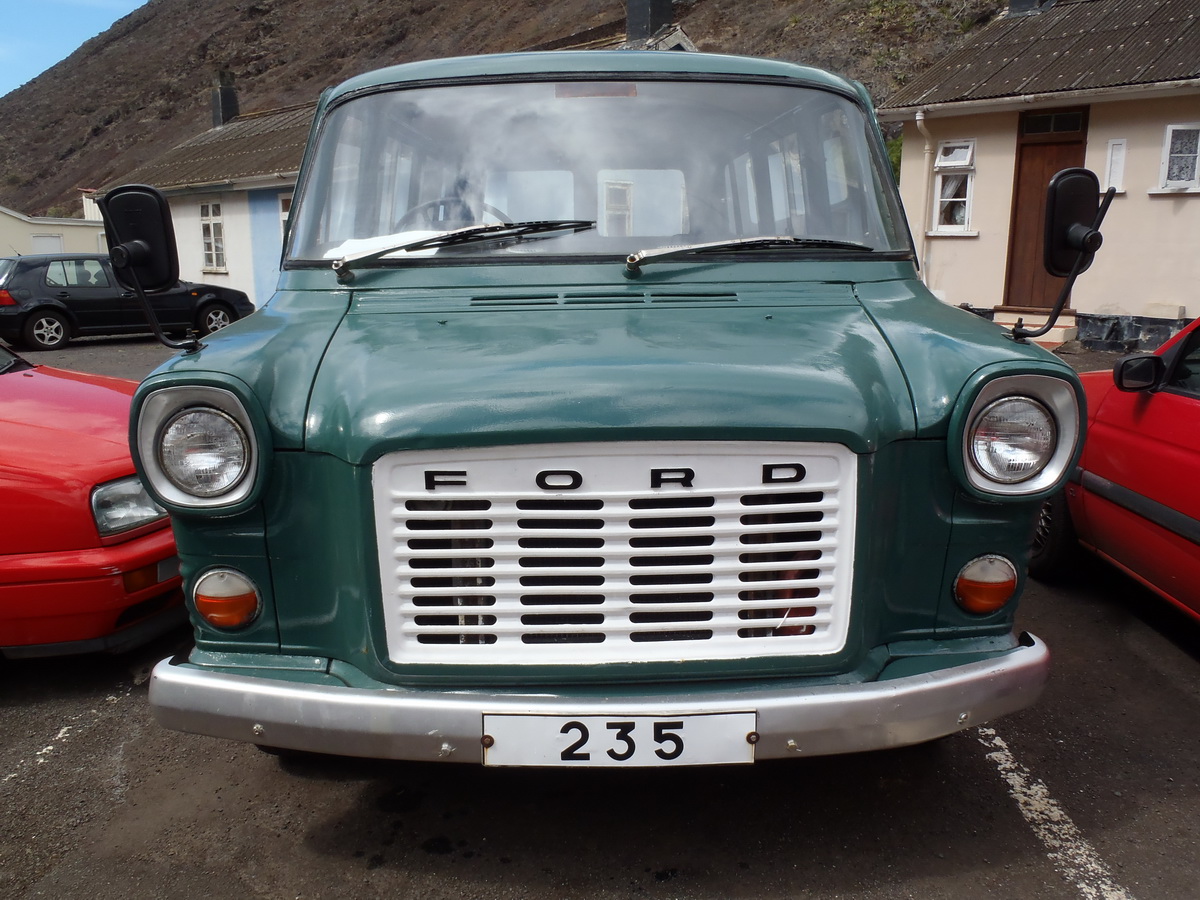
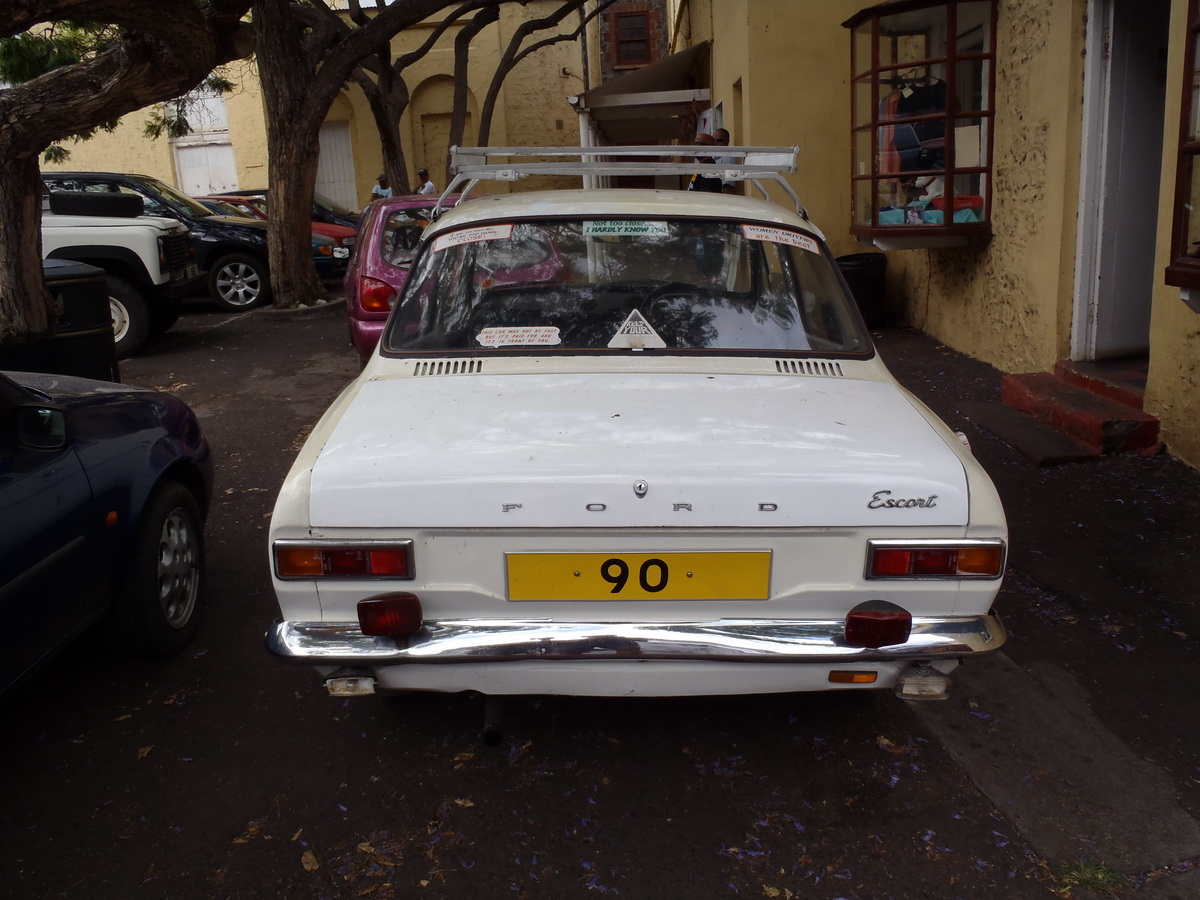
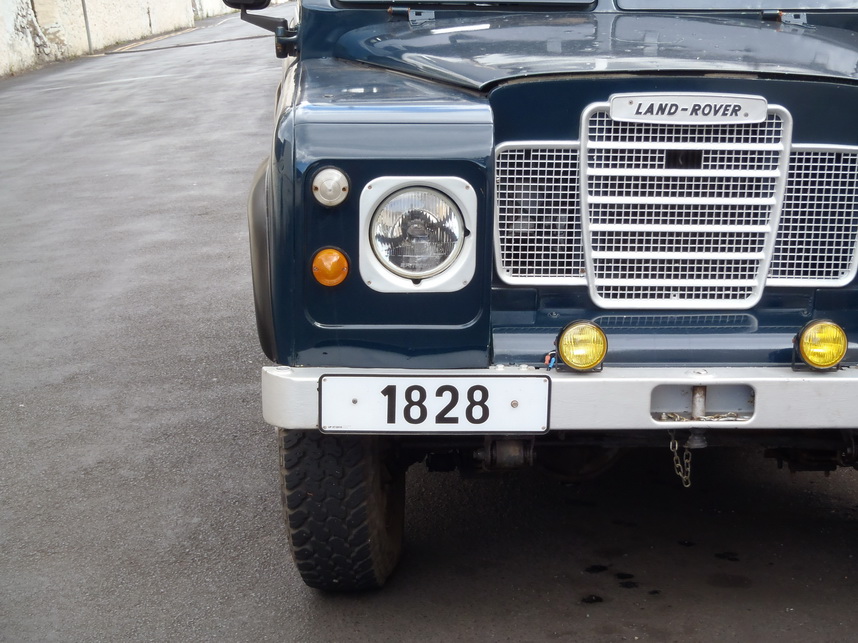
We see that the island is now registering in the 3000’s.   10 years ago, there were 2000 cars on the island, so it’s just possible that another 1500 or so have arrived in the meantime.      Sounds a bit crowded!      Apparently there is no wharf or harbour, and all heavy cargo has to be lowered from ships which come as close as they dare,  to small island craft to be brought ashore, presumably to a beach.

Most of these are models which have disappeared from British roads, due to age, but presumably, cars do such little mileage on this small island, with so few roads………

OLYMPUS DIGITAL CAMERA

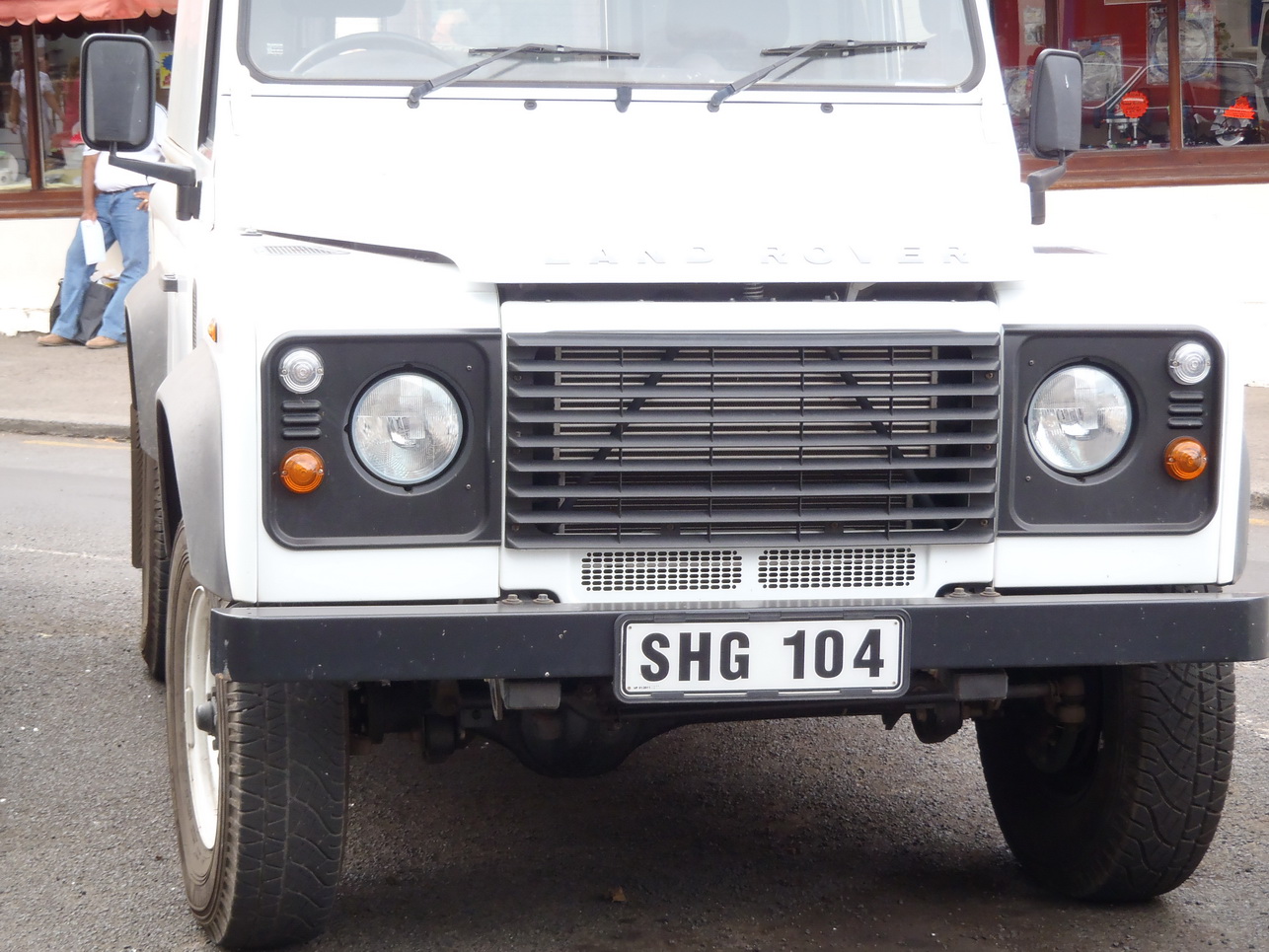
SG 104.       Our first picture of the most recent St. Helena Government series employing reflective white/yellow plates.

(SH'31)-26_comp_VB1980s

26      The only St. Helena plate ever seen by EU38 in England in the 1970s.   The Hillman Avenger (made 1970-76) belonged to the radio operator at the Government House on Ascension.    After such a two-year tour, such personnel were re-stationed elsewhere, usually at embassies or High Commissions, and their well-travelled private cars sometimes had a selection of odd plates in the boots!      Hanslope, near Northampton, was their home station and great spotting was to be had outside the high-security country house at going-home time.     (Brumby archive)

OLYMPUS DIGITAL CAMERA OLYMPUS DIGITAL CAMERA OLYMPUS DIGITAL CAMERA OLYMPUS DIGITAL CAMERA OLYMPUS DIGITAL CAMERA OLYMPUS DIGITAL CAMERA OLYMPUS DIGITAL CAMERA

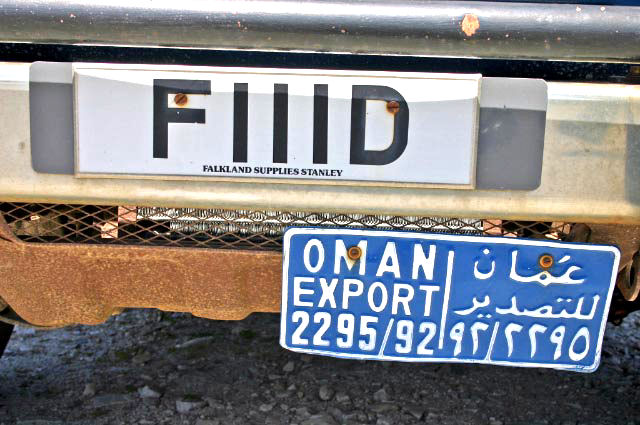
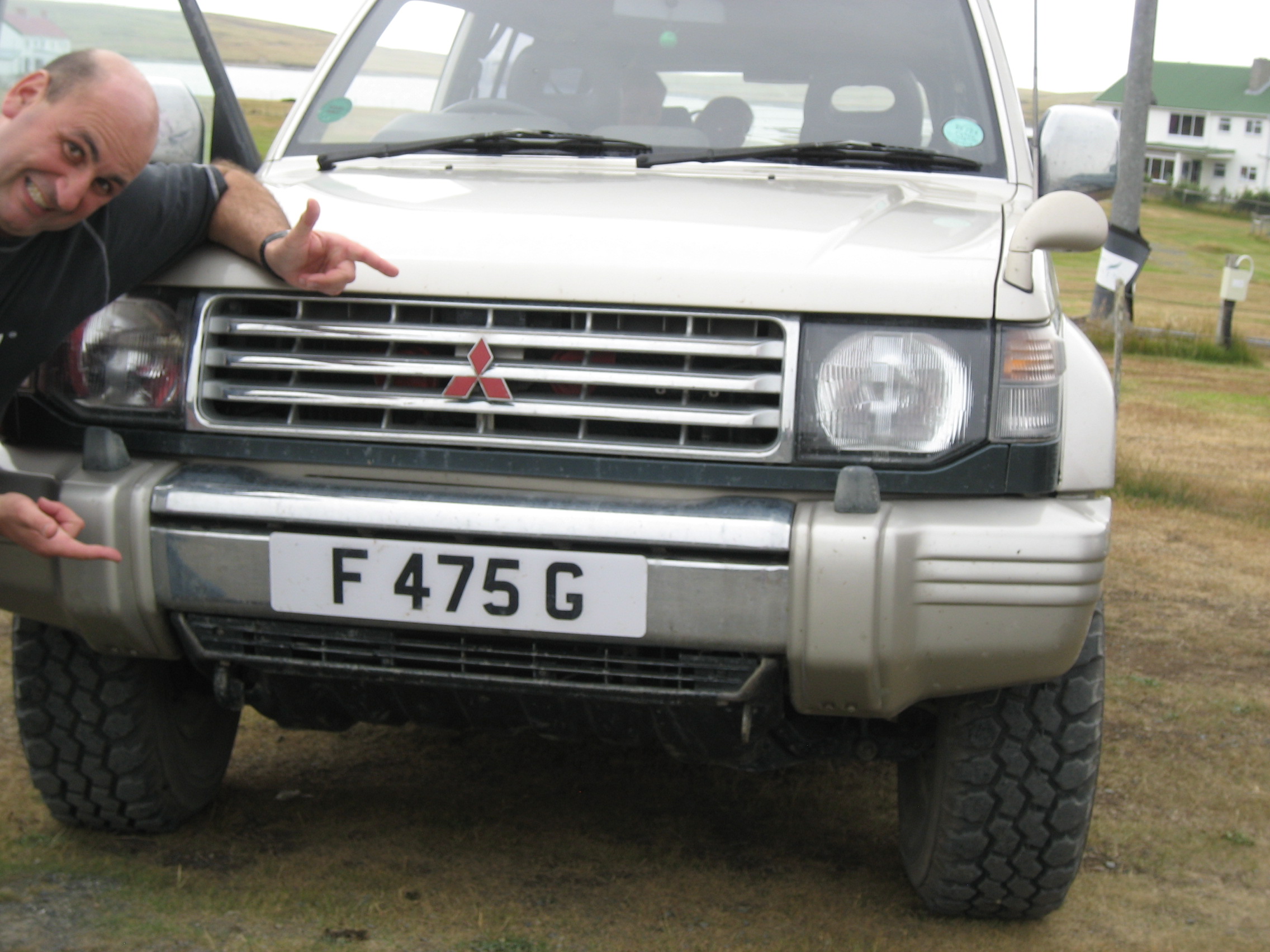
And while we’re in the South Atlantic, here are two of  Mike Oldham’s pictures from a visit to Falkland in 2011.   Until the serial letter was added to these plates in 1968,  they used identical number-only plates to those of St. Helena

(FI3)-1986-F111D-TR(141)

F 111 D has a bit of history behind it!      Brumby archive

(FI3)_F475G_fVBmo


Malaysia – next series and jottings

June 25, 2013

June 2013 – Su Ling, our stringer in Kuala Lumpur sends  information today  carried by the government website:   May 2014 – corrections in red.

http://www.jpj.gov.my/transaksi-percuma-no.-pendaftaran-terkini

The Wilaya (Federal Territory of Kuala Lumpur) is about to issue the last component of its three-letter, four-number series, with WYY 9999.   It is intended to move to W 1 A 1-9999. W 1 B 1-9999 etc.   It has rushed through its ‘W’ code, which only started in 1974 with WA-WY, then WAA=WYY, and it will have lasted just about 40 years…..    The other Malaysian states commenced their issues on or before 1934, first with their single state code letter and 1 to 9999, then adding a  one-letter A-Y suffix* to 9999, then most of them to double-suffix and to 9999.   * missing such as I, O & Z.

No other Malaysian states or territories are anywhere near exhausting their current 3L4N series – indeed, Perlis has not yet issued its first three-letter plates, being still at RJ 8187 this month!   (06/2013)    Even little Labuan, the Bornean island, has reached LE, having only started LA a few years ago.

Malaysia was one of the first jurisdictions to use plastic for its plates and there are many snapped, splintered ones to be seen.    They can be hard to photograph because of their shiny surface reflecting sunlight or flash.    Anyone can make these plates and the new slim characters have slowly replaced the big, British-style ones common to Malaya until the 1970s.    The blue Trade Plates are still pressed alloy in that earlier style and appear to be officially made and issued.    Many heavy lorries and trailers use pressed-alloy plates, because the plastic  plates are too easily breakable on rough terrain/building sites etc.     The most common font is almost identical to the former South Africa design.

I don’t like ’em!

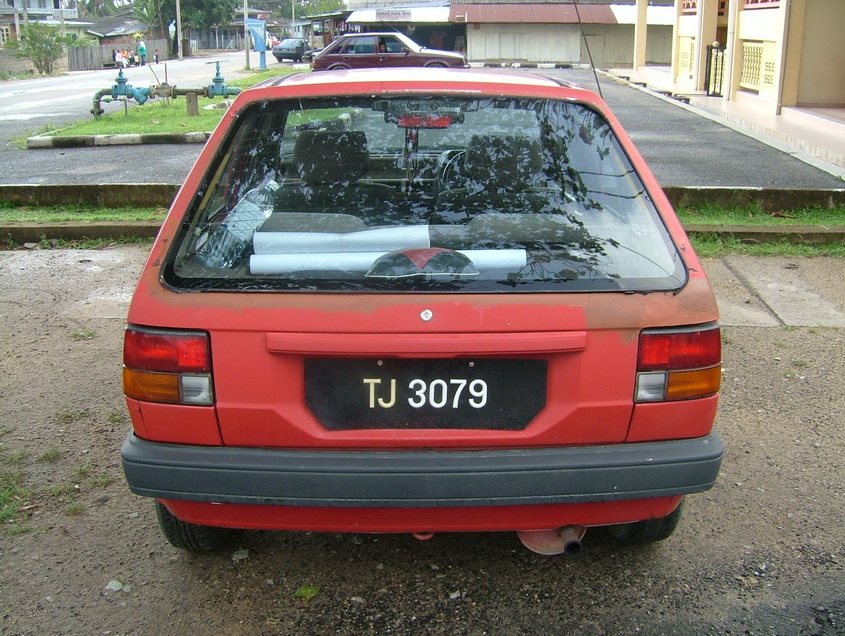
(MAL1a)_TJ3079_VB_resize

TJ 3079. Could be Transvaal-Johannesburg – but it’s from Trengganu.

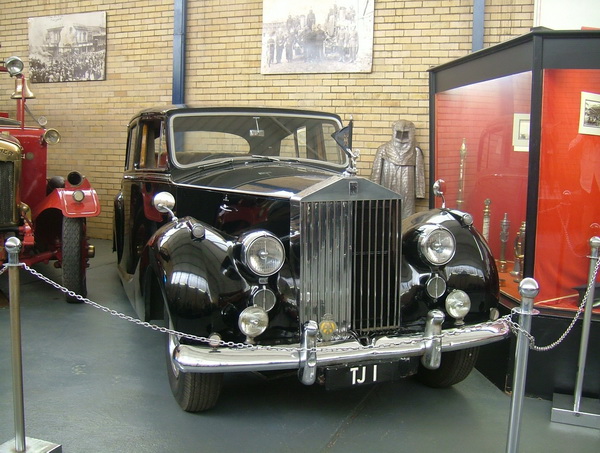
TJ 1 Belonged to the Mayor of Johannesburg,  Brumby archive

TJ 1 Belonged to the Mayor of Johannesburg,
Brumby archive

CA 6363. Could be Cape Town - but it's Pahang (seen in Penang)

CA 6363. Could be Cape Town – but it’s Pahang (seen in Penang)

NN 2625.   Could be from Newcastle (City) in Natal, but it's from Negri Sembilan.
NN 2625. Could be from Newcastle (City) in Natal, but it’s from Negri Sembilan.

UK has adopted the plastic plate, sadly, even for diplomatic and consular series, though still trade plates are officially manufactured and allocated  by the state.    Military vehicles can be seen with metal plates.   (Probably now made for us in China! )

~~~~~~~~~~~~~

SARAWAK

The information contained in the Malaysian Govt. website noted above, confirms the suspicion noted in the 25th. March Blog that Sarawak has adopted a suffix letter.     We showed this photo:

I may be behind on developments in Kuching, Sarawak, but I am surprised to see this apparent development in their system, in the addition of a suffix serial - and already at letter 'C'!   A is for Kuching, the capital; it is unlikely to to have spread to the other registration centres yet, I imagine....    VB in Kuala Lumpur 25/3/2013

I may be behind on developments in Kuching, Sarawak, but I am surprised to see this apparent development in their system, in the addition of a suffix serial – and already at letter ‘C’!     QA is for Kuching, the capital; this new suffix is unlikely to to have spread to the other Sarawak registration centres yet, I imagine…. VB in Kuala Lumpur 25/3/2013

Confirmed first sighting of Sarawak now using a suffix serial, C.    (Vic Brumby)

Confirmed first sighting of Sarawak  using a suffix serial, C.  and now as far as suffix ‘G’.                      (Vic Brumby)

For good measure,  let us finally note the simple transport employed by the wise leader of this Malaysian state.  It was the central vehicle in a noisy son et lumiére cavalcade of motorcycle outriders, dark-window’ed Range Rovers full of goons and an army Landrover or two, which accompanied him to his noodle  lunch one day at the pub I was staying at, near the Kuching airport.

His grandfather travelled by dugout canoe, collected shrunken heads and gave Shell a licence to explore for black gold!

A basic conveyance for the village headman in Kuching.

A basic conveyance for the village headman in Kuching.