Ras al Khaima

April 7, 2013

The BP Mocamp outside Istanbul was a luxury caravanserai for the distance traveller in the 1960s.   Operated by the BP oil company, it was a new idea they had to provide US-style motor-camping facilities allied to service stations, the camping, I recall, being  provided at very modest cost.

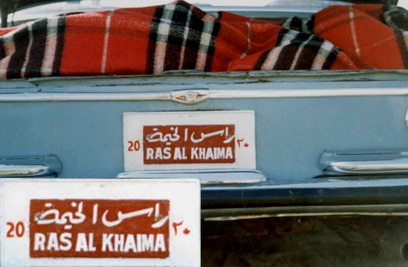
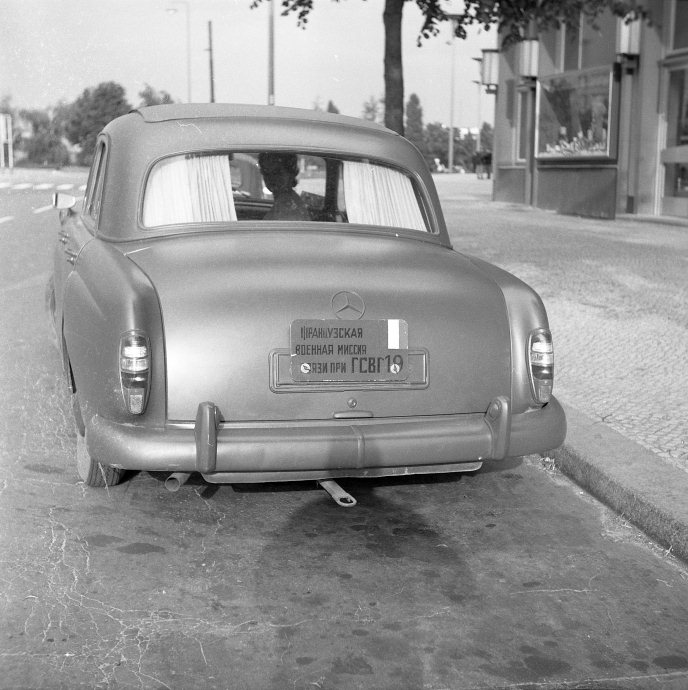
The principal benefit to the writer, apart from clean showers, well-kept lawns and a good restaurant (in 1960s Turkey, that meant something), was the plate scene, as motors came and went from east to west.   When I first glimpsed this Mercedes, I was baffled; even when the driver explained, I was uncertain of the existence of this sheikhdom – but it remains one of my favoured shots today, and still unlike any other I have seen from R.A.K..   The European driver was returning to Europe after a tour of duty in the emirate and the acquisition of the Mercedes from the ‘royal’ fleet.

I was economic with film in early times and only one or two shots were ever wasted on one subject, unfortunately.    Then of course, we waited weeks to finish the film in  the camera, another two weeks while it went away to be processed in to prints or slides – and only then – too late – did one know whether the shot had succeeded!    Happy days now, with digital photography and immediate gratification…..

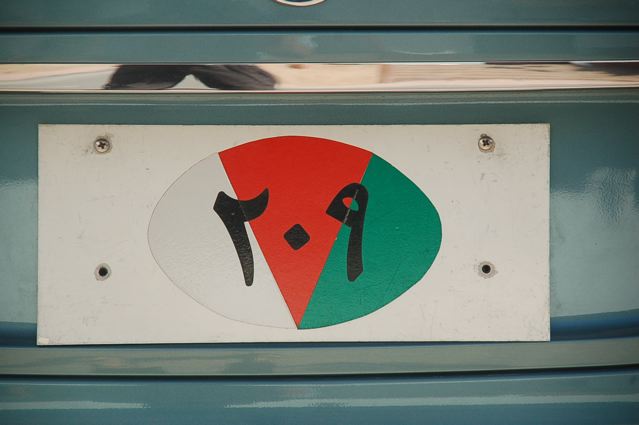
RAK 20 seen in Turkey in 1968.   Red/white indicates a 'royal household' issue.   Brumby archive

RAK 20 seen in Turkey in 1968.      Red/white indicated a ‘royal household’ issue.        Brumby archive

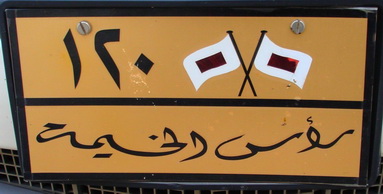
Cedric Sabine’s archive brings the genre forward 50 years, with a current RAK royal plate 120, carried on a Cadillac.

A 1994 visit found so-called royal household cars all over the place and as they are picturesque, they probably justify another airing.  Prince no. 35 stopping for a Coke and a diamond head-dress.

A 1994 visit found so-called royal household cars all over the place and as they are picturesque, they probably justify another airing. Prince no. 35 stopping here for a Coke and a diamond head-dress.


end.


Anguilla (Eel) Island, Br.Leeward Is.

April 7, 2013

The remarkable (and first) sighting of a vehicle outside its own border, from the tiny island territory of Anguilla,  was made in central London in 2011.    It sported the new plate design and an international oval never dreamt-of – AXA !    At least one other Europlate member saw it in ensuing weeks, and interviewed the driver, who told him that  he had brought this car and other Porsches back to Britain several times over the years!  (evidence, please)     If so, the membership had missed his visits!

This and other Anguillan photos from a 1981 visit to the 88 sq. km. British Overseas Territory of 1300 citizens, follows:

The Porsche 940 V-8, perhaps the most unlikely candidate for use on a sandbank.

The Porsche 928S, perhaps the most unlikely candidate for use on a sandbank.    Brumby archive

Snazzy modern design to replace one of the world's simplest commenced in 1997.    P1641 represents the Private vehicle taxation class, which are azure blue, black and white.

A Snazzy modern design to replace one of the world’s simplest, commenced in 1997.     P1641 represents the Private vehicle taxation class, which are azure blue, black and white.    Brumby archive

Though not allocated an international oval, Anguilla is coded on the International List and this owner has taken that for his oval.   Keen chap.

Though not allocated an international oval, and its ISO code is AI, Anguilla must be coded AXA on some list and this owner has taken that for his oval. Keen chap.       See new data below-Comments-D.Wilson

(ANG2)_P 1641_VB2011.2_resize

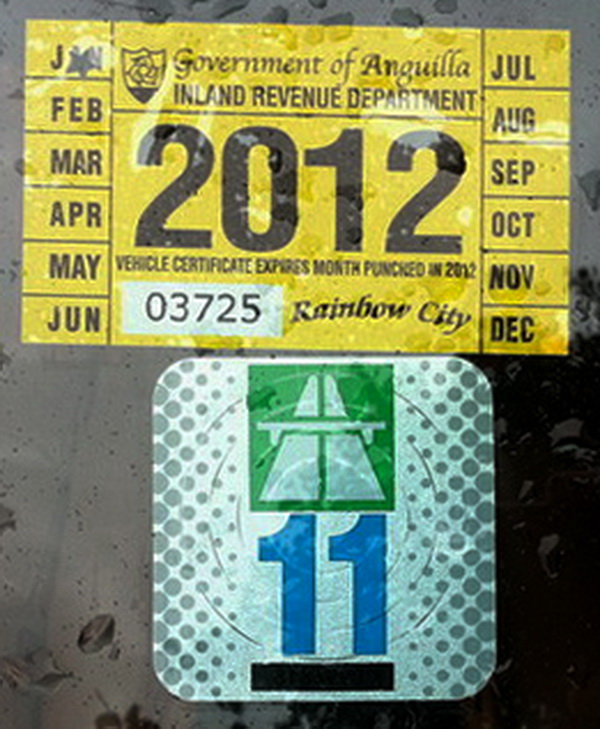
The most up-to-date systems have been introduced to control the few registrations which exist on this tiny, quiet, low-lying isle.

The most up-to-date systems have been introduced to control the few registrations which exist on this tiny, quiet, low-lying isle.

In December  1981, when the writer visited, and long before the technicolour plate revolution of 1997, Anguilla was using painted plates, often on plywood backing, there being so little steel or aluminium material from which to make up plates.    Often they were painted  direct on the old vehicles.    A plate I acquired there, A 402 (no photo), was painted on the obverse of a Gibraltar pressed-alloy from a VW which had been imported therefrom.

a typical painted woden plates on a Morris Marina, the worst British car ever made.

1980S: A typical painted wooden plate A 1216,  on a Morris Marina, the worst British car ever made.

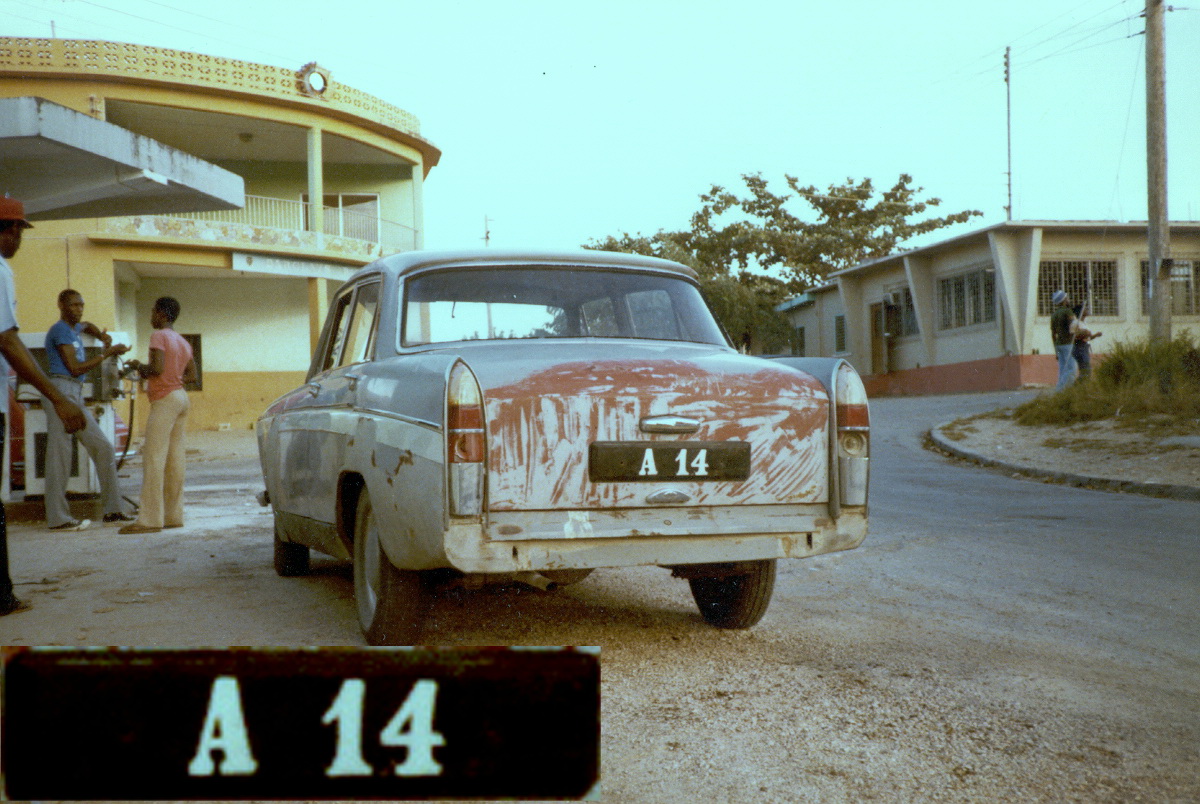
These BMC Farina Austins and Morrises were shipped all over the world and stood up well to tough conditions, often as taxis.    This one was approaching its end of its life at the petrol pump in The Valley, the main settlement.   Brumby archive

These BMC Farina Austins and Morrises were shipped all over the world and stood up well to tough conditions, often as taxis – as did the similar-looking  Peugeot 404s.    This one, A 14,  was approaching the end of its life at the petrol pump in The Valley, the main settlement, in 1981.   In 1980, Anguilla had seceded from its former uneasy union with St. Christopher, Nevis and Barbuda.        Brumby archive

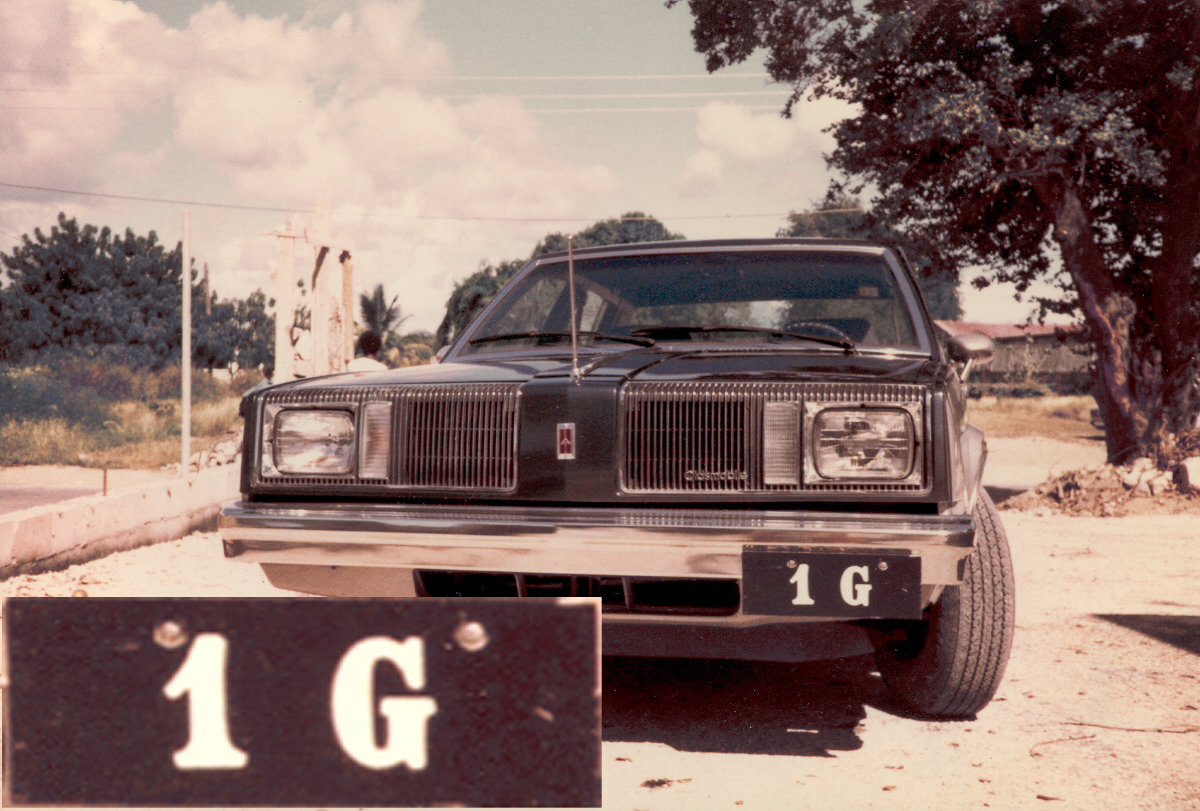
Odd thoiugh it seemed, this plate on the islands' smartest car, was attributed to the Governor  when seen in 1981 in The Valley.   Unusual for a British Resident  to use a non-British car in those days.....   Brumby Archive

Odd though it seemed, this (wooden) plate 1 G on the islands’ smartest car, an  Oldsmobile, was attributed to the Governor when seen in 1981 in The Valley.  RPWO gives it that between 1980 and ’85, the authority on the island was vested in ‘Her Majesty’s Commissioner’  who bore the plate ‘HMC’.    As an aside, it was unknown for a British Resident to use a non-British car in those days – and this is a Left-hand-drive ‘foreign’ car selected for Right-hand-drive Anguilla – very odd….. Brumby archive

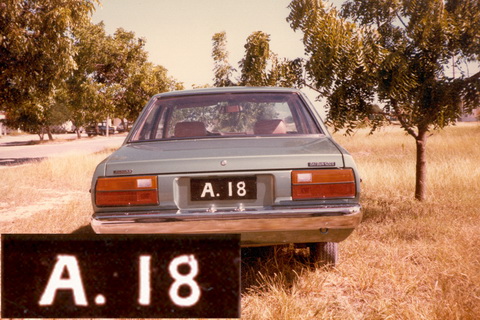
A.18, which would have first been issued in about 1915, is seen on a then-modern Japanese Datsun 120Y, indicating that Anguilla registrations were re-issued when voided.   See also A 14.    The 'A' series had reached the 1400s in Dec. 1981.

A.18, which would have first been issued in about 1935, is seen on a then-modern (1991) Japanese Datsun 120Y, indicating that Anguilla registrations were re-issued when voided.  See also A 14.  The ‘A’ series had reached the 1400s in Dec. 1981, though there was no evidence of so many vehicles.    Brumby archive

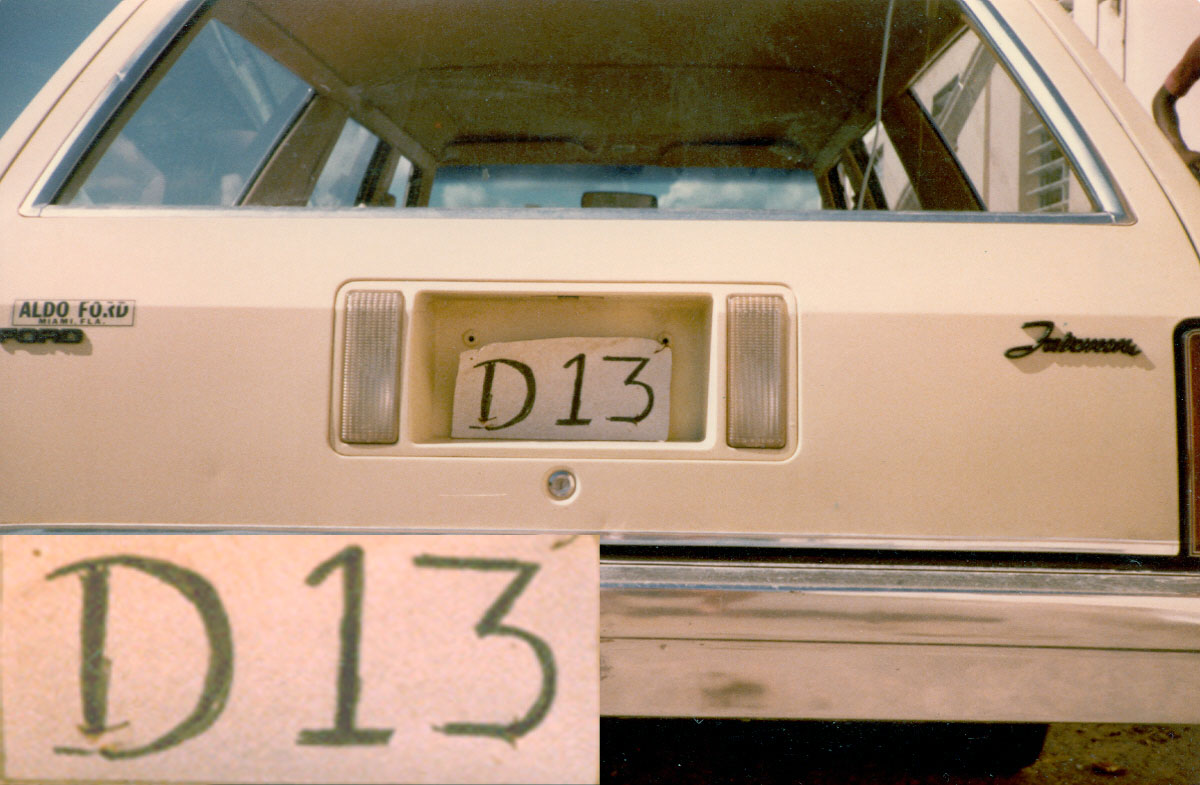
A handful of motor dealers in Anguilla were issued Trade registrations in this format, which they made up themselves, as witness D 13.  Brumby ArchiveA handful of motor dealers in Anguilla were issued Trade registrations in this format, which they made up themselves, as witness D 13. Brumby archive

Another strange photo capture was the P-suffix plate on this redundant crane on Anguilla.    The suffix had been unknown and we have taken it to abbreviate Plant (heavy equipment).    Nothing similar has been seen or reported; this may have been the only one.

Another strange photo capture was the P-suffix plate on this redundant crane on Anguilla. The suffix had been unknown and we have taken it to abbreviate Plant (heavy equipment). Nothing similar has been seen or reported; this may have been the only one.  Brumby archive

ANGUILLA LEADS THE WAY

The system of  suffix letters to differentiate vehicle classes is a simple and clever one.   When the registration status of a vehicle changes, such as the withdrawal of a car from a hire fleet, the suffix letter ‘R’  is removed from the plate and the normal Private plate is now on show – or, the addition of a new ‘T’ converts the car to a Taxi.      Why such a remote place as Anguilla should have originated such a practical scheme is indeed a compliment to someone in a back office.

Trinidad uses something similar, but their vehicle class is the leading letter on their plates (T-AH/P-CF, R-BB etc.) rather than the final letter which seems somehow tidier to the writer.     Most countries of the world use a variety of significantly more complicated or costly methods to split up their national fleets in to types – to the delight of codebreakers everywhere and of Herr Utsch’s bankers.

Another bright idea on Anguilla was to use the A prefix rather than a simple numeral.    Many of the British Caribbean territories commenced licencing with a number-only registration, so that there was no differentiation between the territories.    Then most added a ‘P’ for Privately-owned vehicle and that didn’t help either!     The Administrator on St. Kitts, Nevis, Barbuda and Anguilla had the wit to impose codes CN & A.

The Anguillan registration number is given to the owner and not to the vehicle, so that he may retain his first licence-plate for use on a succession of cars.    This can account for the many low numbers still seen in circulation in 1991.

When did the suffix-letter idea begin in Anguilla?     It was never used in St. Kitts & Nevis, with its CN prefix, to which Anguilla had been politically bound from the beginning of motoring until 1980.    Was it running its own suffix system during the St. Kitts years, and if so, when did it start?      Indeed, how necessary was it to even employ differentiated plates on an island where there were so few vehicles and everyone knew whose car or moped was passing each day?    It was always one of their cousins!     And so we wonder about the past……..


Aden’s Indian period.

April 4, 2013

1914-37  – Aden was originally administered by the Bombay Presidency as a dependency of  British India.     The style of the mainland India plates was for smaller area code-letters, than the serial numbers.     Here is rare evidence of Aden’s Indian plate background on Aden 1238.       These cars would have travelled outside Aden carrying   ‘BI‘  international ovals!


A 1920s picture of transport old and new. It is JUST possible to read the small ADN.

A 1920s picture of transport old and new. It is JUST possible to read the small ADN letters.

A

car 3758 lies in ruins after a local spat, circa 1951

Triumph Mayflower car 3748 lies in ruins after a local spat, circa 1951.  Note the high serial number even then….   


(ADN1)_ADN 3748_cu anon2 9147


Muscat and Oman, 1960s.

April 4, 2013

MUSCAT & OMAN

The earliest pictures of plated cars in Oman are from the 1960s, when there were hardly any vehicles or roads in the sultanate.   Perhaps this is why the few pictures collected are on cross-country vehicles, particularly Land Rover.

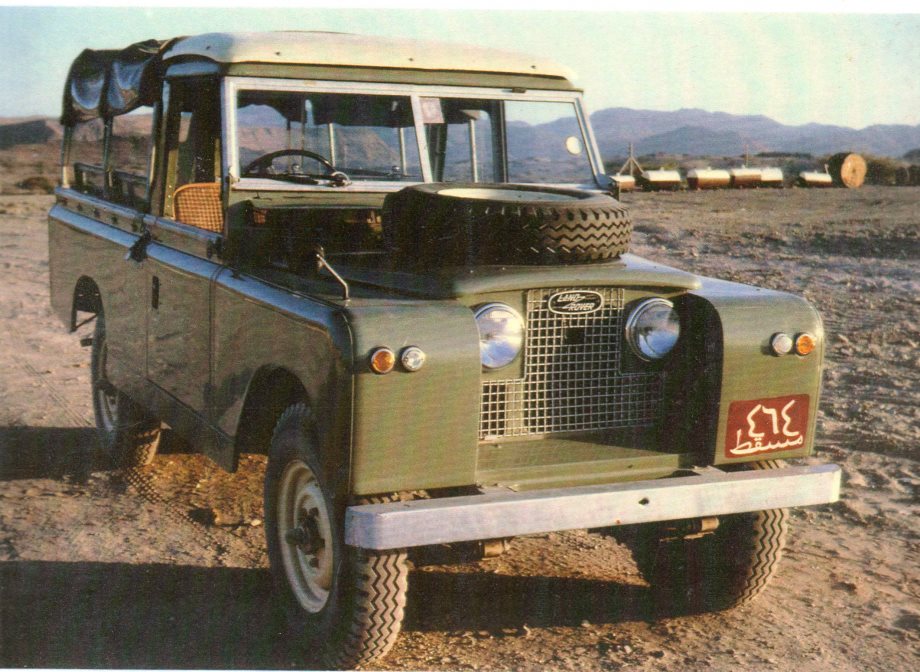
Our former President  Bernt Larsson has fielded this magnificent shot from his library.   It’s almost like a publicity picture for the Land Rover catalogue!

Muscat 464 photographed in Oman in the early 1960s and kept safe in Bernt's album for 50 years until April 2013, when he gave this exhibition!   Bernt Larsson archive.

Muscat 464 photographed in Oman in the early 1960s and kept safe in Bernt’s album for 50 years until April 2013, when he gave us this exhibition!            Bernt Larsson archive.

Prodded by Bernt’s senior-team display, the percussive Mr. James Fox, of those United States, hurried to counter him with this very unusual DIE-CAST Omani plate of the period (they being simply painted tin sheet as a rule).   This plate is reminiscent of the Kuwait plates of the period, which were almost all heavy, cast  metal, like this (and also silver on red)

diecast alloy MUSCAT 337, a classic plate from the Jim Fox cornucopia.

Diecast-alloy 337 MUSCAT, a classic plate from the Jim Fox cornucopia.

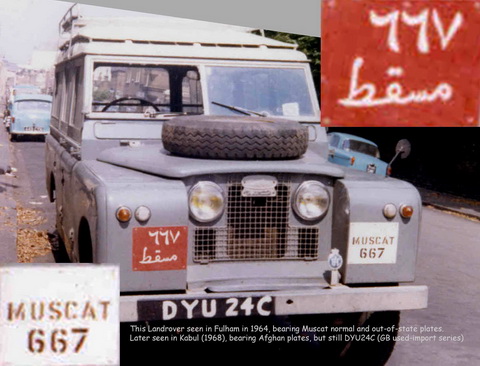
EU38 also has an exemplar of the period, which had the additional curiosity of an out-of-state plate to translate the arabic-only Muscat/Oman registration.

Muscat 667 was captured in Fulham, London, in Spring, 1965, having been imported to Britain, and given a dedicated* used-import re-registration, DYU 24 C. Brumby archive

Muscat 667 was captured in Fulham, London, in Spring, 1965, having been imported used to Britain, and it was given a dedicated* used-import re-registration, DYU 24 C.                                   Brumby archive 1965


DYU 24 C – Readers may be surprised by the evidence of sunshine in this photograph  and wonder if the image may have been put through Photoshop.     I can attest that this WAS taken in England – though, of course, long before global warming was an issue!

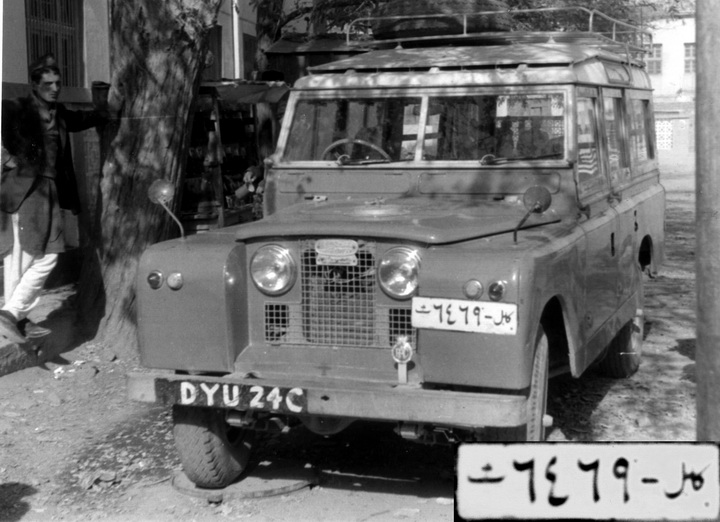
On the taxi-rank in Kabul, in September 1968, the very same Land Rover was to be seen waiting for customers!    Some coincidence…..    The owner must have been just  ahead of me on the overland  route from Britain……     The British plates, DYU 24 C, which had been painted on originally, were still in evidence in Afghanistan.

*Most London registrations between 10 and 99 were kept for registering used imports of all types, probably from the 1940s to the late 1960s.

Kabul Taxi 6469 which had driven from Oman via London to Kabul to become Kabul's toughest taxi.    Brumby archive.

Kabul Taxi 6469 which had driven from Oman via London to Kabul to become Kabul’s toughest taxi.    I think the driver may now be the current President and the tree has fallen without his support..           Brumby archive.

Brumby archive

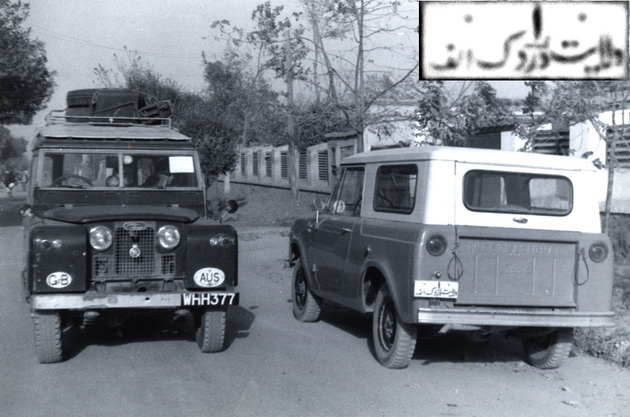
The same Land Rover model I was attempting to drive to Australia, left England in 1965 with its front wings emblazoned with a few of my more colourful plates, including a green Cameroun diplomatic,a red Kuwaiti cast-alloy and a blue Hungarian DT diplomatic.   As we were lifted off the ferry at The Hook of Holland, Netherlands Customs soon put a stop to that, though I was allowed to keep the AUS oval. Here it is in 1965 Kandahar with the very kindly mayor and his official car, an International Scout 4wd, ‘Official’ plate no. 1.         Brumby archive

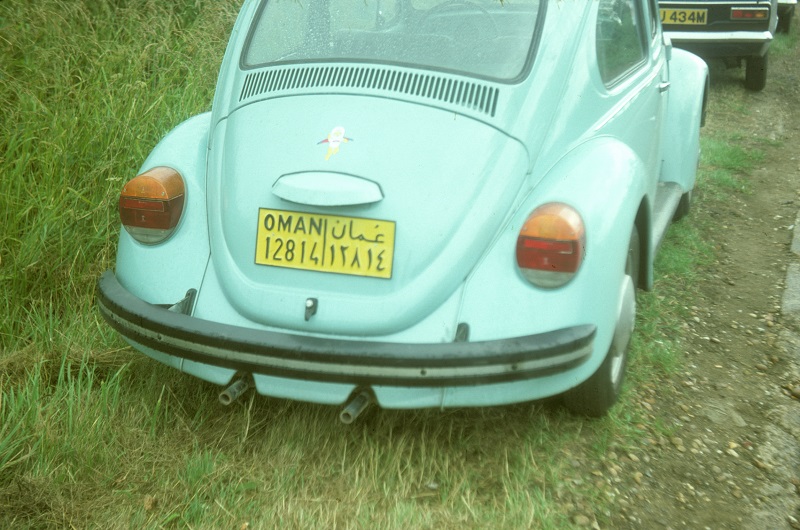
The above series was replaced by simple pressed plates on to soft alloy sheet, in white on black, about 1973.   Later the colours changed to black on yellow.
The above red series was replaced by simple pressed plates on to soft alloy sheet, in white on black, about 1973. Years later the colours changed to black on yellow.      VB plate

810 - the yellow variant.

810 – the yellow variant.      Brumby plate

The yellow plate begs the question:  why the low number, if yellow came after black?   Cedric, please??

Cedric Sabine has responded with the info that the black plates were for commerical vehicles, the yellow for private use.


Another private vehicle issue from the 1970s, caprured by EU9, Terry Gray.

Another private vehicle issue from the 1970s, captured by EU9, Terry Gray.


A final shot we cannot leave out of an Oman Posting:

Thought to be a royal household plate of some sort, the shot was taken by non-member André Mas in a 2010 visit to the country.

Thought to be a royal household plate of some sort, the shot was taken by non-member André Mas in a 2010 visit to the country.

That’s all from Oman for now…….


News from Sarawak

March 25, 2013
I may be behind on developments in Kuching, Sarawak, but I am surprised to see this apparent development in their system, in the addition of a suffix serial - and already at letter 'C'!   A is for Kuching, the capital; it is unlikely to to have spread to the other registration centres yet, I imagine....    VB in Kuala Lumpur 25/3/2013

I may be behind on developments in Kuching, Sarawak, but I am surprised to see this apparent development in their system – the addition of a suffix serial – and already at letter ‘C’!           QA-A is for Kuching, the capital; has this new suffix  been applied to the other registration centres yet, I wonder….         VB in Kuala Lumpur 25/3/2013

The latest registration sighted was in 2011, when QA had reached QAP

(MAL)(SK4a)_QAPpair_VB2011


Addendum June 25 2013.    The new suffix confirmed.    See Blog Page of this date, titled Malaysia News & Jottings.


Hisrtoric duty-free export issues from Europe

March 20, 2013

Most European countries have a special plate system for vehicles bought within their jurisdiction, but which are intended for permanent export.     These are bought free of local taxes, which are charged when they reach their destination country.    Germany and France were the first to formalise such systems and here are some examples from the 1960s and on from round Europe.

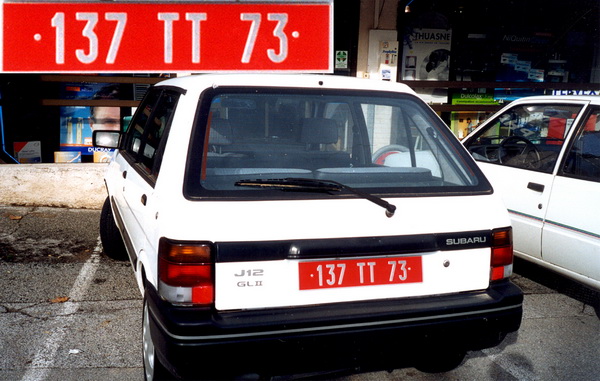
FRANCE.   TT=Titulaire Temporaire or Transit Temporaire??    73 is from Savoie, seen in Ste. Maxime circa 2005, and seems oddly old for that time, as this series ran 1955-84.  False plate?       Brumby archive

FRANCE. Export.    TT=Titulaire Temporaire or Transit Temporaire??     73 is from Savoie, seen in Ste. Maxime (83-Var) circa 2005, and seems oddly old for that time, as this series ran 1955-84.  A false plate?               Brumby archive

GERMANY - Export Customs (Zoll) oval plate .   This once-common Z-plate series was issued between 1951 & 1988 as tend of thousands of German cars were collected for export.  818 Z-9348 was seen in London in 1960. Brumby archive

GERMANY – Export Customs (Zoll) oval plate . This once-common Z-plate series was issued between 1951 & 1988 as tens of thousands of German cars were collected for export.     818 Z-9348 was seen in London in 1960 prior to its ultimate export to Argentina (RA).               Brumby archive

On its way to the Central African Republic, 9 TT 10 first enjoys a drive along the Promenade des Anglais in 1964 Nice.          Brumby archive

FRANCE   TT.   On its way to the Central African Republic, Pontiac Bonneville    9 TT 10 first enjoys a drive along the Promenade des Anglais in 1964 Nice.    10= département of Aube, which seemed not to register many of this category!   Brumby archive

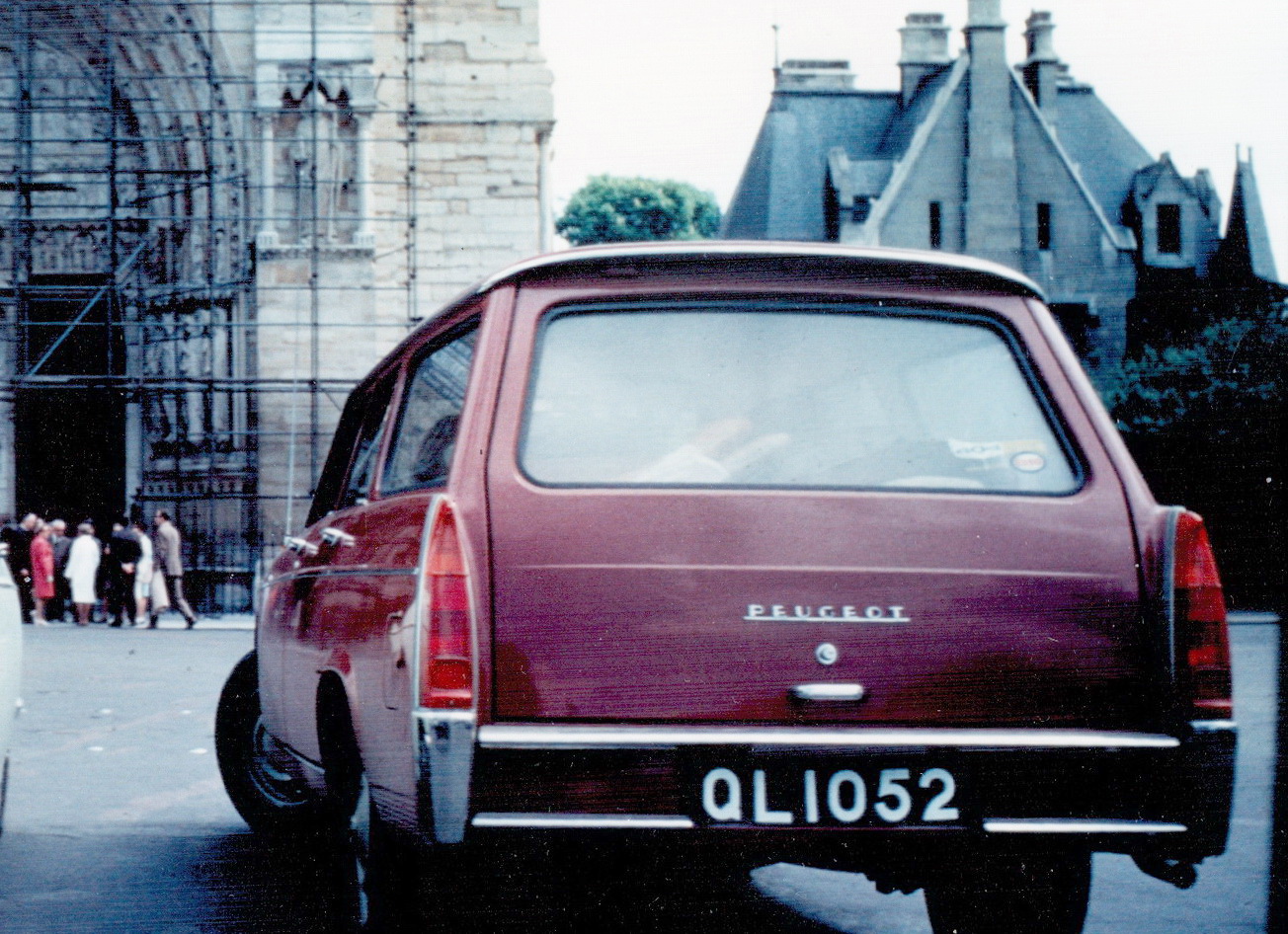
QL 1052 - Peugeot 404L bought in London 1969, for export to Canada.  (Brumby archive/car)

GB    Foreign brand Export.   QL 1052 – Peugeot 404L bought in London 1969, for export to Canada.    (In fact this car never left, and was re-registered with a normal mark, GGN 157 J.)        (Brumby archive/car)

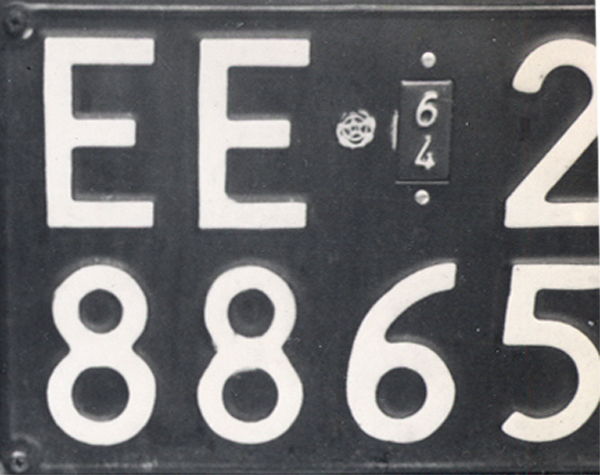
Italian 1964 Export 'EE'   Brumby archive

ITALY   1964 Export ‘EE‘                                                                         Brumby archive

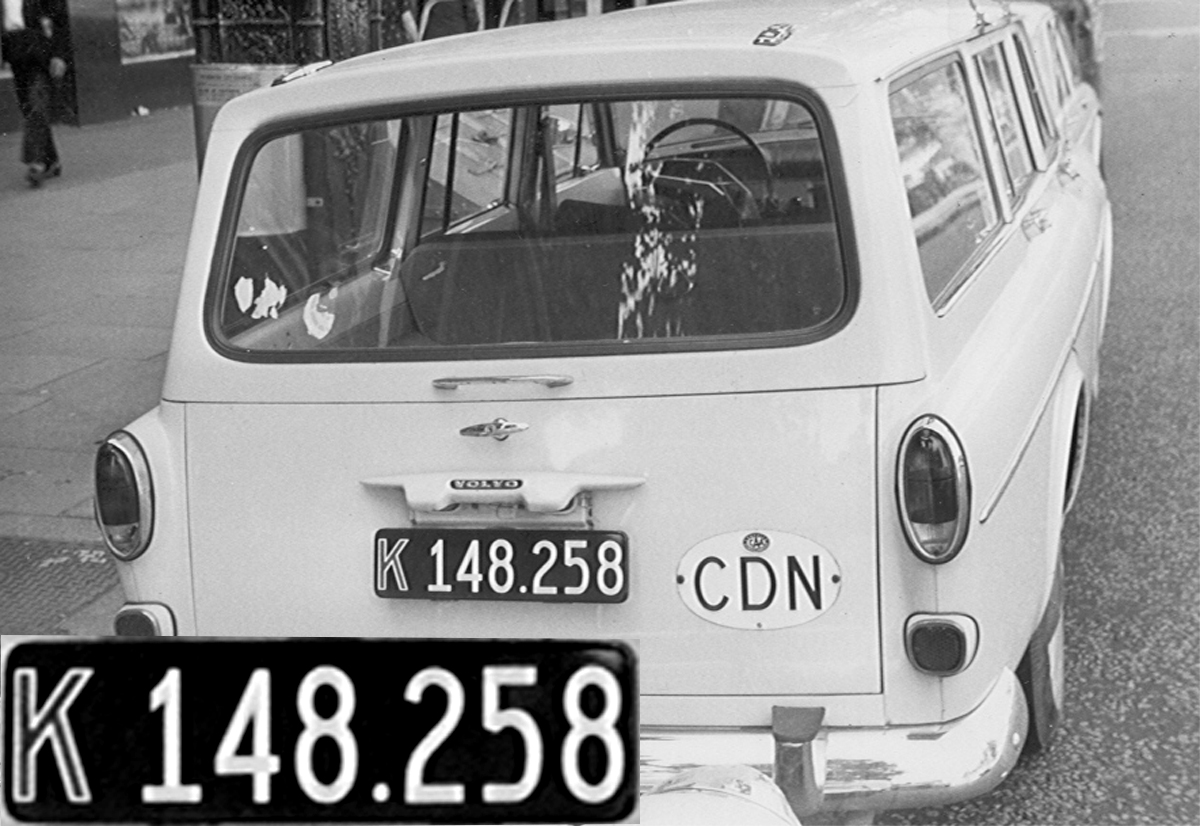
A  Danish export Volvo 245 destined for Canada, seen in London 1964.   Brumby archive

DENMARK.   An export Volvo destined for Canada, seen in London 1964.   The red Copenhagen  ‘K‘ with the white lining indicates temporary validity.              Brumby archive

Swedish export Volvo from Gothenburg (O) valid during 1964, seen in London.   Brumby archive

SWEDEN – export Volvo from Gothenburg (O) valid during 1964, seen in London.                  Brumby archive

FINLAND Export     Brumby archive

FINLAND  1994 Export duty-free.      The letter is serial, not a regional code.                             Brumby archive

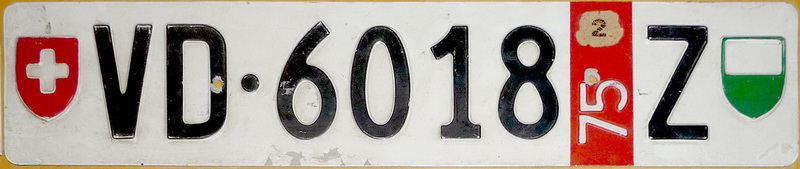
Switzerland.   1975 Export  Brumby archive

SWITZERLAND. 1975 Export Vaud 6018 Z.   Z=tax unpaid.       Brumby archive

Luxembourg 1978 Export 616.     Brumby archive

LUXEMBOURG – 1978 Export 616.                    Brumby archive

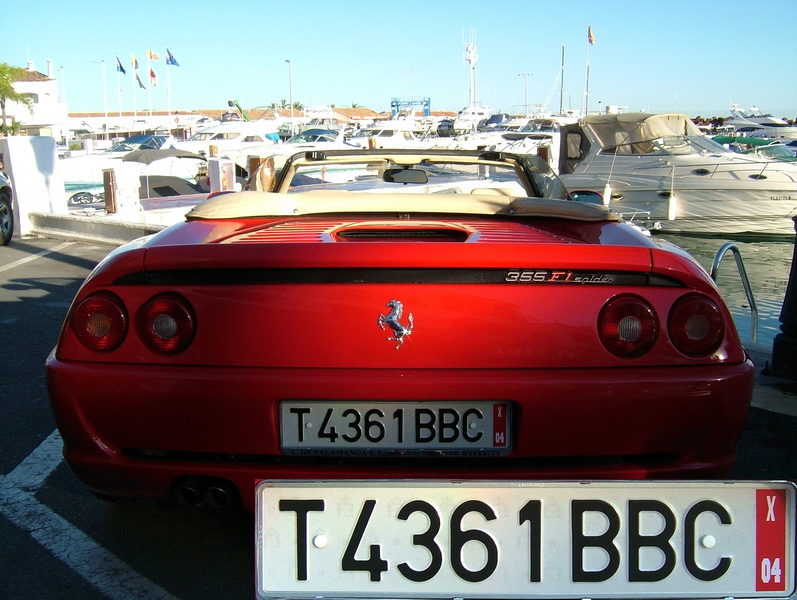
Spain -  Export 2004 T 4361 BBC       Brumby archive

SPAIN – Export 2004 T 4361 BBC , expiring October 2004.                         Brumby archive

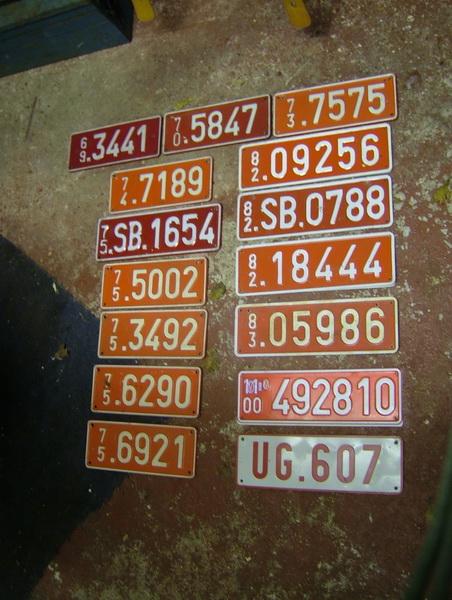
Belgium - some early export plates and others.  Brumby archive

BELGIUM – some early Export plates and others.   Note colour changes.   Brumby archive

Monaco - 1979 Export in red on white - TT 51.   Brumby archive

MONACO – 1979 Export in red on white – TT 51.      Brumby archive

Here is a strange sighting, 27 years later, in Monte Carlo…

Monaco TT 51 Export again, in the later style reflective etc.  Brumby archive

MONACO TT 51 Export again, in the later style reflective etc.    Front plate at upper right, carries no legend.            Brumby archive

Lichtenstein - Export 1963 - FL 9043 Z.  Brumby archive

Liechtenstein – Export 1963 – FL 9043 Z in London.   Z means tax unpaid.     Brumby archive

San Marino - Export 1992.  Thornley album

SAN MARINOExport 1992.              Thornley album

Any more, readers????


2012 – German Car rental in Paris

March 13, 2013

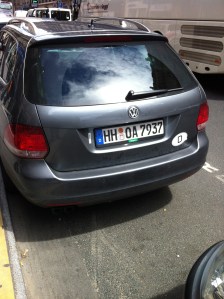
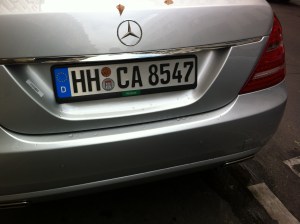
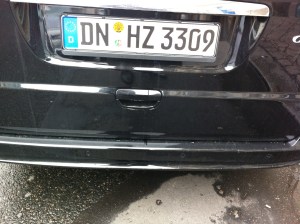
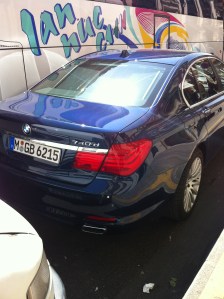
I hope this is of some kind of interest for this Blog –  last year from January to November 2012, I noted the registration of the many German rental cars that visit the streets of Paris.

Here is an overview of the regions and sequences used by the main German rental-car companies:

Hansestadt Hamburg


This Lander uses particular sequences in the following order

1- HH-Bx-8xxx

Overall sequence from HH-BJ 8532 to HH-CI 8795 (not observed from BA to BI then CC to CF and CH)
(Numerical sequence observed from 8033 to 8999)
1 – HH-Ox-7xxx

HH-OA 7172 to HH-OT-7726 (not observed OC to OF OH to OJ, OK, ON, OQ and OR) (Numerical sequence observed from 7019 to 7726).

Observation from HH-OA-7172, HH-OB 7019 then HH-OG 7xxx, HH-OI 7620 to HH-OL 7xxx, HH-OM 7421 then HH-OO 7xxx, OP 7xxxx & HH-OS 7xxx, OT 7726

3 – HH-Px-7xxx (May be the next sequence)

One observation HH-PE-7093

Düren

Düren uses two sequences in this order

1- DN-Hx-xxxx

Overall sequence from DN HO 3746 to DN-HZ 8852 (all series DN-HO to HZ-observed) (numerical sequence observed from 10xx to 9xxx)

2- DN-AA-xxxx (Must be the next sequence) One observation DN-AA 7032

Wiesbaden

Only one sequence observed for Wiesbaden

Overall sequence from WI-AG 8889 to WI-AK 8068 (all series observed from WI-AG to AK) (numerical sequence observed from 1791 to 9694)

München

München’s area seems to have several sequences at the same time, no specific order

M-OA to M-OJ (all series M-OA to OJ observed) (numerical sequence observed in 10xx 9xxx)

M-GA 5042 to M-GD 6556 (all series observed from M-GA to M-GD) (numerical sequence observed from 50xx to 6xxx)

M-AB to M-AG 2912 (not observed AD and AE) (numerical sequence observed from 4226 to 6556)

Neuss

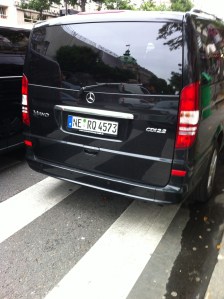
Only one sequence observed  from NE-RQ 4573 to 5365

Bonn

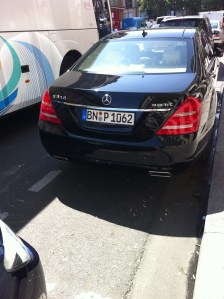
Only one sequence observed from BN-P 744 to BN-P 3168

All photos come from Bruno Vernhes’ collection

Europcar

Hansestadt Hamburg Europcar HH-Ox-7xxx sequence

Hansestadt Hamburg Europcar HH-Bx-8xxx sequence

Hansestadt Hamburg Europcar HH-Cx-8xxx sequence

D-DN-HZ3309-P

Düren DN-Hx-xxxx sequence

Mûnchen M-Gx-xxxx sequence

Bonn BN-P-xxx and xxxx sequence

Neuss NE-RQ-xxxx sequence


Mixed Europeans Part 2

March 4, 2013

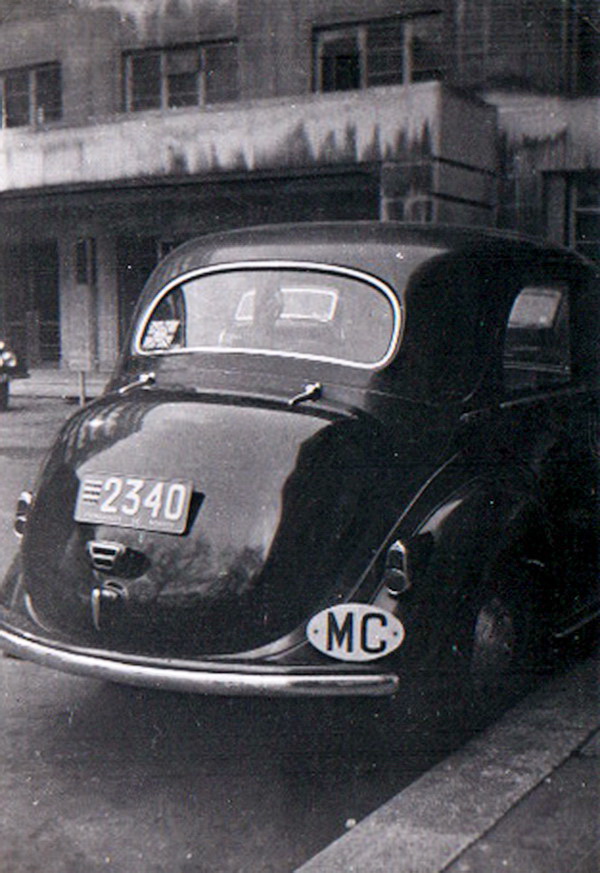
Here are some of the more normal photos from John Pemberton’s album, showing us some early post-war European plates, with their massive international ovals on display.    The French 373-TT 8H is a rare one.

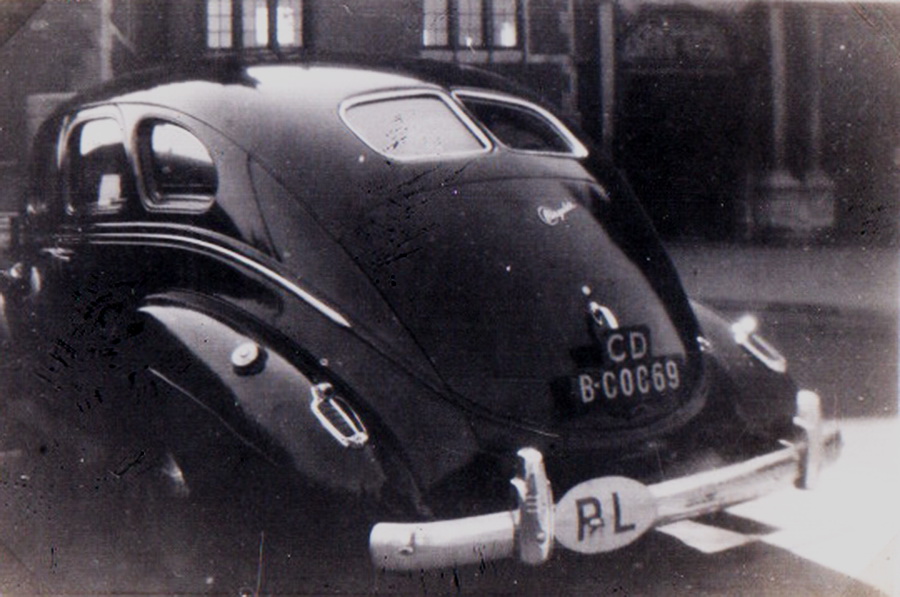
The Polish diplomatic is a very peculiar one – have any bloggers any thoughts on B-00069??  SZYMON has clarified this oddity with his reply below and this web page.   Thanks, Szymon!

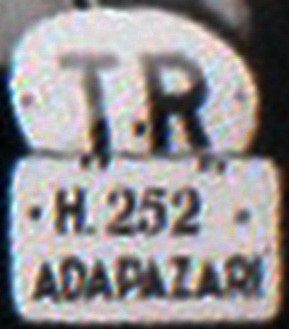
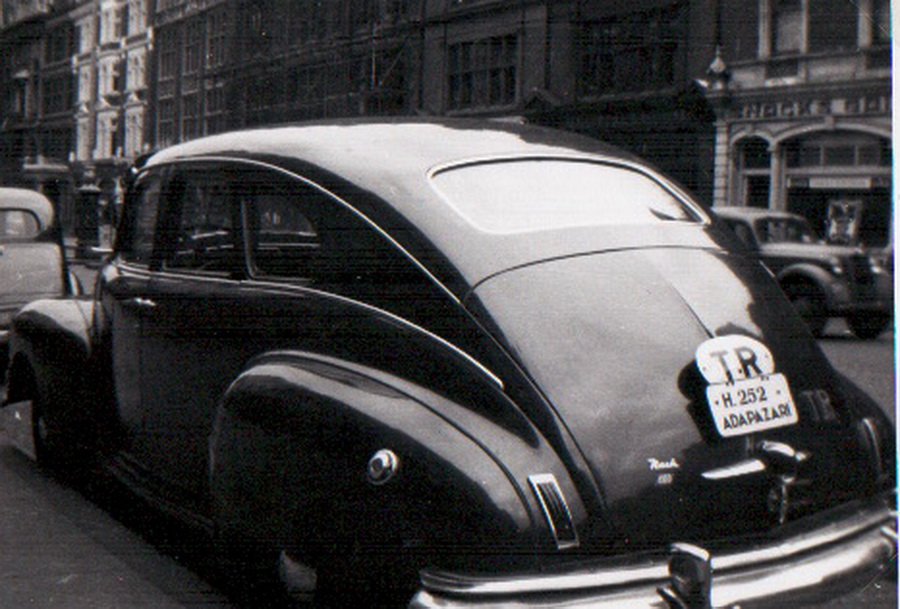
Our Turkey/Greece/Cyprus specialist Pieter Lommerse will be happy to see the old Turk from Adapazari (first picture)

(TR)_H.252_cu_JPvb (TR)_H 252_JPvb

(IS)_R-4793_JP1940sv

(MC2)_2340_JPvb

Peugeot?

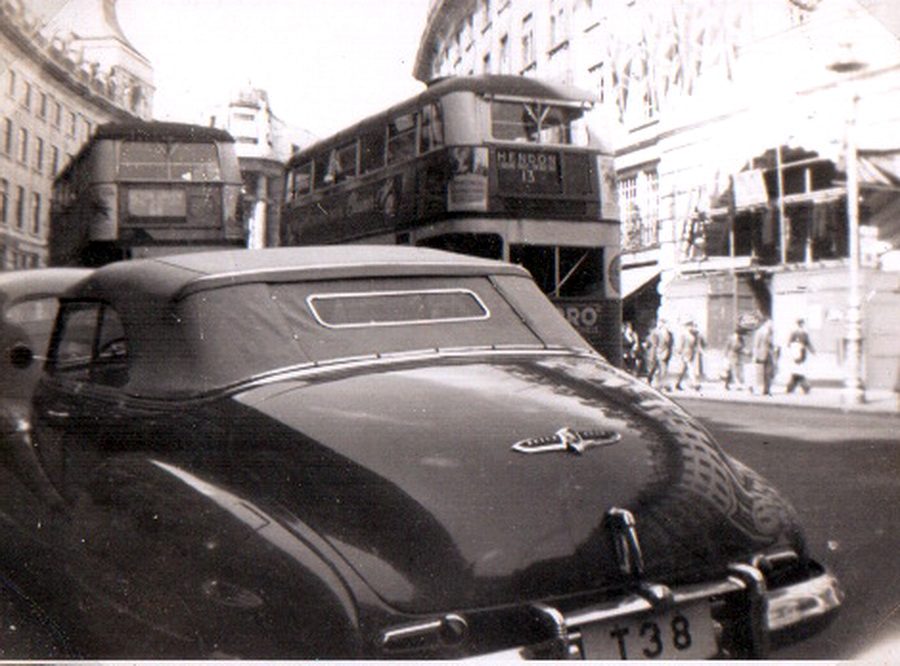
(GR)(0tax)_T 38_jp1940vb

T 38 above is given by John Pemberton as Greek, but is not like known Greek types?       However, could it be a 1940s Thessalonika customs-issued temporary importation plate???         BUSES: Beyond the Buick, going north on Upper Regent Street,  are two pre-war AEC double-deckers of London Transport’s STL class.         Pemberton archive

(PL)_B-C 0069_JP1940svb

B-00069  —  We were baffled by this plate, which claims to be a Polish Diplomatic, yet is nothing like anything seen before. Taken in 1940s London by John Pemberton, and carried on a 1938-1946-ish American car (a Lincoln-Zephyr V12?), an identification one day will be of considerable interest…….   Feb. 2014 –  Finally we have the answer via ‘Szymon’      The ‘B’  WAS for diplomats’ (cars) in 1940s Poland !     B-00069 is a Polish diplomatic plate from 1946. First letter A or B meant passenger car, numbers 00001-00999 were reserved for diplomatic purporses:
00001-00299 – CD cars and motorcycles
00300-00399 – CC cars and motorcycles
00400-00799 – embassy staff cars and motorcycles, CD/CC trucks
00800-00999 – not used                                                                                                   

B-00069 – For more information from the Polish Club, go to 

://wptr.pl/index.php?dz=tablice&pdz=1922

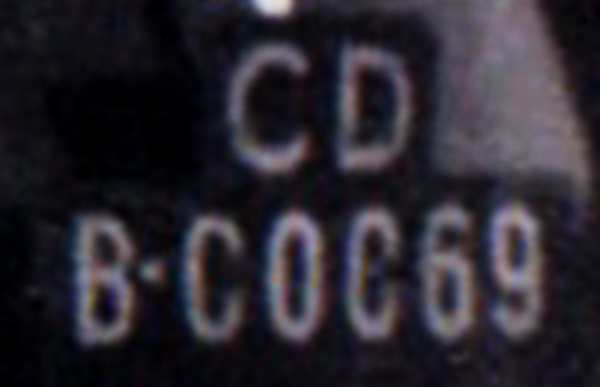
(PL)_B-C 0069_cu_JP1940svb

A close-up of the strange Polish CD – with a narrow font similar to some Spanish plates of later years…….B-00069.  A and B  were for diplomat’s cars

(F2b)(28-50)_2028 QJ 5_JPvb

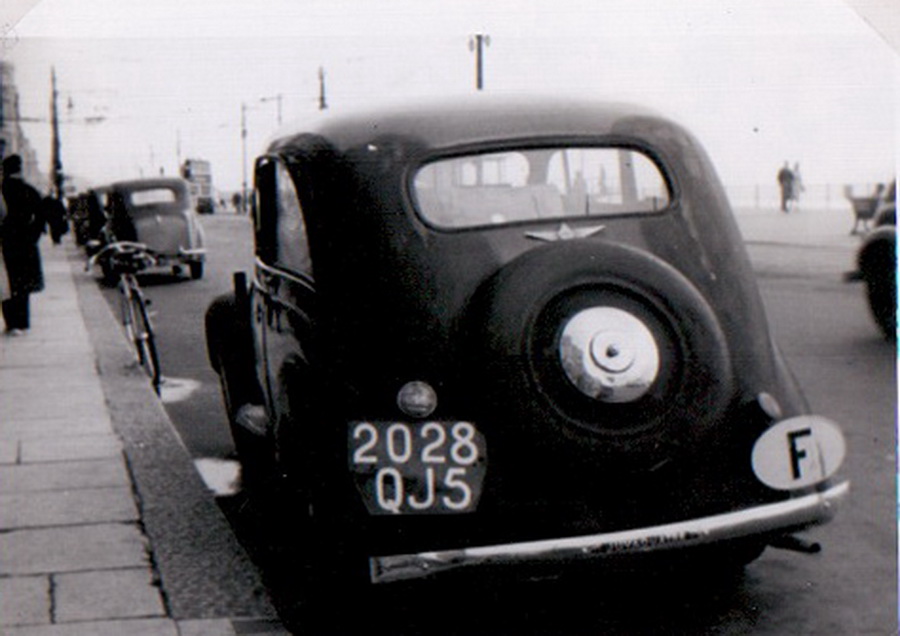
In the 1928 to 1950 French system, the suffix numeral(s) (5 here) indicated the tens of thousands.    Thus this registration can read  QJ 52028 and QJ was the code for Sarthe (Le Mans) until 1950, when the département  code 72 replaced letter-codes with the new, numerically-suffixed, département series.     Is this  a Renault?     Seen on the seafront at Hastings soon after the war.         John Pemberton archive c. 1938

(F2b)(28-50)(exp)_373-TT 8H_JPc1940vb

373-TT 8 H – Packard?     A white-on-red temporary import of a used car to France in 1938 or 1948*.   The 8 signified the year of entry and the H, the port of entry – in this case, H = Cherbourg, the principal French port for the transatlantic liners of the age.    Many wealthy Americans travelled with their grand cars before the era of car rental.
*Thus a ‘3’ suffix could have marked a registration in 1933, 1943 or 1953!             This French temporary series was issued between 1933 and 1955 and apparently could also be used for the temporary registration of new vehicles purchased in France for  imminent export elsewhere.

(F2b)(28-50)_105 RL 8_JPvb

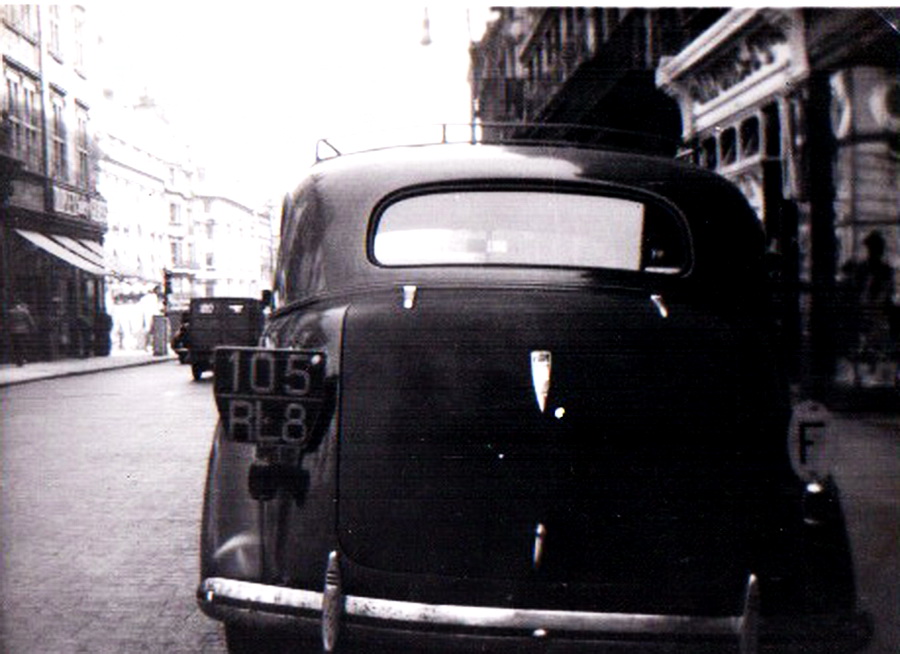
105 RL 8 (F)  –  from 1928-1950, RL was among the codes for Paris.   The 8 suffix represents the ten-thousands in the serial number – hence this  American car could be seen as RL 80105.      Pemberton in Oxford 1947-ish.

(F)_9709 YD_JPvb

1928-50 France srs. YA-YD=Département of Seine-et-Oise(later suffix 78), in London, 1940s.       Soon, at 9999 YD, a suffix 1 would be added, giving 1234 YD 1. Citroen Light 15 Decapotable?

(A)_S 5.320_JPvb

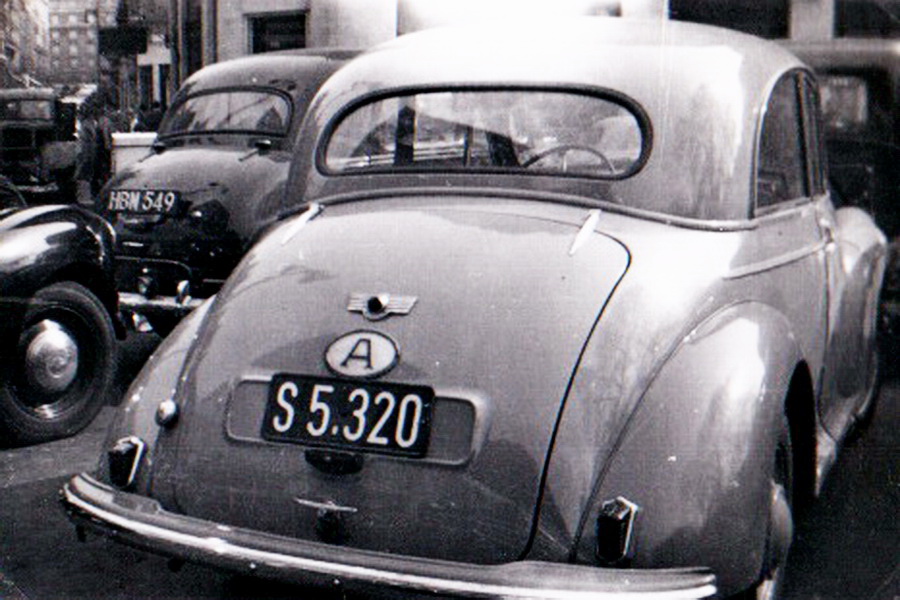
S 5.320 (Austrian 1947-89 series.) – A Morris Minor from Salzburg circa 1951. Pemberton archive

(B)_346148_JPvb

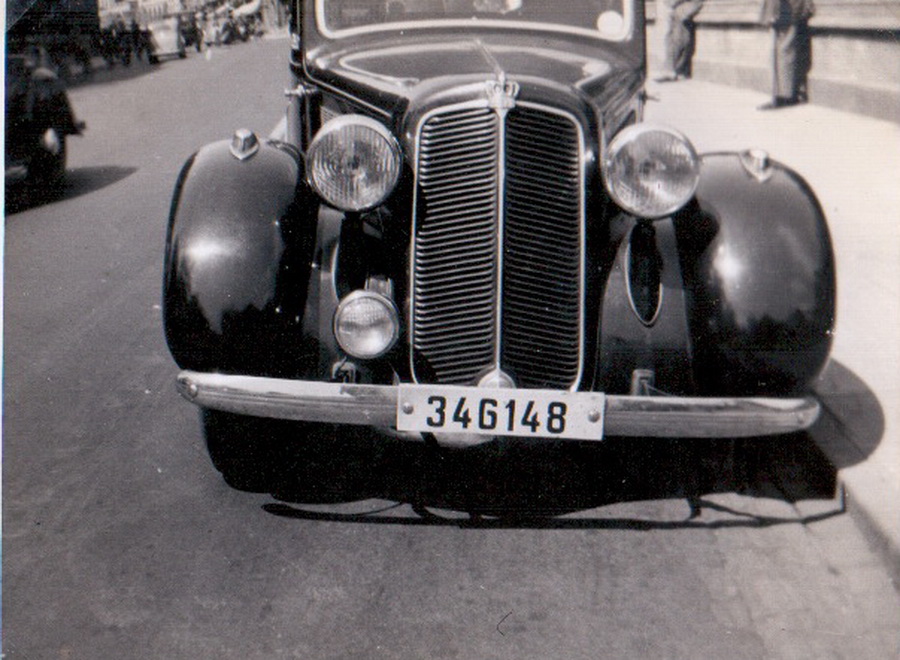
346 148 (B) – 1926-1953 Belgium.    Usually of porcelain, in red-on-white with the last three numerals preceded by a black symbol (see below) on the rear plates – the front being supplied by the owners in varying styles.

Belgium's 1925-63 national seal borne on the rear, official plate.     Brumby archive

Belgium’s 1925-53 national seal borne on the rear, official plate, using the French and Flemish names for the country.           Brumby archive

~~~~~~~~~~~~~~~~~~~~~~~~~~~~~~~~~~~~~~~~~~~~~~~~~~~~~~~~~~~~~~~~~~


Berlin – the Soviet sector

March 3, 2013

Senior Europlate member Bernt Larsson has passed some of his less distinct photographs and negatives to his computer-skilled colleague, Antonio, who can ‘make something out of nothing’, we are told!      Well, Antonion has ‘raised this rare plate from the dead’ and we are so lucky to now see a Soviet sector Berlin plate in its natural milieu, mounted on an early Benz 180, dated 1961.

Bernt’s introduction to the picture follows:

~~~~~~~~~~~~~~~~~~

In July 1961 I paid a visit to East Germany and, when I was driving around East Berlin in my 1958 black Volkswagen with Swedish registration plates “B 68679” and an “S” oval  I suddenly saw a Mercedes-Benz car with rare French Military Mission plates parked in the opposite direction with people inside. I rapidly turned around and stopped just behind that car. I searched for my old camera and jumped out of my car. My shadow is there on the photo confirming, how close I was. I did not even notice, that the lady passenger in the car turned and looked at me. My priority was the plate. At that time I did not have a camera with zoom, so I had to get close. Once having taken the photo I jumped into my car, turned around and headed for Checkpoint Charlie returning to the American Sector. A few weeks later the People´s Army of the East German Republic started building the Berlin Wall, and I would have felt much more nervous. Now this is one of my plate adventures, which I have recovered thanks to the magic work of my friend Antonio Barragan, who has rescued that old and faded negative.

Car 19 from the French Legation in East Berlin, captured by former president Larsson in 1961.   Larsson archive

Car 19 from the French Legation in East Berlin, captured by former Europlate president Larsson in 1961.       Click to enlarge                Larsson archive

The Blog hopes this will be the first of many vintage plate pictures from Bernt’s albums – thanks indeed!

Bernt, through Placamundi, our Spanish section is now working on some fascinating historic research, with Thierry and Alex, which we shall have a chance to see as the documents become ready for release.   The first, Blog hears, is to be the history of the International Oval carried on the rear of cars travelling outside their own jurisdictions.    March 2013.


~~~~~~~~~~~~~~~~~~~~~~~~~~~~~


Malaya – the 1948 single-letter plates

March 1, 2013

1906 (or 1932) -48 Malaya had seen some single-letter and some double-letter area codes, of which the double-letter ones were changed in 1948.   (JB to J, KN to D, PK to A, NS to N and SL to B.)

It is sometimes thought that Pahang may have used  ‘P’  in this period, but that would have duplicated the Penang code;  at any rate, Pahang was allocated ‘C’ in the 1948 rationalisation.        Photographs of this period are unknown, save for this copy photo passed to Europlate by enthusiast Douglas Fox of Penang, for which, most grateful thanks, Douglas…

Double-tap the picture to enlarge.
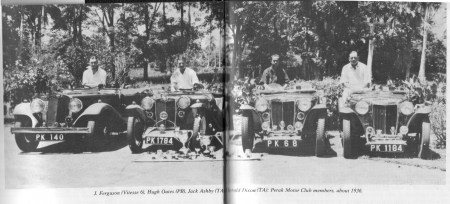
(MAL0)(PK)_various_DFvb1936

This amazing 1936 shot of FOUR PK-registered sports cars in Perak State illustrates the 1932-48 series as used in then-unfederated Perak (and Johore, Kedah, Kelantan, Perlis and Trengganu).   Each was allocated its own International oval, too!   The Federation of Malaya revised these States’ codes to single-letter forms, in common with the Straits Settlements P-Penang, S-Singapore, M-Malacca and L-Labuan, and standardised the International Identification Code to FM.

Today we are unlikely to see a Malaysian plate from the former series, which used single letters to code the areas of  Malaya from 1948.      Some collectors’ cars exist such as A 845 below, which have somehow held on to their original registrations and a handful may be in museums, such as C 4848 on a swb Land Rover fire tender in the palace museum of the sultan of Pahang.    The construction/design of these plates was as determined by the Construction & Use Regulations of the United Kingdom, in common with most of the British overseas territories.   Here are examples of all the original single-letter plates, in photos taken from 1920 (P 1019) to the last seen in 2010 (B 2565).
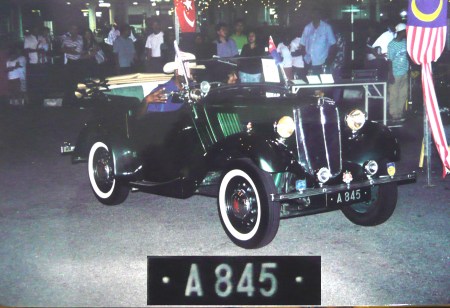
A - Perak state, on a 1935 Morris Eight tourer.

A – Perak state, on a 1935 Morris Eight tourer.

B - Selangor state, on an Austin Seven at the National Museum in Kuala Lumpur.

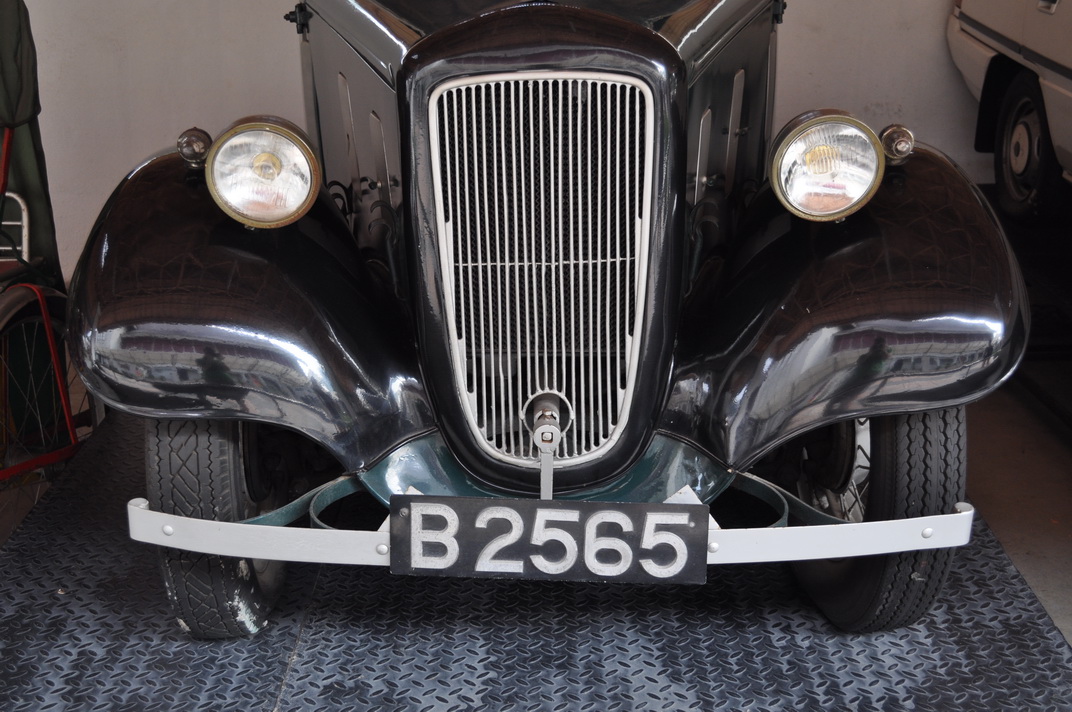
B – Selangor state, on a 1930’s  Austin Seven at the National Museum in Kuala Lumpur.  This 1935 car would have originally borne the SL prefix for Selangor state, and would have had to change to the new ‘B’ plate in 1948.      

C - Pahang state, on a 1950s Peugeot 403.

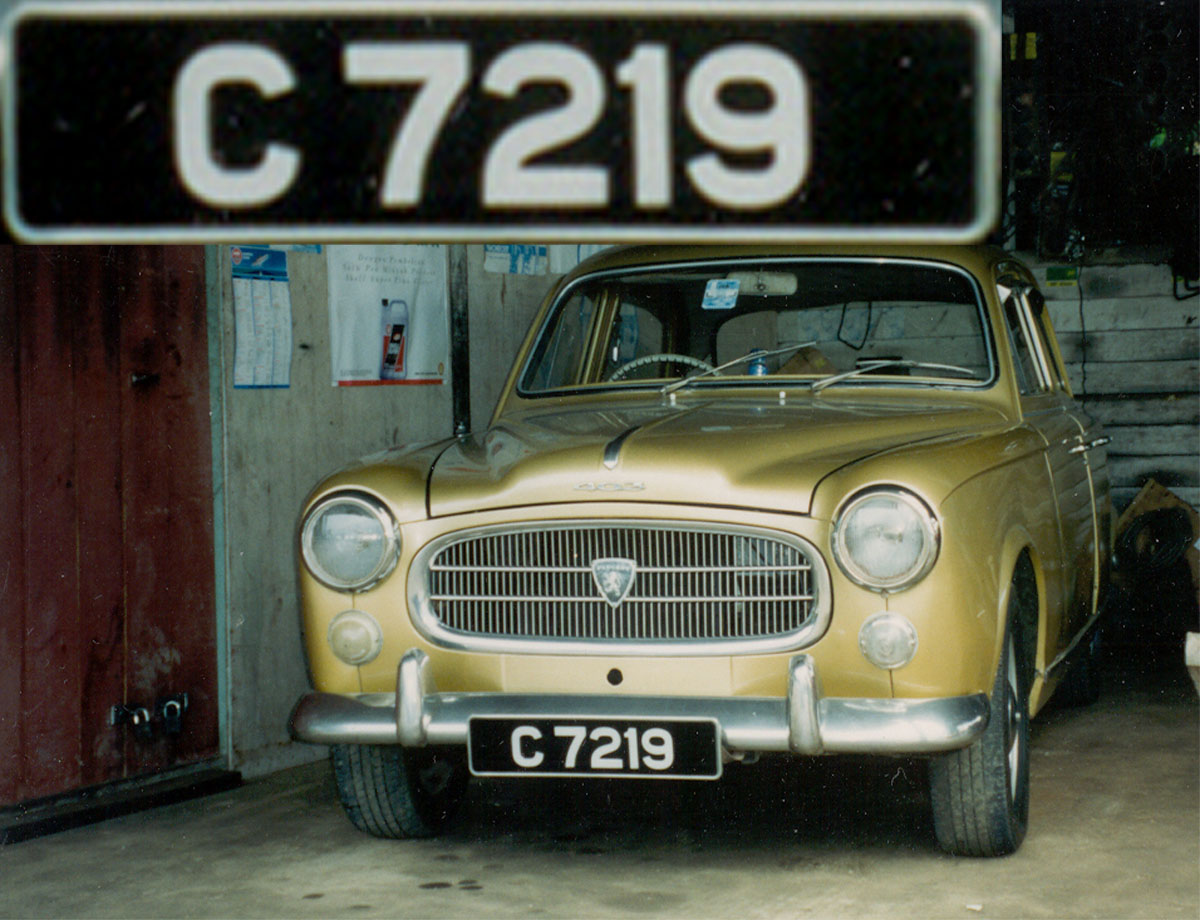
C – Pahang state, on a 1950s Peugeot 403.

D - Kelantan, on  a restored motor-cycle.

D – Kelantan, on a restored motor-cycle.

E was never issued as a Malayan code, nor F, G, H, or I.      H played a part in the plate scene however, as it has been used as a suffix and a prefix to the area codes, to denote Hire – both local and long-distance taxis.  For additional ease of identification, theses plates have always been black on white.

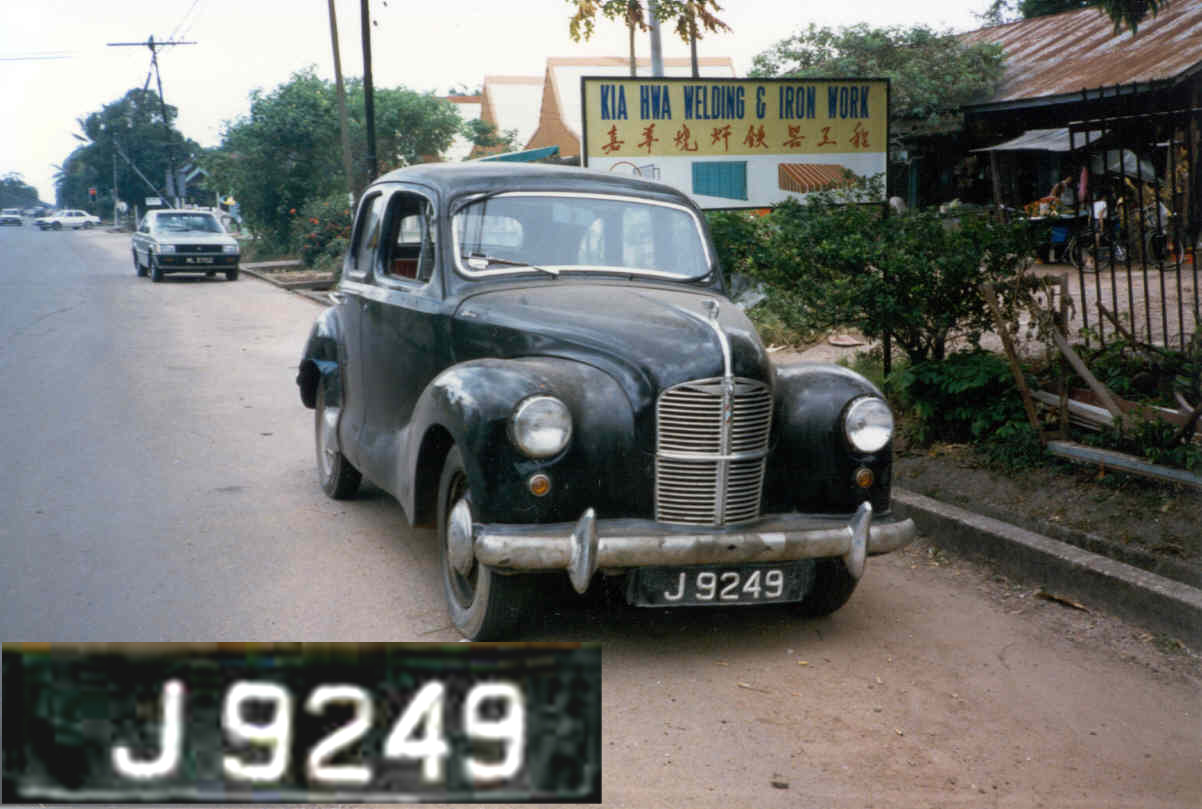
J - Johore state, on a 1947 Austin A 40 Devon

J – Johore state, on a 1947 Austin A 40 Devon


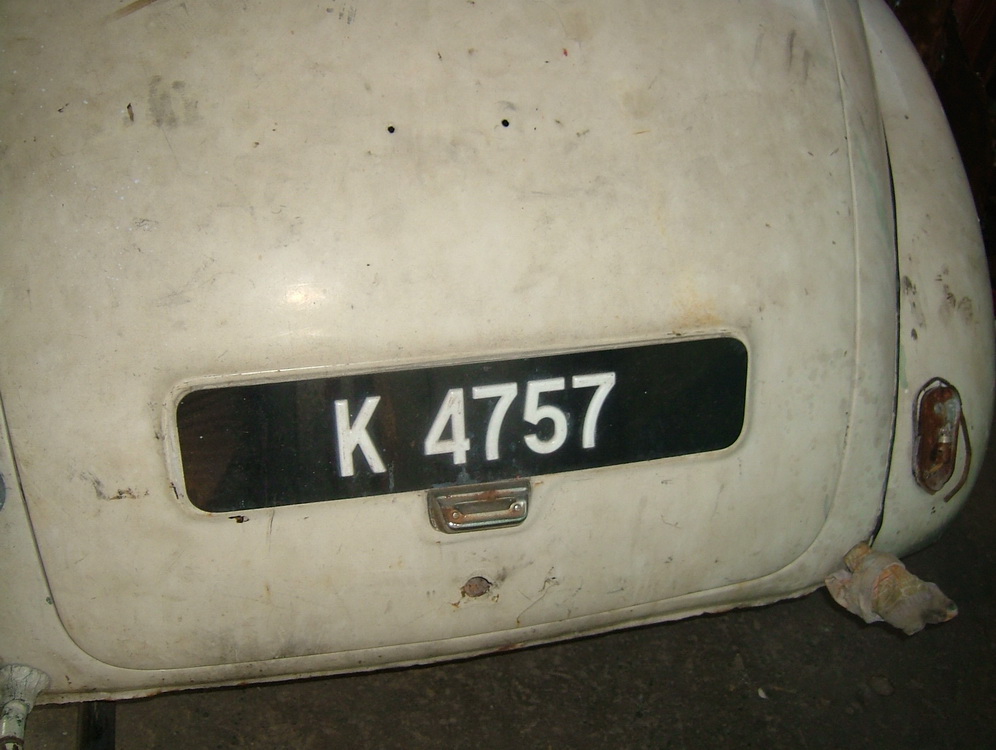
K - Kedah state, on a Morris Minor.

K – Kedah state, on a Morris Minor.

L -Labuan island, on an Austin A40 Farina, preserved in the state museum in Kota Kinabulu, Sabah.

L -Labuan island, on an Austin A40 Farina, preserved (?) in the state museum in Kota Kinabulu, Sabah.     L was issued to the island in 1906 when it was one of the  five Straits Settlements (with Singapore, Penang, Province Wellesley and Malacca) until 1946 when it was made a part of British North Borneo with no change to its plates.    L was  evenyually supplanted by EL in 1963 when the island became part of Greater Malaya – or Malaysia.    Because North Borneo (now named Sabah) and Sarawak  had already been using many regional codes which were common to some regions of mainland Malaya, the additions of ‘E‘ indicating East Malaysia and of ‘Q‘  for Sarawak were designed to prevent duplication of registrations when/if vehicles moved between Borneo and the mainland.     Over the years, Labuan’s international oval has changed from SS to CNB to PTM to MAL!
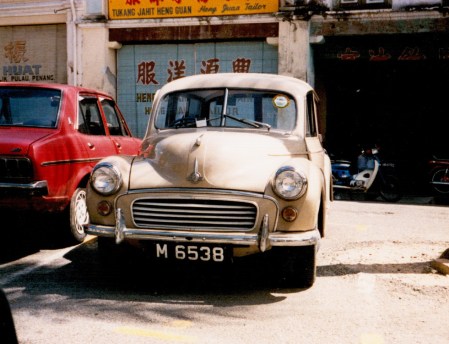
M - Malacca state, formerly one of the Straits Settlements (using the same plates), seen in Penang in 2009

M – Malacca state, formerly one of the Straits Settlements (continuously using the same M code), seen in Penang in 2009

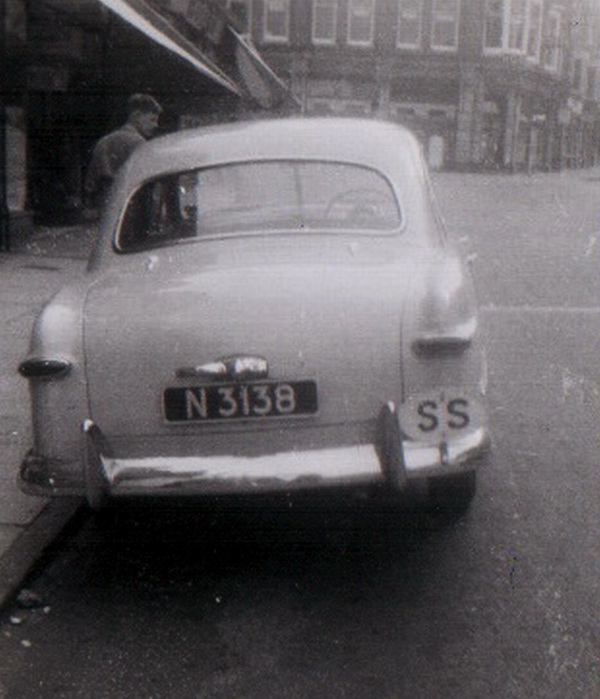
Negri Sembilan N 3138,

Negri Sembilan N 3138, seen by member Pemberton in England about 1949. The Straits Settlements international oval SS is not appropriate to this state and should have read FM (Federation of Malaya)

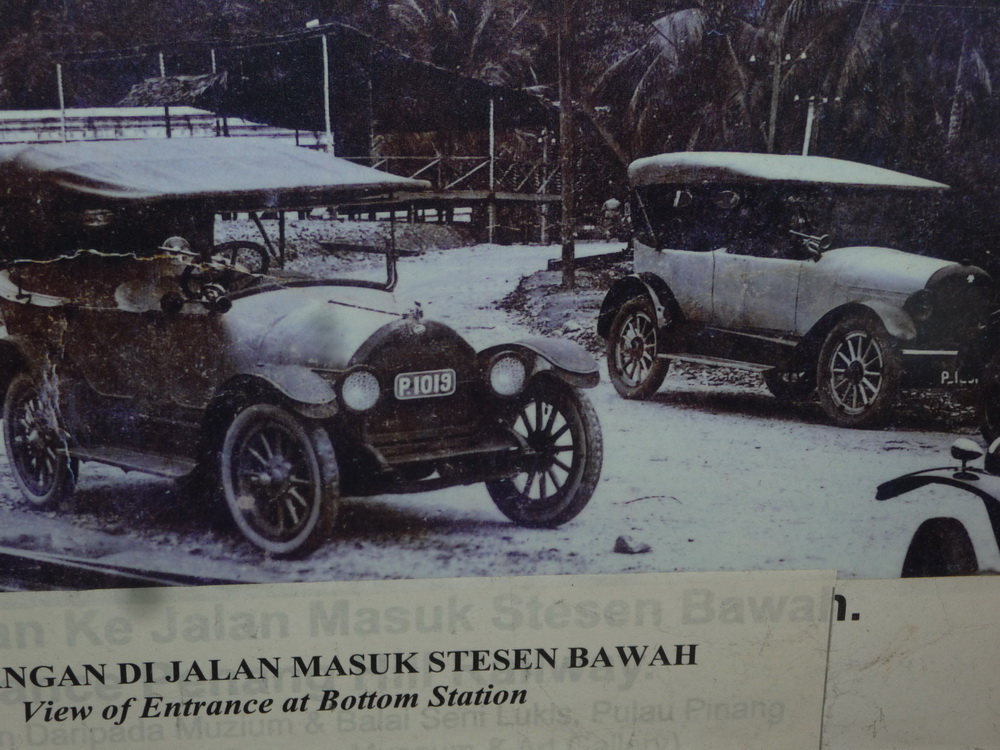
P 1019 - Penang island, in the 1920s, when administered as a Straits Settlement and using the same registration system as mainland Malaya.
P 1019 – Penang island, in the 1920s, when administered as a Straits Settlement and using the same registration system as mainland Malaya.

P 1019 - Penang island,  when administered as a Straits Settlement and using the same registration system as mainland Malaya.  Seen here in 2009 Penang on a Ford Model A awaiting restoration.

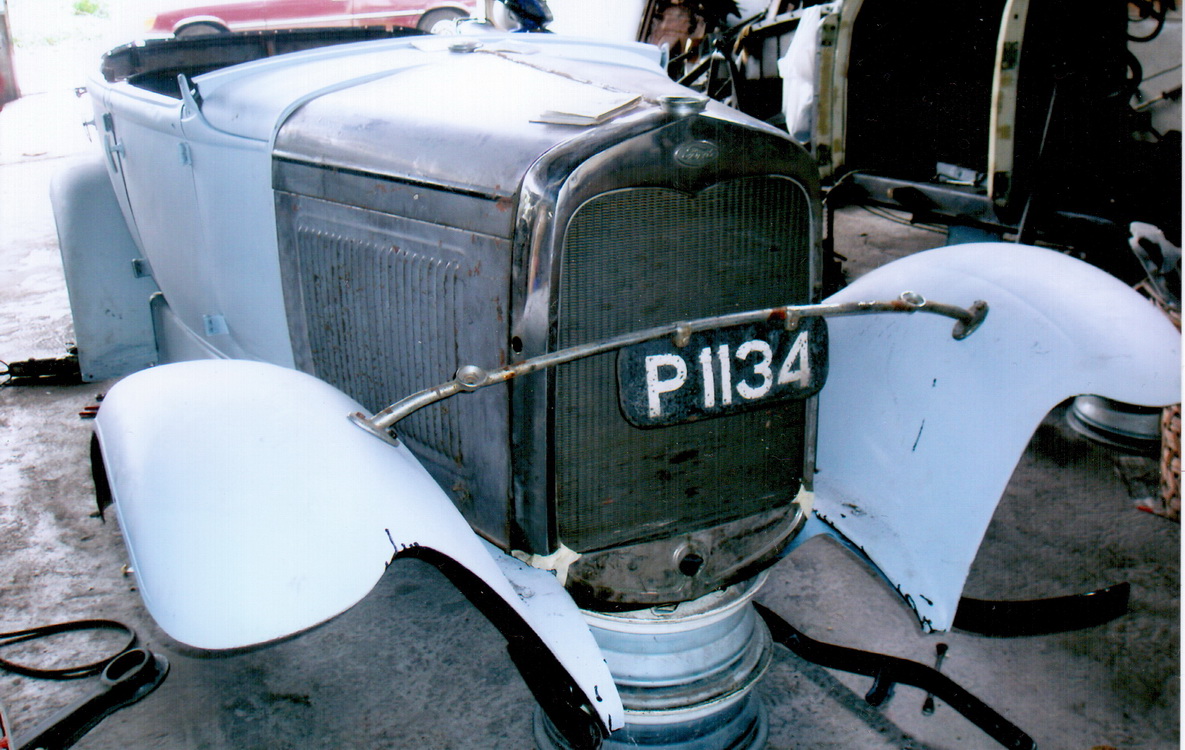
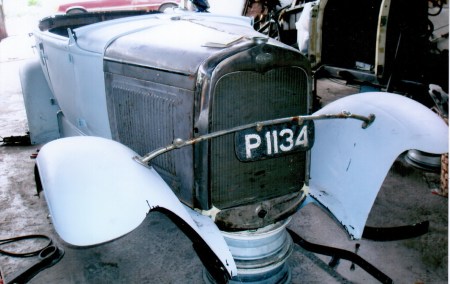
P 1134 – Penang island, 1920s, when administered as a Straits Settlement and using the same registration system as mainland Malaya.    Seen here in 2009 Butterworth  on a Ford Model A awaiting restoration.  (PLEASE keep those original plates!)

Ford Eight from Penang, Straits Settlements,

P 3338 – Ford Eight from Penang, Straits Settlements, seen in London in the 1940s,   A rare shot with the SS oval displayed.

O was never issued, nor Q, U,V, X or Y.

Z is reserved for staff cars for senior military officers.

R is the state code for Perlis but we have no on-car photo yet.

R is the state code for Perlis but we have no on-car photo yet.

Too good a shot not to include Singapore's eighth car in our single-letter article!  Thought to be 1911.

Too good a shot not to include Singapore’s eighth car in our single-letter article! Thought to be 1911.

S was the code for Singapore when it was a part of the Malaya.     At secession, S plates living in Malaya had to change to local Malaysian registration, and lose their 'S' plates.

S was the code for Singapore when it was a part of  Malaya.    At 1965 secession, S plated vehicles living over the causeway in Malaya had to change to local Malaysian registration, and lose their ‘S’ plates.

T was for the state of Trengganu, for which we have no on-car plate picture - yet!

T was for the state of  Trengganu, for which we have no on-car plate picture – unless YOU know of one!

W - originally the code for Province Wellesley, the mainland component of Penang and discontinued in 1967.   Later re-issued to Kuala Lumpur autonomous zone, the Wilaya.

W – was allocated originally the code for Province Wellesley, the mainland component of Penang  and discontinued in 1957, to use the P code instead.   17 years later, in 1974, W (only with serial suffix letters A and on) was re-issued to Kuala Lumpur autonomous zone, (the Wilaya).      Some new vanity plates are appearing with the single-letter W code, which seem dubious in their authorisation.          Anon.

...It's who you know...

…It’s who you know…

Z is a post-independence letter allocated to senior officers of the armed forces in Malaysia.   VB archive,

Z is a post-independence letter allocated to senior officers of the armed forces in Malaysia.                  VB archive.

We will inspect the trade plates and the two taxi types in later Pages on Malaysia.

END