Resumé of postwar period spotting

February 21, 2013

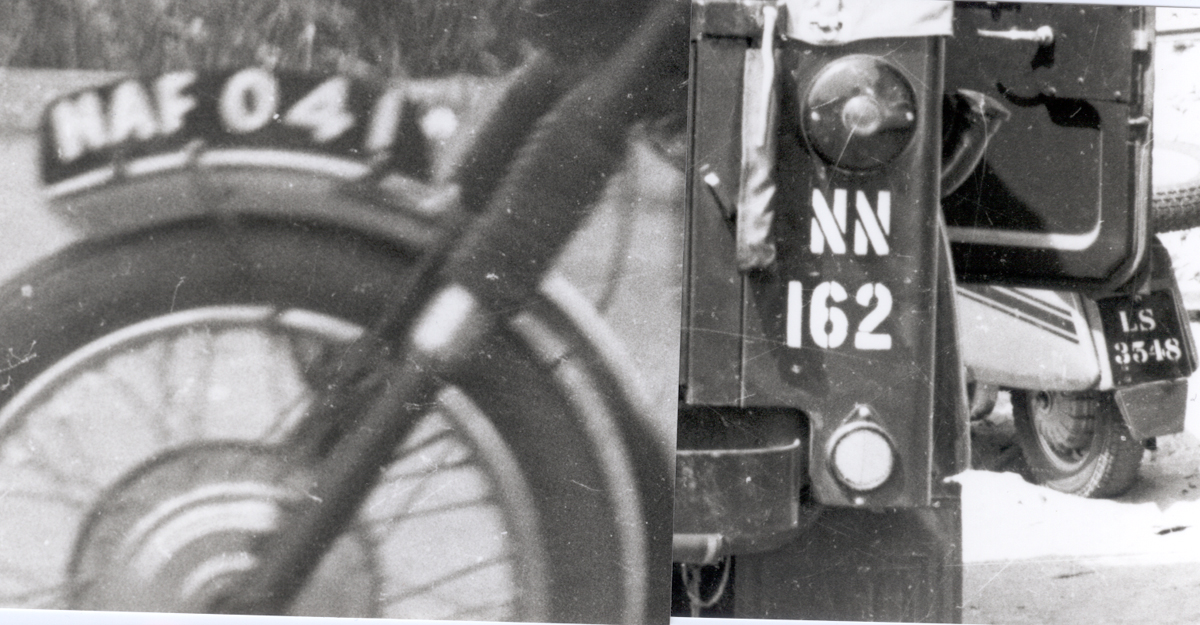
Before the era of worldwide car hire and  aeroplane travel – one might say, before 1965 – people travelled between continents by passenger liners and cargo boats.      Car ownership was  limited to wealthy and  to important people, and factory production was slow as the world’s economies, with limited supplies of steel, glass, lubricants and rubber, began to recover from the vast cost of WW2.    It was due to the steel shortage that many post-war British cars had body panels made in aluminium, a material still  in good supply, but no longer wanted by the war machine for aircraft production.      That serendipitous circumstance was to become an important reason for the 60 years of  success of the Land Rover, the body of which would not rust on the beaches of the Cook Islands…..

Insufficient spae to mount this plate horizontally led the owner to use his imagination!    Brumby archive

Insufficient space to mount this plate horizontally led the owner to use his imagination!    Raratonga MN 9713.             Brumby archive

…..or the sweltering jungles of Malaysia….

W is the code for the Federal Territory of Kuala Lumpur, seen in Kedah.

W is the code for the Federal Territory of Kuala Lumpur, seen in Kedah.

For a long period after peace was declared, a second-hand vehicle would sell for more than a new one, as any new  products were built purely for the export markets, so as to earn foreign currency.     Only  a  few, privileged,  UK-based, professional people were allowed to buy new cars, for work of national importance, such as doctors, farmers and mobile engineers.       A trick used by the rich, was to travel to another country, including to the US and Canada, and to buy a new car there, under their local export scheme!

In this era, of the 1940-1960s,  many technical, administrative and educational personnel were sent  to distant parts of the globe  to perform work on behalf of  the allied governments, which needed to rebuild and modernise  their territories overseas as well as their domestic infrastructures.       When those people travelled, they were entitled to buy a car to take with them, as this would count as an export sale; of course, no spare vehicles would have been available for them to buy in the countries for which they were bound.

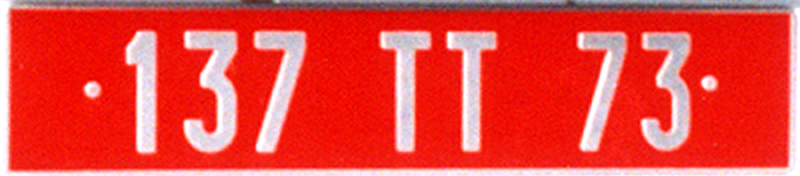
France marked these duty-free export cars with the special, red, Temporary Transit plates…….

On its way to the Central African Republic, 9 TT 10 first enjoys a drive along the Promenade des Anglais in 1964 Nice.          Brumby archive

1964. On its way to the Central African Republic, an American sedan export-registered  9 TT 10 first enjoys a drive along the Promenade des Anglais in  Nice.      Brumby archive
(F3)(exp55-84)_137TT73_cu_VB2003

……….Germany by their unique oval Zoll (Customs) plates…………

A new Beetle destined for eventual export to Argentina   Brumby archive

A new Beetle destined for eventual export to Argentina.     Brumby archive

……Italy by their EE  ‘Escursione Estranieri’ (Foreign Traveller) series………..
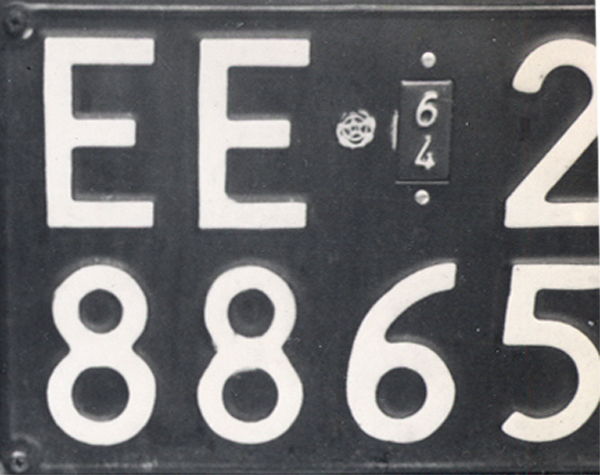
Italian 1964 Export 'EE'   Brumby archive

Italian 1964 Export ‘EE’ Brumby archive

……….Eire, using the prefix ZZ……….
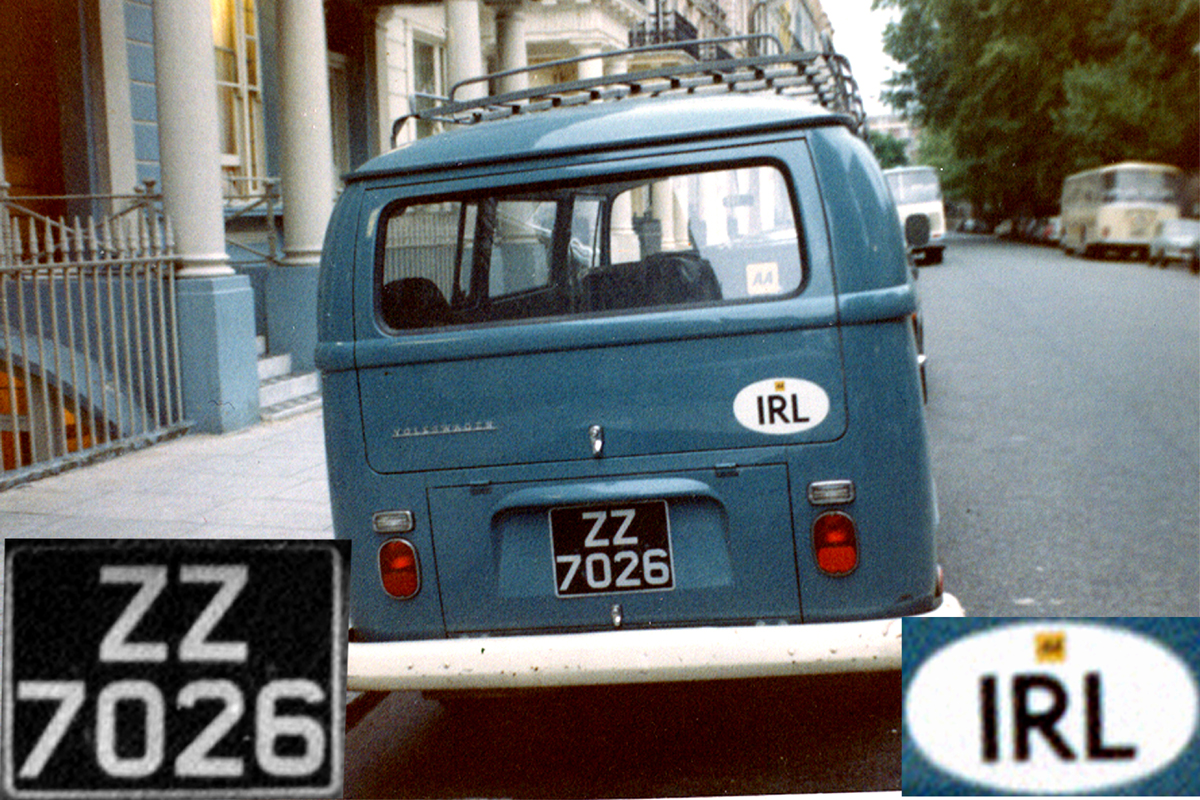
ZZ allocated to new cars of any make, bought in Ireland for export, was an unusual and uncommon issue.   London 1969.   Brumby archive

ZZ allocated to new cars of any make, bought in the Republic of Ireland for export, was an unusual and uncommon issue.      VW Kombi in South Kensington, London 1969.         Brumby archive

…………Denmark by their red lining within the regional code letter.   K -Copenhagen……….
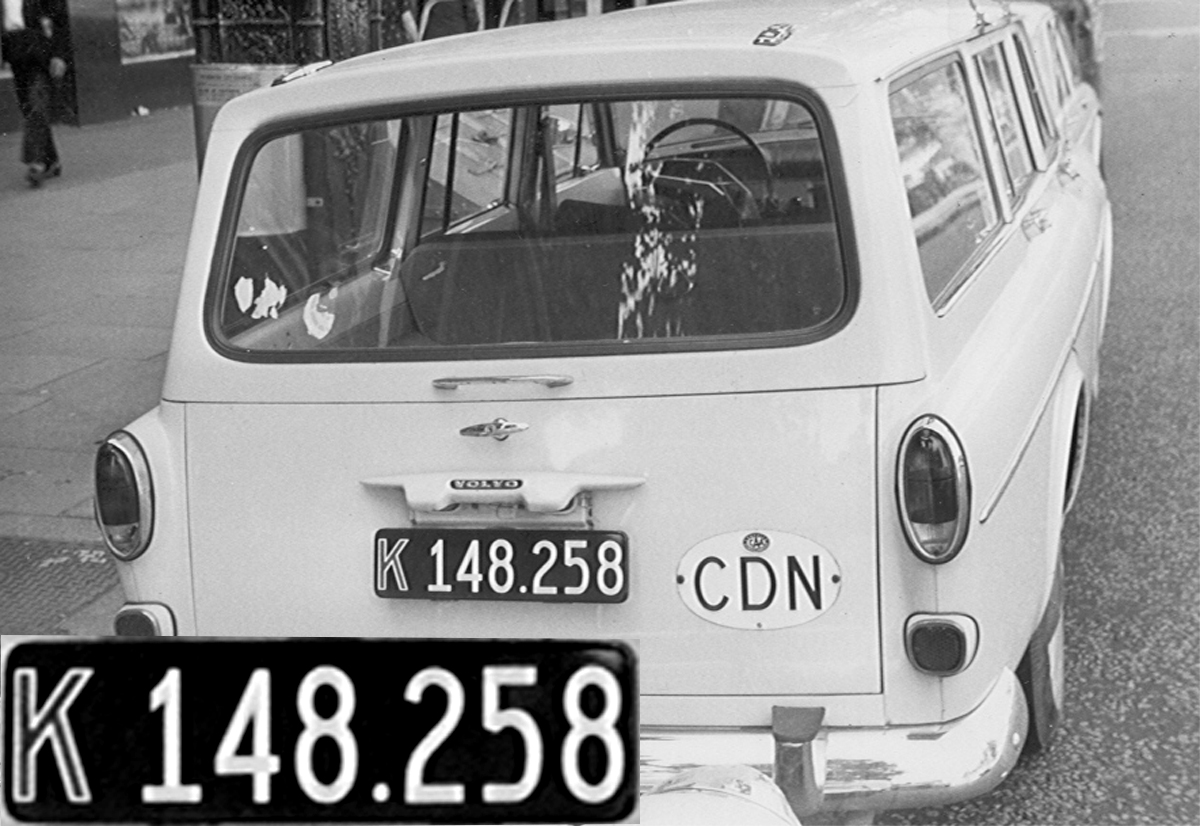
A  Danish export Volvo 245 destined for Canada, seen in London 1964.   Brumby archive

K 148.258   A Danish export Volvo 220 destined for personal export to Canada, seen in London 1964.                            Brumby archive

………Sweden, recognised by the year of temporary validity, in white on red,  added to the right of the standard registration………

Swedish export Volvo from Gothenburg (O) valid during 1964, seen in London.   Brumby archive

Swedish export Volvo from Gothenburg (O) valid during 1964, seen in London.                                   Brumby archive

……..and several other nations had an export plate system, too.      Britain allocated batches of normal registrations to the

Home Delivery Export Scheme,

whereby a new buyer could collect his new (British-made) car in UK and use it for up to three months before his supplier arranged for its shipping to the eventual destination for which it was bound.    In  later years, these HDES  plates were marked with with a yellow rim and from 1 Jan 1973, for the obligatory new white/yellow reflective plates, a red rim.

Some HDES examples seen in a motor museum in Queenstown, New Zealand.    Brumby archive.

Some HDES examples seen in a now-defunct motor museum in Queenstown, New Zealand.                       Brumby archive.

HDES with red border to reflective plates.    JW archive

HDES with red border for reflective plates from 1973    . JW archive

Sometimes, but not always, when such a car returned to Britain, these original HDES plates could be re-mounted and some of these  can be seen still today, looking innocently as if they have never been away.    If you see one, interview the owner – you might win a Bhutan diplomatic or a Tristan for your collection!
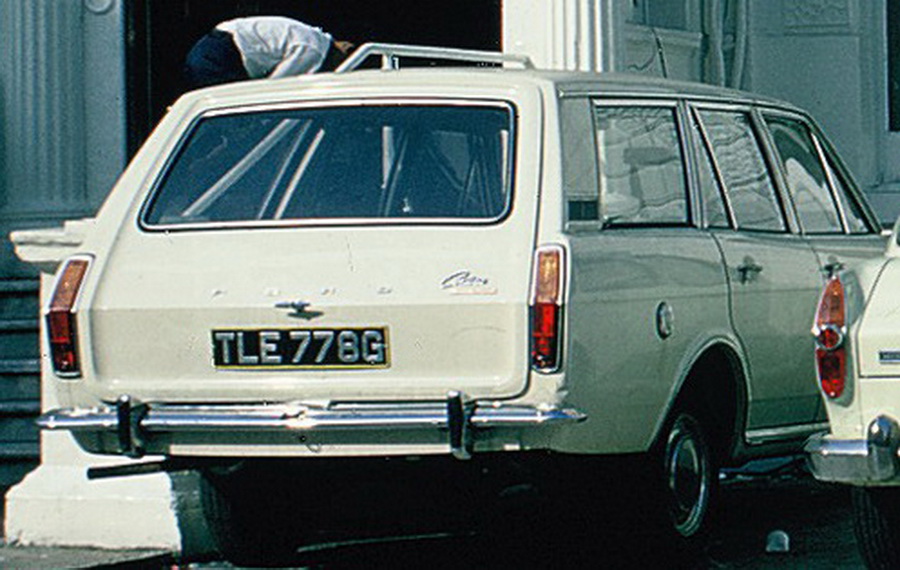
This Mk, 2 Ford Cortina has been somewhere and come back to adopt its HDES identity.

This 1968 (G) Mk.2 Ford Cortina has been somewhere and come back to adopt its HDES identity.    Where had it been???

If someone wished to buy a non-British-built car car in Britain, for export, that car would be given a British Temporary Import plate from the ‘ Q’ series.
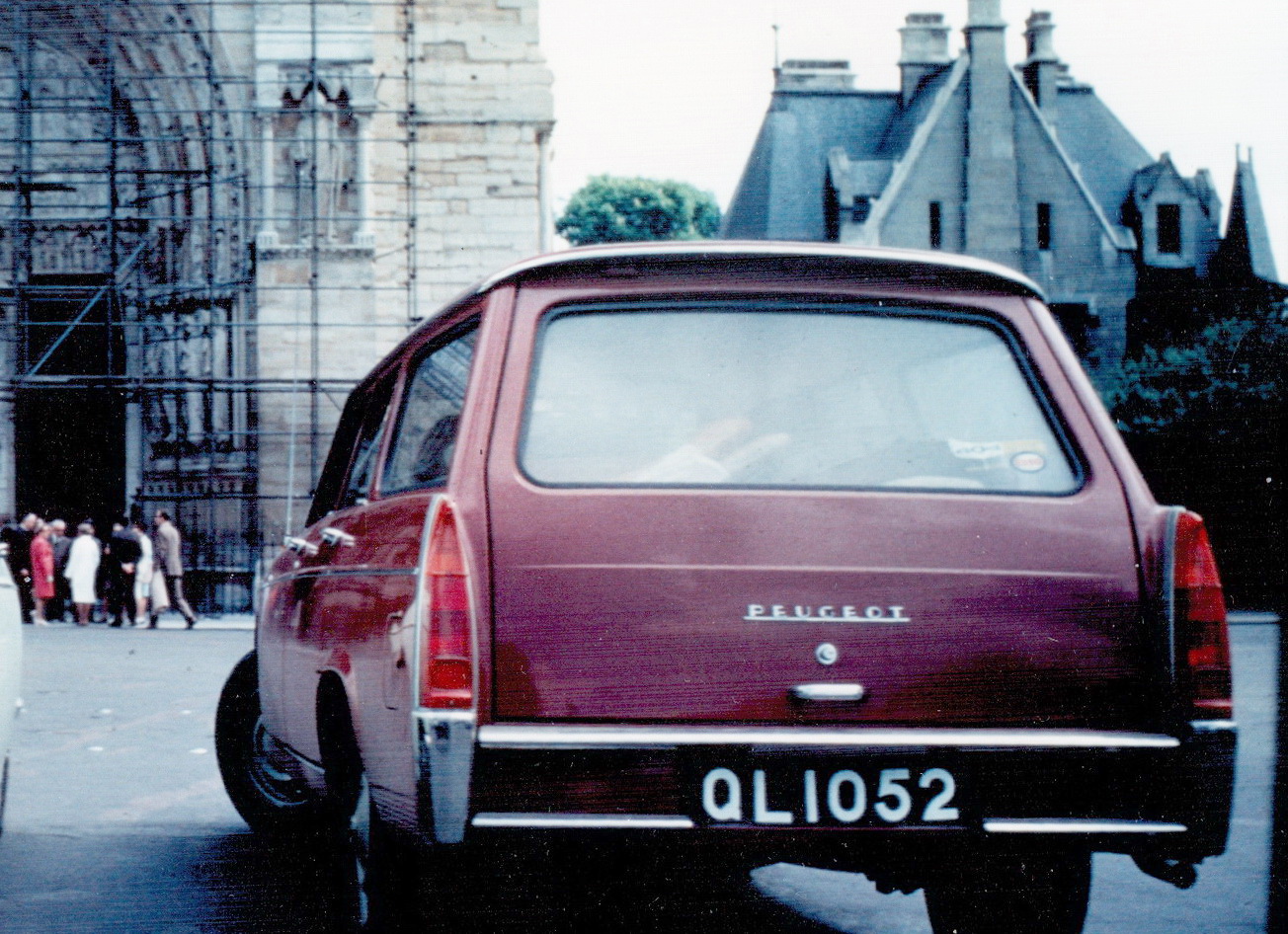
QL 1052 - Peugeot 404L bought in London 1969, for export to Canada.  (Brumby archive/car)

QL 1052 – Peugeot 404L bought in London 1969, for export to Canada. Outside Notre Dame, Paris.     (Q L was issued by the Automobile Association on behalf of the national suthority.)     (Brumby archive/car)

~~~~~~~~~~~~~~~~~~~~~~~~

This was still  the age of the ship and cars were easily and cheaply carried as part of the passengers’  luggage cargo.    When their tours of service were at an end, and knowing that new cars would be difficult to buy when they arrived back in Europe, this army of  colonial civil servants, miners and infrastructuralists – and also thousands of military personnel – would return to Europe with their foreign-registered cars aboard their ships.    Many vehicles circulated for up to a year on the foreign plates, usually carrying the international ovals, to identify their country of registration.

Sometimes, however,  they changed plates immediately at the port of re-entry and in England, the spotters of the period  would particularly look out for shiny new aluminium plates issued with the codes of the three great dock cities, London, Liverpool and Southampton, where the motor organisations, the AA and the RAC, would undertake the complicated paperwork of the re-importation on the owners’ behalf.      Usually, the garage-man who changed the plates, would throw the dismounted foreign ones into the boot, in case the owner needed them.      Usually the driver didn’t particularly want them, and if, later,  a youthful car-spotter, recognising the new dock-issued numberplates,  interrogated him with sufficient intent, he would willingly open the boot and hand them over!     Thus many a collection was born and to this day, the writer wishes that plates had not gone on to assume a money value – for they had once simply been a trophy of a well-run, low-cost hobby, as might be a stuffed hunting trophy, or a prized fish!

…………………..

Ubiquitous air travel and cheap and efficient international car rental combined to bring the  collapse of the passenger shipping lines, and has brought these big quantities of re-imported cars to an end; it is mostly diplomatic corps plates which we see today,  by way of  rare-country sightings.      To counter that loss to the spotter, an increase in general prosperity also permits the modern enthusiast to travel the world and to see the plates of a country in their native setting.

Here are a few of the odd sightings of vehicles returning from the Outside World to Britain and Europe during the 1940’s 1950’s and 1960’s.

Tanganyika - John Pemberton's shot of a Peugeot 203 from Dar-es-Salaam circa 1954 in London,

Tanganyika – John Pemberton’s shot of a Peugeot 203 from Dar-es-Salaam circa 1954 in London.   DS D 770.      Note the bracketed ‘ T ‘; worldwide, parentheses on ovals were only used on the four codes for British East Africa – EA(T), EA(K), EA(Z)and EA(U) – though they were not  frequently used.

A rare sight indeed, then and now - India plates in Britain, circa 1948, on an American 'tank'.    Pemberton archive

BMY 7797   A rare sight indeed, then and now – Bombay, India, plates in Britain, circa 1948, on an American Pontiac.             Pemberton archive
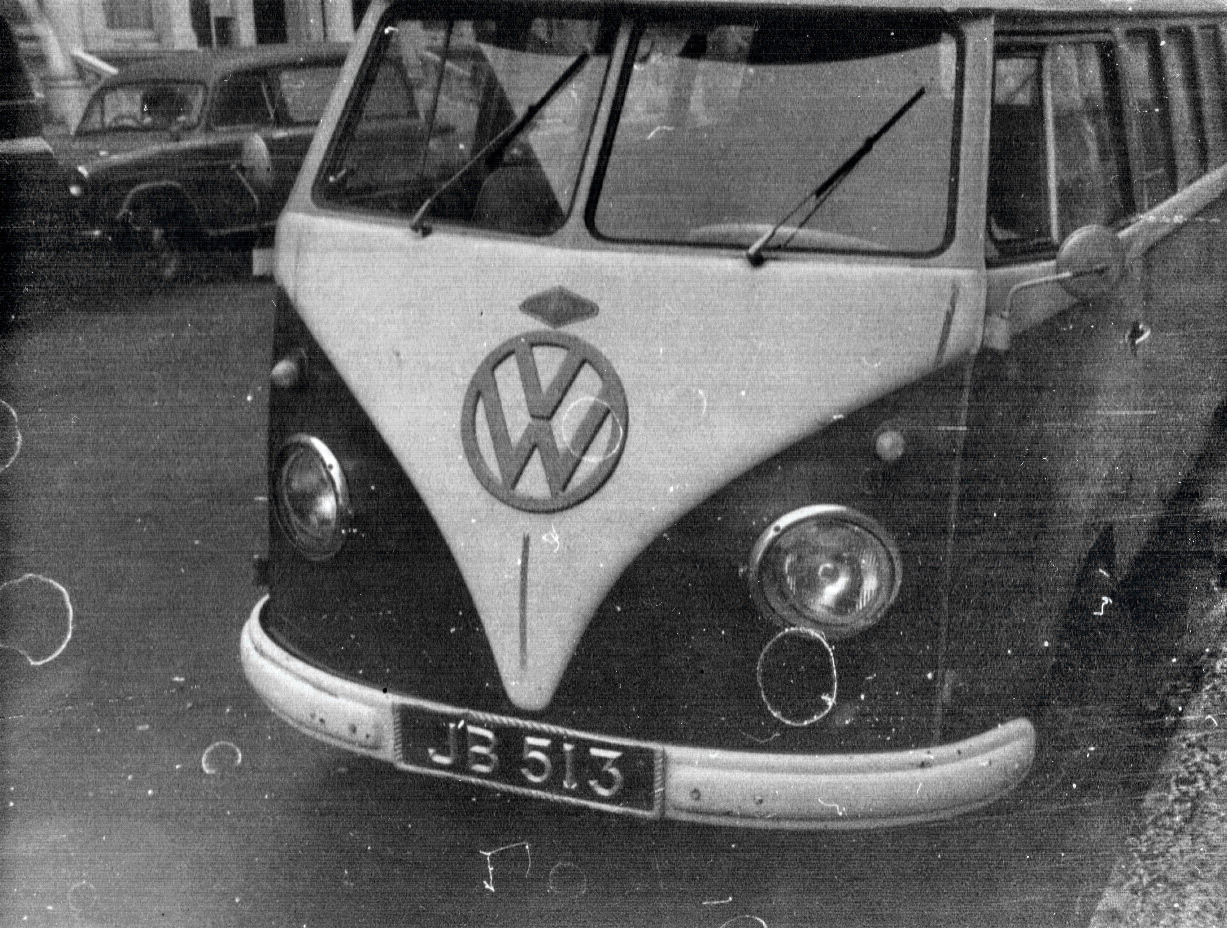
is VW Kombi came ro live in Earls Court during the 1960s,   It was registered JB 513 in Johore state, Malaya and showed a PTM oval to rear.    Brumby archive

This VW Kombi came to live in Earls Court during the 1960’s, It was registered JB 513 in Johore state, Malaya and showed a PTM oval to rear.  Brumby archive
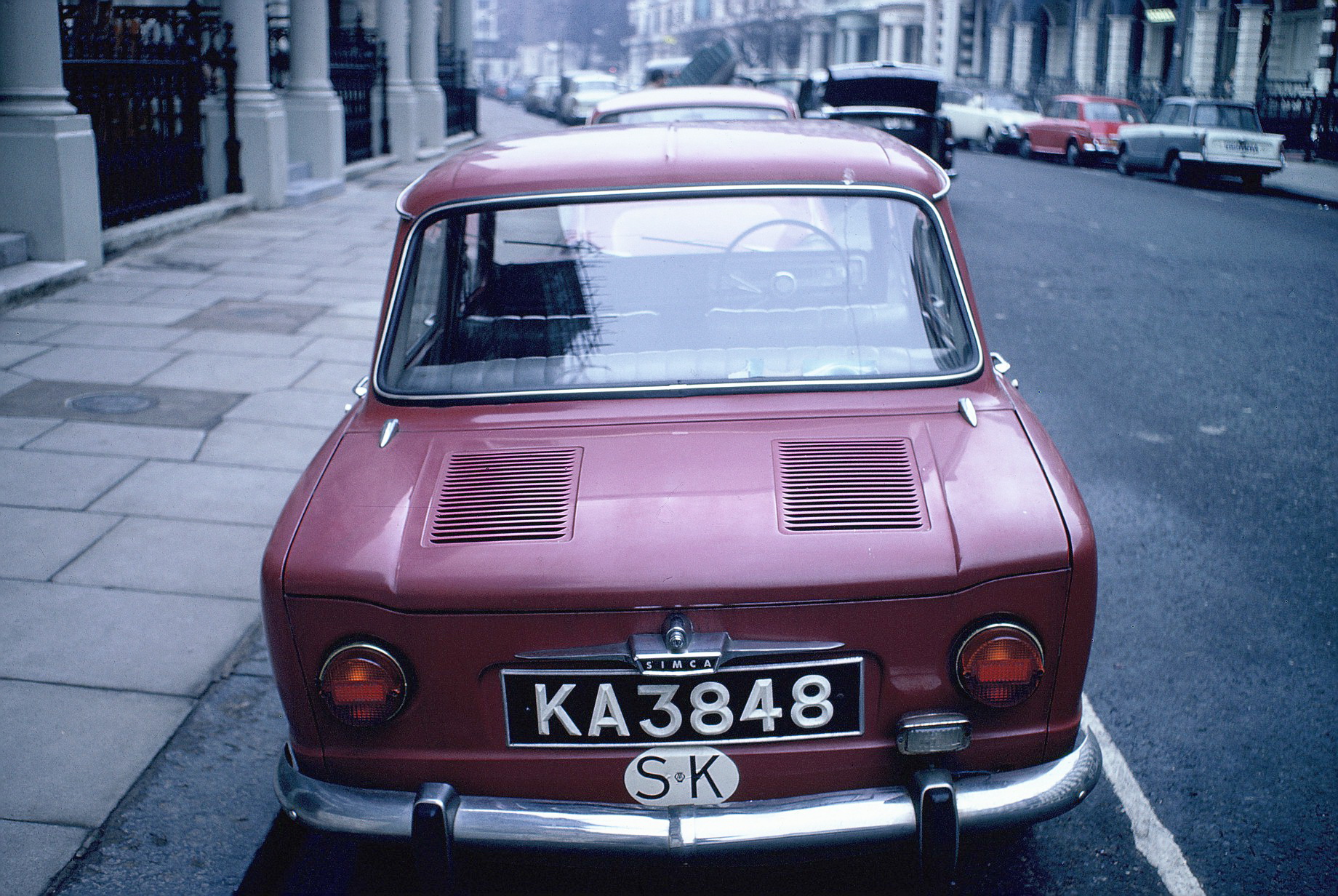
The only Sarawak plate ever seen in England by VWB, this Simca 1100 was from Kuching district in 1965 London.     Brumby archive

KA 3848  The only Sarawak plate ever seen in England by EU38, this Simca 1000 was from Kuching district in 1965 London.          Brumby archive
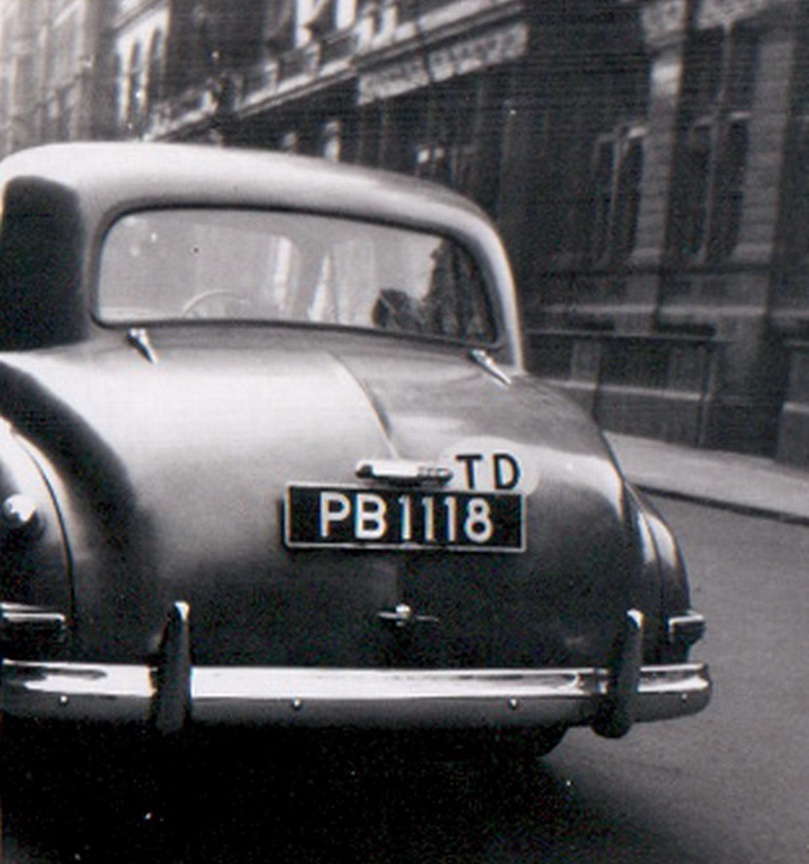
JP captured this 1950 Humber Hawk, home to England from Trinidad

PB 1118   JP captured this 1950 Humber Hawk, home to England from Trinidad.                     Pemberton archive
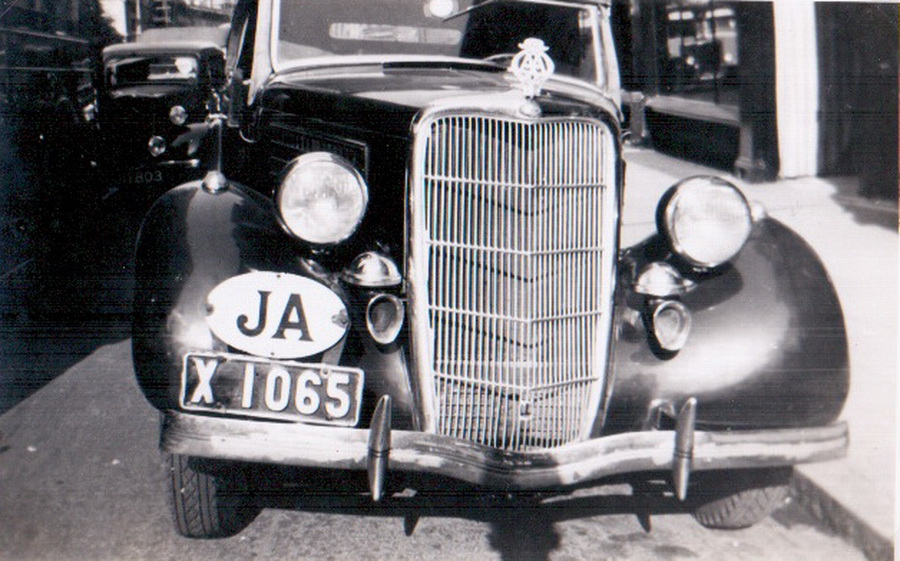
X 1065 spotted in Oxford in 1947 on a pre-war Canadian Ford, registered in Spanish Town, Jamaica.  Note he giant oval!    Pemberyon archive

X 1065 spotted in Oxford in 1947 on a pre-war Canadian Ford, registered in Spanish Town, Jamaica.     Note the giant JA oval and the Jamaican AA badge atop the rad. grille!              Pemberton archive
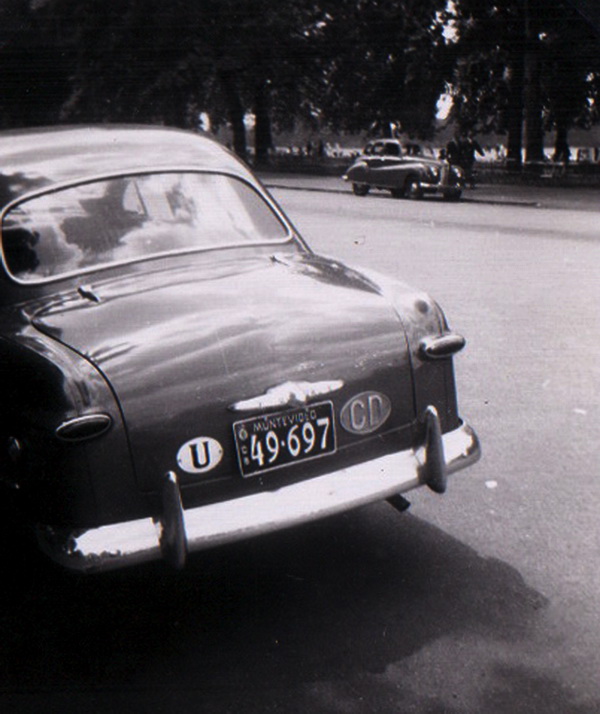
A diplomat back from Montevideo, seen in Hyde Paek circa 1952, on a Simca Aronde.

C/D 49-697   A diplomat returns from a tour in Montevideo, seen in Hyde Park circa 1952, on a Simca Aronde.    Rare U oval picture.         Pemberton archive.

The Enosis (Union with Greece) uprising in Cyprus in the early 1950s saw thousands of troops sent there over the decade, most of whom seemed to come back with with a smart car,    It was a common sight o see Cyprioys all over Britain.    Here is a Morris Mini-Minor, somewhere in London, circa 1963,    Brumby archive

The Enosis (Union with Greece) movement in Cyprus in 1950 saw thousands of troops sent there over the next decade, most of whom seemed to come back with with a smart car.   Even after 1960 Independence, Britain maintained a large presence there alongside the UN and it was a common sight to see Cypriot plates all over Britain through the 60’s.     Here is a Morris Mini-Minor BF 355, somewhere in London, circa 1962.                                    Brumby archive

Aden must have been one of the hottest, dustiest, dreariest postings for a soldier in the British services,   However, there probably aren't any Jaguars driving round out there in 2013, so times must have been easier then, s we see a Mk.2  2.4 returned to London after a rece   Most unusually, L 5993 has an arabic translation as part of the plate design, never seen before or sinve.   nt posting there.

Aden must have been one of the hottest, dustiest, dreariest postings for a soldier in the British services.    However, there probably aren’t any Jaguars driving round out there in 2013, so times must have been easier then, as we see an officer’s smart Mk.2 2.4 returned to London’s Kensington in 1963,  after a recent posting there.  The first few years of Aden vehicles were registered under the registration system of India, as were Christmas Island and possibly one or two of the Straits Settlements.    It is not understood why Aden chose the letters L, M and finally N for its plate prefixes during that series.. 

 Here, most unusually, L 5993 has the arabic translation as part of the plate design, never seen before or since on an Aden Colony plate.         Brumby archive

Low security in the 1960s Port of London, enabled this keen spotter to slip in to the docks on my Vespa, with camera at the ready.    A ship from the Far East has just discharged its cargo, and waiting on the dockside for customs clearance is Jaguar Mk.7  XX 1190 from Hong Kong.  And can you i/d the DKW Autounion in the background?       Brumby archive

Low security in the 1960s Port of London, enabled this keen spotter to slip in to the docks on his Vespa, with camera at the ready.     A ship from the Far East has just discharged its cargo, and waiting on the dockside for customs clearance is c.1954 Jaguar Mk.7  XX 1190 from Hong Kong.   The long-lived HK prefix was exhausted, and XX was issued from 1957 to 1958 (RPWO).       (And can you i/d the DKW Autounion in the background? )               Brumby archive
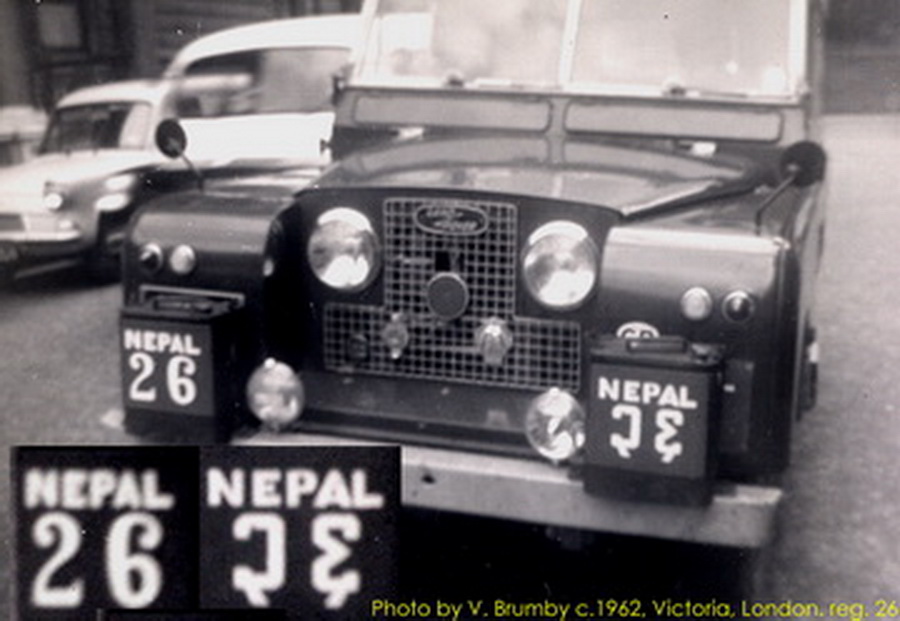
 

It took a two-kilometre chase on foor in heavy traffic to get this photo of the olnyNepali EU38 ever saw in England in 1962.     Brumby archive

In 1962, it took a two-kilometre chase on foot in heavy traffic to get this photo of the only Nepali vehicle EU38 ever saw outside Nepal.  The owner had had to specially make the ’26’ translation plate  in order to travel legally outside Nepal.       Brumby archive

ER.22944 was seen in 1963 on an Austin A30 c.1954.   Never another seen, anywhere.     Brumby archive.

ER.22944 was seen in 1963 on an Austin A30 c.1954.     Never another seen, anywhere.    Made with the classic Italian dies.                                Brumby archive.          (Note: I was in error, describing Eritrea on the photo, as ‘former Italian Somaliland’!)


So – we can see that these were good days for seeing plates from all over the free world – and, strangely, the communist bloc countries remained among the rarest of sights.  Of course, China, North Korea and Albania followed the communist path, forbidding citizens to own cars and with the remarkable exception of John Pemberton’s China Diplomatic (shown elsewhere in this Blog) nothing was seen from those benighted lands.

Not many photographs were taken and fewer still survive, lost in house-m0ves, cast away by surviving relatives as being of no interest etc.     Work done by such members as Pieter Lommerse, who has trawled so many sources to gather historic pictures of  Turkey, Greece and Cyprus, is of inestimable value to all collectors.   The Legend of  The Larsson Library is whispered of in exalted circles!      Any shots you may have will find a welcome home in the Blog, or else simply post them in for scanning and return, to Victor Brumby at 8 Cleeve Court, Streatley, Berks. UK – RG8 9PS.

End…………..


West Africa – Gold Coast/Ghana

February 17, 2013

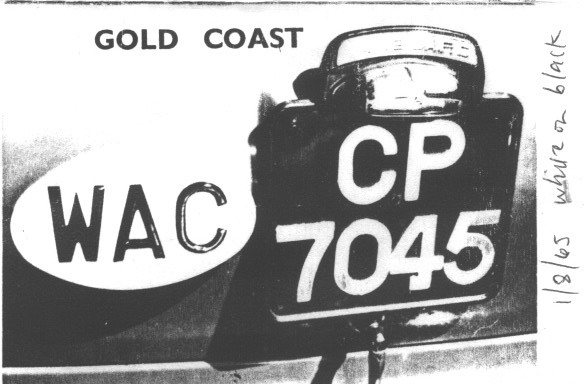
Reg Wilson, one of the earliest British collectors, lived near the great dock city of  Liverpool, where the ships discharged many a motorcar returning after duties abroad.     This Gold Coast (West Africa-Coast) (?  Standard Vanguard was photographed by Reg on 1st. August 1965.

CP 7045 was from Central Region (Cape Coast).  (Reg Wilson archive)

CP 7045 was from Central Region (Cape Coast). (Reg Wilson archive)

Below is a Ford Zephyr Six,  made in 1955, seen in London years later, registered on the 1955-6 special (tax-free)  Home Delivery Export Scheme plates PLO 357 with which it was originally delivered in Britain, prior to being shipped out to the Gold Coast.     After its period of use there, and returning to UK, it changed its African plates back to its original British export plates, but happily, left the rare WAC international oval (used 1932-57) firmly bolted to the body,  for our delectation.

(GH)(WAC)_PLO357_VB1950s

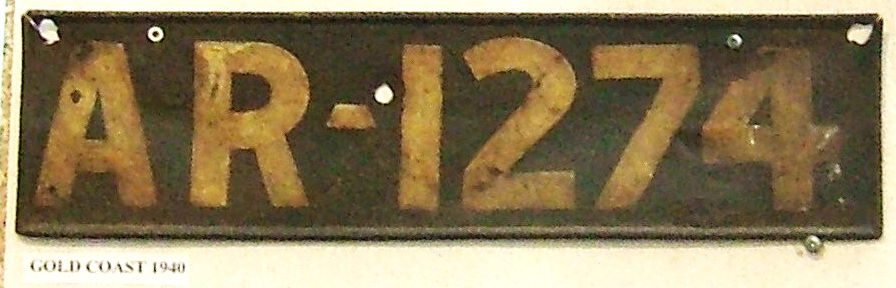
Below:   AR-1274 is a 1940 issue from Accra, photographed at the Barcelona Placamundi conference members’ displays.

(GH)(WAC'40s)_AH1274_c_Placamundi

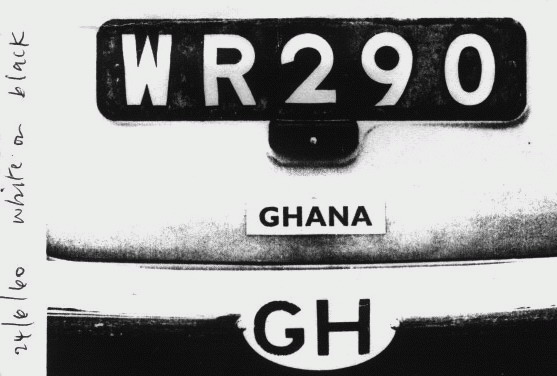
WR 290 was coded for the Western Region (Sekondi) and photographed when it returned to Liverpool on June 26th. 1960.     Looks like a Morris Minor….   Reg Wilson archive

(GH1)_WR290_RW1960vb

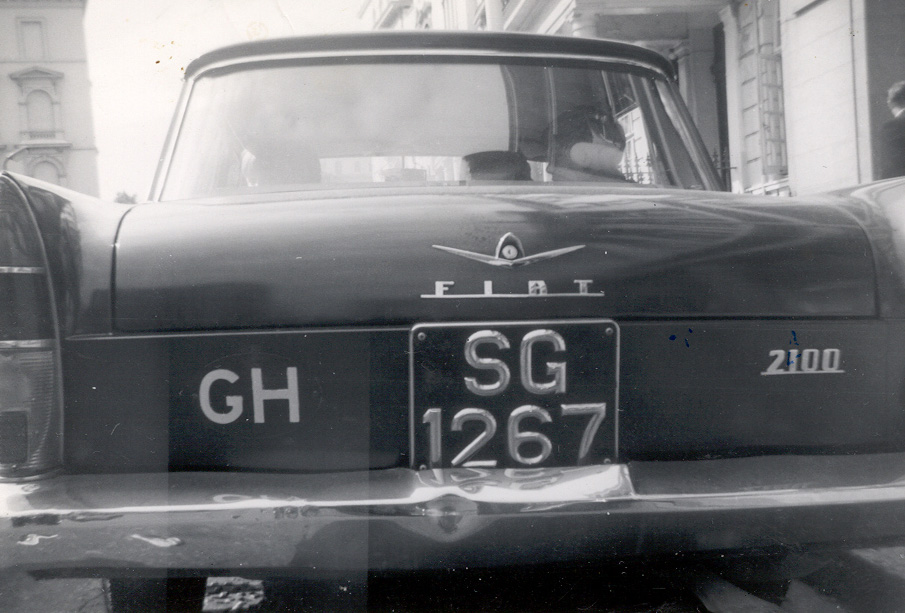
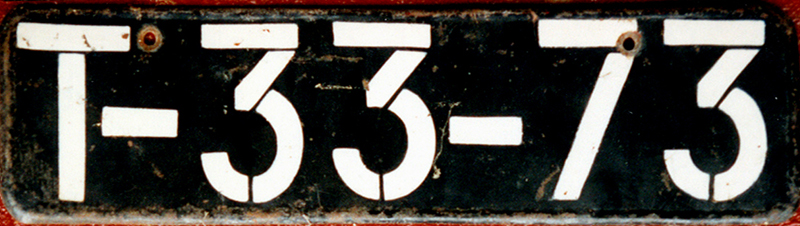
SG 1267 – A London VB sighting in 1960 was this Fiat 2100 bearing the special SG series plate which was issued to celebrate The Gold Coast’s independence from Britain in 1959.   The Ghana international oval GH was introduced shortly after independence.   The prefix SG  was believed to abbreviate Self-Government and to be a form of temporarily-issued treasured plate.   Vic Brumby archive
(GH1)_SG1267_VB1960s

Below

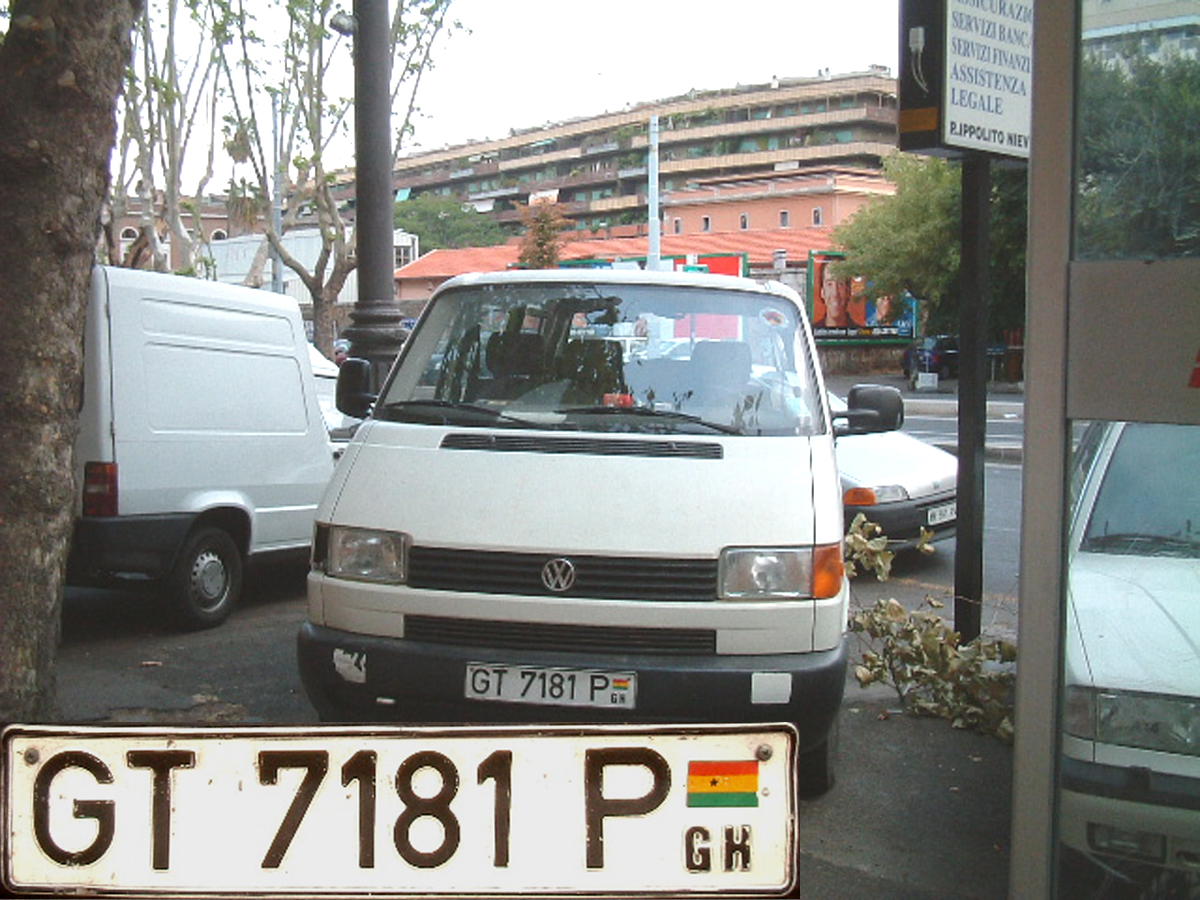
GT = Greater Accra (Tema) and the  P is for 1998 first registration.

Finally, a current Ghanaian vehicle, seen in Italy, in 2003.   Brumby archive

GT 8181 P    A current Ghanaian vehicle, seen in Italy, in 2003. Brumby archive


West Africa – Nigeria

February 17, 2013

NIGERIA Historic


West Africa  had four British-governed territories until March 1957, when Gold Coast/Ghana become the first to obtain independence under Kwame Nkrumah.   (Actually, there was also the ex-German Trust Territory of the British Cameroons, which was  absorbed into Nigeria).

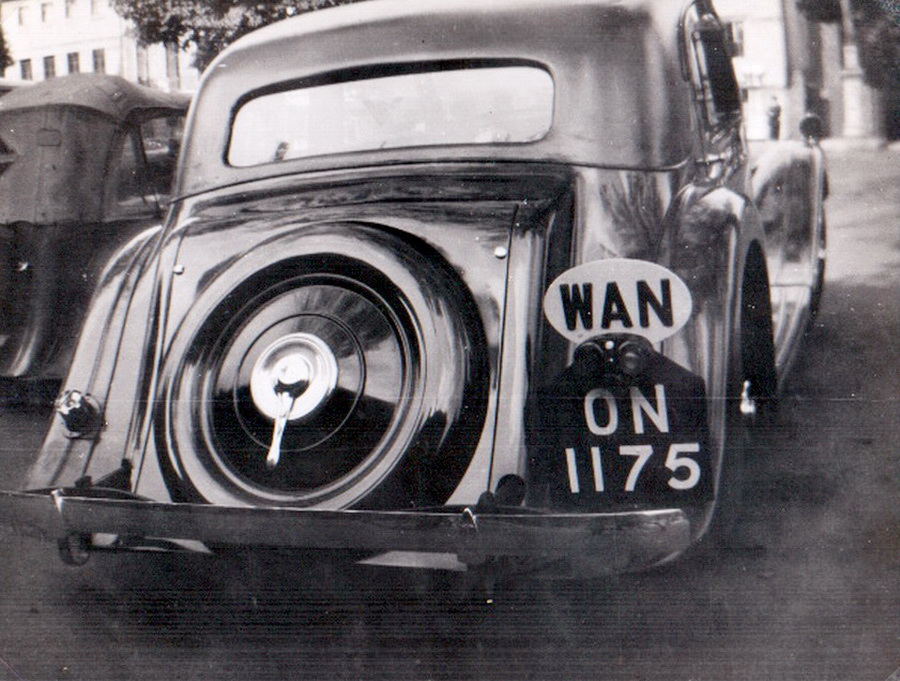
The Gambia, Sierra Leone and Nigeria were the other three and we see below a smart sports saloon of the 1930/40s,  from the Nigerian city  of  Onitsha in Anambra State.    The port city lies on the banks of the Niger river and was an important trading settlement in palm oil.    This expat.  had been so successful there as to own and run what seems to be a very prestigious motor (Bentley? Jaguar? Alvis?), and ship it home to England, where member Pemberton shot it in the late 1940s in London.

Nigerian reg. ON 1175 is  from Onitsha, seen in the 1940s in Oxford, on an unidentified car.  Pemberton archive

Nigerian reg. ON 1175 is from Onitsha, seen in the 1940s in Oxford, on a yet-unidentified car (any ideas?).            Pemberton archive 1940s

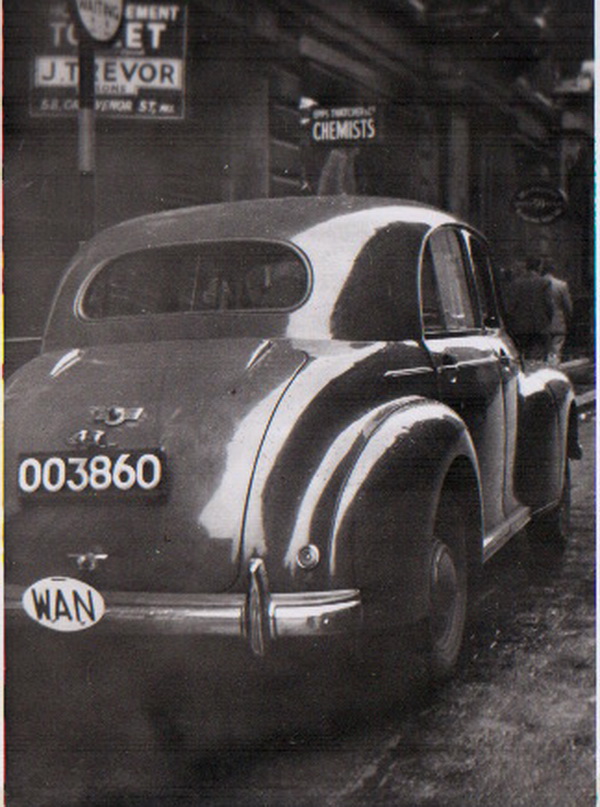
Below   John P. also saw this 1948 Morris Oxford OM type, with the unusual  OO code, probably signifying Abuja, now the administrative capital.    Fortunately for us, he was carrying his camera on  this wintry day in London.

OO 3860 is an unlisted area code, but may be from Abuja (OOA), seen on a 1940s Morris Oxford.   Pemberton Archive

OO 3860 is an unlisted area code, but may be from Abuja (OOA), seen on a 1948 Morris Oxford MO.     Pemberton Archive late 1940s

OO 3860  —  Most interesting data concerning the Morris Oxford above may be read below,  from Morris specialist SMODRIVER – see his 17/2/2013  notes in the Comments section.


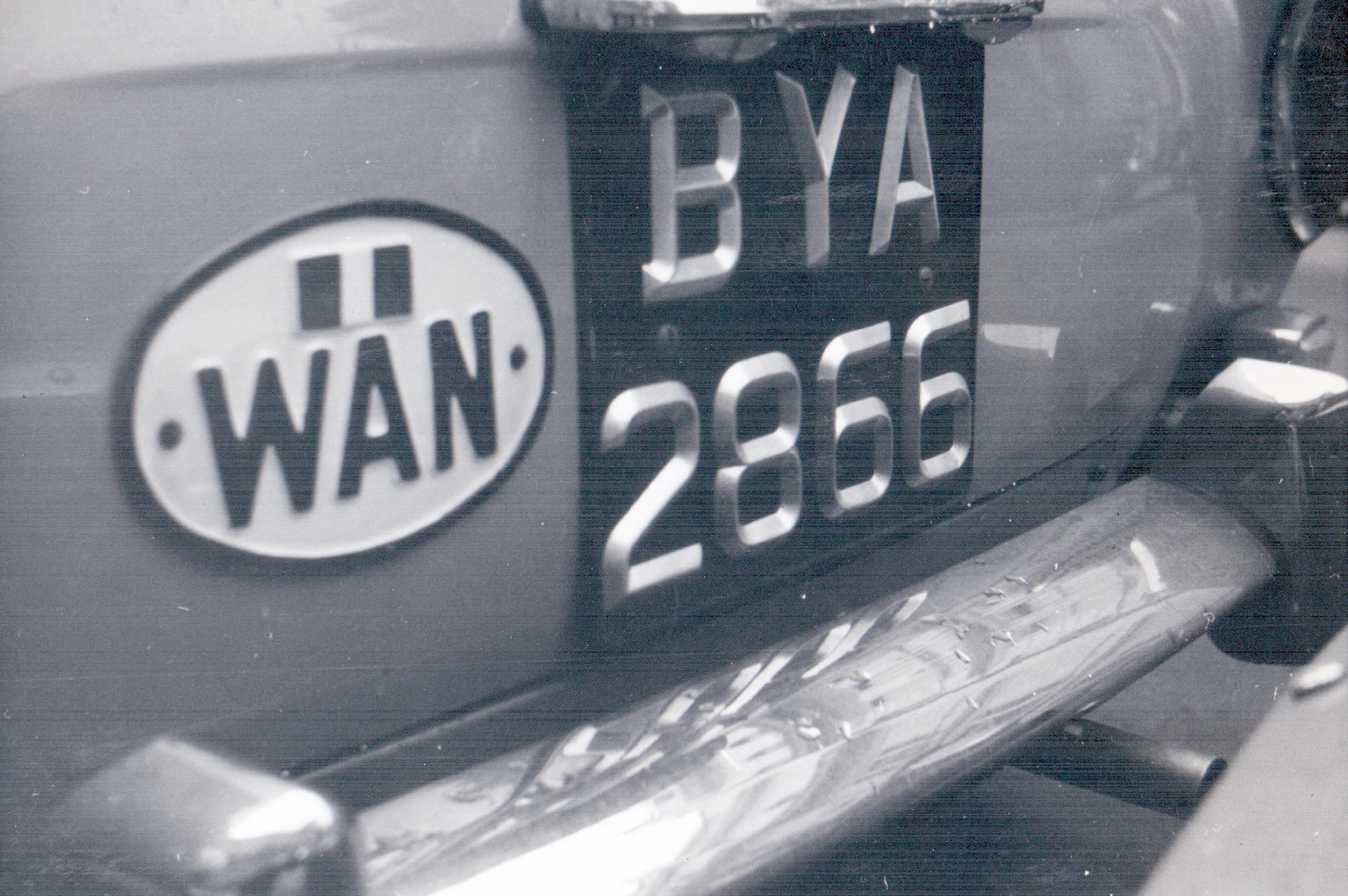
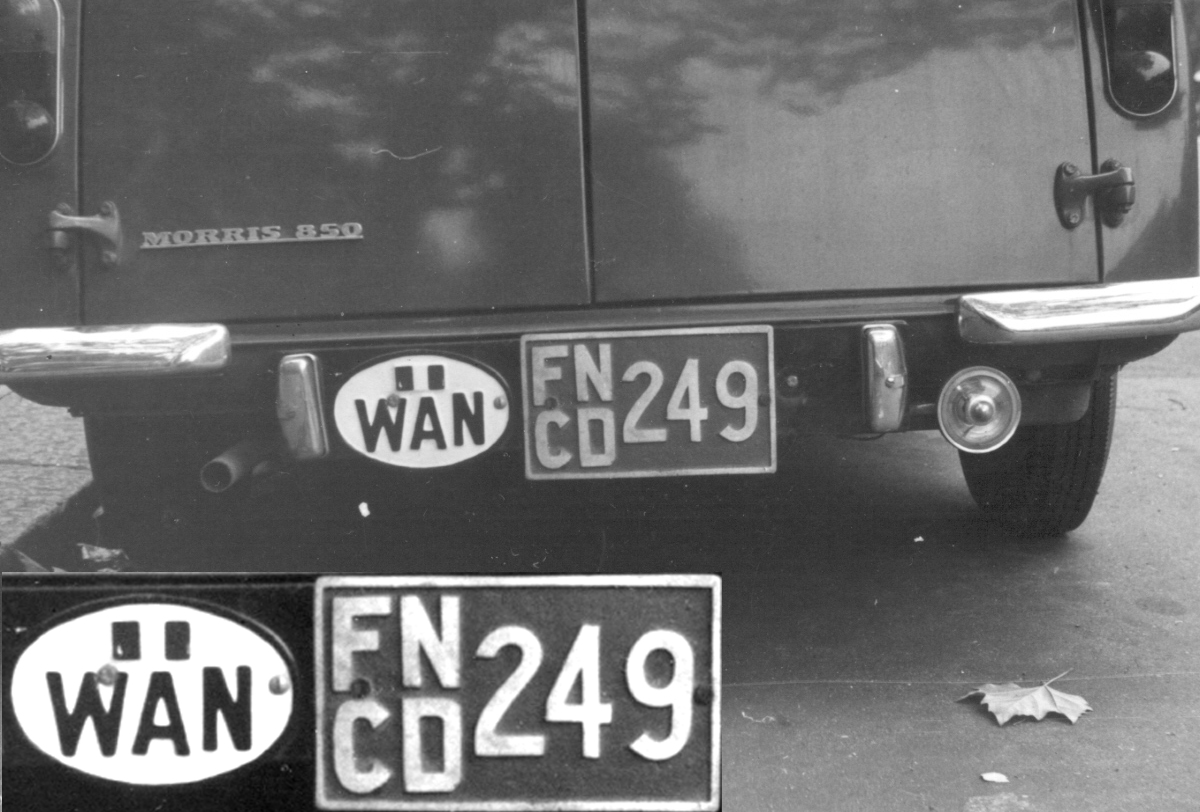
BYA 2866 was caught stationary in traffic during the early 1960s, and had the oval WAN not have been mounted, we would have been baffled by the non-African look of the plates.    BYA = Jos city, a prosperous tin-mining area .

BYA 2866 was seen in London by EU38 in the 1960s, coded for Jos, capital of Plateau state.   On a VW Karmann-Ghia.   Brumby archive
BYA 2866 was seen in London by EU38 in the 1960s, coded for Jos, capital of Plateau state. On a VW Karmann-Ghia. Brumby archive
LA 1561 is an early 1950s Lagos registration, shot by member Reg Wilson in Britain in 1954.    Rover 60.   Wilson archive
LA 1561 is an early 1950s Lagos registration, shot by member Reg Wilson in Britain in 1954 on a Rover 75 P4 saloon.     Wilson archive 1954
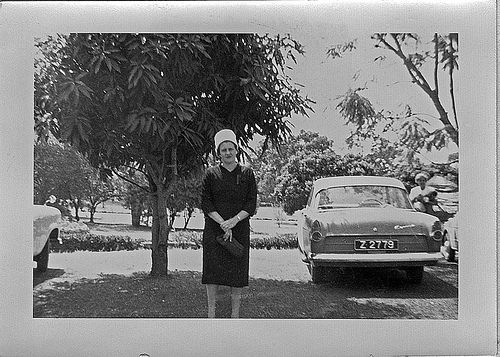
Z 2779 is a Flickr-sourced Picture of a Ford Consul Mk2 in Zaria, Kaduna state.

Z 2779 is a Flickr-sourced picture of a Ford Consul Mk2 in Zaria, Kaduna state.    Must be about 1958.

Official series below, from Nigeria 1960-70……

This Mini-Minor Traveller was a rare Nigerian Diplomatic Corps to be seen in London during the 1960s by EU38.    Red, cast-alloy plates abbreviated Federation of Nigeria and were not thought to be country-coded.    Brumby archive

This Mini-Minor Traveller shows the rare Nigerian Diplomatic Corps series, seen in London during the 1960s by EU38.     Red, cast-alloy plates abbreviating ‘Federation of Nigeria’  are not thought to have  been country-coded.          Brumby archive

This time, seen in Nigeria, another layout of the Federation-period CD plates, pressed on soft alloy sheet and un-coded.   Brumby archive

This time, seen in Nigeria, a variant layout of the red Federation-period CD plates, pressed on soft alloy sheet and  believed un-coded.         Brumby archive 1970s


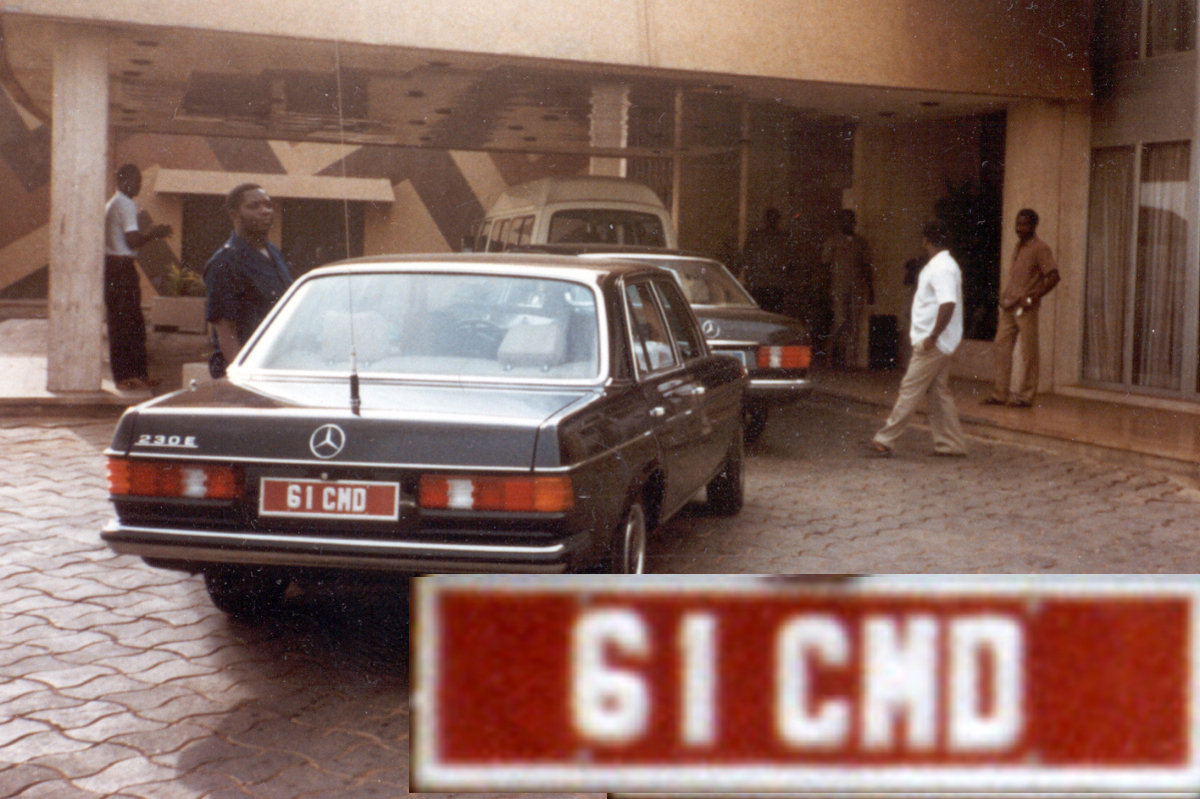
Below:     CMD = Chef du Mission Diplomatique – Chief of Diplomatic Mission – Ambassador.

61 CMD was an ambassador's plate, possibly for Hungary, and taken during the 1970s in Abuja by Murray Bailey.

61 CMD was an ambassador’s plate, possibly for Hungary, and taken during the 1970s in Abuja by Murray Bailey 1970s.

Early issue government series FGN 103 from 1960s or 1970s.   Info needed.    Brumby archie

Early issue Federal Government of Nigeria series FGN 103 from 1960s or 1970s. Info needed.                         Brumby archive


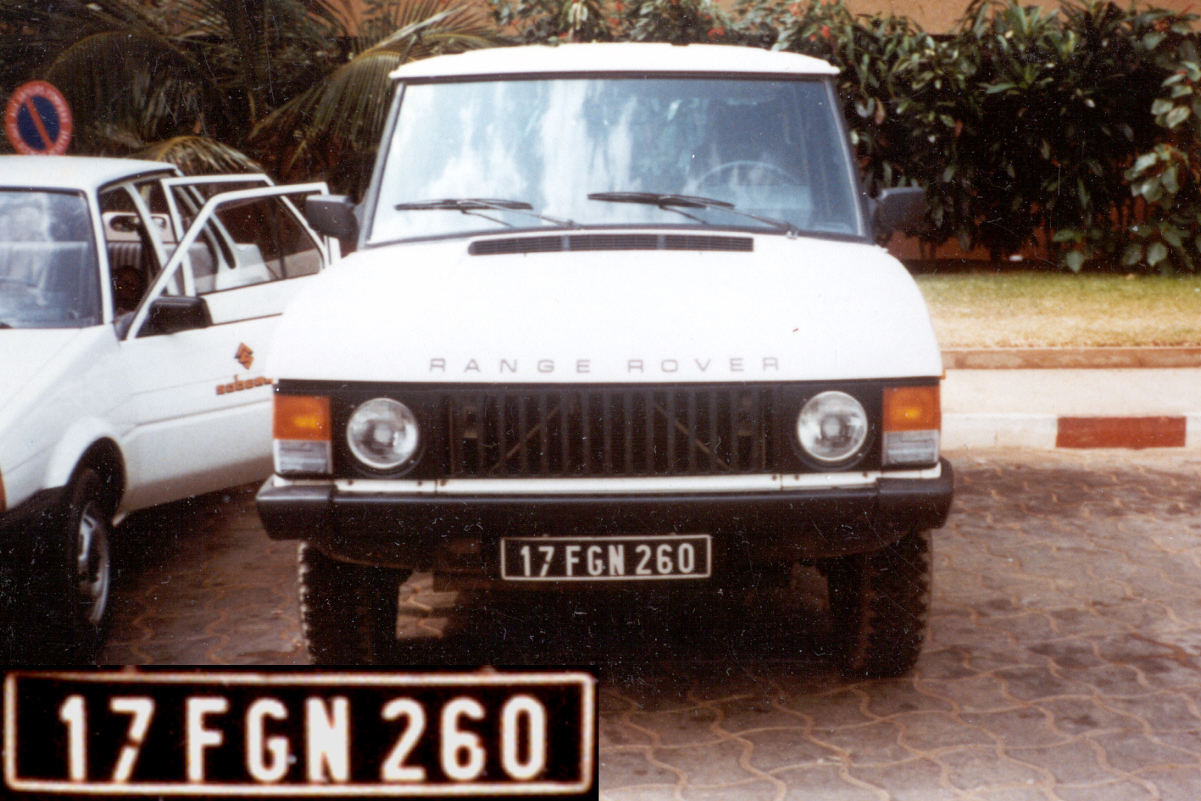
Below17 may be coded for the National Planning Commission, seen on this later-series1970s Nigeria Federal Government plate.

A Federal Government plate of the 1970s on a Range Rover, in Lagos.Brumby archive

17 FGN 260 – a Federal Government plate of the 1970s on a Range Rover,      in Lagos.
Brumby archive

Army, Navy, Air Force and Police each had their own prefixes. (Army not shown):

Air force motorbike and Navy Land Rover.

Nigerian Air Force motorbike (leading zero) and Navy Land Rover.  Brumby archive,1970s.

Nigerian Police Force.   Austin 3-ton truck.

Nigerian Police Force. Austin 3-ton truck. 1970s

Below:    Another civilian series commenced in the early  1970s, using a regional code, with a serial number followed by a town code.  Varying colours used for differing vehicle types.

OG...E codes Ake Abeokuta in the 1990s series.  Orange on black was for cargo vehicles.

OGE codes Ake Abeokuta in the 1970s series. Orange on black was for cargo vehicles.              Brumby archive (plate)

~~~~~~~~~~~~~~~~~~~~~~~~~~~~~~~~

A radical change in Nigerian plate styles occurred in 1992 when the US style and dimensions of pressed plates appeared, continuing in use today.     In earlier years, it was not uncommon to see Nigerian plates in UK, but for the last 30 years, it is possible that only one or two have been seen in all of Europe.

UNLESS YOU KNOW BETTER!!             Share it with us, please….


Mpumalanga or not?

February 8, 2013
Dealer (trade) plate from Mpumalanga Province, ZA.

Dealer (trade) plate from Mpumalanga Province, ZA.

Here is an example of the dealer plate for the South African province of Mpumalanga, characterised by the letter ‘A’ starting the trio of registration letters, and of course the MP suffix of the province.

So when I was cruising the streets of Knysna (ZA) today, and saw a BMW parked, registered ACE 668 MP, I stopped the scooter and went back to photograph it, as MP dealer is quite unusual.(MOC)_ACE 668 MP_ VB2013_resize (MOC)_ACE 668 MP_cur_ Knysna VB2013

Well, it caught me out!     Perhaps you other members were quicker to recognise my mistake?

Who will be first to explain by commenting below?

~~~~~~~~~~~~~~~~~~~~~~~

Did you know that South Africa doesn’t issue plates with any vowels – because without vowels, no vulgar words can be formed – which saves the authorities the headache of  contemplating possible word meanings in many African and other languages.

One day, when they see how much money they can make from adding vowels, and then being able to sell stupid letter combinations to vain citizens, I expect they will change their minds!      Even Sweden succumbed to the demon vanity plate industry, a country I always assumed was too ‘straight’ to do such a thing.    Germany and France still proudly sidestep the temptation to mine this income source – bravo!


West Africa – Cameroons

February 7, 2013
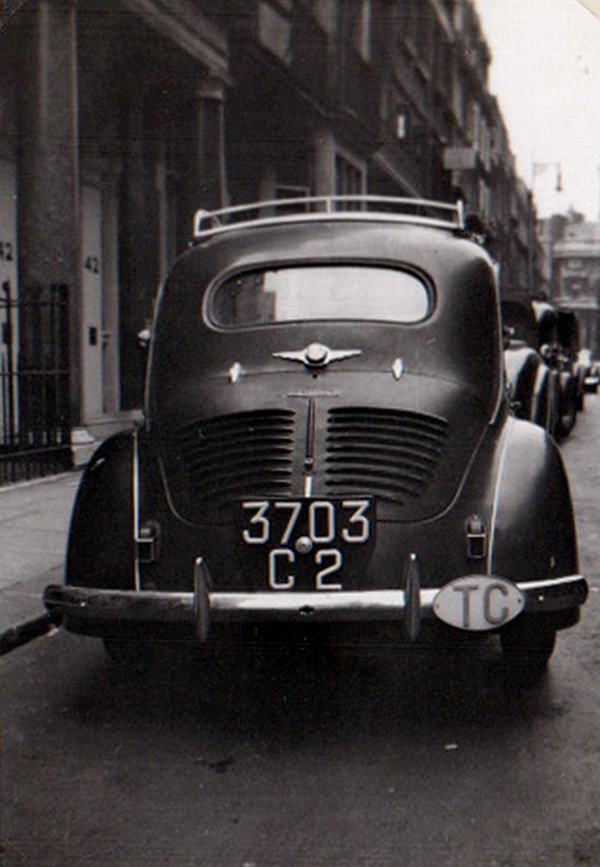
This Renault 750 from the (French) Trusteeship of the Cameroons was an unusual sight in the 1950 Britain, and probably France, too. 3703 C 2 carries the correct 1932-1954 oval and uses the French-designed  registration format.   John Pemberton archive.

This Renault 750 from the (French) Trusteeship of the Cameroons was an unusual sight in 1951 Britain, and probably France, too.    3703 C 2 carries the correct 1932-1960 oval TC and uses the original French-designed registration format.       John Pemberton archive.

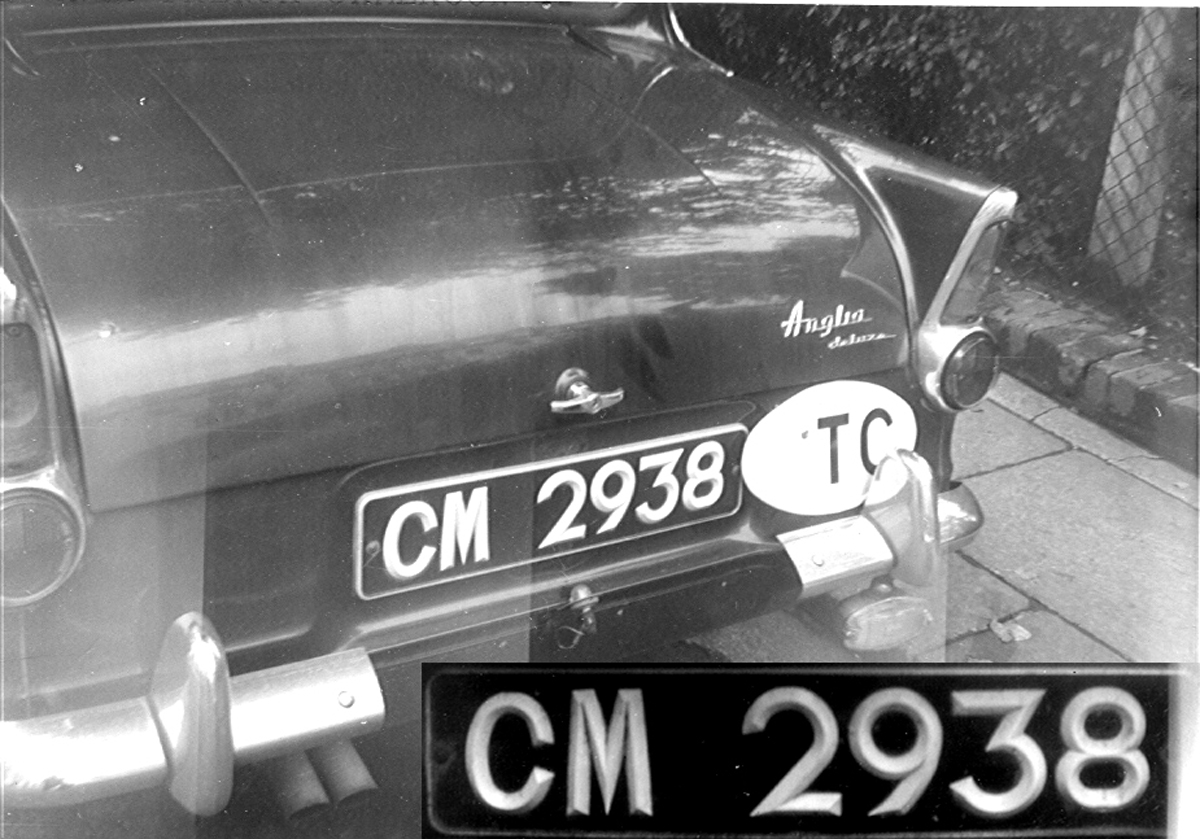
(RUC2a)(TC)_CM2938_comp_VB1960s

c. 1962     The British Cameroons, until  then part of British Nigeria,  amalgamated with the French Trusteeship in 1961, to form the new,  independent country of  Republique Unie de Cameroun.     For a while, it seems that cars from both the former Cameroons  used the long-lived TC oval, as witness CM 2938, from the British sector, in London’s Bayswater during the early 1960s, on a Ford 105E Anglia.      The ‘ TC ‘ had been overpainted on a formally pressed ‘ WAN ‘  oval and this example was the only one ever seen in UK – (unless YOU know otherwise!).      (VB)

(RUC2)(CAM'60-84)_2281C5_comp_VB1960

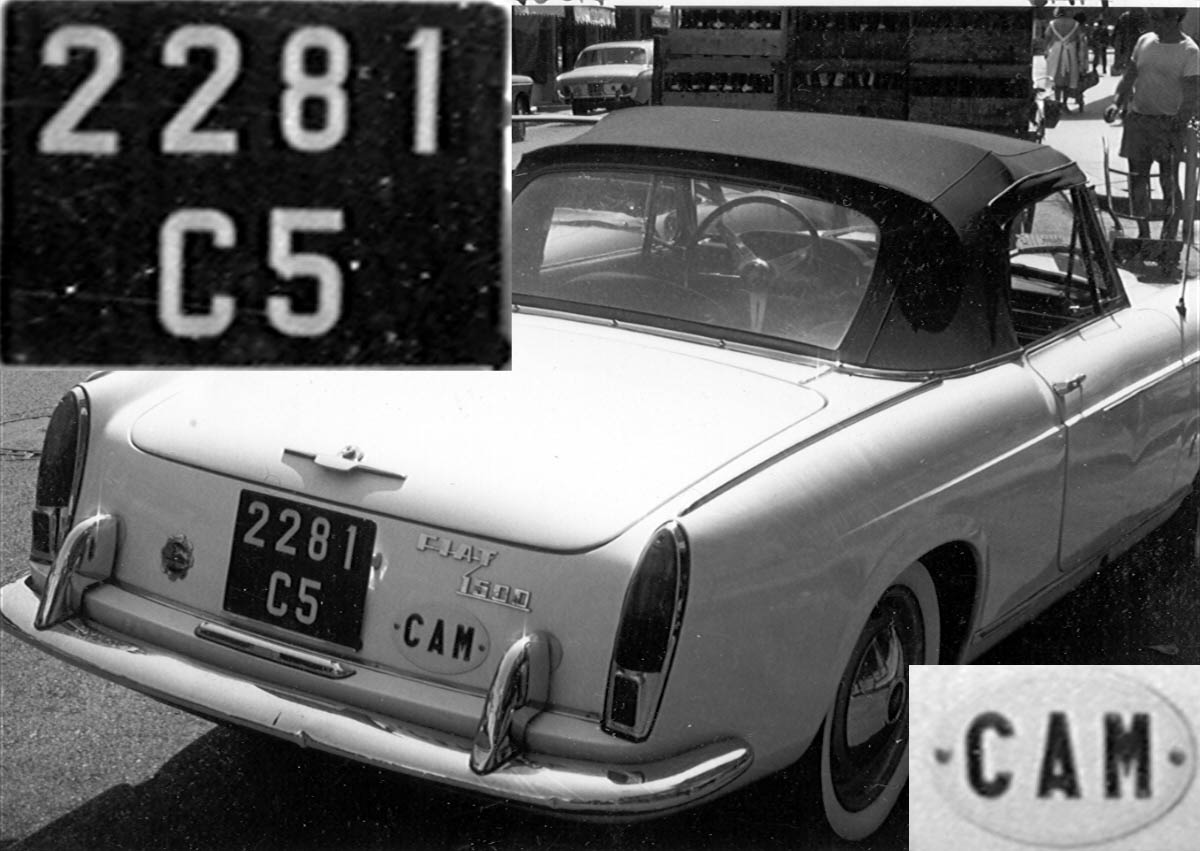
1960      With no change to  the 1932 series of  (up to) four numerals, a C and a serial number – came a change of  International Code, to CAM.    This Fiat 1500 sports was  seen in Juan les-Pins in 1960.   (VB archive)

Below:

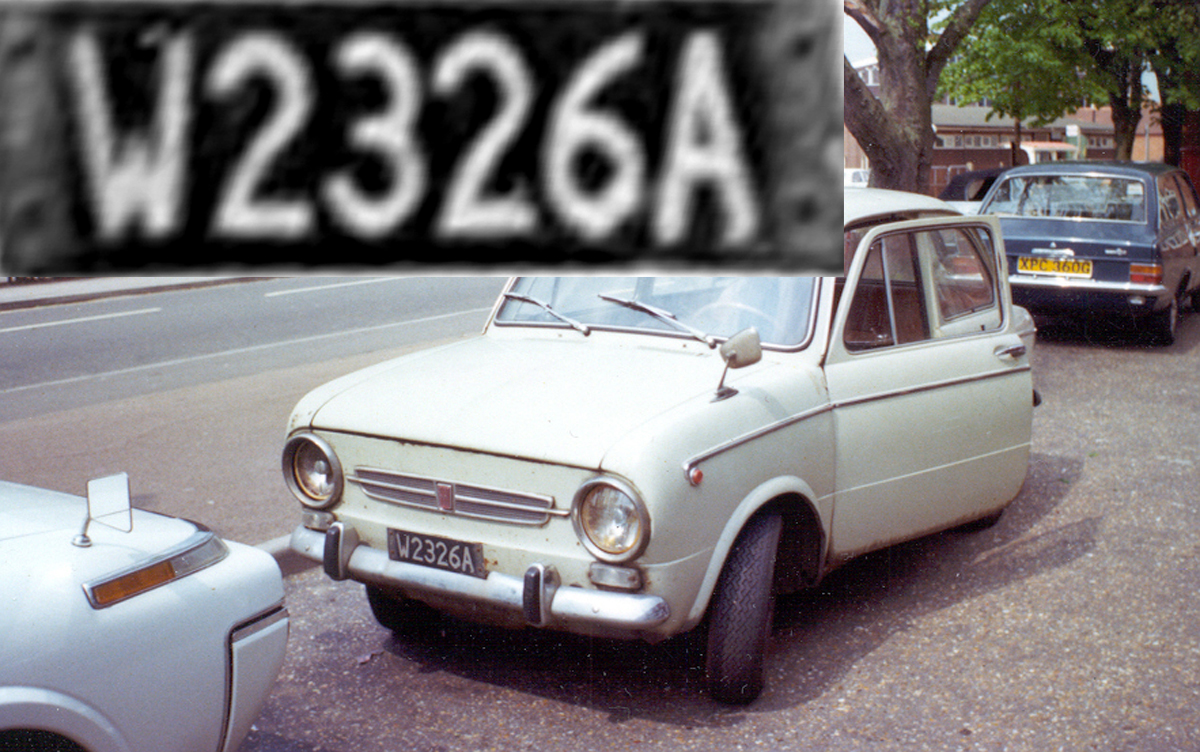
Another change of Oval is seen on Fiat 850 W 2326 A, found in Middlesex in 1963.   W was the regional code for West Cameroun (Buea); the RFC abbreviation was presumably for République  Fédérale  de Cameroun, but has not been officially recognised.     Classic stencilled French plates of the period at the rear….       (VB)

(RUC3)(RFC'73-85)_W2326A_(r)_comp1963_VB
(RUC3)(RFC'73-85)_W2326A_f_VB1963

1970s:

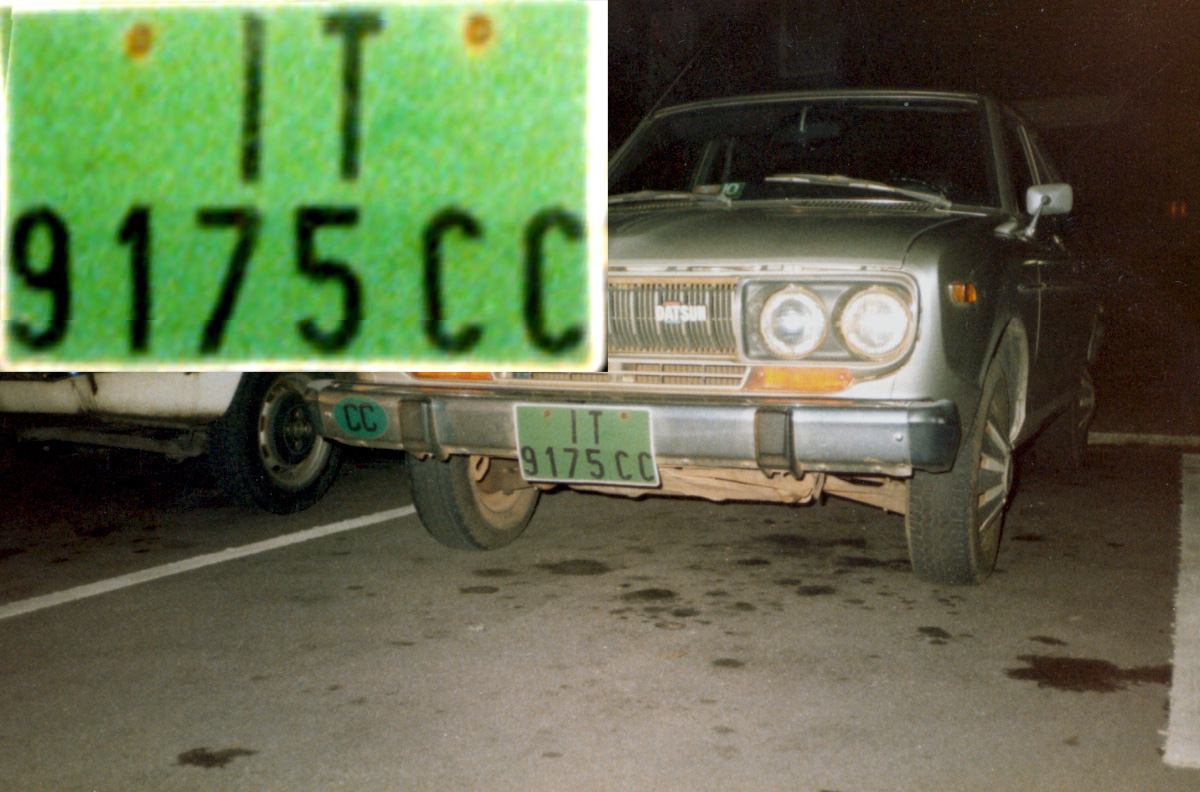
This Camerounian consular corps Datsun, attached to the US embassy, lived briefly in Swiss Cottage, London during the 1970s.   Brumby archive

c. 1970     This Camerounian consular corps Datsun IT 9175 CC, attached to the US embassy, lived briefly in Swiss Cottage, London, during the 1970s.        Brumby archive

‘IT ‘  was the abbreviation of Importation Temporaire, whereby such medium-term visitors to the country as Consular, Diplomatic and Technical Aid/NGO personnel and others, could enter their vehicles to the country free of import and local duties, on the understanding that they were to be re-exported at the end of tour.   Failing that, duties became payable and normal plates issued to the car.   When the vehicle was attached to an embassy or consulate, CD or CC was added as a suffix.    Other temporary imports used simple IT and up to four numbers.

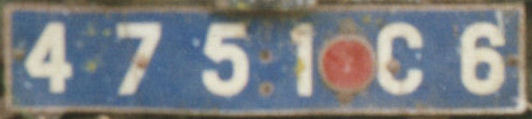
Some vehicles chose a blue background , particularly in the CM former British sector. Luoma archive.

Some vehicles arbitrarily chose a blue background , particularly in the CM former British sector.    Luoma archive.

~~~~~~~~~~~~~~~~~~~~~~~~~~~~

NOTES

Cameroun ALMOST  holds the record for the territory which has used the greatest number of International Ovals

TC, CAM, RFC, RUC and now CMR

But Congo (Leopldville)  just pips Cameroun, with CB, RCL, CGO, ZR, ZRE,  and now DRC, (which, somewhat tongue-in-cheek, uses the ‘ D ‘ to refer to a political system not yet adopted by that country –  though might possibly, in the forthcoming centuries…)


The Portuguese overseas territories-historic

February 5, 2013

In her colonial period, Portugal had two territories using ‘M’ and two,  ‘G’.

It may be that to differentiate, one of each (Macao and Goa) used a full hyphen set of two dashes (in the style of  mainland Portugal) and the others (Madeira and Guinea), one dash only  following the code letter.   Proof needed

Every one of the single-letter Portuguese territories was – and remains – amongst the rarest of sightings and even photographs or plates are unknown.    (Unless YOU know otherwise????)

MACAO

MACAO until 1960s,(then MA-nn-nn)

MADEIRA

MADEIRA until 1962 (then MA-nn-nn)

AZORES

AZORES until 1962 (then AR- or AC or HO-nn-nn)

TIMOR

TIMOR until late 1960s? then TP-nn-nn until 1976 Indonesian putsch)

GUINEA

GUINEA until 1974 (independence)

GOA

GOA 1930-57 (then IGA-nn-nn to 1961 when ceded to India)


Egyptian visitors of the 1950s and later

February 4, 2013

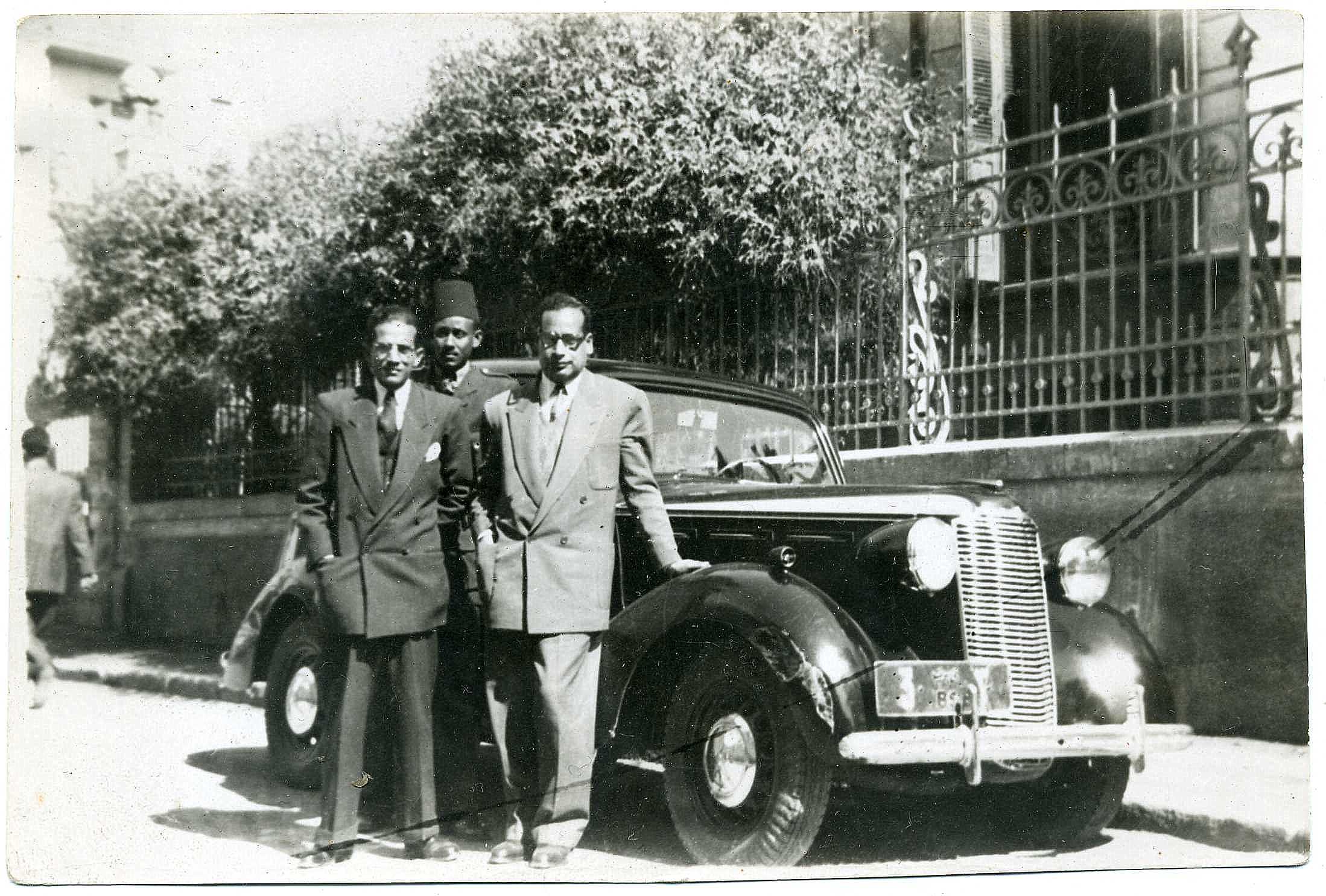
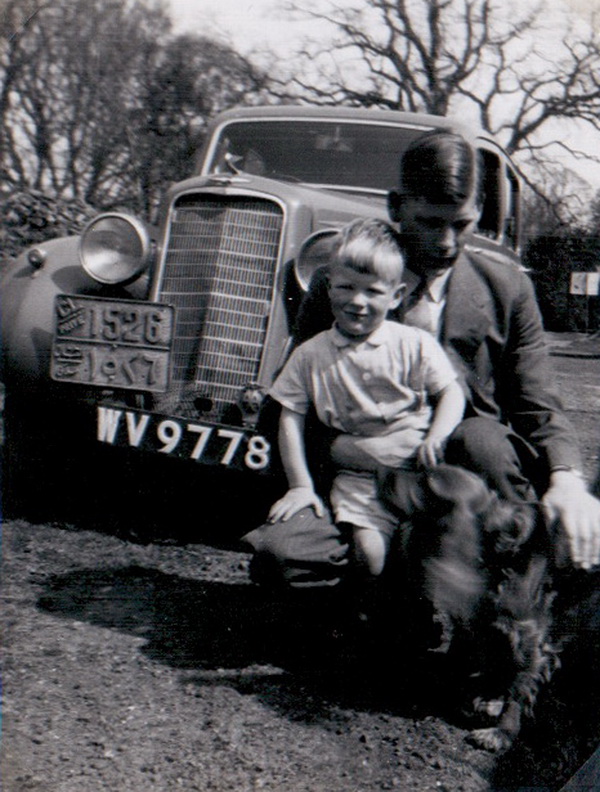
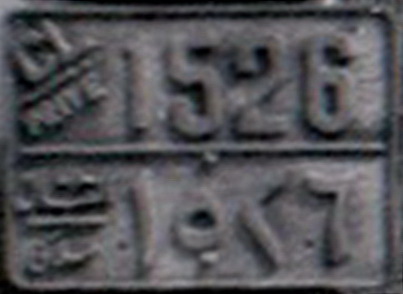
This home album photo depicts a 1936  Hillman Minx de luxe which has returned from Egypt, probably in the ownership of a serviceman in the Royal Air Force, posted to the Egyptian Suez Canal Zone before the war .   There he was given sand-cast alloy plates CL  Privé 1526 – Private use/Canal/vehicle 1526.      This manufacturing method gives rise to the longest-lasting, strongest numberplates.         The 1936 British registration WV 9778, was issued by the County Council of Wiltshire, in which many RAF establishments were located.    It may be the Hillman’s original English plate from new, or it may be a new registration issued on it’s return to Britain.    Happily, the squadron-leader has left both plates for us to enjoy, though the village policeman would have scolded him for showing both …… It crosses my mind that the elder boy MIGHT be member John Pemberton himself – which, in 1938, say, it could well have been!  (Confirme

CL 1526 is from Canal Zone, with a plate sandblasted clean of black paint.   Pemberton archive.
CL 1526 is from Canal Zone, with the plate sandblasted clean of black paint by sand and the desert wind.       Pemberton archive.
san
Sand-cast aluminium Egyptian plate CL 1526
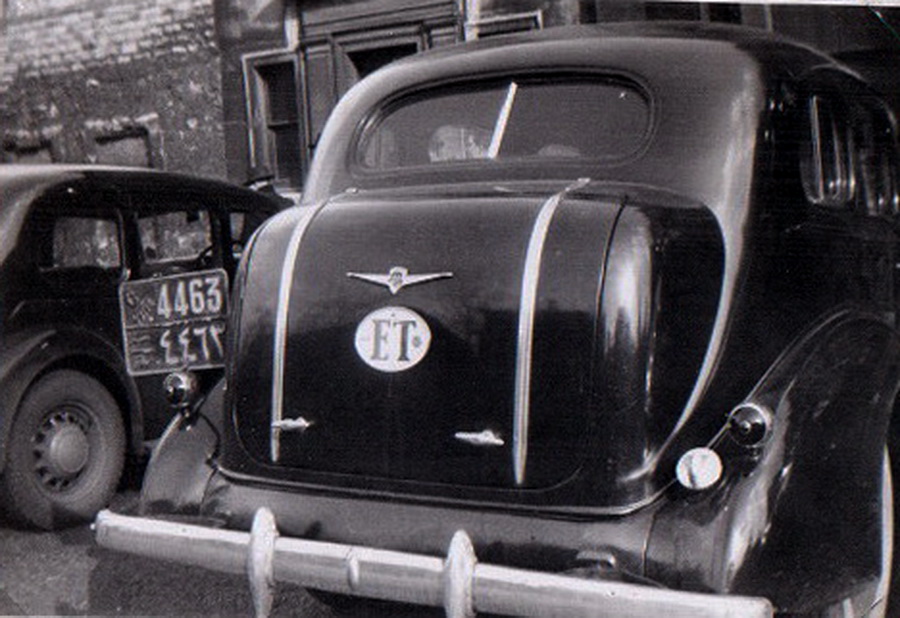
A more prosperous visitor from Cairo or Gaza (is the code C or G?) brought his massive American car to Oxford, as prey to JP's camera.    C/G 4463 waits alongside a 1930s Wolseley in 1940s Oxford.   Pemberton archive.
A  prosperous visitor from Cairo or Gaza (is the code C or G?) brought his massive American car to England, as prey to JP’s camera. C/G 4463 waits alongside a 1930s Wolseley in 1940s Oxford.      Pemberton archive.
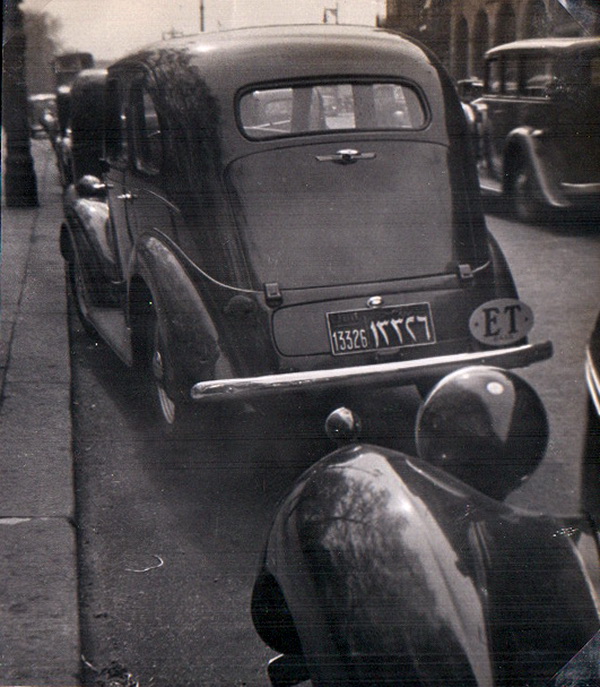
A 1930s Ford Eight, returned from the Souks of Cairo.    Pemberton archive.
A 1938-49 Ford Prefect Ten, Cairo 13326, returned from the soukhs of Cairo.  Estimated at 1947, in Oxford.   JP to advise.         Pemberton archive.

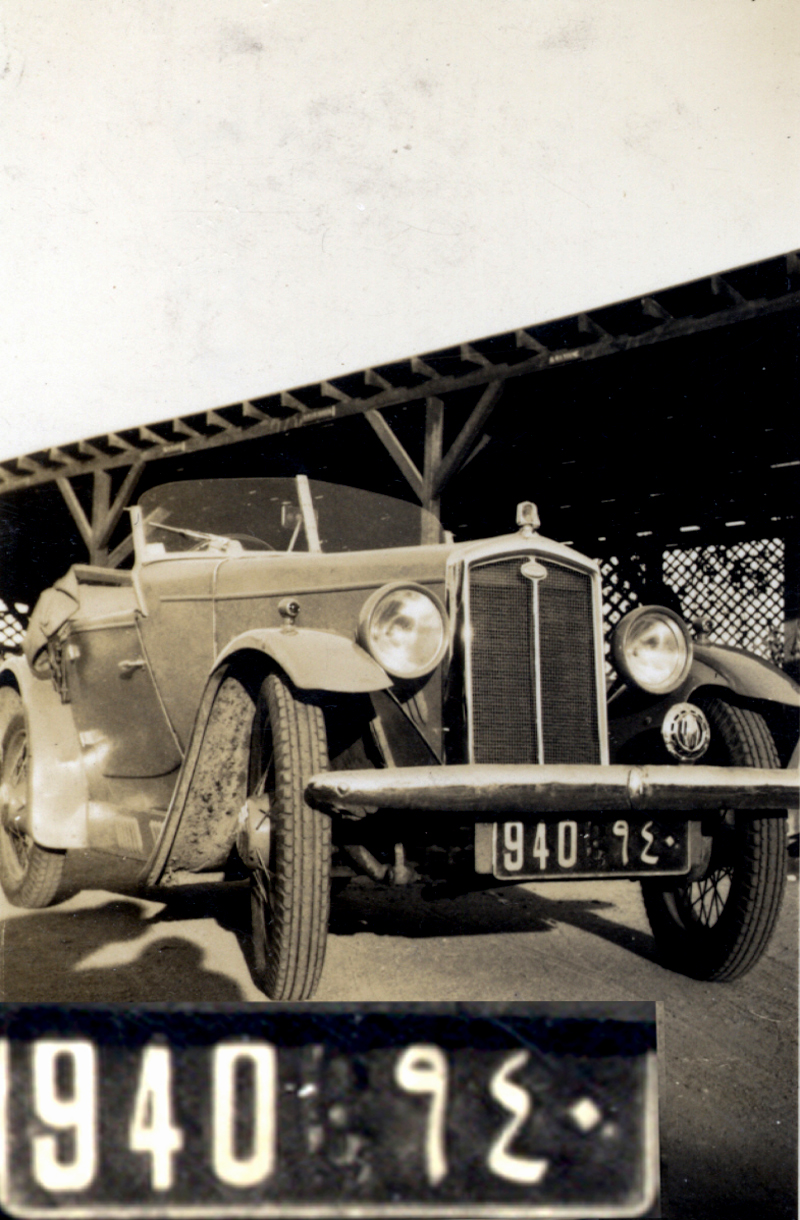
An English family we knew, lived in Cairo in the 1930s, where there was a thriving motor club and great interest in sports cars.    They kindly passed VB a pictures of their cars there, the first being the sporty English Wolseley Hornet:

Cairo 940 shown in 1934 outside the Asp & Turban p.h.   Brumby archive
Cairo 940 shown in 1934 outside the Asp & Turban pub, Nile Lane.               Brumby archive

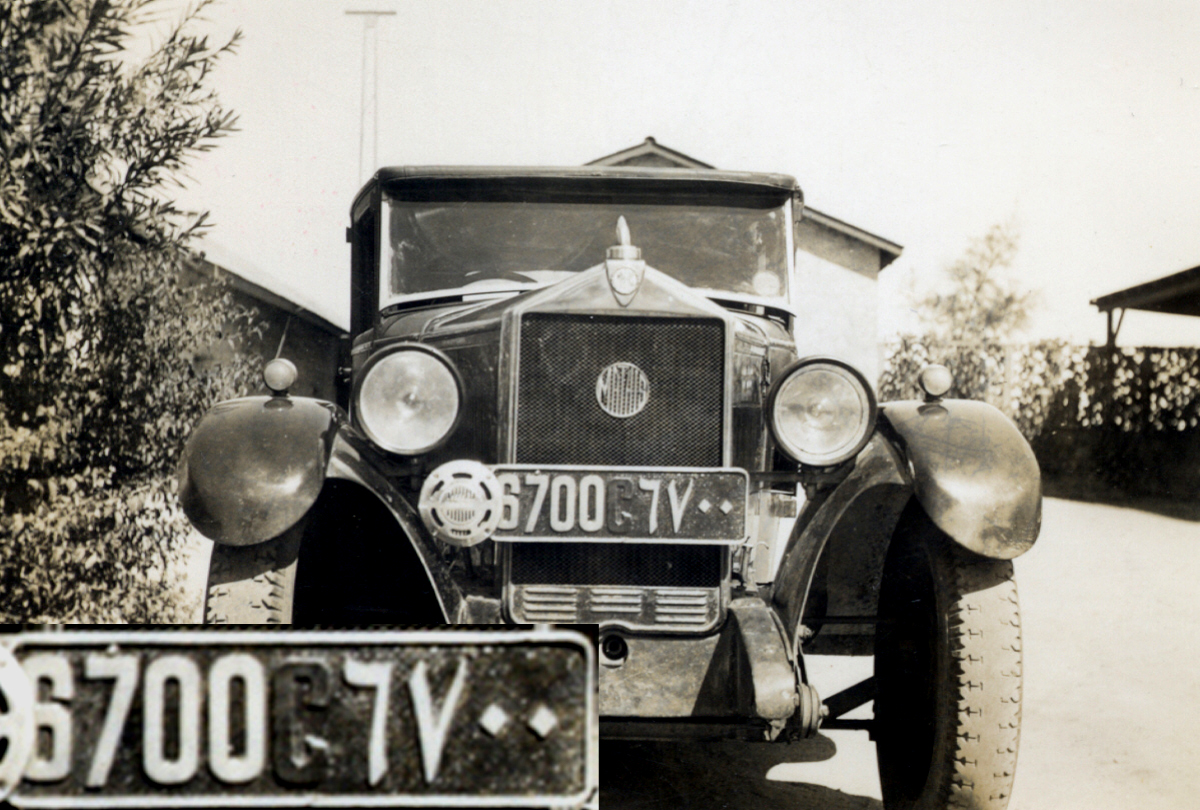
Note that this Egyptian series preceded the later PRIVÉ series above, using simply the city code (usually in roman and arabic)  as a central separator (in red)  for the numerals.   These two only show the C in roman. Their second car was a French Mathis (perhaps a 1932 Emyquatre) registered C 6700 – a big jump from 940, on the Wolseley of similar production year.   Why?

The French Mathis car in Cairo 1934.   Brumby archive
C 6700 – The French Mathis car in Cairo 1934.    Brumby archive

Below: Here’s one from the same 1913-56 series, using both scripts as separator.  3 BS 3 (Beni Suef) on a Vauxhall 12 (if you can see it).

BS 3 on a Vauxhall 12, made 1937-46, though wartime production was only for the military.  JG archive
BS 3 on a Vauxhall 12, made 1937-46 (though wartime production was only for the military).      JG archive
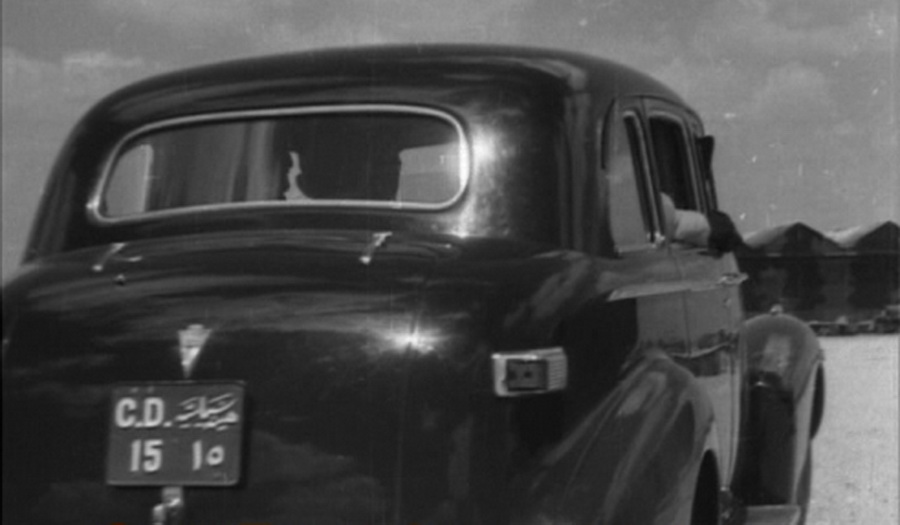
..and a rare picture of the pre-war Egyptian Diplomatic plate, of unknown source, CD 15. White on green.
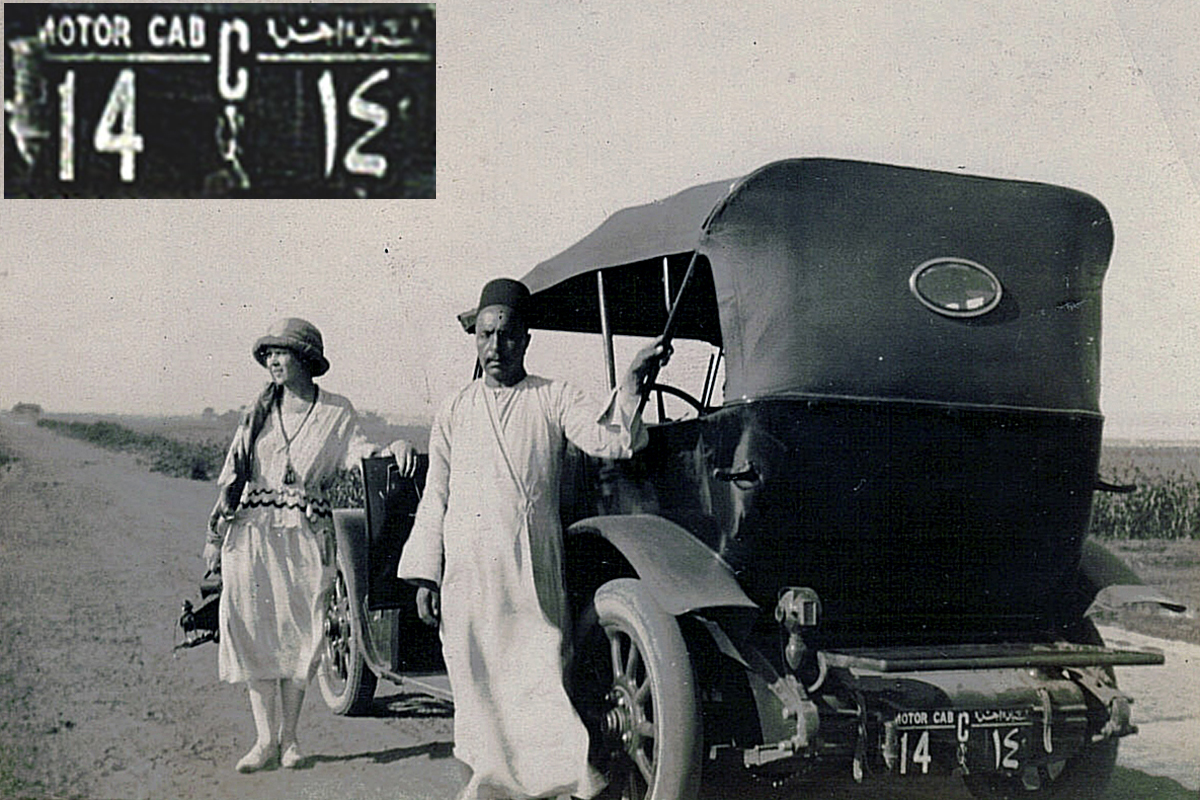
Cairo Motor Cab 14 pauses for a photo opportunity a hundred years ago. (anon)

Because of the constant shortage of  material, Egyptians were obliged to wear hats without a brim, which worked OK save for the brief rainy season.

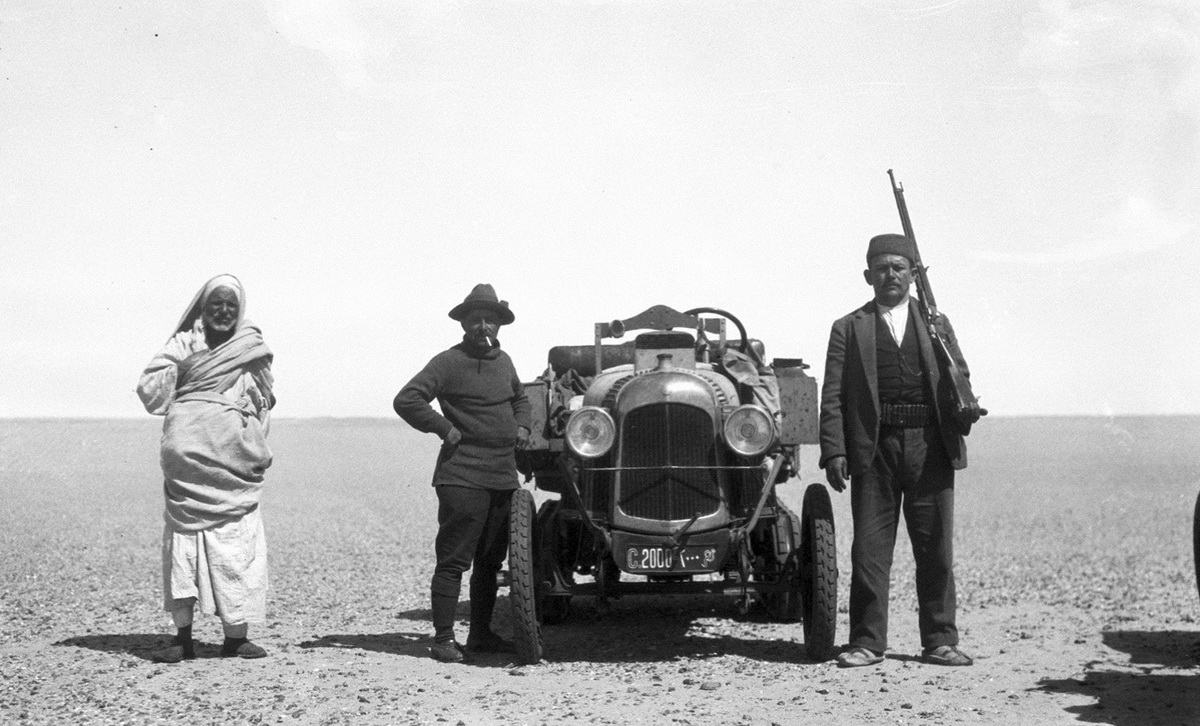
Early cross-desert explorers used C 2000 for most of the way.   This is taken before they left.   (anon)
Early cross-desert explorers used a vanity plate, C 2000 for most of the way. This is taken before they left, a long time ago.   Red ‘C‘ with white outline: probably enamelled plate. (anon)
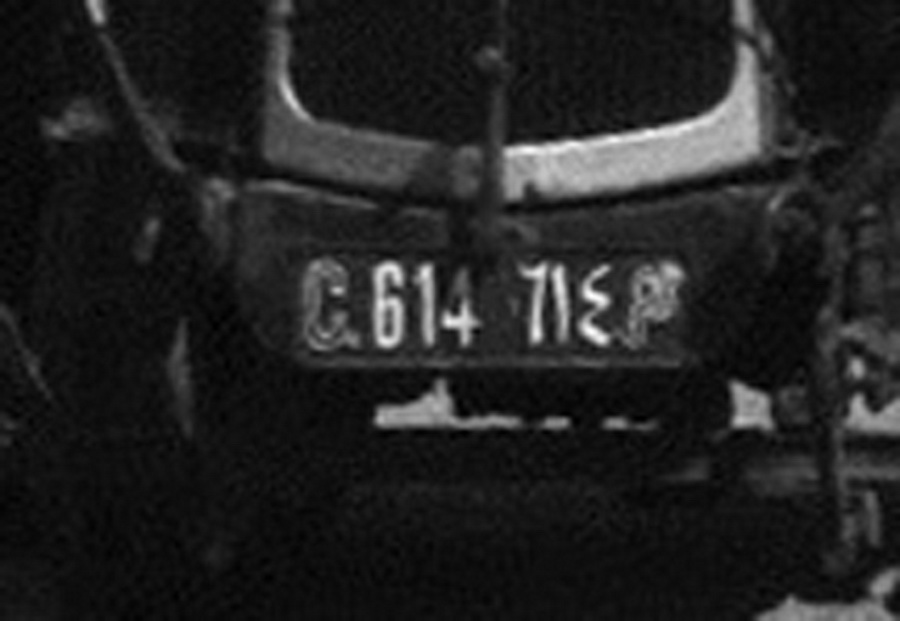
Another red 'C' early Cairo car, circa 1913.    (anon)
C 614 – Another red ‘C’ early Cairo car, circa 1913. (anon)

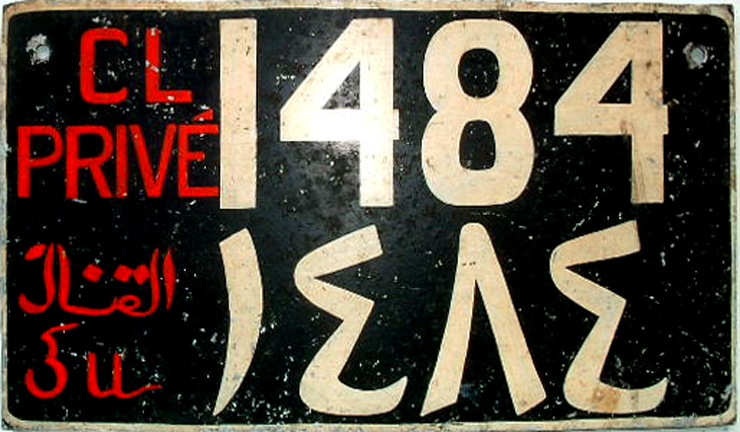
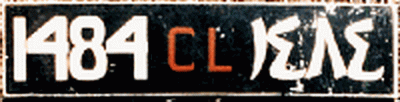
Colonel Blinman of Penn, Bucks., UK  had this plate  hanging in his garage when I visited him in 1974 to deliver his new lawnmower.    Painted on the obverse of the other, long, front plate, was the new Buckinghamshire number allocated to his Hillman Minx when he returned from military duty at The Canal in the ’50s.     My need was agreed to be greater than his, for this pair of redundant plates, and I left clutching them with glee and a promise of a free first mower service!

Canal Zone 1484 circa 1951.  Brumby plate
Canal Zone 1484 circa 1951.                    Brumby plate (rear)

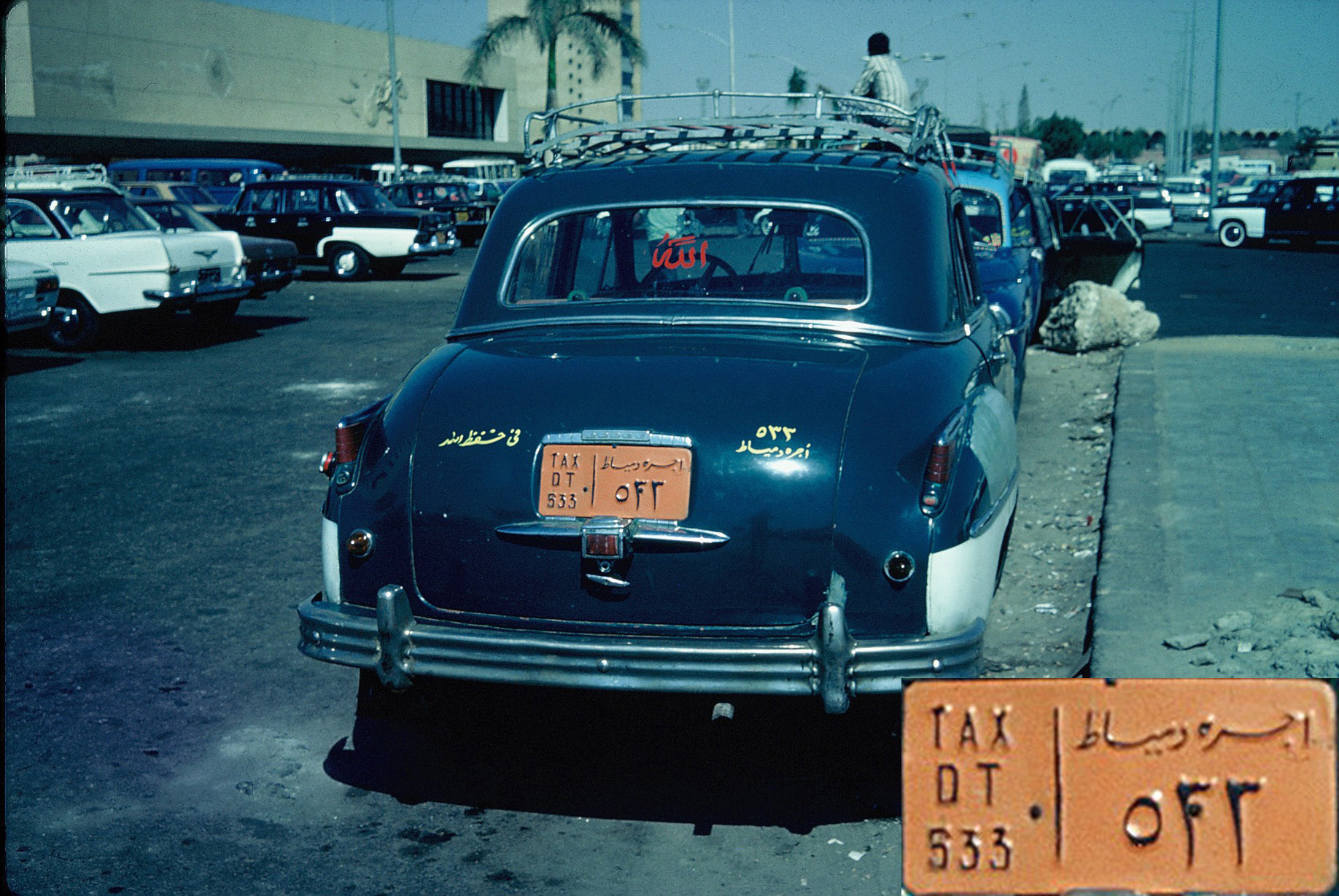
Below:   Taxi (orange) from DT = Dumyāţ, seen in Cairo by Angela Brumby 1966, in sea transit to Australia. A Fiat 1400/1900?      Not so, says David Wilson – it’s a Canadian Dodge (see comments)

1966 shot in Cairo of an elderly taxi DT 533.   Brumby archive
1966 shot in Cairo of an elderly Dodge taxi DT 533.    Brumby archive
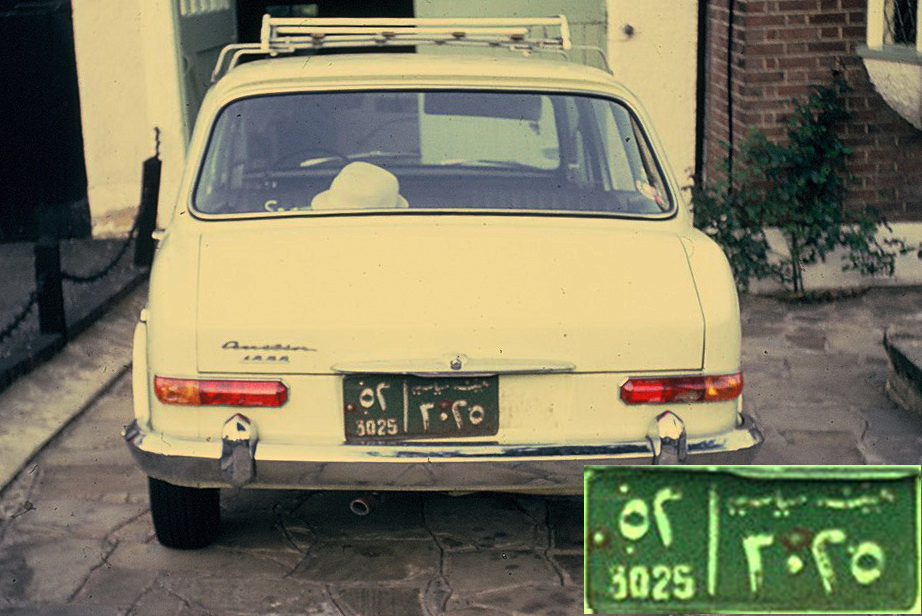
Austin 1800 from the British embassy in Cairo in the 1970s, seen in Amersham, UK.  Brumby archive
1970s – Austin 1800 from the British embassy (52) in Cairo, seen in Amersham, UK.   52 / 3025       Brumby archive

~~~~~~~~~~~~~~~~~~~~~~~~~~~~~~~~~~~

Well, that’s where John Pemberton’s pictures of  ‘Egypt in England’  have led us this time!     Next – West Africa. ~~~~~~~~~~~~~~~~~~~~~~~~~~~~~~~~~~~

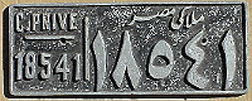
(ET3)(50-56)_C18541_cu_ALPCA
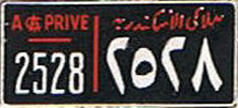
(ET3)(50-56)_A2528_cu_RKi
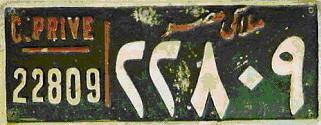
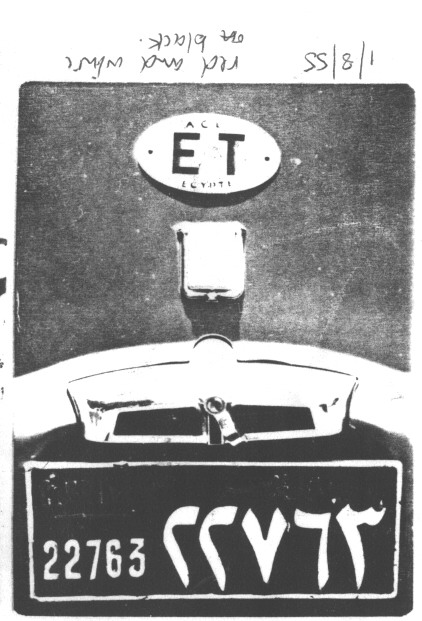
(ET3)(50-56)_C22809_cu_CS
(ET3)(50-56)_CL1484_cuf_VBpl1951c
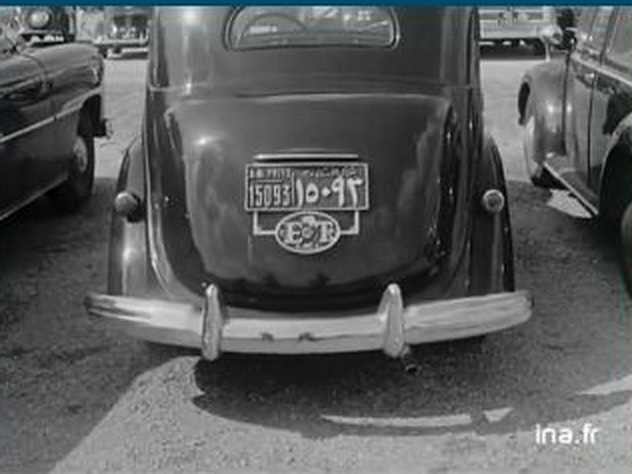
(ET3)(50-56)_A15093_FPQ1954

But…. we have  few other early Egyptians, too…….. Cairo Alexandria Cairo Canal Zone (front) Alexandria Unknown – probably Cairo.

Reg Wilson saw this in Liverpool in 1955.

All die-cast in sand, except Canal Zone 1484, which is painted on the obverse of a  British plate previously  used on Colonal Blinman’s Hillman. Plus……

tax-free temporary import s were white on blue or blue on white
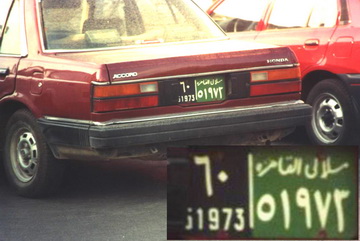
60 is the Greek embassy code in Cairo and the black/green plates were for non-diplomatic embassy staff there. Seen Athens Sept. 1993 by Trog Houghton.
tax-free temporary import s were white on blue or blue on white
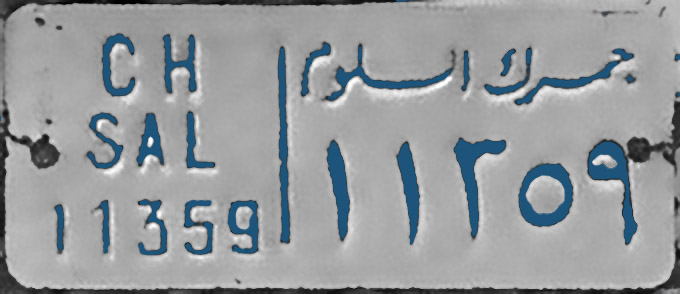
Tax-free temporary imports to Egypt were white on blue or blue on white.     SAL is from Saloum. (Tom Tom)  
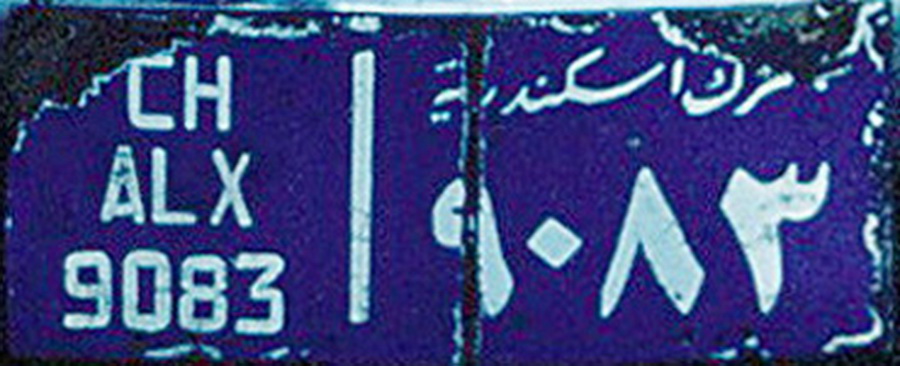
(ET4)(56-83)(it)_CH ALX9083_cu_VBmb

ALX from Alexandria.

::::::::::::::::::::::

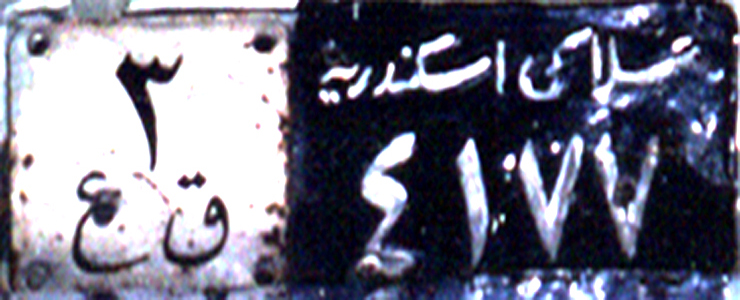
Unknown type seen 1980s at Luxor.
Unknown type seen 1980s at Luxor by VB.    It reads Luxor Private 4177.      The white panel remains unexplained (unless it might indicate a second replacement plate 4177, the original lost following an accident or plate theft……..)    (Tom Tom)

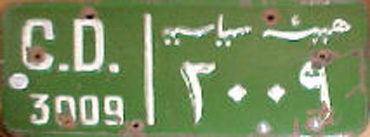
……and 3 different CD layouts, possibly from different periods….

Uncoded CD 3009 – remains undefined.   Embossed.

2020 – valuable response sent to the Blog by ‘Tom Tom’:

3 different types of CD

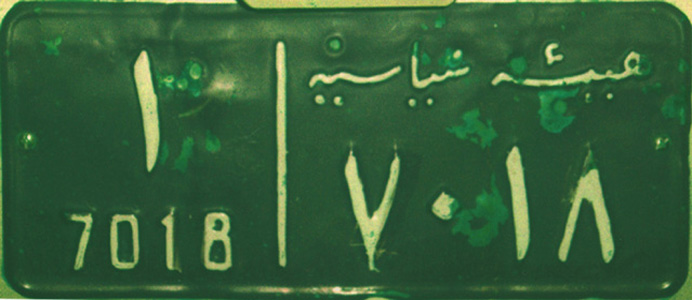
1 / 7018 below is identified by ‘Tom Tom’  (25/01/20) as a 1958c-73 issue, with ‘1’ as the code for the Soviet Union.   The embassy code was given only in arabic.       The 7018 meant nothing and was simply a serial.                    See 31/1301 below (which looks to be embossed).

(ET4)(cd2-SU)(56-83)_1 7018_cu_VB96

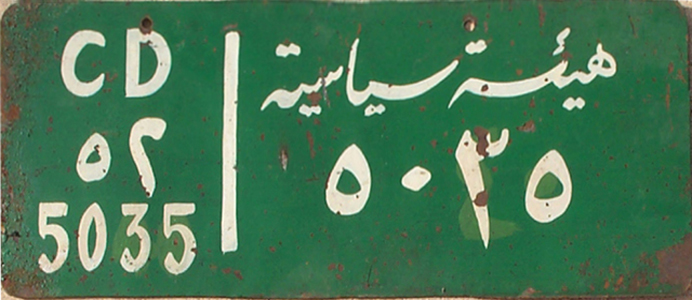
CD 52 / 5035 is probably a variant of the 1958c-73 series.     Hand-painted on flat sheet, whereas 7018 above had been in pressed steel, probably still hand-painted. Embassy 52=United Kingdom.

(ET4)(cd3-GB)(56-83)_52 5035_cu_MasPlvb

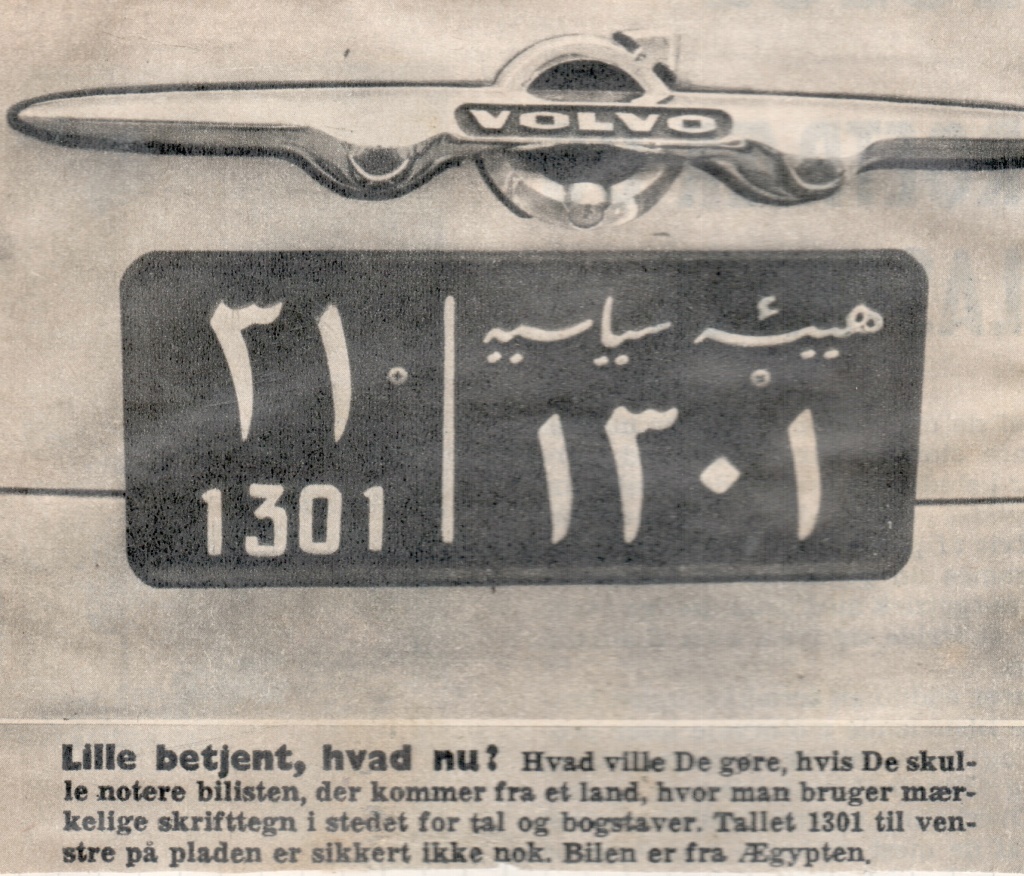
And added later, 31/1301, another 1956c-83 series image, with diplomatic code 31 for Sweden.

In all cases the arabic script translates to ‘Political Corps’.

:::::::::::::::::::::::

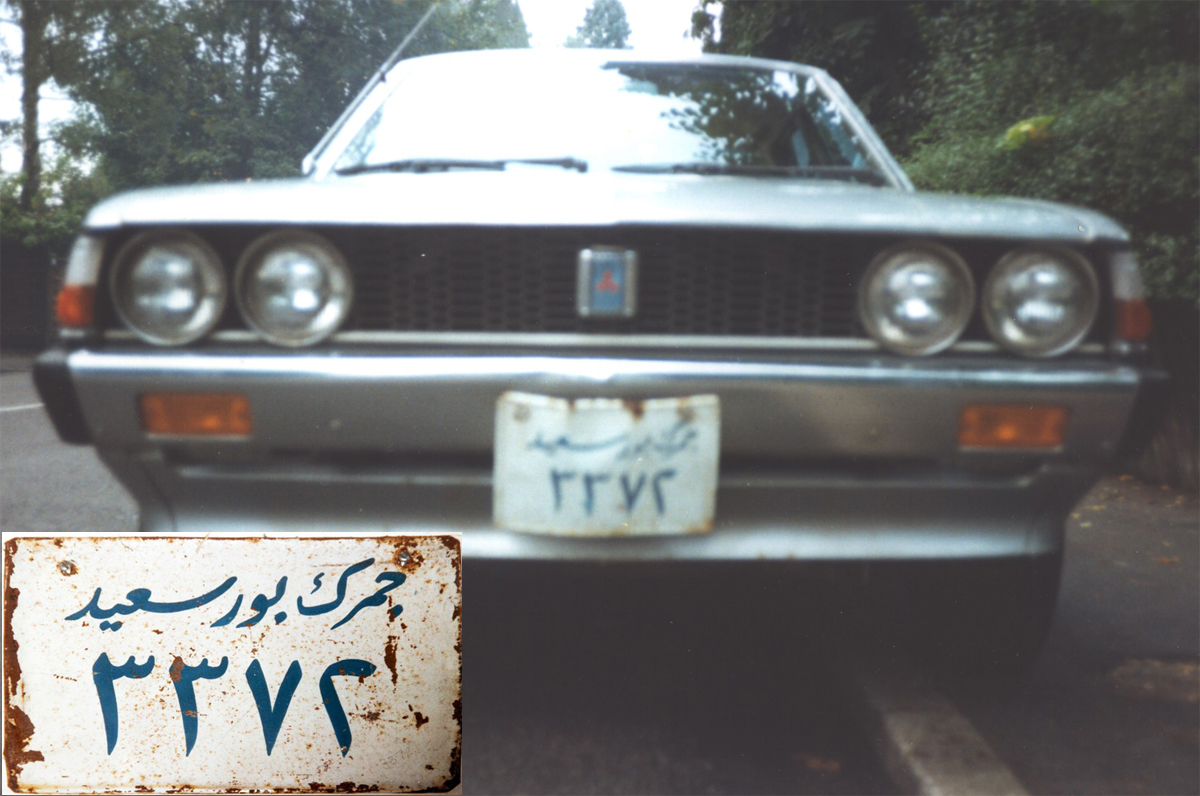
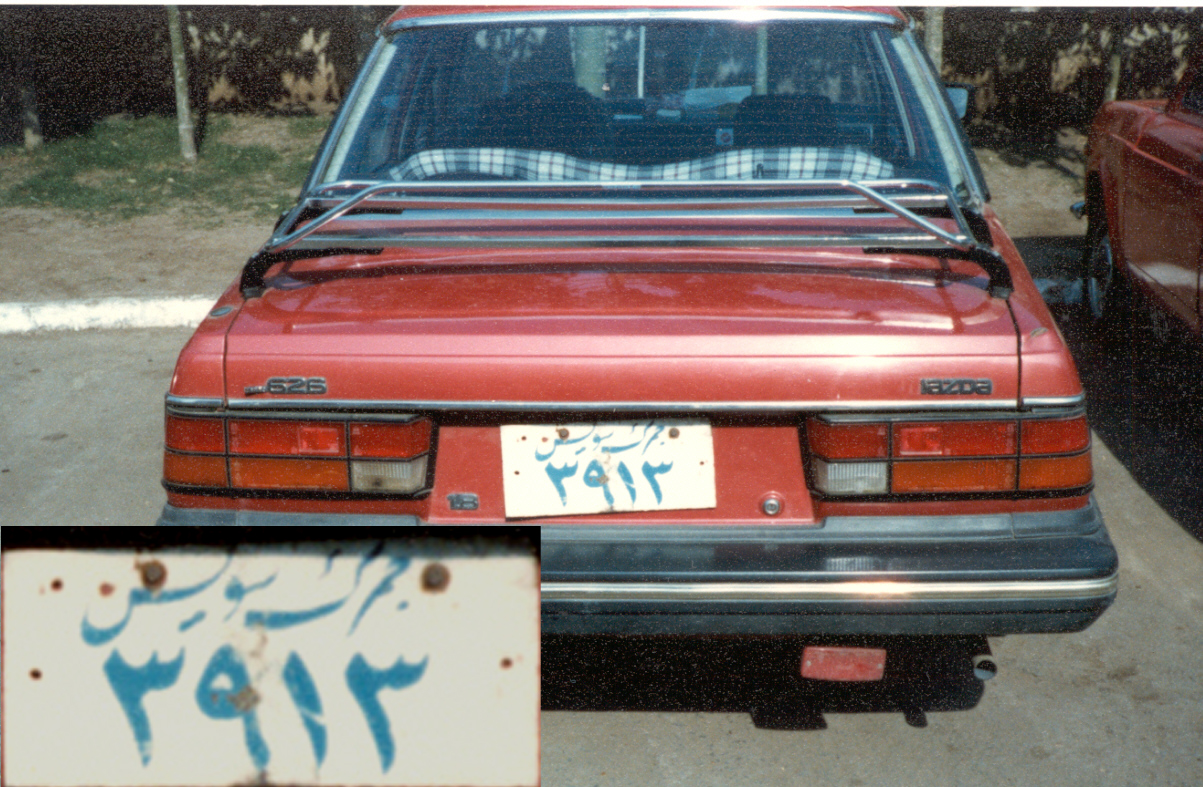
Below are two temporary transit plates, handpainted, seen in London, years apart.   The first is from Port Said (1972) and the second from Suez (1976).   They are thought to be  ‘get-you-to-the-border’ exit* plates, valid for a few days for vehicles leaving Egypt and made to hand back in their normal plates.     They and have surprisingly high serials.

(ET4)(56--)(exp)_PTS3372_comp_VBpl70s
(ET4)(56--)(exp)_SZ3913_comp_VBmb76

*Japan and Hungary CD also employ this system of retaining their national plates when vehicles are known to be leaving the country permanently.

:::::::::::::::::::::::

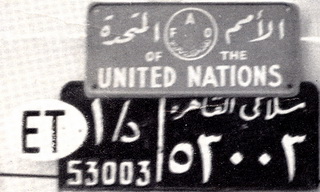
Below: An odd UN type from the 1960s.   Personnel attached to the World Food and Agriculture Organisation, who had a semi-diplomatic status.     White on black.     Reading: Private, Cairo 1/D 53003.     (Tom Tom). The arabic letter D indicates an embassy/Organisation-owned vehicle; the 1 code could signal USSR – but on a British Morris Oxford ??????

An odd UN type from the 1960s.

That all for now  (16/06/2020)


Middle East when it was OK

February 3, 2013

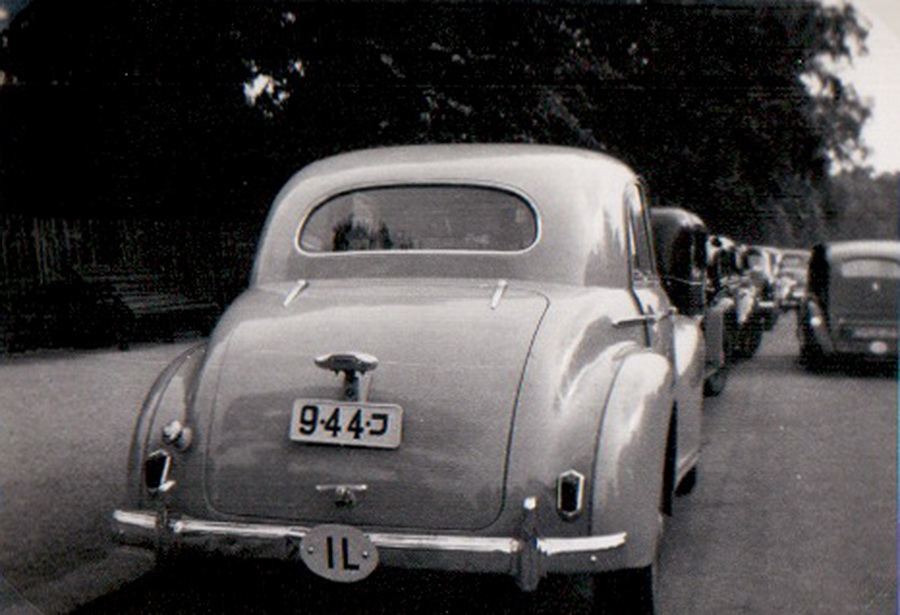
John Pemberton found a few sandhoppers in London in the 1940s, one of the most interesting of which was this 1948 Morris Oxford registered in Israel, a country which had only just started registering its own vehicles after the British Mandated presence there came to an end in 1948.

1948-55 series of first Independent Israel plates used a number followed by a regional code, in this case, that for Haifa.    Taken in a London Park, in 1949-50.

944 H  —  The 1948-55 first-series of newly-Independent Israel plates used black-on-white numbers followed by a regional code letter, in this case, that for Haifa. Taken in London’s Hyde Park, in 1949-50, on a new Wolseley 4/50 or 6/80 (thanks, Mike Parry – we had it as a Morris Oxford MO).    Both Wolseley models (4-cylinder and 6-cylinder) were built from 1948-56..                               Pemberton archive

~~~~~~~~~~~~~~~~~~~

Oil exploration was well under way in the 1940s and it was probably that business which took these cars  to the Middle East and then home again, when the owners’ tours of duty were ended.     First, below, a 1948  Hillman Minx Mark 3 with clearly painted plates:

IRAQ – Kirkuk

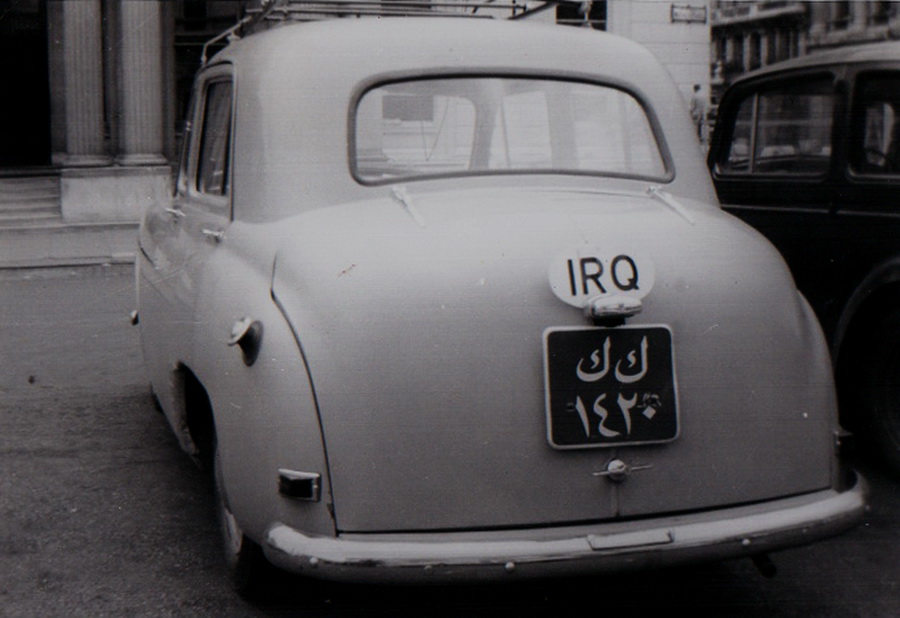
Iradi Hillman from Kirkuk oilfields area.  Pemberton archive.

KK 1420.  Iraqi Hillman MInx from Kirkuk oilfields area.   Seen in Britain early 50s.     Pemberton archive.

IRAQ – Baghdad

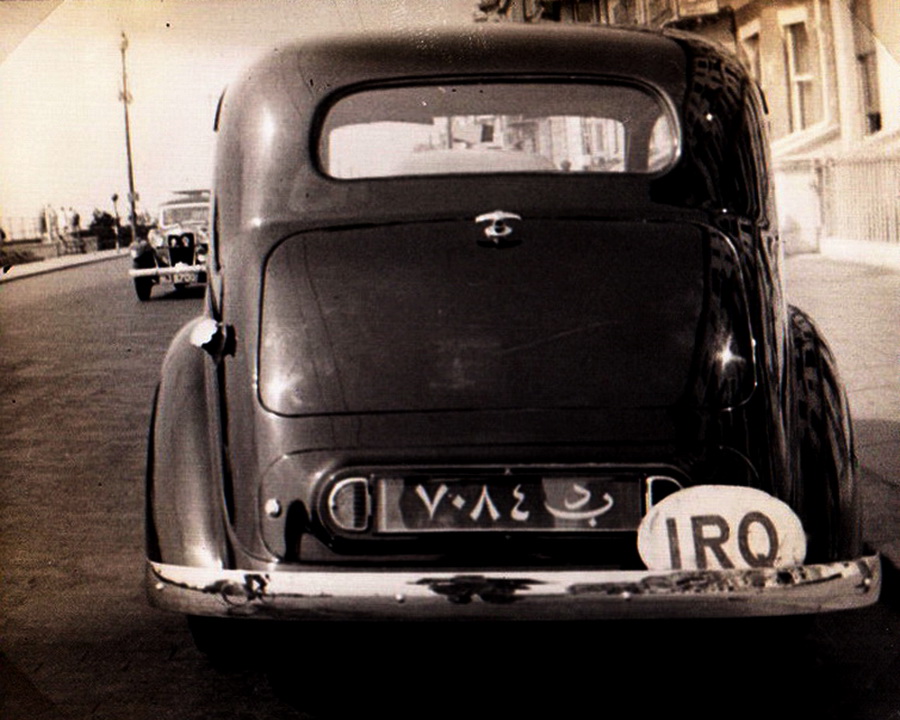
Maybe a Bentley, BD 7084, at Brighton Marine Drive during 1940.   Pemberton archive

Maybe a Bentley, BD 7084, at Brighton Marine Drive during the 1940s.   Iraqi plates of this period could be either black or red, and b/w photos don’t help us to decide which!                          Pemberton archive c.1940

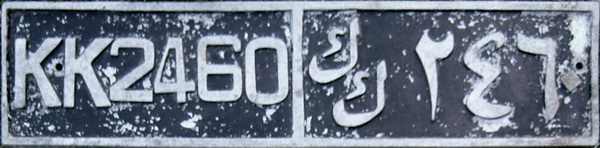
Iraqi vehicles travelling outside the country should have carried translation plates or be made to carry ‘Q’ temporary import plates when they visited Europe and Britain.   The above cars slipped in ‘under the radar’, it  seems, but the car which carried  KK 2460 was correctly prepared for its trip, via its translation/out-of-state  plate.   The vehicle ended in a scrapyard in Amersham in 1973, where this plate was salvaged by EU38!  (Below)

Kirkuk 2460, probably a plate of the late 1950s, with translation for use outside Iraq.   Brumby archive)

Kirkuk 2460, probably a plate of the late 1950s, with its translation for use outside Iraq.    Brumby archive

BAHRAIN

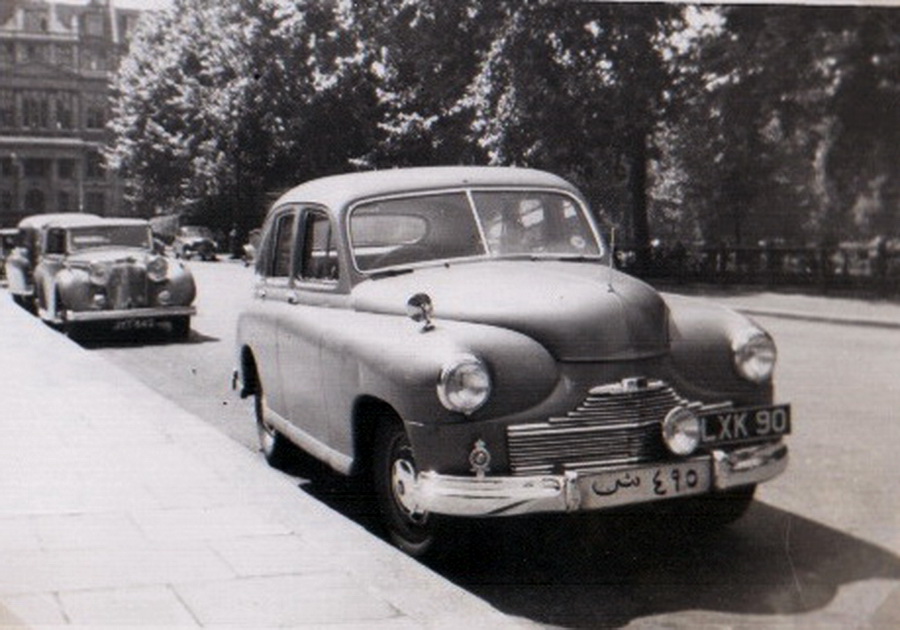
Below:   Re-imported to London in December 1950 from Bahrain,  this 1947 Vanguard LXK 90 was allocated a registration from the London batches of 10 to 99, which were retained for the re-registration of used imports. Unusually, this owner chose not to dismount his original Bahrein 495 numberplate – strictly not legal, but its suits us!

(The London batches from 1-9 were then generally held for diplomats and privileged citizens.)

Standard Vanguard Phase 1 built 1947-53.  This one has served in Bahrain and returned to Britain to use LXV 90 plates.

495  —  Standard Vanguard Phase 1, model built 1947-53.     This one had served in Bahrain and returned to Britain in 1950 to carry LXK 90 plates.     Pemberton archive.

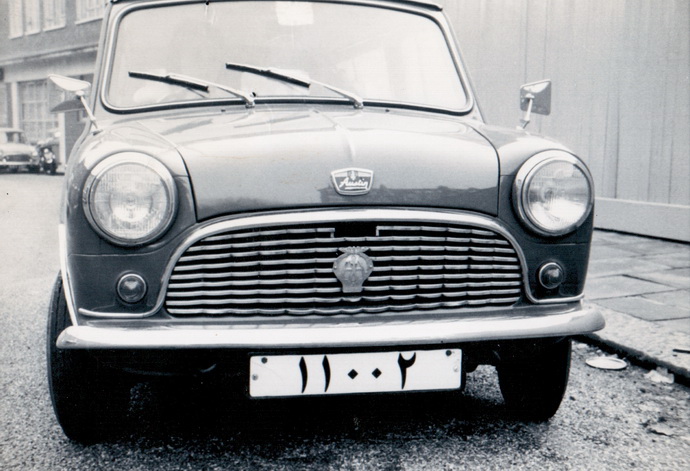
Below;   About 13 years later, a Bahrain Mini was parked for a photo-opportunity.

Bahraini Austin Seven 'Mini' 11002 in Notting Hill, London in 1962. Brumby archive

Bahraini Austin Seven ‘Mini’ 11002 in Notting Hill, London in 1962.    The arabic script for ‘Bahrain’ was not usually shown in this period and it is odd that many such cars were permitted to run in Britain with these arabic-only plates, when really, they should have been given ‘Q’ temporary import plates at the UK port of entry…….          Brumby archive

Some Bahrein royal household plates were occasionally seen in London in those times, sometimes with modest cars……

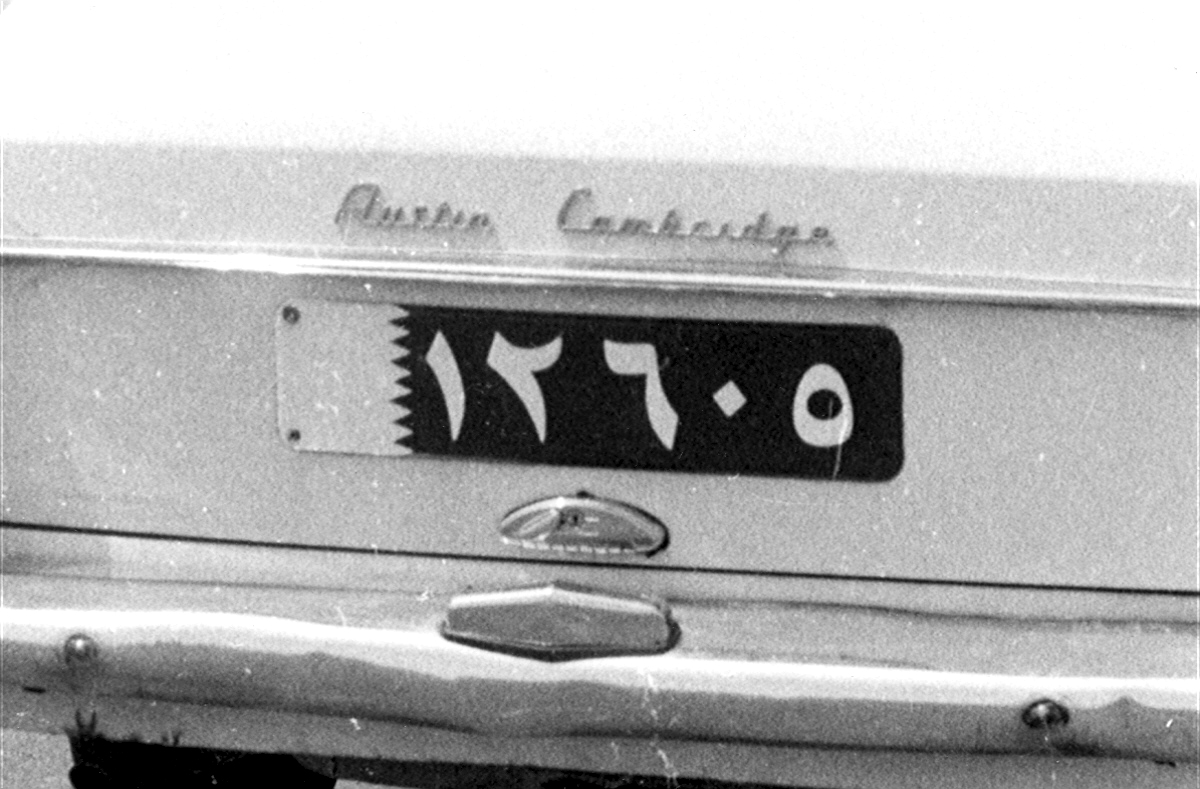
A  c.1960 Austin A55 Cambridge with the serrated red and white plates of the Bahrain 'royal household'  members. Early 1960s - reg. 12405. Brumby archive.

A circa 1960 Austin A55 Cambridge 12405, with the serrated red and white plates of the Bahrain ‘royal household’  members.            Brumby archive.

….and sometimes with the grandes voitures which would become the hallmark of Gulf visitors in later years……

http://en.wikipedia.org/wiki/Facel_Vega_Facel_II

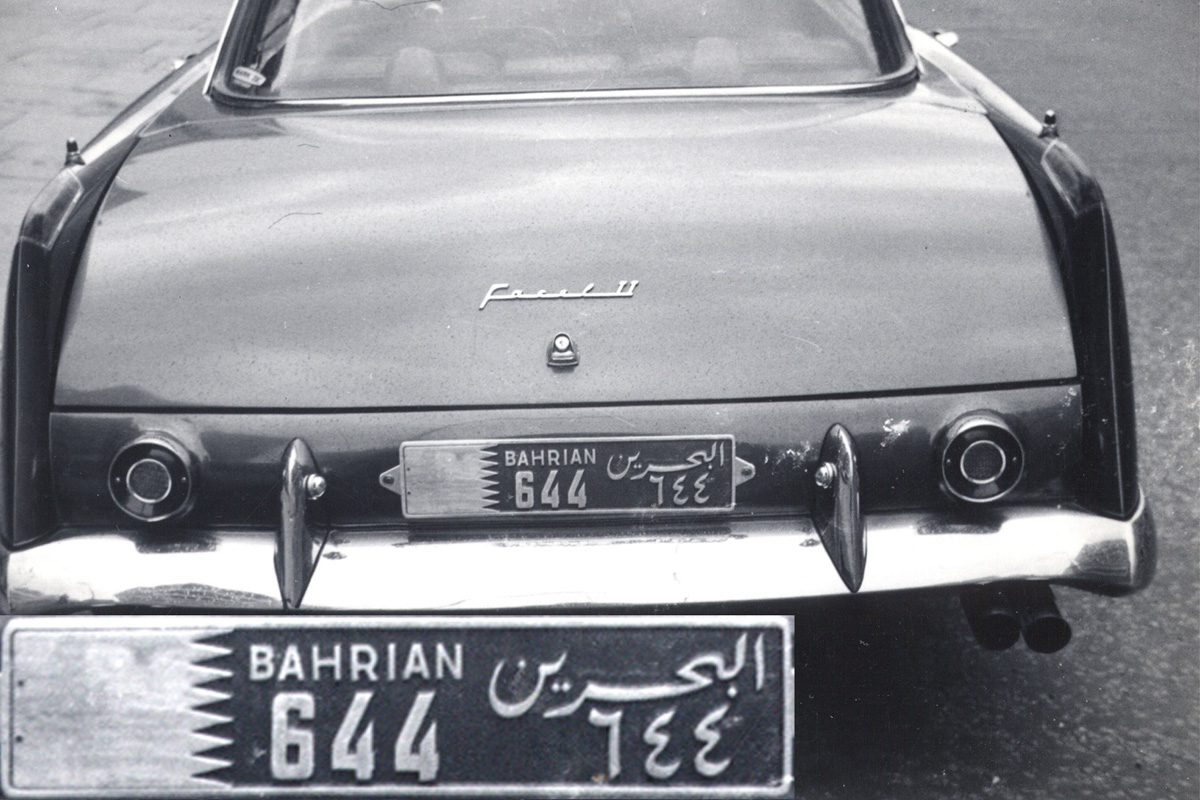
A French Facel-Vega supercar in London during the 1960s, bearing 'royal house' red/silver die-cast plates, with a minor error of spelling!Vic Brumby archive

644  —  A French Facel-Vega ‘Facel 2’  supercar in London during the 1960s, bearing ‘royal house’ red/silver die-cast plates – with a minor error of spelling!    Only 180 of this car were made, in their 2 years of production 1962-4
Vic Brumby archive


Current St. Lucia (WL)

February 3, 2013

Roger Kimbell has returned from the island today with two nice shots for our delectation:

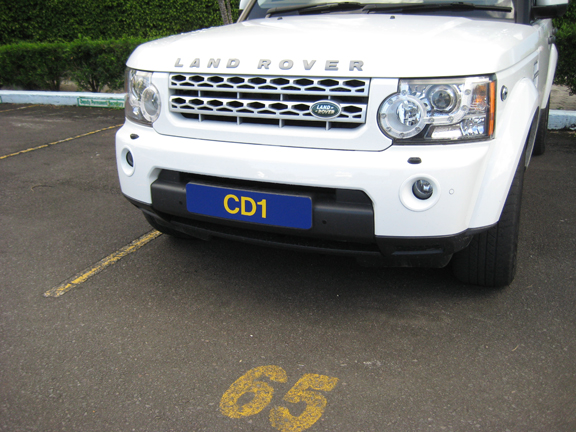
The British High Commissioner has a smart Land Rover Discovery with a cherished Dip. plate!

St. Lucia - British H.C. 2013.   CD 1.

St. Lucia – British H.C. 2013. CD 1.

(WL)(cc)_748_VBrk2013

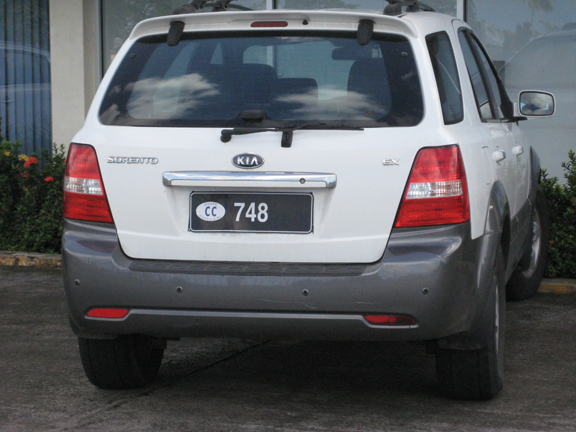
Previously un-noted St. Lucia Honorary Consul, with CC oval on normal plate. January 2013 – thanks to Roger Kimbell.

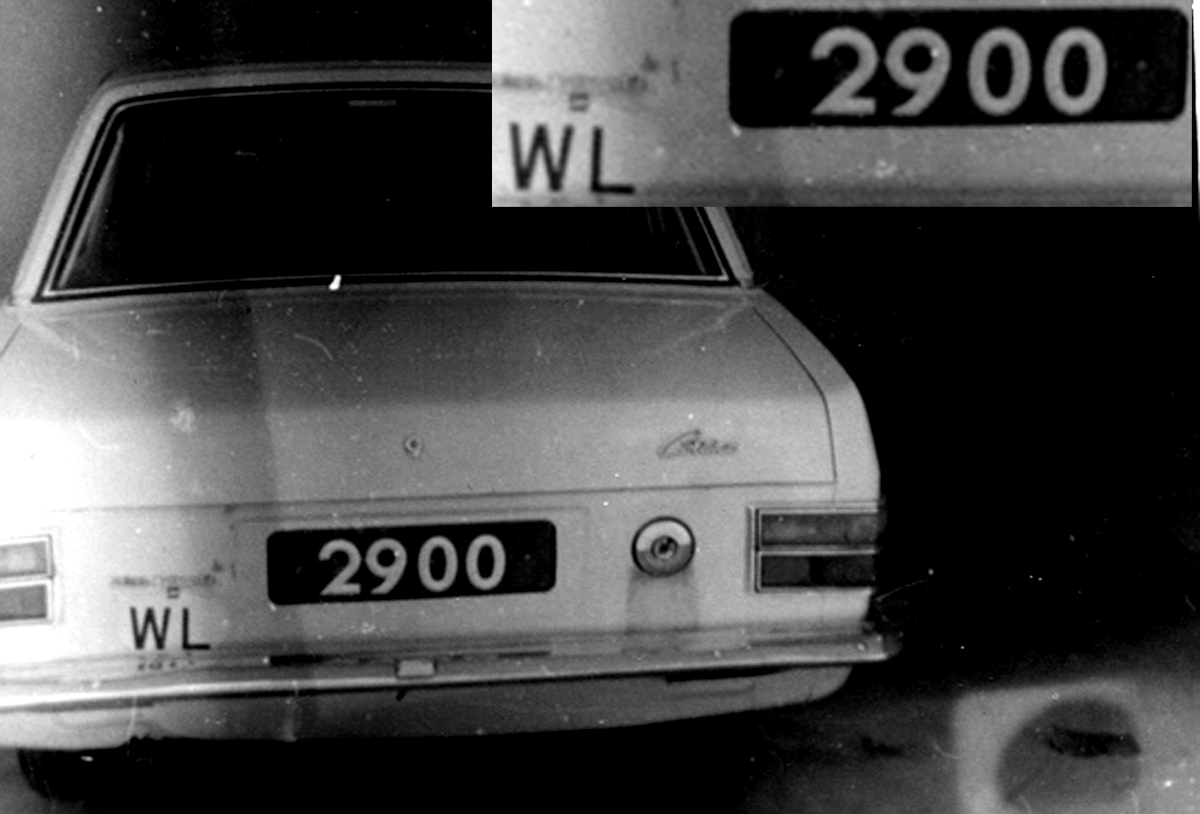
The four Windward islands seldom send cars off-island, and thus a sighting of an international oval WD/WG/WL/WV  is neccessarily rare.      The only photo of which I am aware is of this Mk. 2 Ford Cortina in Bayswater, London in the 1970s.    The owner must have visited the Automobile Association HQ in Leicester Square, and asked them to dig an adhesive plastic one out of a dusty drawer for him.

The only known WL oval on-car, in London 1970s.  Brumby archive

The only known WL oval on-car, in London 1970s.  Saint Lucia 2900.    Brumby archive


Greece in the 1950s

February 2, 2013

Young Pemberton collared two odd Greeks on celluloid, during his forays into the capital during the days of rationing.    A 1950s American Buick Eight convertible  parked in Upper Regent Street in London bears a baffling, plain,  T 38  plate, unlike anything we know.   John  was certain it was Greek.

Was it a Thessaloniki Port tourist entry plate?

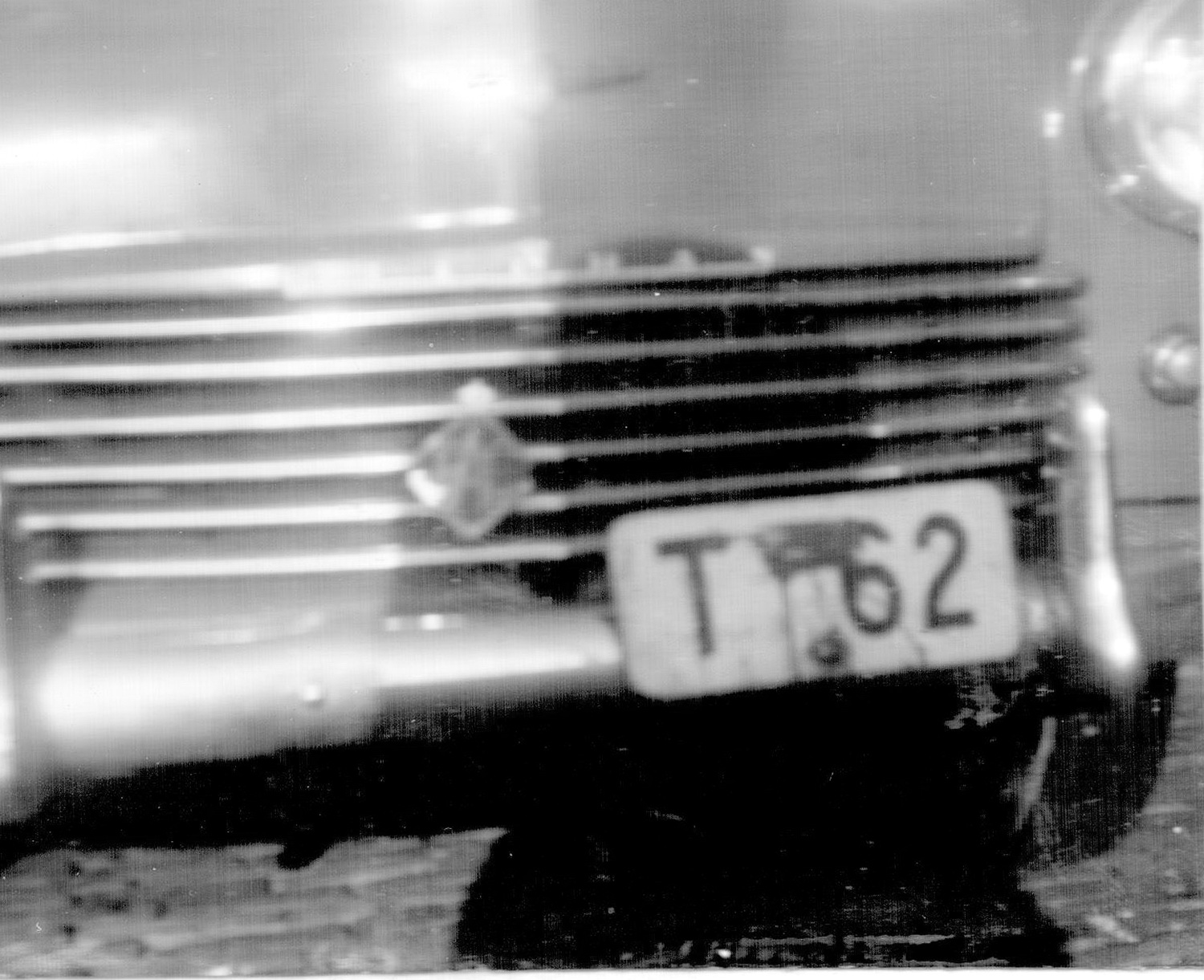
May 31, 2019   Yes – this transpired to be just that, and our Stoel albums provided another example from the same period – T 62, carried by a 1949-ish Hillman Minx.

Any ideas about this 'Greek'?

Any ideas about this ‘Greek’?                JP archive  

May 31, 2019   Yes – this transpired to be just that, and our Stoel albums provided another example from the same period – T 62, carried by a 1949-ish Hillman Minx.

(GR)(timp 14-54)_T 62_r_HillmanMinx.plKS(GR)(timp 14-54)_T 62_f_HillmanMinx.plKS

Well – there’s another series we had not known of!     Thessalonika Temporary Importation registration, free of duty.


Below:

A Morris Oxford MO was the choice of transport for this 1940’s-era British diplomat in Athens, seen on leave in UK.     Embassies were not coded in those times.

CD 277 on leave from Athens. in Britain, circa 1949-50.

CD 277 on leave from Athens. in Britain, circa 1949-50. Pemberton archive

~~~~~~~~~~~~~~~~~~~~~~~~~

Below; Not many years later, in about 1958, the rare Greek diplomatic was photographed in Earls Court by VB.    Also on a Morris Oxford, but the later, Farina-designed 1960s version.

A Farina-designed Morris Oxford from Athens embassy, in about 1958. VB archive.

A Farina-designed Morris Oxford from GB Athens embassy, in about 1958.           VB archive.

The 56 on these plates gave the year of their first issue only.   56 continued to be issued until they were replaced in 1969 with similar (green) plates, but now showing ‘69‘.   This ran until about 2011, still marked ‘69‘!    So the date meant nothing.

The DS transliteration of the Greek dip. plates abbreviates ‘Diplomatikos Somos‘ or ‘Diplomatic Body‘.   Greeks are not keen to use Latin-based words (Corps), when they have their own, older language!

At last, an attractive new turquoise plate design has replaced the 1969 series:

The latest Greek CD.

The latest Greek CD.