French possessions in the 1940s

January 19, 2013

To see a car from Senegal, in Britain, in about 1950, would have been a big slice of luck.   Here is John Pemberton’s sighting, on an Austin A40 Devon car – unusual to find in a French territory.

Can Francoplaque help to explain why the plate is ‘dark on light’, perhaps, as we think all were white on black then?

Note that it carries the light-alloy ‘F’ ‘oval’ which was so common in early times.   As Senegal was not independent until 1960, this car could have carried an ‘AOF’ oval, is it was part of Afrique Occidentale Francai

a 1949 Austin Devon from Senegal, 7081 1.A
A 1949 Austin Devon from Senegal, French West Africa.  
7081 1.A   (1=Dakar)

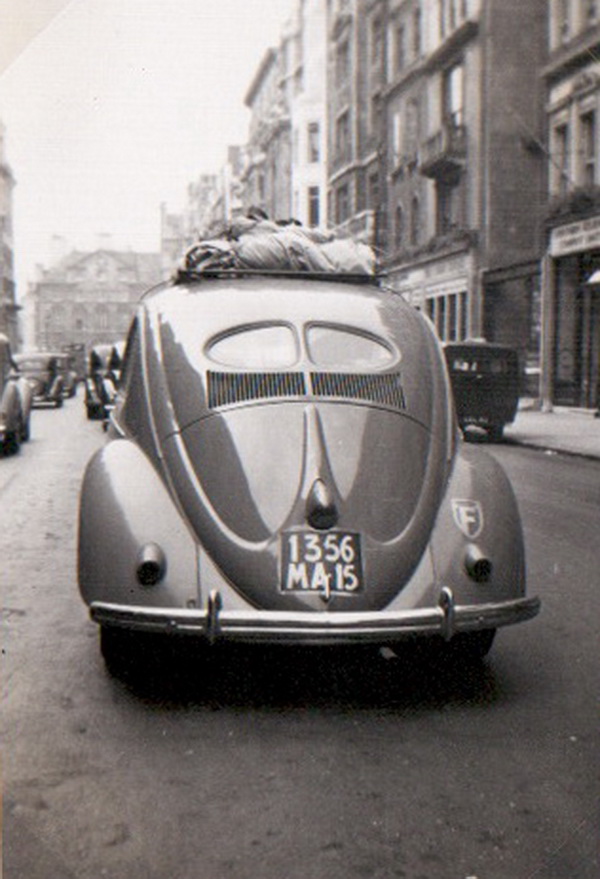
1356 MA 15 in Oxford, 1940s/50s

Odd French diplomatic, 1940s-50s.

Odd French diplomatic, 1940s-50s.

This early VW also carries the alloy ‘F’ sign, because its plate is from the pre-1956 independence, French Moroccan series – 1356 MA  15.

~~~~~~~~~~~~~~

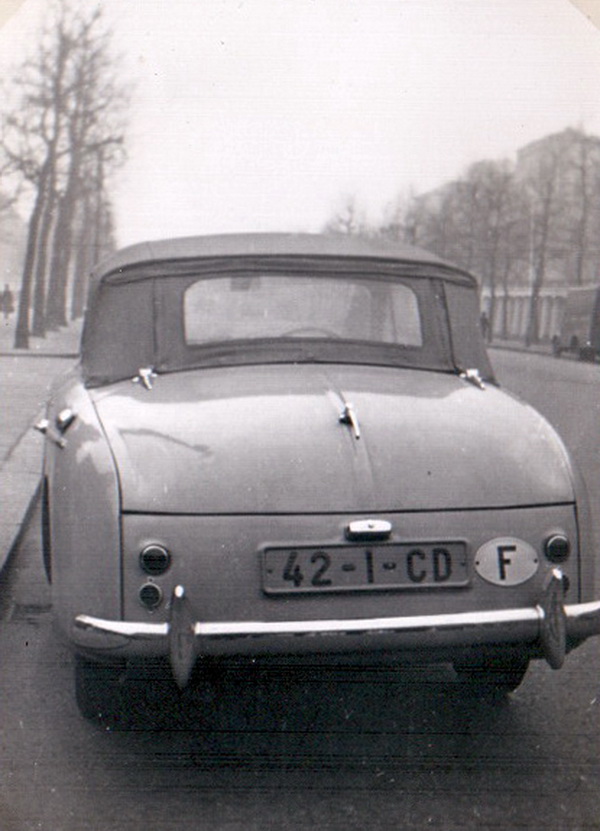
And concluding this foray into interesting French series, John captured a CD of an unknown type to me, carried on a rare Austin A40 Sports, made predominantly for the USA.

(Or is the car carrying the wrong international oval??)

Francoplaque! M’aider, m’aider!


CD symbol on Chinese and Taiwanese plates

January 19, 2013

More on John Pemberton’s possible China 1940s  diplomat.

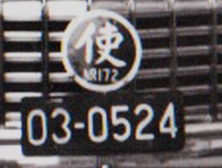
03-0524 PRC CD

03-0524 PRC CD

MR(?) 172 remains unexplained for now……


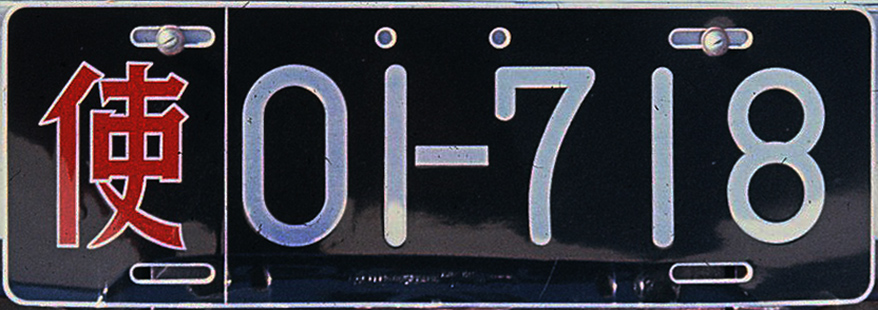
Further to the March 2013 Post  ‘Fancy a Chinese?‘  and the subsequent identification of the Chinese character on the shield, Alex Kavka sends the Blog the Chinese ideogram for ‘ambassador’, on his Taiwan diplomatic photo 359.    It is the same as that of the current PRC diplomatic corps (not necessarily ambassador)  ideogram 01-718 and another 1972-4 Taiwanese dip. 1 50 also shows the same character.       (from ‘RG’.)

Shown below are the examples from both countries, for comparison…   (Top, RC (current),  centre, PRC,  bottom, RC historic)

(RC)(cd)_359_AK2012

Peoples' Rep. China diplomatic corps from

Peoples’ Rep. China diplomatic corps from 1970s/80s.     Brumby archive

Taiwan dip.1972-4 (RG plate)

Formosa/Taiwan dip.1972-4 (RG plate)


Maroc-Tangiers MT international zone

January 12, 2013

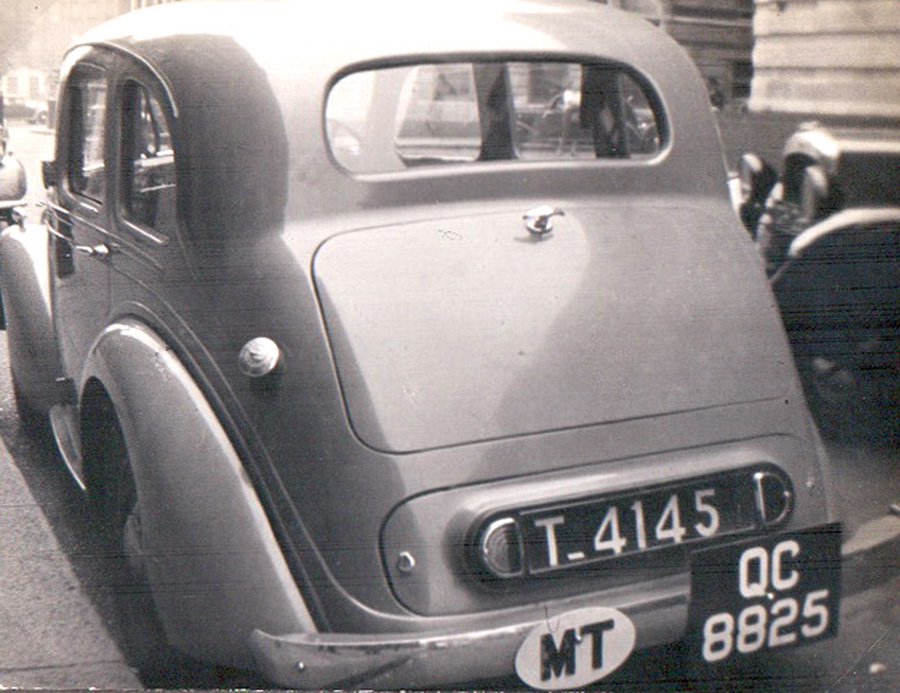
Another notable photo-capture of member EU83 is of the short-lived issue to the international settlement of TANGIERS, an enclave in Morocco, facing Gibraltar across the Straits.    The plates followed the British style of the times (and might have been made across in Gibraltar, half-an-hour away on the ferry.)

T-4145 is seen here in 1940s London.

(From 1661-4, TANGIERS was a possession of the British Crown.)

http://en.wikipedia.org/wiki/Tangier

Daimler(?) T-4145 from Tangiers, in Oxford durin 1947.

Standard 14 or Daimler(?) T-4145 from Tangiers, in Oxford during 1947.  Also bearing a British Foreign-Visitor’s registration, QC 8825.

An example of a territory which was not party to the treaties permitting free circulation of foreign vehicles, was the TANGIERS international enclave, and to visit Britain after the WW2, this owner was given QC (foreign visitor to Britain) plates to permit his entry.      Q-C was allocated to, and handed out by, the the Royal Automobile Association (RAC), as were Q-D and Q-H.        The RAC and AA  auto clubs assisted travellers with the considerable documentation required for international travel in those times – Motor Insurance, Carnets (partly to prevent the sale of cars in foreign countries), supply of International Ovals (seldom available in the originating countries) and so on.

BELOW

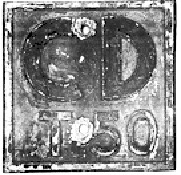
T 50 & T 11259.   Evidence of diplomatic activity in TANGIERS is given by these pictures below, 11259, circa 1953.

The system existed until 1956, when the TANGIERS internationally-administered zone  was re-incorporated into the Kingdom of Morocco.    You have to be fairly elderly, by now, to have seen one of these in circulation!

Most interesting explanatory notes are given below, by Thierry Baudoin, who studies the Conventions regulating international vehicle movement.  (See Comments).

An early Tangiers number T 50, used by a diplomat

An early Tangiers number T 50, used by a diplomat

T 11259 from the MV archive.

T 11259 from the MV archive.


The Straits Settlements

January 12, 2013

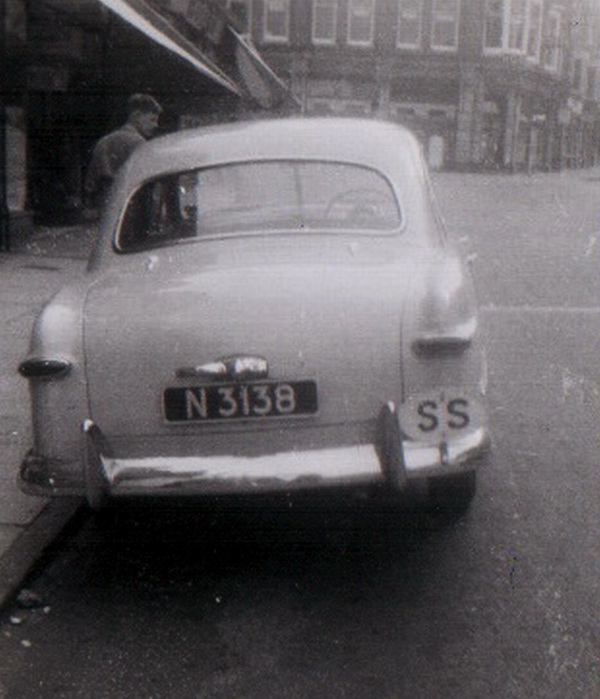
Will sharp-eyed viewers note the  apparent error in this picture of N 3138?

The Straits Settlements were originally named for the coastal enclaves ceded to Britain by the sultans of the independent states of Malaya – lands facing the Straits of Malacca, in the Bay of Bengal.      N was the code for Negeri Sembilan state from 1948, (from 1932 it had been NS), when all the states of Malaya combined to form the Federation of Malaya (international oval FM.)      Thanks to EU83 John Henderson for this historic picture/puzzle.

Q.  Is this a German-built Ford Taunus 12M (built from 1952)?

A.  (No”), responds David Wilson  “It’s an 1949 (American) Ford, with the right-hand part of the trunk- (boot-) lid piece broken off.    With RHD, this was likely made in Australia by Ford Australia”.      (That would tie in with its presence in ‘nearby’  British Malaya and the lower duties applied to Commonwealth-built vehicles.)

Negri Sembilan N 3138, in Harwich (GB) during the early 1950s.

Negri Sembilan N 3138, in Harwich (GB) during the early 1950s.

The rare SS oval is shown twice in the Pemberton album, this second one being from Penang island, and seen in London, probably 1949.    An MG YA is parked alongside, built from 1947.

Ford Eight from Penang, Straits Settlements, London 1940s.

1939 Ford E04A Anglia from Penang, Straits Settlements, in London, 1940s.


Fancy a Chinese?

January 12, 2013

One of EU38 Pemberton’s rarest sightings is shown below – a  US Dodge from Chinese region 03 (or perhaps embassy 03?) with only four numbers, not five as expected via the para. x) in RPWO.       Thought  to have been taken 1947-1952, certainly in London.     The characters on the shield have been sent off for identification*.     Any thoughts, members?

The photographer, John Pemberton, notes that he believes the plate to be from Inner Mongolia…    RPWO gives 03 to have been for Nei Mongol (I.M.) from circa 1949-86.      We suspect that this photo is from about 1946, but it could actually be pre-war………

American Dodge sedan from postwar China.

American Dodge sedan from postwar China.

* A quick answer from  Yun Li in Hong  Kong today reads:

It depends on the context, the most common meaning can be
-messenger
-ambassador
-a certain title for soldiers / officer, used only in the past
 
The numbers below the character may be related to the context too. It reminds of something like a signpost in the old china, 1850-1900, or even older
~~~~~~~~~~~~~~~~~~~~
So perhaps it IS a diplomatic series yet undiscovered?
(PRC2)_03-0524 cu_JPvb

Pemberton Quiz January 2013

January 9, 2013

Who can identify the plate on this 1950 Hillman Minx, taken by Member EU83 John Pemberton  c. 1951?

January quiz M-3139

January quiz      M-3139     Pemberton archive

He though it was Madeira, yet HOPED it might be Macao!    I cannot agree with either – but cannot offer an alternative.

The  separator dash  is  odd…….

Answers/ideas, please, in the box below.

FEBRUARY 2013  UPDATE M-3139

NO-ONE CAME UP WITH AN ANSWER ON THIS, BUT MORE RESEARCH BY THE WRITER HAS ESTABLISHED THAT IT IS A NORMAL MADEIRA PLATE FROM THE POST-WAR SERIES, WHEN THE NUMBERS WERE NOT DIVIDED BY THE CLASSIC PORTUGUESE DASH, BUT THE SINGLE LETTER ‘M‘ WAS!      AZORES USED  ‘A‘  IN THE SAME WAY AT THAT TIME.


SIAM until 1939, then Thailand, but SM oval kept until 1956

January 8, 2013

Which of us ever thought we might see a photograph of a car from pre-1956 Thailand, when the international oval was ‘SM’?    Well, Europlate member no. 83,  John Pemberton, started noting strange plates when he went up to Oxford University in 1937 and though his thousands of records of the intervening years are in written logs, he did take some black-and-white photos from time to time, many of which are now important historical records of plates never to be seen again.

John, who is in his nineties, and still spotting whenever he goes out in a car, has passed his album to the RPWO Blog for scanning, so that we can all share his gift to the recorded history of our odd pursuit.

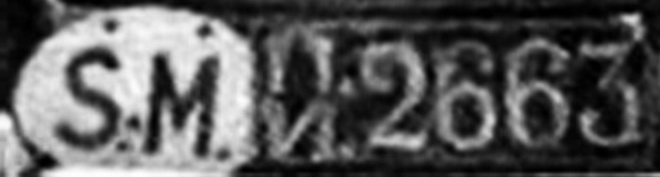
Let us first show his Siamese picture, taken in Denmark in Amalienborg, Copenhagen in 1947.     The style of the plate is exactly as described in RPWO:

 (y)     1940s    plates were 390×110 mm (or 270×90 mm for motorcycles) and the registration consisted of two small Thai letters vertically aligned being a code for the province (see Table 1, column 2), followed in Bangkok and Chon Buri by a Thai letter and four numerals, or in other provinces, by five numerals.

Postwar Siamese plate on an unknown car type.

Postwar Siamese plate 2663

The 2 Thai letters abbreviate Krung Thep, the short-form Thai ceremonial name for Bangkok – and meaning City of Angels according to King Rama III.
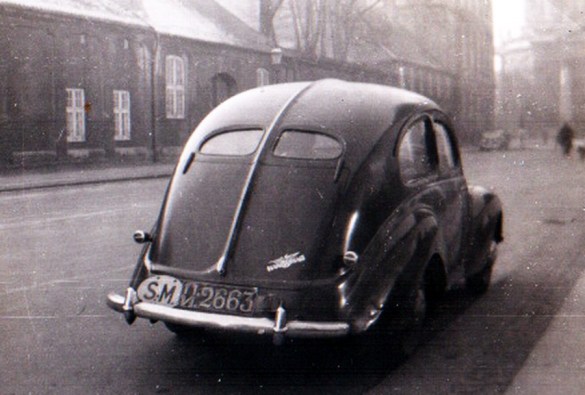
Siamese car of unknownmake,  in Denmark 1947

Siamese-registered Hanomag 1300 ‘Autobahn’ model, made between 1938 and 1941, seen in 1947 Denmark by member Pemberton.   Note that unique oval!

The same day, John saw a 1947 New Jersey plate off  Radthusplads, also bearing Stockholm reg. A 34351.    It seems that it was then common for foreign tourists to carry both their home plate and a visitor plate during their tour in Europe, as several of John’s shots depict such doubled plates.

Addendum    It transpires that countries which were not signatories to the International Traffic Convention, could not circulate freely on the roads of the member countries while using their own plates.     Among others, the USA and Canada were late to join and until about 1955, had to obtain some temporary plates of the country they were visiting, as they entered at a port or other frontier.   Britain had its ‘Q’ series, France its TT.    Sweden and Switzerland  gave them normal plates.     Full details of the Conventions are being assembled currently, by our former president, Bernt Larsson.
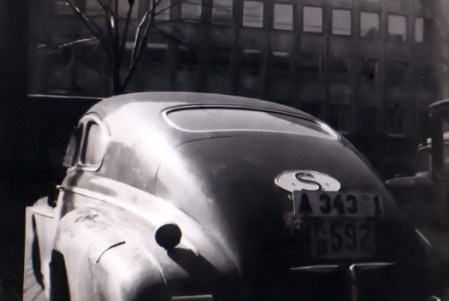
Sweden, A 34351 with N.J.1947 still mounted.

Below:  Another example of doubled plates is Zurich 28560 with 1946 Virginia, too,on a new Oldsmobile, in 1946 London.   Possibly from the US consulate/embassy in Switzerland…

(USA)(Va46)_487.842_JP1946

More of John’s sightings will be coming to the Blog shortly.


Indian plates using Hindi

December 30, 2012
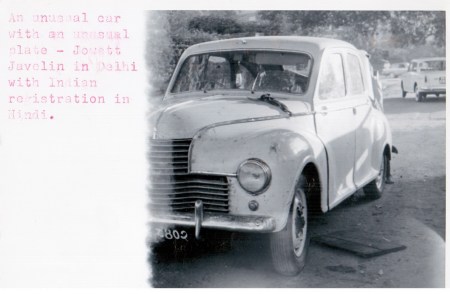
1965 Delhi sight of (part of) a Hindi-scripted plate - uncommon at that time.

1965 Delhi sight of (part of) a Hindi-scripted plate – uncommon at that time.#

In support of a member’s sighting of an Indian Jeep in London in the 1950s, bearing Hindi scripted plates, we see another example in 1965 New Delhi, snapped just as a camera came to the end of a roll of film.    The Jowett Javelin was quite a rare car in Britain, using a flat-four water-cooled engine and many advanced features.     It would have been very difficult indeed to keep a 1951 car like this, still running in India in ’65!

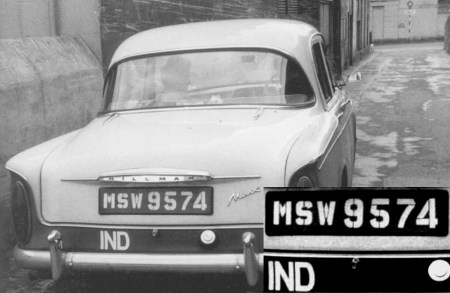
The sight of an Indian car in Britain was – and remains – a rarity.     Of the handful I saw, royal household red plate with silver letters  ‘PALITANA 1’  was on a red Ford Mustang belonging to Prince Shiv and was shown in the Daily Mail circa 1957, though no photo by me.    This Hillman Minx however was captured in Plymouth one day in 1964

Madras-registered Hillman in 1964 Plymouth.

Madras-registered Hillman in 1964 Plymouth.

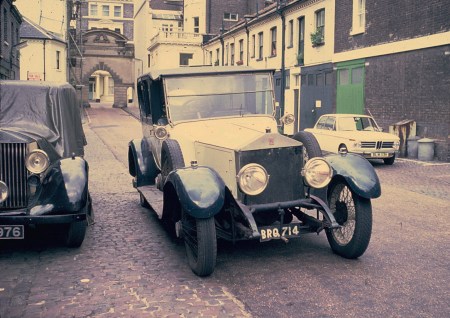
and a Bihar-registered early Rolls-Royce in a London mews:

BRQ 734 - one of the last grand cars to be permitted to leave India for international collections.

BRQ 714 – one of the last grand cars to be permitted to leave India for international collections.

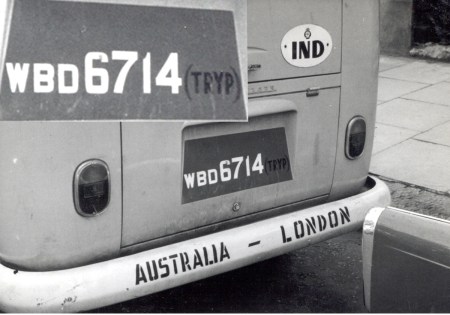
and a type never reported before or since, seen in Earls Court, London, in the 1960s, using West Bengal plates in white on red and marked with (TRYP).

WBD 6714 - VW Kombi overlander in 1960s London, with an unexplained plate type.

WBD 6714 – VW Kombi overlander in 1960s London, with an unexplained plate type .

I have concluded that an Australian overlanding team was arriving by ship at Calcutta  (WB was for West Bengal until 1973) and was required by the customs at port of arrival to mount temporary transit plates, perhaps because they could not show documentation proving paid-up overseas licencing.   (Bad luck!)   They might have had to buy a carnet to transit India and the abbreviation TRYP on a red numberplate (rear only)  might have indicated the temporary nature of the registration.   It was all painted in the exact style of the period, the letters shorter that the numerals…..

The only red plates in India then were those of the princely states’  ‘royal family’  and the trade plates for dealers, of which DLH 267 M appears in RPWO/India/Historical Notes http://europlate.org.uk/countries/hai-kyr/ind/ind-hist.htm


Zambia re-plating

December 14, 2012

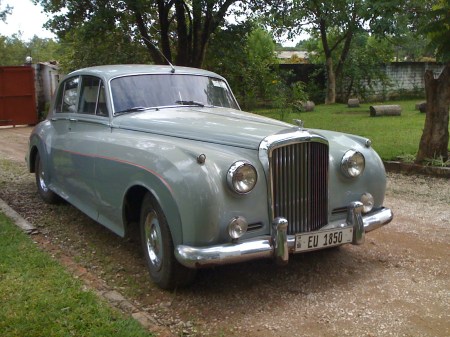
This Bentley S1 picture has been sent to us by  non-member Wayne Kennerley, an avid student of old cars in Southern Africa.

1950s Ndola District re-made in current style.

EU 1850 – 1950s Lusaka District re-made in current  Zambian style.

We see an example of  the original Northern Rhodesia series which ran from the inception of registrations there in the 1920’s, up to 1963.      This 6-cylinder Bentley S1 model was built from 1955-59 so if brought to Rhodesia new, this S1 would have received it’s EU  (Lusaka/Mumbwa) 1850 plates  in the original British style – but this car has replaced its plates in the format of the new 2000 > Zambia system of black on reflective white, pressed alloy.

Contemporary Lusaka motor-sportsmen with their Triumph TR4s on EA (Lusaka) plates.

Early 1960s Lusaka motor-sportsmen with their Triumph TR4s on (almost consecutive) EA (Lusaka & Mumbwa) plates, in the original design.

Thanks, Wayne.     Rare pictures.

** Any interesting Zambian items available from  RPW members??


Southern Africa historic

December 6, 2012

A fine collection of photos from former Nyasaland, Northern and Southern Rhodesia are to be found at this web-site link:

http://www.classiccarsinrhodesia.co.za/Makes/SWA.html

There are other African countries represented too, and gen on many interesting cars.   Some examples are here:

L=Livingstone, Northern Rhodesia in 1956.

L=Livingstone, Northern Rhodesia in 1956.


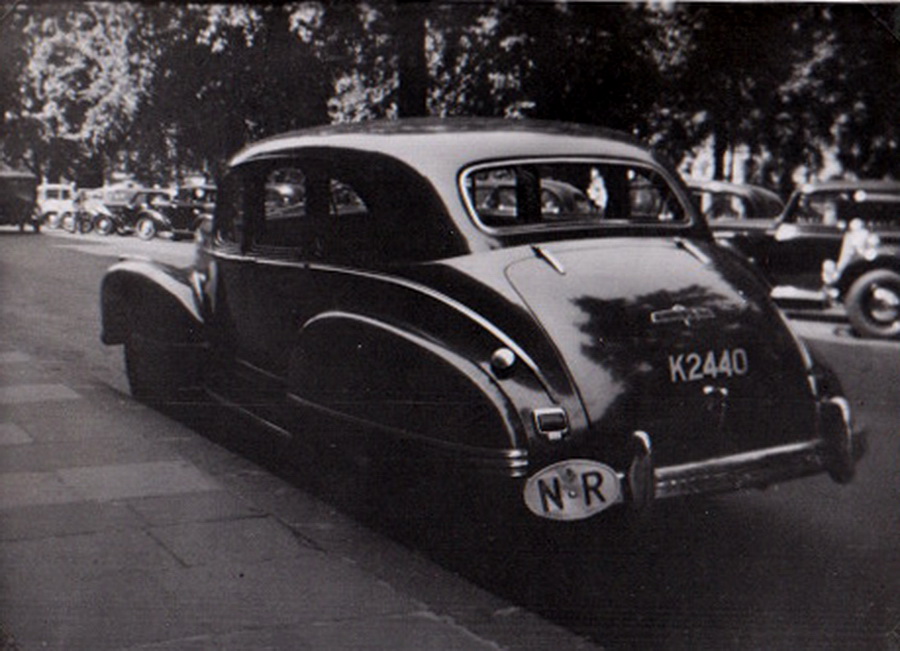
K 2440 is the Lusaka code in the former Northern Rhodesia which became Zambia upon independence in 1964.     Unknown car.  Pemberton archive

K 2440.   K was the Lusaka code in the former Northern Rhodesia which became Zambia upon independence in 1964. Unknown car. Pemberton archive.


RA 790.  A & RA = Belingwe & Shabani (now Mberengwa) in Zimbabwe.  Peugeot 404.

RA 790. A & RA = Belingwe & Shabani (now Mberengwa) in Southern Rhodesia-Zimbabwe.        Africa’s car – the Peugeot 404.

Morris Mini-Moke in police service, Southern Rhodesia 1960s.

G/T PW=Govt. Passenger car -Wee.     S. Rhodesia 1960.  Classiccarsinrhodesia archive


Southern Rhodesia registration 483, estimated 1905

Southern Rhodesia registration 483, estimated 1905

There is not much known of the numeric-only Rhodesian plates which the first vehicles used.    South Africa used identical plates at the time – note this Transvaal example below:

465 is a Transvaal issue 1900-1910 approx.

465 is a Transvaal issue, 1900-1910 approx.

And, from Western Australia:

Numeric-only WA 414

1900s numeric-only Western Australia’s  4140

It seems that many (Empire)  jurisdictions didn’t expect the expansion of motorcar populations, and thought a simple numeric format would suffice!

Evidence that Britain  also influenced early China plates is shown here:

China 1928, reg. 808

China 1928, reg. 808

Enjoy the Classic cars in Rhodesia website!   http://www.classiccarsinrhodesia.co.za/Makes/SWA.html